It's 9:55pm. Your Pramp slot starts in five minutes. You've been refreshing the page, slightly nervous, slightly hopeful, and at exactly 10:00 you get matched with a stranger named, let's say, "candidate_4471." You exchange the awkward "hey, can you hear me?" ritual, and then candidate_4471 admits he's never given a system design question before, isn't totally sure what the prompt means, and — based on the long pauses — may be Googling it in another tab while you talk. You give it your best. He says "yeah, that sounds good" to literally everything. You swap roles. You spend the next 30 minutes interviewing him. The session ends. You learned roughly one thing: scheduling a stranger is hard.
This is the Greenroom vs Pramp question in a nutshell. Both are tools for practising interviews out loud — which already puts them ahead of silently re-reading notes — but they solve the problem in completely different ways. Pramp pairs you with another human job-seeker for free peer mock interviews. Greenroom is an on-demand AI mock interview tool that plays the interviewer itself, any time you want, and gives you structured feedback afterward. This is an honest comparison of where each one wins, where each one falls short, and how to decide.
Why both of these tools exist
It's worth a beat of context, because it explains why the comparison even matters. For most of interviewing history, "practice" meant one of two things: reading question dumps silently, or roping in a friend who'd lose interest after one session. Neither rehearsed the actual skill — producing a coherent spoken answer, in real time, while someone evaluates you. That's the gap the whole category formed to fill.
Pramp emerged from a clever insight: every job-seeker is also a willing, free interviewer for someone else. Pair them up and you get human practice at zero marginal cost. It scaled because it solved availability with reciprocity — there's always another candidate somewhere who also needs a rep. The tradeoff was baked in from day one: your interviewer is, by definition, another person who needs practice.
Greenroom and the AI-interviewer wave came from a different insight: the thing that makes practice work — focused reps with immediate, specific feedback that you can repeat instantly — is exactly what humans are bad at providing on demand. A friend can't give you twenty consistent reps at midnight; software can. So instead of solving availability with reciprocity, it solved it with automation, and added the feedback layer humans rarely deliver well. Different starting insight, different shape, different strengths — which is the whole reason the rest of this comparison has anything to say.
What Pramp actually is
Pramp (now part of Exponent) is a peer-to-peer mock interview platform. You pick a topic — data structures and algorithms, system design, behavioral, front-end, and a few others — book a time slot, and get matched with another person preparing for interviews. The format is reciprocal: in a typical hour, one of you interviews the other for the first half, then you switch. Each of you gets a prompt and a suggested solution to read from while playing interviewer.
The big selling point is that it's free and it's human. You're speaking to a real person in real time, which is genuinely closer to a real interview than talking to yourself. You get reps at being interviewed, and — a quietly valuable side effect — reps at being the interviewer, which teaches you what evaluators are actually listening for. For a free product, that's a lot.
The catch is baked into the model. Your interviewer is another candidate, so the quality of the experience is a coin flip. Sometimes you get a sharp, generous partner who pushes you and gives real notes. Sometimes you get candidate_4471. The feedback you receive is only as good as the person giving it, and most peers aren't trained interviewers — they're as nervous as you are, often more reluctant to be critical, and sometimes reading the "right answer" off the screen for the first time. And structurally, half of every session is spent interviewing someone else, which is great practice or wasted time depending on what you came for.
What Greenroom does differently
Greenroom takes the interviewer out of the matching lottery entirely. Instead of pairing you with a stranger, it is the interviewer — a voice-based AI called Ari that asks you questions out loud, listens to your spoken answers, and asks adaptive follow-up questions based on what you actually said. When your answer is vague, it probes. When it's strong, it pushes harder. It can pull context from your GitHub so the questions are about your real projects, not generic trivia. We cover the mechanics in how to use an AI mock interview tool.
The two things Pramp can't reliably offer, Greenroom is built around. The first is availability: there's no slot to book and no partner to wait for. It's 11:40pm the night before your interview and your only practice partner is asleep? That's exactly when Greenroom is most useful. The second is consistent, structured feedback: after every session you get notes on pace, filler words, answer structure, and content — plus a score on a 1–10 scale — generated the same way every time, so you can actually measure whether you improved. We break down what's in that report in how AI interview feedback actually works.
The honest tradeoff runs the other way too: Greenroom is not a human. It won't grab a coffee with you afterward, it won't share war stories about its own onsite, and for the most nuanced, role-specific judgment, a great human interviewer is still the gold standard. We're not pretending otherwise — we lay out that exact limit in AI mock vs a real engineer mock.
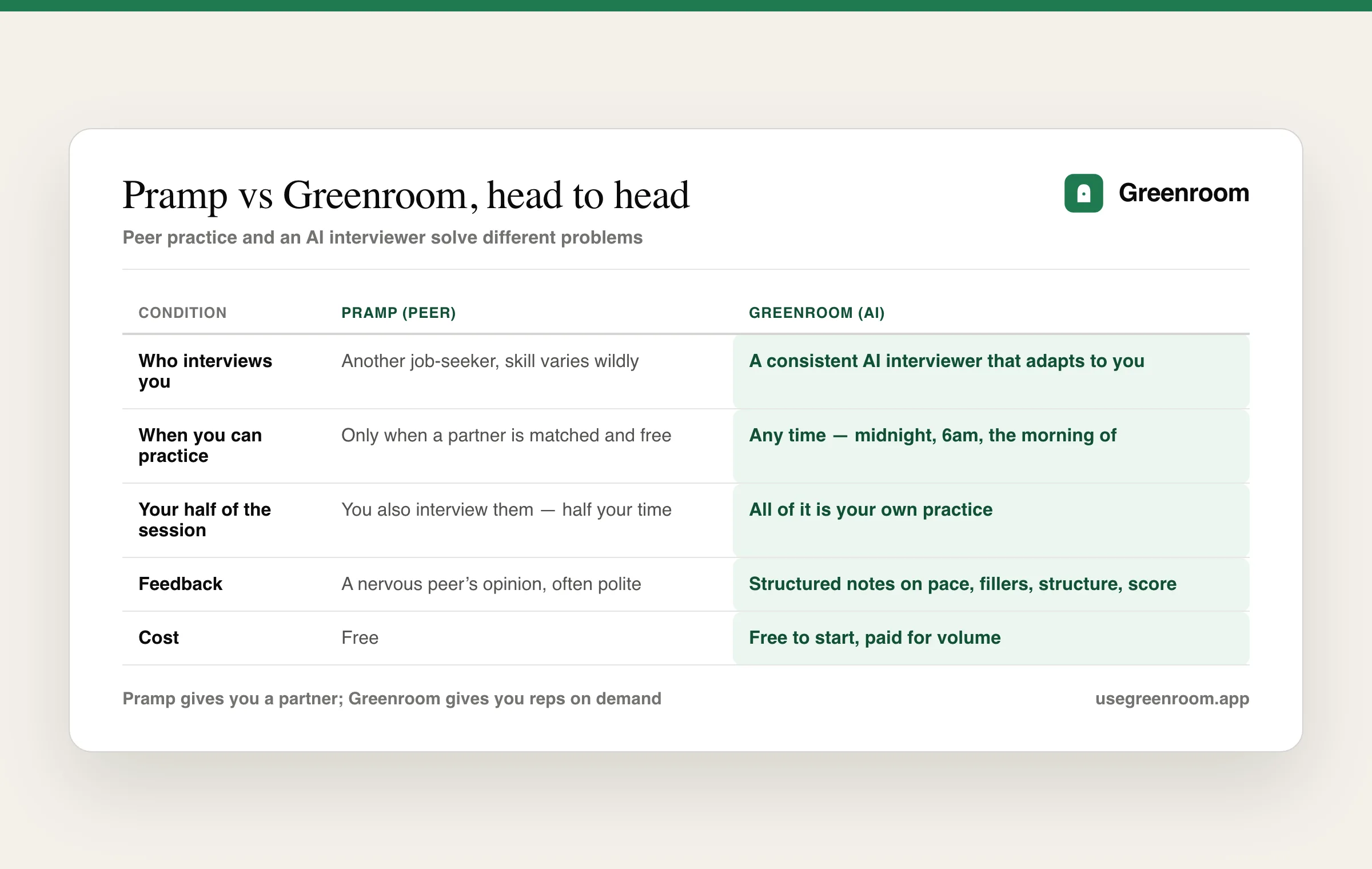
Greenroom vs Pramp, head to head
Here's the comparison on the dimensions that actually decide which one you'll reach for the night before an interview.
Who's interviewing you
On Pramp, it's another job-seeker — variable, sometimes excellent, sometimes lost. On Greenroom, it's a consistent AI interviewer that adapts to your level and asks real follow-ups. Neither is a senior FAANG engineer; if that's what you want, interviewing.io is the platform to compare.
When you can practise
Pramp needs a scheduled slot and a matched partner, which means availability windows and the occasional no-show. Greenroom starts the second you click. If your prep happens in unpredictable bursts — a free hour here, a panic at midnight there — on-demand wins decisively.
How much of the session is yours
This is the underrated difference. On Pramp, roughly half the session is you interviewing your partner. That's valuable if you want to learn the evaluator's seat; it's dead weight if you just needed to rehearse your own answers. Every Greenroom minute is your own practice.
Feedback quality and consistency
Pramp feedback is human but unpredictable — and peers are notoriously reluctant to tell you that your "tell me about yourself" rambled for four minutes. Greenroom's feedback is automated, specific, and identical in format every time, which is what lets you isolate one weakness and re-test it. That re-test loop is the whole point of deliberate mock interview practice.
Cost
Pramp's core matching is free, which is a real advantage if budget is your hard constraint. Greenroom is free to start and paid for serious volume — but "volume" is exactly where it earns its keep, because you can run ten focused sessions in the time it takes to schedule two Pramp slots.
Pramp vs Greenroom by interview type
The right tool also depends on which round you're prepping, because the two products have different strengths across the interview formats. Here's the honest breakdown by type.
Coding / DSA rounds
Pramp has a real edge here in one narrow way: it gives you a shared editor and a human watching you write code, which is closer to a live coding round than a voice-only session. The catch is the peer — a partner who doesn't really understand the problem can't probe your approach, spot the off-by-one, or push you on complexity. Greenroom's strength in coding prep is the communication layer: explaining your approach out loud, narrating tradeoffs, and handling "why did you pick a hash map here?" — the part most candidates lose points on. The pragmatic move is to write code against Pramp or a judge like LeetCode and rehearse talking through code like a senior engineer on Greenroom.
System design rounds
This is where peer matching struggles most. A good system design interview needs an interviewer senior enough to push on bottlenecks, data models, and tradeoffs — and the average Pramp peer simply isn't that person yet. Greenroom can rehearse the spoken structure of a design answer (requirements, high-level design, deep-dive, tradeoffs), but for true senior-level pressure-testing, a real engineer via interviewing.io is the gold standard. Start with the framework in our system design interview guide, drill the spoken delivery on Greenroom, and buy a human session for the final check.
Behavioral rounds
Greenroom's clearest win. Behavioral answers live or die on structure, specificity, and a result — and the follow-up probe ("what was your contribution, specifically?") is exactly what exposes a weak STAR story. A polite peer rarely pushes there. Drill your stories until they're airtight using these behavioral questions and answers, then test them on a Pramp human once they're solid.
HR / phone-screen rounds
The "tell me about yourself," "why this company," "what are your salary expectations" round is pure spoken fluency — high-frequency reps territory, which favors Greenroom. These are the questions you most want to have said aloud a dozen times, and that's hard to do one weekly peer slot at a time.
Pramp vs Greenroom: myths, debunked
A few persistent beliefs lead people to pick badly. Let's clear them up.
- "Free always beats paid." Free beats paid only if the free option delivers the reps you need. If "free" means two variable sessions a week and "paid" means twenty repeatable ones, the cheaper-per-useful-rep option is often the paid one. Cost-per-improvement is the metric, not cost-per-session.
- "An AI can't really interview you." A modern voice AI asks adaptive follow-ups, scores against a rubric, and flags delivery issues most peers miss. It isn't a senior engineer's judgment — but it's a more consistent interviewer than a random nervous stranger, which is who you're actually comparing it to on Pramp.
- "Practising with a human is always more realistic." A human is more realistic socially. But a confused peer asking off-topic questions about the wrong role is less realistic than a tool calibrated to your actual job. Realism depends on the match, not just the medium.
- "More mock interviews is the goal." The goal is more corrected reps. Ten sessions where you never fix the flagged weakness beat nothing; ten where you fix one thing each time beat everything. Tools that let you re-test instantly win on this axis.
- "You have to pick one." You don't. The strongest prep blends free human reps and on-demand AI reps. The mistake is using either one as your entire plan.
Where Pramp still wins
Let's be fair, because credibility matters more than a sales pitch. Pramp genuinely beats an AI tool in a few situations:
- It's free, full stop. If you have zero budget and plenty of time, free human practice is hard to argue with.
- It's a real human in real time. The micro-awkwardness of a live person — the eye contact, the slightly-too-long silence, the small talk before the question — is a stressor an AI doesn't fully reproduce. Reps against that are worth something.
- Being the interviewer teaches you the rubric. Sitting in the evaluator's chair for half the session, watching someone else flail through a problem you also struggle with, is a genuinely good way to internalize what good answers look like.
- It's social. Job-hunting is lonely. Sometimes a 50-minute call with another person in the same boat is good for your morale in a way a tool isn't.
If those are your priorities — free, human, social — Pramp is a perfectly good choice, and you can ignore the rest of this article with a clear conscience.
Where Greenroom pulls ahead
For most people preparing seriously, though, the things that actually move the needle are the things Pramp's model makes hard:
- Reps, on your schedule. Fluency comes from volume, and volume comes from being able to practise the moment you have twenty free minutes — not the moment a stranger is also free. Greenroom removes the scheduling tax entirely.
- Honest, specific feedback. The AI will tell you that you said "um" fourteen times, that your STAR story had no result, and that you rambled past the two-minute mark. A polite peer usually won't. We cover why that delivery feedback matters in the best tools to practise interview speaking.
- Adaptive follow-ups every time. The second and third question — "and why did you pick that approach?" — is where real interviews are won or lost. Greenroom always asks them; a peer reading from a script often doesn't.
- A measurable score. Same rubric, every session, so you can see the line going up. With peer feedback you mostly get vibes.
- Zero social cost to failing. You can blank, restart, sound terrible, and try again — no stranger watching, no awkwardness. That judgment-free space is where people actually take the risks that lead to improvement.
Which should you actually use?
The most useful answer isn't "pick one" — it's "know what each is for." A practical plan:
- Building fluency (the bulk of your prep): Greenroom. Short, frequent, judgment-free sessions where you fix one weakness at a time and watch the score move. This is where most of your reps should live.
- Testing on a human before the real thing: Pramp. Once your answers are solid, run them past a live person to feel the social dynamics — the small talk, the eye contact, the human pauses.
- The gold-standard dress rehearsal: if you can afford it, a real senior engineer via interviewing.io. We compare that path directly in Greenroom vs interviewing.io.
If you're choosing only one and you want the most improvement per hour invested, the on-demand AI tool wins for the simple reason that you'll actually do it more — and reps you actually do beat the perfect session you keep failing to schedule.
How a Pramp session actually flows
It helps to see the whole machine, because the friction lives in the details. You start by booking a slot — Pramp runs on scheduled times, so you pick a window (say, Saturday 7pm) and a topic. As the slot approaches, the platform tries to match you with another person who booked the same topic and window. If the match pool is thin — a niche topic, an odd hour, a small time zone — you might wait, get rematched, or face a no-show. That's the first tax: you're dependent on a stranger's reliability.
Once matched, the session is reciprocal and split down the middle. One of you is the interviewer first; the other answers. The interviewer gets a prompt and a suggested solution on screen — which is the polite way of saying your "interviewer" is frequently seeing the problem and its answer for the very first time, in real time, while trying to look like they've asked it a hundred times. They read the question, you work through it (often in a shared editor for coding rounds), they nudge you using hints from the doc, and a timer runs. Then you swap: now you're the interviewer, reading a fresh prompt off the screen and trying to evaluate someone else's answer to a question you might not fully understand yourself.
At the end there's a mutual feedback step — you rate each other and leave comments. In theory this is gold. In practice it's where the model's weakness shows: two tired, nervous people who just met, each slightly worried about being rude, tend to converge on "that was great, maybe tighten the intro a bit." Genuinely sharp peer feedback happens, but it's the exception, not the design. None of this makes Pramp bad — it makes it a specific tool with a specific shape: free, human, scheduled, reciprocal, and variable. Knowing that shape is how you use it well instead of being frustrated by it.
How a Greenroom session actually flows
The Greenroom loop is built to remove every one of those friction points. You open it and start — no slot, no match, no waiting for a stranger. You set the role and seniority (senior backend, new-grad data analyst, whatever the real job is) so the questions resemble what you'll actually face, then pick a focus: behavioral, technical, or a specific question you keep fumbling. Ari opens with a question, out loud, and you answer out loud, exactly as you would on the real call.
Then the part that matters: it follows up. Give a vague answer — "I improved the system's performance" — and it probes: "By how much, and what was the bottleneck?" Give a strong one and it pushes into tradeoffs. This is the rep that peer scripts often skip, because a peer reading from a doc tends to ask the next listed question rather than the next logical one. When the session ends, you get a structured report: a 1–10 score plus specifics — pace, filler-word count, whether your STAR story had a result, where you rambled, which claims you didn't back up.
The last step is the one that creates improvement: fix one thing and re-run. Saw "rambled past two minutes"? Do the same session again, holding answers to ninety seconds, ignoring everything else, and watch that one number move. No scheduling, no social cost, no waiting a week for the next slot — you can run the corrected version five minutes later. That tight, private, repeatable loop is the entire difference between performing once and practising until it's automatic.
A tale of two prep weeks
Meet Ravi and Meera, both interviewing the same Friday, both starting to prep the previous Sunday. Ravi decides Pramp is all he needs. Meera builds her week around Greenroom reps and saves one Pramp session for the human element.
Ravi's week: Sunday, he books three Pramp slots — Tuesday, Wednesday, Thursday. Tuesday's partner is great; he learns his system-design intro is too long. Wednesday's partner no-shows, and the rematch is someone interviewing for a totally different role who asks him front-end trivia he'll never be tested on. Thursday's partner is fine but spends most of the feedback talking about his own nerves. Net result after a week: two useful data points, one wasted evening, and an intro he knows is too long but never got to re-practise, because there was no "do it again right now" — only "book another slot next week." He walks in Friday having rehearsed his fixed intro exactly zero times.
Meera's week: Sunday night, a diagnostic Greenroom session flags three things — filler words, a weak "tell me about yourself," and a project story with no clear result. Monday she drills only the intro, four times, until it's clean. Tuesday she rebuilds the project story around its result and re-runs it twice. Wednesday she does a full mixed session; filler words are down. Thursday she books one Pramp slot to feel a real human across the screen, and because her answers are already solid, the peer's "honestly, that was tight" is actually true. Friday she walks in having said her fixed answers, out loud, more than a dozen times.
The moral isn't "Pramp bad." Ravi's Tuesday session was genuinely valuable. The moral is that improvement lives in the re-test loop, and a scheduled, reciprocal, once-a-week tool can't give you that loop — so it shouldn't be your whole plan. Use the peer session for what it's uniquely good at, and do the reps somewhere you can actually repeat them.
Which one fits you?
The right answer genuinely depends on who you are. A few honest mappings:
The fresher in placement season
You have many interviews compressed into a few weeks and a budget of roughly zero. You need volume and speed. Lead with Greenroom for daily reps on the exact "tell me about yourself," "why this company," and core-CS questions you'll be asked, and use Pramp's free slots when you want a human. The thing that sinks freshers is freezing on questions they technically know — and that's cured by reps, not by one weekly session. Our campus placement guide goes deeper.
The senior engineer
Your interviews lean on system design, tradeoffs, and crisp communication. Pramp peers often can't push you hard enough on senior design, and reading a solution off a doc isn't the same as a senior interviewer's judgment. Use Greenroom to rehearse explaining decisions out loud, and spend money on a real senior via interviewing.io for the high-fidelity check. Pramp is the weakest fit here.
The career-switcher
You're fighting the "can you really do this?" doubt, so your stories need to be airtight. You want a tool that probes your claims — exactly what Greenroom's follow-ups do — and a few human reps to practise telling your switch narrative convincingly. Both have a role; the AI does the volume of story-polishing.
The non-native English speaker
Your bottleneck is often producing fluent answers under pressure, not knowing the content. You need lots of low-stakes spoken reps without the anxiety of a stranger judging your accent — which is precisely where a judgment-free AI shines. We wrote about this in AI mock interviews for non-native English speakers.
The very nervous candidate
If a live stranger spikes your anxiety to the point you can't think, starting with peer sessions can backfire. Build fluency privately on Greenroom first, then add Pramp once your answers are solid and the human pressure is the only thing left to acclimate to. Pair it with how to stop panicking mid-interview.
The cost math, honestly
"Pramp is free" is true and important — but it's not the whole equation, because the real currency in interview prep is useful reps per hour invested, and both tools spend that currency differently.
On Pramp, a one-hour booking yields, at best, ~30 minutes of your own practice (the other half you're interviewing your partner). Subtract the variance — the no-shows, the mismatched topics, the partner who can't give real feedback — and the average useful practice per booked hour is well under 30 minutes. It costs no money, but it costs scheduling overhead and the half-session reciprocity, and the value swings wildly with your match.
On Greenroom, every minute is your own, the feedback is consistent, and — crucially — you can re-run a corrected answer immediately, which is the highest-value rep there is. It's free to start and paid for serious volume, but the paid volume buys you the one thing Pramp's model can't manufacture: many repeatable, measurable reps with zero scheduling and zero reciprocity tax. The honest framing is: Pramp optimizes for "free," Greenroom optimizes for "reps that compound." If your constraint is money, Pramp wins; if your constraint is improvement-per-week, the math favors doing most reps on the tool you can repeat instantly.
Common mistakes people make with Pramp
Most people who say "Pramp didn't help me" used it in a way the model punishes. Avoid these:
- Making it your only prep. One or two scheduled sessions a week can't build fluency. Pair it with high-frequency reps elsewhere or you'll arrive under-rehearsed.
- Phoning in the interviewer half. Reading the prompt flatly and saying "yeah, looks good" wastes your partner's session and your own learning — being the evaluator is where you internalize what good answers look like. Take it seriously.
- Not preparing the question you'll ask. Skim your assigned prompt and solution beforehand so you can actually run a decent interview, not stumble through one cold.
- Being too polite to be useful. "That was great!" helps no one. Give one specific, honest piece of feedback — and ask your partner to do the same for you.
- Treating a bad match as a verdict on your ability. A confused or checked-out partner is a roll of the dice, not a referendum on you. Rebook and move on.
- Never re-testing the fix. Pramp surfaces a weakness; if you don't drill the correction before the next session, the insight evaporates. This is the gap an instantly-repeatable AI tool fills.
What actually builds interview skill
Step back from both products and the choice gets clearer, because decades of learning research point the same way. Three findings matter here.
First, deliberate practice — the concept popularized by psychologist Anders Ericsson — says skill grows fastest when practice is focused on a specific weakness, gives immediate feedback, and is repeated with correction. Not "do interviews," but "fix your rambling intro, get told it's still too long, fix it again." That's a re-test loop, and it's exactly what a private, instant tool enables and a weekly scheduled session does not.
Second, the spacing effect: skills consolidate better when practice is distributed across days rather than crammed. Five twenty-minute sessions across a week beat one exhausting two-hour grind. That cadence is trivial with on-demand reps and nearly impossible if every session requires matching a stranger.
Third, the production gap: there's a large, well-documented difference between recognizing an answer (reading it and nodding) and producing it out loud under pressure. Interviews test production. Both Pramp and Greenroom make you produce answers aloud — which is why both beat silent note-reading — but only one lets you produce, get specific feedback, and immediately produce again. Whatever tools you pick, organize your prep around those three principles, and you'll improve faster than someone simply logging hours. More on the philosophy in practice like you play.
A weekly prep plan that uses both
Here's a concrete week that spends each tool where it's strongest, assuming an interview the following Monday:
- Sunday — diagnose. One full Greenroom session across behavioral and role questions. Read the report, write down your three biggest weaknesses. Don't fix anything yet; just find them.
- Monday — weakness one. Drill only your weakest answer (say, "tell me about yourself") on Greenroom, four or five reps, until it's clean. Nothing else.
- Tuesday — weakness two. Same loop on your second weakness — maybe a project story with no result. Rebuild it, re-run twice.
- Wednesday — human rep. One Pramp session. Your answers are now solid, so you get real value from the live pressure and a peer's reaction — and you practise being the interviewer, which sharpens your own instincts.
- Thursday — integrate. A full mixed Greenroom session with everything you've fixed, checking the score has moved since Sunday.
- Friday — light reps. Two short sessions on whatever still feels shaky. Keep it brief; you're polishing, not cramming.
- Saturday — rest. Seriously. A rested brain interviews better than a fried one. Maybe re-read your STAR notes once.
- Sunday — dress rehearsal. One full Greenroom session as if it were Monday: real role set, camera on, no notes. Then stop and trust the work.
Volume on the tool you can repeat, one human rep for the social texture, and rest baked in. That's how you arrive on Monday having genuinely rehearsed — not just scheduled.
Other alternatives worth knowing
Pramp and Greenroom aren't the only options, and a good comparison names the rest honestly:
- interviewing.io — anonymous mocks with real senior engineers. The best human feedback money can buy, and priced like it. See our full breakdown.
- Final Round AI — an AI "interview copilot" that leans toward feeding you answers live; a different philosophy entirely, covered in Greenroom vs Final Round AI.
- Google Interview Warmup — a free, no-frills warm-up that transcribes your answers but doesn't grade them or ask follow-ups (comparison here).
- InterviewBuddy — scheduled mock interviews with industry professionals, popular in India (comparison here).
- ChatGPT — you can prompt it into a text mock, useful for brainstorming answers but not for spoken practice. We cover the prompts in can ChatGPT do mock interviews?
How to get the most out of Pramp
If you're going to use Pramp — and for free human reps, you should — make the model work for you instead of against you:
- Book unusual hours for better matches. Peak slots fill with the most nervous, least-prepared crowd. Off-peak windows often match you with more serious candidates in other time zones.
- Pre-read your interviewer prompt. Five minutes skimming the question and solution you'll administer turns a fumbling interviewer-half into a useful one — for them and for your own learning.
- Ask for one specific thing. At the start, tell your partner "please be brutal about my structure and pacing." Naming what you want makes polite peers far more useful.
- Record the session if allowed. Watching yourself back catches the fillers and the rambling that in-the-moment feedback misses.
- Treat each match as one data point. One bad session is noise. Three sessions surface a real pattern. Don't over-read a single partner's reaction.
How to get the most out of Greenroom
The AI side rewards a different discipline — treating it as a gym, not a demo:
- Set the real role and seniority. A generic session wastes the calibration. Match the exact job and level so the questions and difficulty mirror your actual interview.
- Run it like it counts. Camera on, notes away, full answers out loud. The session is only as honest as the conditions you give it.
- Isolate one weakness per re-run. Don't try to fix five things at once. Pick the biggest, redo the session targeting only that, and confirm the number moved.
- Chase fluency, not a perfect score. The goal is an answer that comes out clean without effort — usually three to five focused reps. We unpack the workflow in how to use an AI mock interview tool.
- Do a real dress rehearsal. One full, uninterrupted session a day or two before the interview, done early enough to build confidence rather than spark last-minute panic.
A longer worked example: fixing a rambling intro
Theory is easy to nod at, so let's watch the two tools handle the single most common weakness in interviewing: a "tell me about yourself" that wanders. Imagine your current answer starts in tenth grade, lists every technology you've ever touched, detours into a side project you abandoned, and lands — three and a half minutes later — somewhere near the present, with no clear point. It's the answer that quietly loses you the room in the first two minutes of half the interviews you'll ever do.
On Pramp, here's the realistic outcome. If you draw a sharp, generous partner, they might say at the end, "honestly, that felt a bit long — maybe tighten the start." Useful, if vague. But you've now used your session, and to actually practise the tightened version you have to book another slot, match another stranger, and hope they're paying enough attention to tell you whether the new version landed. More likely, you drew an average partner who, not wanting to seem harsh, said "yeah, that was good!" — and you walk away with your three-and-a-half-minute answer fully intact and falsely validated.
On Greenroom, the loop is tighter and more honest. The feedback names it directly: ran ~3.5 minutes against a target of ~60–90 seconds, no clear structure, strongest point (your most relevant project) buried at the two-minute mark, never connected to the role. You rebuild it using a present-past-future spine — what you do now, the experience that led here, what you're looking for next — and run it again. This time it's 75 seconds, and the follow-up question ("you mentioned that project — what was your specific contribution?") forces you to have a crisp answer ready. You run it a third time and it's clean. Fifteen minutes, three reps, one fixed answer — versus a week and two scheduling cycles to maybe get the same result on a peer platform. The structure that fixes this exact answer is laid out in how to answer "tell me about yourself".
The point isn't that Pramp can't surface the problem — a good partner can. It's that surfacing a problem and drilling the fix until it's automatic are two different jobs, and only one of these tools is built for the second one. That's the whole reason "do most of your reps where you can repeat them instantly" keeps being the recommendation.
The science of why spoken reps work
It's worth understanding why repetition with feedback works so well, because once you see the mechanism, the right way to use both tools becomes obvious. Three findings from learning and performance research do most of the explaining.
The first is retrieval practice, sometimes called the testing effect: actively producing an answer from memory strengthens your ability to produce it again far more than re-reading or re-recognizing it. Every time you say an interview answer out loud, unaided, you're not just rehearsing — you're physically strengthening the retrieval path you'll need under pressure. Silent re-reading feels productive but barely touches this mechanism, which is why people who "know" their answers still freeze. Both Pramp and Greenroom force retrieval, which is why both beat note-reading; the difference is how many retrievals you can get and how good the feedback on each is.
The second is desensitization. Interview anxiety is, in part, a stress response to an unfamiliar, high-stakes situation. The proven way to dampen it is graded exposure — repeatedly facing a milder version of the stressor until your nervous system stops treating it as a threat. Every mock interview is a dose of exposure; the more reps you do, the less the real thing spikes you. A tool you can use twenty times delivers far more exposure therapy than one you can schedule twice. We go deeper in how to deal with interview anxiety.
The third is the feedback loop itself. Retrieval and exposure build raw familiarity, but improvement — getting better, not just calmer — requires knowing what to change and then changing it. That's why the consistency and specificity of feedback matters so much, and why a tool that gives you the same rubric every time and lets you immediately re-test is structurally better at producing improvement than variable peer feedback you can't act on until next week. None of this is magic; it's just the boring mechanics of how humans get good at a performed skill, and they all point toward high-frequency, feedback-rich, repeatable reps as the core of your prep.
The bottom line
Strip away the brand names and the choice is simple. Pramp is the best free way to get a human across the screen — a peer, scheduled, reciprocal, variable in quality, and genuinely useful for the social texture of interviewing and for learning the evaluator's seat. Greenroom is the best way to get the volume of spoken, scored, instantly-repeatable reps that actually turn a shaky answer into a fluent one — on demand, judgment-free, calibrated to your real role.
The candidates who interview well aren't the ones who found the single perfect tool; they're the ones who practised often and fixed what they practised. That argues for doing most of your reps where you can repeat them instantly, and adding human sessions — peer or expert — for the texture an AI can't fully reproduce. Pick your blend, but don't let either tool become your entire plan, and don't let "I scheduled a session" masquerade as "I rehearsed my answers."
Quick reference: which to open when
If you remember nothing else, remember this decision shortcut. Reach for Greenroom when you want a rep right now, when you need honest feedback on a specific answer, when you're drilling a weakness toward fluency, when an interview is close and you can't afford to wait for a partner, or when nerves mean you'd rather build confidence privately first. Reach for Pramp when you specifically want a free human across the screen, when you want to practise being the interviewer to learn the evaluator's seat, or when your answers are already solid and you want one last rep against real social pressure. And reach for a paid expert — interviewing.io for senior technical depth, InterviewBuddy for a booked human professional — when you've drilled the basics and want a high-fidelity calibration before a high-stakes loop. The mistake is never "I used the wrong tool once"; it's "I used one tool for the entire job," when the job has clearly different parts.
Start with one real session
The fastest way to settle the Greenroom vs Pramp question for yourself is to run one proper session of each and notice which one you'd actually open again at 11pm. Greenroom is a spoken AI mock interviewer that asks real questions, follows up the way a live interviewer would, and hands you specific feedback on every answer — no slot to book, no stranger to wait for. Do one diagnostic session today, fix the one weakness it surfaces, and you'll have done more focused practice than most candidates manage in a week.
Frequently asked questions
Is Greenroom or Pramp better for interview practice?
It depends on what you need. Pramp is free and pairs you with a real human peer, which is good for low-stakes reps and seeing how you handle being on both sides of an interview. Greenroom is an on-demand AI interviewer that is available any time, asks adaptive follow-up questions, and gives structured feedback on your delivery and a score. For consistent, high-frequency practice that you can do at midnight without scheduling, Greenroom wins; for free human contact and the experience of interviewing someone else, Pramp has the edge. Many people use both.
Is Pramp still free in 2026?
Yes, Pramp's core peer-to-peer mock interview matching is free. You book a slot, get paired with another job-seeker, and the two of you interview each other — typically one of you asks a coding or system design question while the other answers, then you swap. The cost is your time: roughly half of every session is spent interviewing your partner rather than practising yourself, and the quality of feedback depends entirely on who you are matched with.
What is the main difference between Pramp and an AI mock interview?
On Pramp your interviewer is another job-seeker, so the questions, difficulty, and feedback vary with whoever you are paired with, and you also spend half the session interviewing them. An AI mock interview like Greenroom gives you a consistent interviewer that adapts difficulty to you, asks follow-up questions based on what you actually said, and returns structured feedback on pace, filler words, structure, and content immediately — and the whole session is your own practice, available on demand.
Can a peer on Pramp give as good feedback as an expert?
Sometimes, but it is inconsistent. Your Pramp partner is usually another nervous candidate, not a trained interviewer, so feedback ranges from genuinely sharp to vaguely polite. They may not know the rubric a real interviewer uses, and social pressure makes peers reluctant to be harsh. A real senior engineer — for example through interviewing.io — gives far better human feedback, while an AI mock interviewer gives consistent, rubric-based feedback every single time.
Do I have to interview other people on Pramp?
Yes. Pramp's model is reciprocal: in a standard session you spend roughly half the time being interviewed and half the time interviewing your partner. For some people that is useful practice — being the interviewer teaches you what evaluators look for. For others it is simply half a session of unpaid effort when they only wanted to practise answering. With an AI tool like Greenroom, the entire session is your own practice.
Should I use Greenroom and Pramp together?
That is a strong combination. Use Greenroom for the high-frequency reps — quick, judgment-free sessions whenever you have twenty minutes — to build fluency on your answers and fix specific weaknesses against the feedback. Then use Pramp for occasional human reps to test those answers on a real person and practise the social dynamics of a live interview. The AI gives you volume; the peer gives you a human in the loop.
How does the Pramp mock interview format actually work?
You book a time slot and a topic (DSA, system design, behavioral, and a few others), and the platform matches you with another job-seeker who booked the same slot. The session is reciprocal and split roughly in half: one of you plays interviewer first, reading a prompt and suggested solution off the screen, then you swap roles. It ends with a short mutual feedback step where you rate each other.
Is there a cost or pricing plan for a Pramp mock interview?
Pramp's core peer-to-peer mock interview matching has no per-session price — it's free to book and use. Pramp is now part of Exponent, which sells separate paid courses and coaching products, but the peer-matching feature itself carries no pricing plan or paywall.
What do Pramp reviews typically say?
Reviews and candidate feedback on Pramp tend to repeat the same pattern: strong praise for being free and for the value of practicing out loud with a real human, alongside consistent complaints about match quality — no-shows, mismatched topics, and partners who are as nervous or unprepared as you are. Most reviews land on "good for free human reps, inconsistent for real feedback," which matches the honest tradeoffs in this comparison.