You finally booked an interviewing.io session with a real Google engineer. It cost more than your weekly grocery budget, you scheduled it four days out, and you spent those four days quietly terrified. The session arrives. The engineer is sharp, kind, and devastatingly accurate: in 45 minutes she identifies that you jump to code before clarifying requirements, that your time-complexity analysis is hand-wavy, and that you go quiet exactly when you're thinking — which reads as "stuck." It's the best feedback you've ever gotten. It's also the only session you can afford this month, and you have eleven more weaknesses to fix.
That gap — between the quality of one expert session and the quantity of reps you actually need — is the whole Greenroom vs interviewing.io story. interviewing.io connects you with real senior and FAANG engineers for anonymous mock interviews; the feedback is the gold standard and the price tag reflects it. Greenroom is an AI mock interview tool that gives you unlimited, on-demand, spoken reps with consistent feedback for a fraction of the cost. They're not really rivals so much as two halves of a good prep plan — but if you're choosing where your time and money go, here's the honest breakdown.
Why both of these tools exist
A quick bit of context makes the whole comparison click. Interview prep has always had a quality ceiling and a quantity ceiling, and you usually had to pick which one to hit. A mentor who actually interviews at top companies gives world-class feedback — but you get maybe one favor before you've worn out the relationship. Question banks give infinite quantity — but zero feedback and zero spoken practice. Most candidates lived in the gap between those two.
interviewing.io attacked the quality ceiling. It built a marketplace of vetted, senior engineers and made their judgment buyable by the session — turning "I happen to know a Google engineer" into a service anyone can book. The price reflects what it is: expert human time. The constraint is the same one expert time always has — it's scarce and scheduled, so you can't do it twenty times.
Greenroom attacked the quantity ceiling without giving up feedback. The insight is that most of what makes practice work — adaptive follow-ups, specific notes on delivery, a score you can chase, and the ability to immediately try again — can be automated and delivered on demand. It can't replicate a senior engineer's lived judgment, but it can give you the volume of feedback-rich reps that a human never could. So the two products aren't really competing for the same slot in your week: one is the rare expert calibration, the other is the daily training. The rest of this piece is about spending each where it pays off.
What interviewing.io actually is
interviewing.io is a marketplace for mock interviews with real, vetted engineers — many of whom actively interview candidates at top-tier companies. You book a slot, get matched with an interviewer in your domain (algorithms, system design, and so on), and run an anonymous mock that closely mirrors a real technical round. Afterward you get detailed, human feedback, and because it's anonymous, the platform reduces the bias that your name, accent, or background might otherwise introduce.
There's a second layer that makes it more than a practice tool: perform well in the mocks and you can get into their hiring marketplace, where companies reach out based on anonymized performance rather than résumé pedigree. For a strong candidate from a non-traditional background, that's a genuinely powerful path — it's not something an AI practice tool offers, and we won't pretend it is.
The constraints are the obvious ones. It's expensive — paid sessions commonly run from roughly $100 to a few hundred dollars each, depending on the interviewer's seniority. It requires scheduling, so you practise when a qualified engineer is free, not when you're free. And the focus leans heavily toward technical and system design rounds; it's not built for grinding behavioral answers or "tell me about yourself" until they're fluent.
What Greenroom does differently
Greenroom attacks the opposite end of the problem: volume. It's a voice-based AI interviewer — Ari — that asks questions out loud, listens, and asks adaptive follow-up questions based on your actual answer. No slot to book, no engineer to pay, no waiting. You get a session whenever the urge (or the panic) strikes, and after each one you get consistent structured feedback — pace, filler words, answer structure, content, and a 1–10 score — generated identically every time so you can measure progress. The mechanics are in how to use an AI mock interview tool, and the scoring in how AI interview feedback actually works.
Greenroom also covers the rounds interviewing.io largely skips. It does behavioral practice and role-specific questions alongside technical, and it can pull from your GitHub so the questions are about projects you actually built. The point isn't to out-judge a senior engineer — it can't — it's to give you the dozens of low-stakes, spoken reps that turn a wobbly answer into an automatic one.
And the honest limit, stated plainly: an AI doesn't have a real engineer's lived judgment, can't vouch for you in a hiring marketplace, and won't catch every subtle thing a great human interviewer will. That's exactly why this isn't an either/or. We dig into the broader version of this tradeoff in AI mock vs a real engineer mock.
Greenroom vs interviewing.io, head to head
Stack them on the dimensions that decide where each fits in your prep.
Interviewer and feedback depth
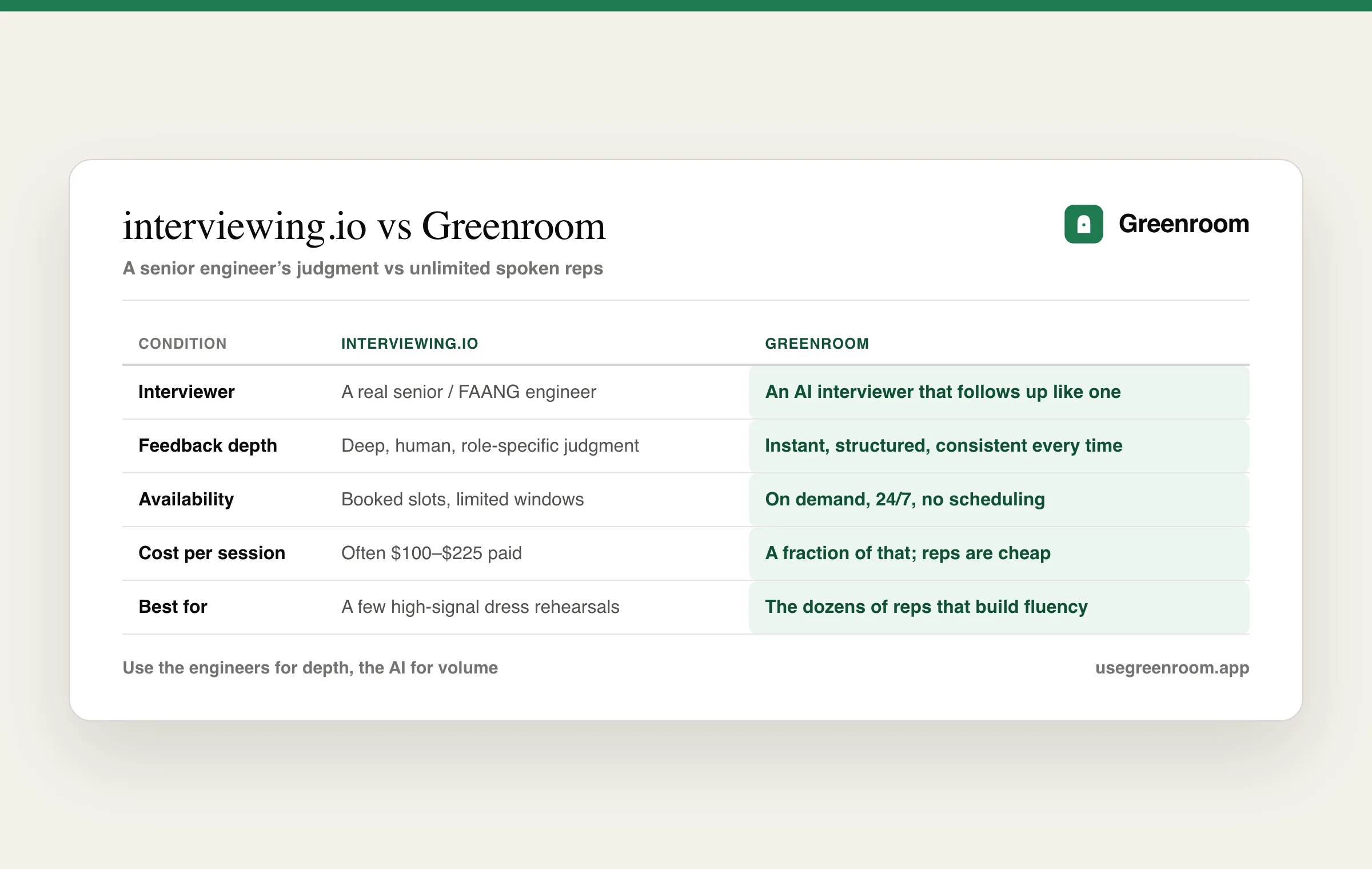
interviewing.io wins, clearly: a real senior engineer reading nuance and judging tradeoffs beats any rubric. Greenroom's edge isn't depth-per-session — it's that you get good-enough, consistent feedback every single time, which compounds across many sessions in a way one expert critique can't.
Availability
No contest the other way. interviewing.io needs a scheduled slot with a qualified engineer; Greenroom starts instantly. If your prep is bursty — an hour tonight, a panic at 6am — on-demand is the only thing that fits.
Cost per session, and therefore reps
This is the crux. At $100–$225 a session, even a motivated candidate does a handful of interviewing.io mocks. At AI prices, you can do that many in a week. Since fluency is a volume game — see how many mock interviews you actually need — cost per session quietly decides how good you get.
Coverage
interviewing.io is technical-first. Greenroom spans behavioral, role-specific, and technical, so the same tool drills your STAR stories and your algorithms.
The marketplace
interviewing.io's hiring marketplace is a real, unique advantage Greenroom doesn't try to match — if anonymized performance-based job matching matters to you, that's a reason to use it regardless of everything above.
Common mistakes people make with interviewing.io
Because the sessions are expensive, the mistakes are expensive too. Avoid these:
- Showing up cold. Spending the first ten minutes of a paid expert session shaking off rust is money lit on fire. Warm up with AI reps right before so the engineer sees your real ceiling, not your warm-up.
- Using it to learn the basics. If an expert's main feedback is "you ramble" or "you didn't state complexity," you've paid premium prices for notes a free or cheap tool would have given you. Fix the obvious things first, then buy the expert's eye for the subtle ones.
- Not drilling the feedback. The session's value is realized after it, when you drill the weakness it found. Walk out, write down the one fix, and grind it on a cheap tool — or you'll re-pay to be told the same thing.
- Booking too many, too early. Three sessions in your first week — before you've built any base — wastes the calibration. Space them so each one measures real progress.
- Treating one engineer's take as gospel. Interviewers vary. A single harsh or lenient session is a data point, not a verdict. Look for patterns across sessions and tools.
interviewing.io vs Greenroom: myths, debunked
A few beliefs lead people to over- or under-invest. Let's correct them.
- "Real engineers are always worth the money." They're worth it for calibration and subtle feedback — not for telling you things a cheap tool already would. Worth depends on what you use the session for.
- "AI feedback is too shallow to matter." Consistent, specific feedback on delivery and structure, delivered every session and re-testable immediately, compounds into real improvement. Shallow-per-session beats deep-but-rare when you can repeat it dozens of times.
- "If I just do enough expert sessions I'll be ready." Almost nobody can afford "enough" expert sessions to build fluency through them alone. Fluency is a volume game, and volume is the AI's job.
- "The marketplace replaces applying to jobs." It's a powerful extra channel, not a complete job search. Treat it as one door among several.
- "I have to choose AI or experts." The whole point of this article is that you shouldn't. Volume on the cheap tool, calibration on the expensive one.
Where interviewing.io still wins
No hedging here — these are real advantages, and for some candidates they're decisive:
- The best feedback available. A vetted engineer who interviews at the company you're targeting can tell you things no automated system will. One session can surface a blind spot you'd never have found alone.
- Anonymous, bias-reduced evaluation. Performance is judged without your name, accent, or résumé in the frame — valuable if you've felt screened out before you opened your mouth.
- The hiring marketplace. Do well and companies come to you based on how you actually performed. That's a job-search channel, not just practice.
- Real-round realism. The format and difficulty closely mirror an actual senior technical loop, because the person running it actually runs them.
If you can afford a few sessions and you're targeting competitive companies, interviewing.io is worth every rupee or dollar — for a small number of high-stakes reps.
Where Greenroom pulls ahead
For the other 90% of your preparation — the part that's about repetition, not revelation — the economics flip hard:
- Unlimited reps. You can't do twenty expert sessions; you can do twenty AI sessions. Fluency comes from the twentieth rep, not the first, and that's the rep interviewing.io prices out of reach.
- On demand. No scheduling, no waiting for a qualified engineer's calendar. Practice the night before, the morning of, whenever the nerves spike.
- Behavioral and delivery, not just code. Greenroom grades how you sound — pace, fillers, structure — which is exactly the layer most technical-only platforms ignore. More on that in the best tools to practise interview speaking.
- Measurable progress. Same rubric every time means you can watch one weakness improve across sessions instead of guessing.
- Zero stakes to fail. No expensive slot wasted, no human watching you blank — so you take the risks that actually build skill.
Which should you actually use?
Don't frame it as a duel. Frame it as a budget — of time and money — and spend each where it's strongest:
- Daily reps (most of your prep): Greenroom. Cheap, instant, judgment-free. Fix one weakness at a time, watch the score move, repeat until fluent.
- A few high-signal calibrations: interviewing.io. Once your fundamentals are solid, spend on one or two expert sessions to catch the subtle things and pressure-test against a real senior engineer — ideally before an important onsite.
- Job matching: if the anonymous marketplace fits your situation, that's a standalone reason to be on interviewing.io regardless of practice.
If your budget is genuinely zero, do all your reps on the AI tool and substitute a free Pramp peer session for the human-in-the-loop piece. If money's available, buy a couple of expert sessions and surround them with AI volume. Either way, the volume tier is where most of the improvement lives.
How an interviewing.io session actually flows
The experience is deliberately close to the real thing. You book a slot with an interviewer in your domain — algorithms, system design, front-end — around their availability. Sessions are anonymous: you join under a handle, often with voice masking, so the interviewer judges your performance, not your name, accent, or résumé. That anonymity is a feature, not a gimmick — it strips out a layer of bias and lets you fail safely.
The mock itself runs like a real technical round: a problem, a shared editor or whiteboard, the interviewer probing your approach, your complexity, your edge cases — pushing the way an actual senior interviewer does because they are one. Afterward comes the part you're really paying for: detailed, human feedback, often both verbally at the end and written afterward, covering not just whether you solved it but how you communicated, where you hesitated, and what would have moved you from "no" to "strong yes."
There's also the marketplace layer: perform well across mocks and you can unlock anonymized access to companies that reach out based on how you actually interviewed, not how your résumé reads. For candidates from non-traditional backgrounds, that's a genuinely different door into hiring. The cost of all this is the obvious one — real expert time is expensive and finite, so this is a tool you use a handful of times, not nightly.
How a Greenroom session actually flows
Greenroom is engineered for the opposite rhythm: open it and go, as often as you like. You set the role and seniority so questions match your target job, pick a focus, and start. Ari asks a question out loud; you answer out loud; it asks adaptive follow-ups based on what you said — probing vagueness, pushing on tradeoffs. When you finish, you get a structured report: a 1–10 score plus specifics on pace, filler words, structure, and whether your claims held up.
Then the multiplier: you fix one thing and immediately run it again. No booking, no waiting for an engineer's calendar, no spending another $150. That instant re-test loop is what converts a flagged weakness into a fixed one in the same sitting — something a once-a-month expert session structurally cannot do, simply because you can't re-book a senior engineer five minutes later. The two tools' session flows reveal their whole philosophy: one optimizes the depth of a rare session, the other optimizes the repeatability of frequent ones.
A tale of two budgets
Consider Aditya, prepping for a senior backend loop, with ₹15,000 set aside for interview prep and four weeks to go. Two ways he could spend it.
All-in on experts: he books three interviewing.io sessions across the month. Each is excellent — the first reveals he buries his lead in system design, the second that his complexity analysis is shaky, the third that he goes silent when stuck. World-class feedback. But between sessions, he has no cheap way to drill the fixes, so he shows up to each new expert session having improved only a little since the last, partly re-paying for the same lessons. Three great data points, thin practice between them.
The blend: he spends most of the budget on a month of unlimited AI reps and saves enough for one interviewing.io session in week three. He uses Greenroom daily — drilling his system-design lead, re-running until his complexity analysis is automatic, practising narrating his thinking so he doesn't go silent. By the time he sits the one expert session, his fundamentals are already sharp, so the senior engineer's feedback is about subtle, high-value things — not the basics he could've fixed himself for free. He gets more out of the expensive session precisely because he didn't rely on it for the cheap lessons.
Same money, very different return. The expert session is worth the most when it's not also doing the job a cheap, repeatable tool should be doing. Spend human time on what only humans can give.
Which one fits you?
Where you should weight your spend depends on your situation:
Targeting FAANG / top product companies
The bar is high and the feedback gap is real, so a couple of interviewing.io sessions are genuinely worth it — but surround them with heavy AI volume so you're not buying expert time to learn basics. See our FAANG interview preparation guide for the full picture.
On a tight or student budget
Expert sessions may simply be out of reach, and that's fine. Do all your reps on the AI tool and substitute a free Pramp peer session for the human element. You'll lose the expert calibration but keep the thing that matters most — volume.
From a non-traditional background
interviewing.io's anonymous marketplace is a real edge here — performance-based access to companies that bypasses résumé screening. If that path fits you, it's a reason to be on the platform regardless of practice volume.
Strong on code, weak on communication
If you solve problems but lose offers on "communication," your bottleneck is spoken delivery, not algorithms — which is exactly Greenroom's wheelhouse. Drill narrating your reasoning until it's second nature; the expert session then confirms it landed.
Behavioral and leadership rounds
interviewing.io is technical-first, so for behavioral and leadership prep it's the wrong tool entirely. Use Greenroom (or a human mentor) for those — start from STAR answers for senior engineers.
The cost math, honestly
The honest comparison isn't "expensive vs cheap" — it's cost per useful rep, and the two tools sit at opposite extremes. An interviewing.io session delivers extremely high value per session but at a price that caps you at a handful of reps. An AI tool delivers good, consistent value per rep at a price that lets you do dozens. Since interviewing skill is built through repetition with correction, the number of corrected reps you can afford quietly determines your ceiling.
Put concretely: three expert sessions might cost what a long stretch of AI access does, but they buy you three reps versus dozens. If those three reps are spent on subtle, senior-level calibration after you've already drilled the fundamentals cheaply, the money is brilliantly spent. If they're spent discovering that you say "um" a lot — something an AI would've flagged on rep one — you've bought an expensive mirror. The rule that falls out: never pay expert prices for feedback a cheaper tool could have given you first.
interviewing.io vs Greenroom by interview type
Which tool to lean on also depends on the round:
Coding / DSA
interviewing.io is excellent — a real engineer watching you code and probing your approach is close to the live thing. Greenroom's role here is the communication layer: rehearsing how you narrate the approach and tradeoffs. Use a judge or expert for the code, the AI for the talk-track.
System design
This is interviewing.io's strongest case: senior design genuinely needs a senior interviewer to pressure-test it, and the average peer can't. Build the framework from our system design guide, rehearse the spoken structure on Greenroom, and spend an expert session on the deep pressure-test.
Behavioral / leadership
Greenroom's domain. interviewing.io largely doesn't cover it, so don't pay expert prices to practise "tell me about a conflict." Drill it on the AI until your stories are tight.
Phone screens / recruiter rounds
Pure spoken fluency and high-frequency reps — Greenroom, all day. These aren't worth an expert slot.
What actually builds interview skill
Zoom out and the research settles the strategy. Deliberate practice — the principle popularized by psychologist Anders Ericsson — holds that skill grows fastest from focused work on a specific weakness, with immediate feedback, repeated with correction. A great interviewing.io session gives you the "specific weakness" with unusual clarity; what it can't give you, because of cost and scheduling, is the "repeated with correction" part. That part needs a cheap, instant tool.
Layer in the spacing effect — distributed practice beats cramming — and the production gap — producing an answer aloud under pressure is a different, harder skill than recognizing a good answer on a page — and the optimal design becomes obvious: many spaced, spoken, corrected reps, punctuated by occasional expert calibration. interviewing.io supplies the calibration; an on-demand AI supplies the spacing and the volume. Neither principle is served by relying on the expensive tool alone. We expand on this in how many mock interviews you actually need.
When to spend the money on interviewing.io
Since the sessions aren't cheap, it helps to have a clear rule for when they're worth it. Spend on an expert session when:
- Your fundamentals are already solid. You've drilled the basics on a cheap tool and you're past "you ramble" — now you need a senior eye for the subtle 10% that separates a hire from a strong hire.
- You're targeting a genuinely competitive role. The stakes justify the spend. For a high-bar FAANG or top-product loop, one calibration session can be the difference between an offer and a near-miss.
- You have a specific blind spot you can't self-diagnose. You keep failing onsites and don't know why. That's precisely what an expert's outside view is for.
- The interview is close and high-stakes. A dress rehearsal with a real senior engineer a week before the real loop is worth a lot of confidence.
Don't spend on an expert session when you're still making beginner mistakes you could fix for free, when budget is genuinely tight and the money would buy far more value as volume, or when the round is behavioral or a recruiter screen that doesn't need a senior technical interviewer at all. The single sentence to remember: buy expert time for diagnosis and calibration, never for reps. If you can articulate exactly what you want the session to tell you, it's probably worth booking; if you just have a vague "I should practise more," that's a sign to do cheap volume instead.
A prep plan that uses both
A four-week plan that spends each tool well, targeting a competitive loop:
- Week 1 — build the base. Daily Greenroom reps across behavioral and your weakest technical area. Diagnose, fix one thing per session, re-test. No expert money spent yet.
- Week 2 — first calibration. One interviewing.io session once your fundamentals are decent, so its feedback is about depth, not basics. Bring its findings home and drill them on the AI.
- Week 3 — close the gaps. Heavy AI volume on whatever the expert flagged. This is where the cheap reps pay off the expensive lesson.
- Week 4 — final check + rehearsal. Optionally one more expert session for the dress rehearsal, then taper into light AI reps and rest. Walk in calibrated and well-practised.
How to get the most out of each
Each tool rewards a different discipline. For interviewing.io: come in already warmed up so you don't waste expensive minutes shaking off rust; ask the interviewer the one question that matters — "what would have moved me from a no to a yes?"; and write down every piece of feedback to drill later. For Greenroom: set the real role, run it like it counts, isolate one weakness per re-run, and chase fluency over a perfect score — the workflow in how to use an AI mock interview tool. The meta-rule across both: let the cheap tool find and fix the obvious things, and save the expensive tool for the subtle ones.
A worked example: turning a "no" into a "strong yes"
Abstract advice is easy to nod along to and hard to use, so here's a concrete example of how the two tools combine on a single weakness. Say you're prepping a system-design round and an interviewing.io session reveals a specific, common problem: you jump straight into databases and microservices before establishing what you're even building. The expert's note is precise — "you lost me in the first two minutes because I didn't know the requirements you were designing for; strong candidates spend the opening clarifying scale, read/write ratios, and constraints."
That's a fantastic diagnosis — and it's also exactly the kind of thing you now need to drill twenty times, which the expert session can't give you affordably. So you take it to Greenroom. You run a system-design prompt and force yourself to open differently: "Before I design anything, let me clarify scope. How many users? What's the read-to-write ratio? Is strong consistency required, or is eventual consistency fine? What's the latency budget?" The AI follows up — "assume ten million daily users, read-heavy, eventual consistency is fine" — and you continue. You finish, see that you opened with requirements this time, and run it again with a different prompt. And again.
By the fourth or fifth rep, opening with clarifying questions stops being a thing you remember to do and becomes the natural way you start — which is the entire definition of fluency. Here's the key point: the expert found the weakness with a precision no AI matched, but the AI fixed it with a volume of corrected reps no expert could afford to supervise. If you'd tried to fix it purely through interviewing.io, you'd have needed five paid sessions just to groove one habit. If you'd tried to find it purely through the AI, you might never have realized that that specific opening was what cost you offers. The combination is strictly better than either alone — and it's why "which is better, Greenroom or interviewing.io?" is the wrong question. The right question is "what's each one uniquely good at, and am I using it for that?"
You can run this same loop on almost any weakness: a rambling "tell me about yourself" (find the ideal length with one human take, then drill it on the AI), a habit of going silent when stuck (an expert names it; the AI lets you practise narrating instead), weak complexity analysis (an engineer flags the gap; you grind stating Big-O out loud until it's automatic). The pattern is always the same — diagnose with the expert, drill with the AI.
The science of why this combination works
The "diagnose with the expert, drill with the AI" advice isn't just a neat slogan — it maps onto how skill acquisition actually works, which is worth understanding so you trust the plan instead of just following it. Three mechanisms are doing the work.
Retrieval practice says that producing an answer from memory, out loud, strengthens your ability to produce it again — far more than re-reading or passively recognizing it. This is the engine of improvement, and it runs on volume: every spoken rep strengthens the path. An expert session gives you a small number of high-quality retrievals; an AI tool gives you many. Since the strengthening compounds with repetition, the bulk of your retrievals should happen on the tool you can use most.
Specific, immediate feedback is what turns raw retrieval into improvement. This is where the expert is unmatched per session — a senior engineer can tell you precisely why your system-design opening failed. But feedback only helps if you then act on it and re-test, which requires reps you can do immediately and cheaply. An expert critique you can't drill for another two weeks loses most of its value to forgetting; the same critique, drilled the same night on an AI tool, sticks. The two tools split this perfectly: the human supplies the highest-quality feedback, the AI supplies the immediate re-testing that converts feedback into a fixed habit.
Spacing and desensitization round it out. Skills consolidate better when practice is distributed across days rather than crammed, and interview anxiety fades with repeated graded exposure. Both favor frequent, low-friction reps — which, again, is the AI's lane. The expert session is the occasional high-stakes dress rehearsal; the daily reps are what make you calm and fluent enough to use it well. Understand these three mechanisms and the optimal allocation stops being a matter of opinion: most reps on the cheap, repeatable, spoken tool; a few calibrations from the expensive human one.
A four-week budget breakdown
To make the "spend each where it's strongest" advice concrete, here's how a candidate with a fixed prep budget and a month of runway might actually allocate it, and why.
The wrong allocation is to blow the whole budget on three or four expert sessions in quick succession. You'd get superb feedback, but you'd arrive at each new session having barely improved since the last — because you had no cheap way to drill the fixes in between — and you'd effectively re-pay for overlapping lessons. The feedback is excellent; the return on it is poor, because diagnosis without drilling doesn't compound.
The better allocation spends the majority on a month of unlimited AI reps and reserves enough for one, maybe two, expert sessions placed strategically — one around the two-thirds mark (after your fundamentals are solid, so its feedback targets the subtle 10%) and optionally one as a dress rehearsal a few days before the real loop. In between and after, you drill everything the expert flagged on the AI tool. The expert time costs the same per session, but each session now lands on a well-prepared candidate, so it buys subtle, high-value calibration instead of basic diagnosis you could have gotten for free. Same money, far more skill — because you stopped using the most expensive tool to teach you the cheapest lessons.
Common questions about combining the two
A few practical questions come up constantly when people try to run both tools together. "Won't the AI feedback contradict the expert's?" Rarely on the things that matter — both will tell you a rambling answer is rambling and a missing result is missing. Where a human adds nuance the AI can't, take the human's read; where they agree, you've got strong confirmation. "How do I know when I'm ready for the expert session?" When your AI sessions stop surfacing basic issues — you're not rambling, your structure is clean, you state complexity without prompting — that's the signal you're ready to pay for a senior eye on the subtle stuff. "What if I can only afford one expert session ever?" Place it as late as you reasonably can before your target interview, after you've drilled hard on the AI, so it functions as a high-fidelity dress rehearsal rather than an early diagnostic. "Is the AI enough on its own if I genuinely can't pay for any expert sessions?" Yes — it won't give you a senior engineer's judgment, but combined with a free Pramp peer session for the human element, it covers the large majority of what most candidates need.
Is interviewing.io worth it for an India-based candidate?
Worth a specific note, because the value calculus shifts a little depending on where you are and what you're targeting. The sessions are priced in dollars, which makes them a meaningful expense relative to Indian salaries — so the "use it sparingly, for calibration" advice applies even more strongly. For a candidate targeting US-remote roles or global product companies, a couple of sessions with a real engineer who interviews at those companies can be genuinely worth the spend, because the bar and the style are exactly what you're being measured against and hard to replicate locally. For someone targeting Indian service or product companies, the math is different: a domestic option like InterviewBuddy may match the local interview style more closely and cost less, and a lot of the rounds are behavioral and HR-heavy where an AI tool does most of the work anyway.
The constant across both situations is that the expensive human session should never be your volume tier — at dollar prices, it simply can't be. Do the reps cheaply, in your own currency and on your own schedule, and reserve the premium spend for the moments where a top-tier engineer's judgment genuinely changes your odds. For the broader India-specific picture, our FAANG preparation from India guide maps out where each kind of spend pays off.
What a great expert session actually feels like
To use interviewing.io well, it helps to know what you're aiming for, because a session you steer is worth far more than one you passively sit through. A great expert session has a few hallmarks. It starts with you being warm — you've done a few reps that morning, so the engineer sees your real ability, not your rust. It's specific: rather than "give me general feedback," you've told the interviewer what you're worried about ("I think I jump to code too fast — watch for that"), so their attention is pointed at your actual weak spot. And it ends with you extracting the one question that matters most: "If you were the hiring manager, what single thing would most change whether you'd pass me?" That answer is worth the price of the session on its own.
Contrast that with the wasteful version: you show up cold, ramble through a problem, get a generic "you did okay, work on communication," and leave with nothing specific to drill. Same money, a fraction of the value. The difference is entirely in preparation and direction — both of which come from having done your volume reps beforehand on a cheap tool. In other words, the better you've used Greenroom, the more you get out of interviewing.io. They don't just coexist; they make each other better, because a prepared candidate turns an expert's hour into precision calibration instead of basic diagnosis.
Quick reference: which to open when
The shortcut, if you remember nothing else: open Greenroom for the daily reps — any time you want to drill an answer, fix a specific weakness, build fluency, or calm your nerves before an interview, for a fraction of an expert session's cost. Book interviewing.io when your fundamentals are already solid and you want a real senior engineer's judgment on the subtle things, a high-fidelity dress rehearsal before a competitive loop, or access to the anonymous hiring marketplace. Add a free Pramp peer session if you want a human in the loop on zero budget. The recurring mistake is using the most expensive tool for the highest-volume job — drill cheaply, calibrate expensively, and never let one tool try to do the whole thing.
The one rule to remember
If every nuance in this article collapses into a single rule, it's this: buy human expertise for diagnosis and calibration, and do your volume on the tool built for volume. A senior engineer's hour is the most valuable feedback you can get and the worst possible way to log your fiftieth rep. An AI interviewer is a merely good critic and an unbeatable training partner. Match each tool to the job it's uniquely suited for, and you'll extract far more skill from both your time and your money than someone who picks one and forces it to do everything. That single principle resolves almost every "which should I use?" question you'll face in your prep.
The bottom line
interviewing.io is the best feedback money can buy and a real path into hiring — used occasionally, for calibration and for the rounds that need a senior human's judgment. Greenroom is the engine of everyday improvement: unlimited, on-demand, consistently-scored, instantly-repeatable reps that build the fluency a few expert sessions never could on their own. They aren't rivals; they're the calibration and the training. Do most of your reps on the tool you can repeat, and buy expert time for what only an expert can give. That's how you get the most interview skill per rupee — and per hour.
One honest caveat about the marketplace
A final note for balance: the hiring marketplace, genuinely valuable as it is, isn't a magic door, and it's worth not over-weighting it in your decision. Getting in requires performing well in the mocks, which means you still have to be good — the marketplace rewards skill, it doesn't substitute for it. And like any channel, it works better for some profiles and target companies than others. So while it's a real, distinctive advantage of interviewing.io and a legitimate reason to be on the platform, treat it as one promising door among several in your job search, not the whole strategy. The thing that opens it — and every other door — is still being a genuinely strong interviewer, which is built through the volume of reps the rest of this article is about. Use the marketplace as a bonus that your preparation earns, not as a replacement for the preparation itself.
Other alternatives worth knowing
- Pramp — free peer-to-peer mocks; a human, but a fellow job-seeker rather than an expert (comparison here).
- Final Round AI — an AI "copilot" aimed at live assistance during interviews, a very different philosophy (comparison here).
- Google Interview Warmup — free, transcribes your answers, but no grading or follow-ups (comparison here).
- InterviewBuddy — scheduled mocks with industry professionals, popular in India (comparison here).
- ChatGPT — fine for brainstorming answers in text, weak for spoken practice (details here).
Start with the reps you can actually do
interviewing.io is a fantastic occasional dress rehearsal. But the candidate who improves is the one who practises often — and that's a problem of cost and availability, not motivation. Greenroom is a spoken AI mock interviewer that asks real questions, follows up like a live engineer, and gives specific feedback on every answer, any time you want, for far less than one expert session. Do a diagnostic today, fix the weakness it surfaces, and save the paid human session for when your fundamentals are already sharp.
Frequently asked questions
Is Greenroom or interviewing.io better?
They are built for different jobs. interviewing.io connects you with real senior and FAANG engineers for anonymous mock interviews and is the gold standard for deep, human, role-specific feedback — but each session is expensive and must be scheduled. Greenroom is an AI mock interviewer you can run any time for a fraction of the cost, which makes it ideal for the high volume of reps that build fluency. The strongest prep uses Greenroom for daily reps and interviewing.io for a small number of high-signal dress rehearsals.
How much does interviewing.io cost?
interviewing.io's paid mock interviews with professional and FAANG-level engineers typically run from around one hundred to a few hundred US dollars per session, depending on the interviewer's seniority and specialty. There is also a free, anonymous peer-practice option, but the flagship value — feedback from a vetted senior engineer plus access to their hiring marketplace — sits behind the paid sessions. By comparison, an AI tool like Greenroom is built for unlimited low-cost reps.
Does interviewing.io use real engineers?
Yes. That is the core of its value. Paid mock interviews on interviewing.io are conducted by vetted engineers who actually interview at top companies, and the platform is anonymous to reduce bias. The feedback you get is a real practitioner's judgment, which is more nuanced than any automated rubric. The tradeoffs are cost, limited slot availability, and a heavy focus on technical and system design rounds rather than the full spread of behavioral practice.
Can an AI mock interview replace interviewing.io?
Not entirely, and it is not meant to. A real senior engineer can read nuance, judge tradeoffs, and give you the kind of role-specific feedback an AI cannot fully match, so interviewing.io remains the gold standard for a dress rehearsal. What an AI tool like Greenroom replaces is the volume problem: you cannot afford or schedule twenty sessions with real engineers, but you can do twenty AI sessions this month. Use the AI for reps and the human for the final calibration.
Is interviewing.io worth it?
For a serious candidate targeting competitive companies, a few interviewing.io sessions can be well worth the money — real-engineer feedback and the anonymous hiring marketplace are genuinely valuable, and one sharp critique can fix a blind spot you would never have spotted alone. The limit is that it is too expensive and too slow to be your everyday practice. Pair it with a cheaper, on-demand tool for the daily reps and reserve the paid human sessions for the moments that matter most.
What does Greenroom do that interviewing.io does not?
Greenroom is available on demand with no scheduling, costs a fraction of a real-engineer session so you can do many reps, gives consistent structured feedback on delivery — pace, filler words, structure, and a score — every single time, and covers behavioral and role-specific practice alongside technical, with questions that can draw on your real GitHub projects. What it does not do is give you a real human's nuanced judgment or access to a hiring marketplace, which is exactly where interviewing.io stays ahead.