System design इंटरव्यू कैसे क्रैक करें is the question every Indian engineer preparing for a senior role eventually faces. System design rounds are the most feared part of product company interviews — not because they require genius, but because most engineers have never been asked to design a system from scratch in 45 minutes while talking through their decisions out loud.
This guide covers system design interview india preparation from the ground up. Whether you are a fresher trying to understand what system design even means, or a senior engineer who has been avoiding this topic, this is where to start.
What system design interviews actually test
Most engineers approach system design for beginners by memorizing architectures — "Uber uses Kafka here, Twitter uses Redis here." That is the wrong approach. What interviewers are actually testing is:
- Do you clarify before diving in? Jumping to an answer without asking about scale or constraints is a red flag.
- Can you make and defend trade-offs? Every design decision involves trade-offs. Interviewers want to see that you understand them, not that you memorized the "right answer."
- Do you know when to use what? SQL vs NoSQL, synchronous vs asynchronous, cache vs database — the reasoning matters more than the choice.
- Can you think at scale? A design that works for 1,000 users may break at 10 million. Engineers who cannot reason about this do not pass senior interviews.
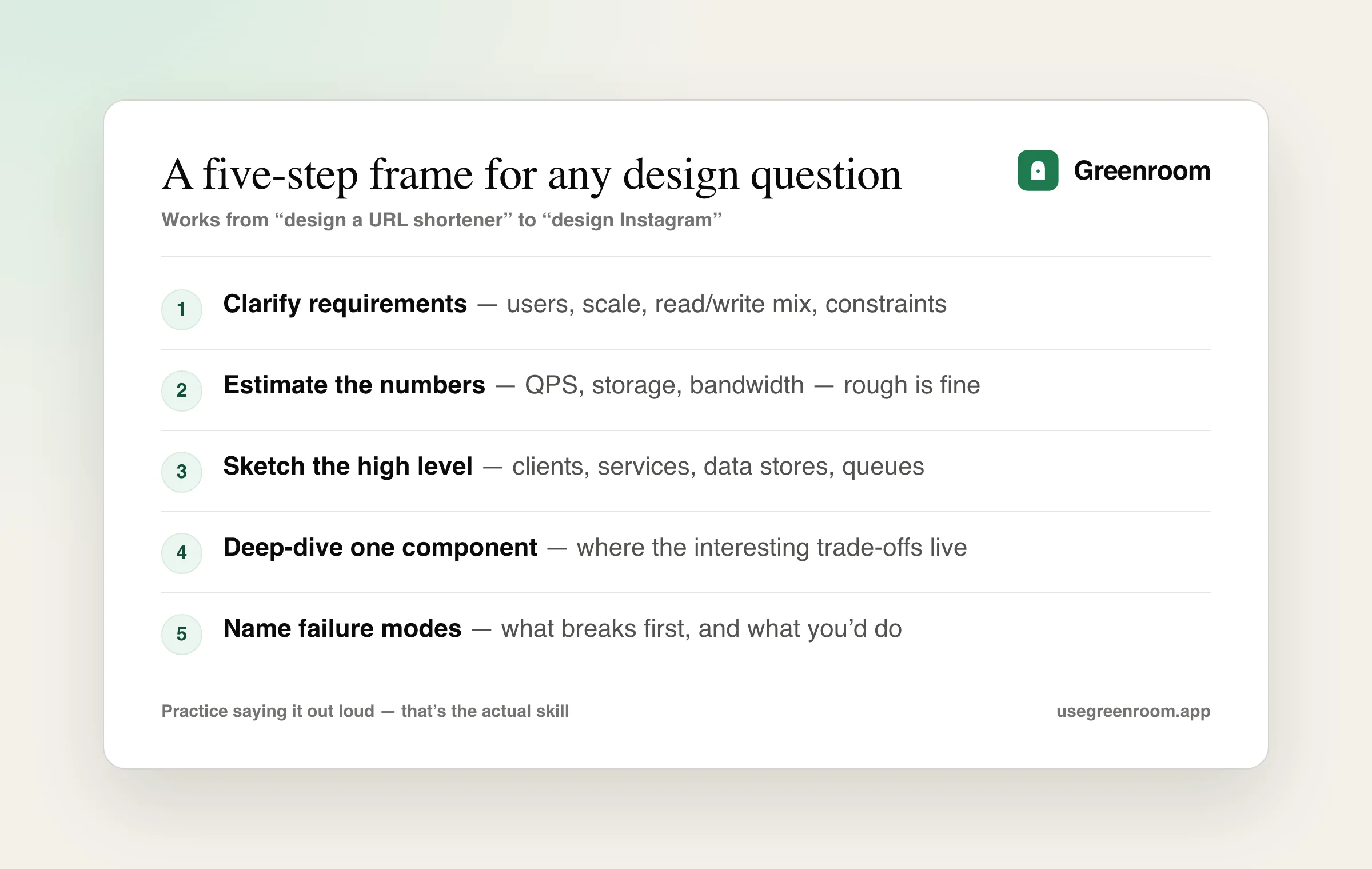
The 5-step framework for any system design question
For senior engineer interview prep, having a repeatable framework is more valuable than memorizing 50 system designs. Use this for every question:
Step 1: Clarify requirements (3–5 minutes)
Ask about functional requirements (what the system does), non-functional requirements (scale, latency, consistency), and constraints. "How many users per day? What is the acceptable read latency? Is this write-heavy or read-heavy?"
Step 2: Estimate scale (2–3 minutes)
Back-of-envelope calculations. "If we have 10M daily active users with 5 requests each, that's ~580 QPS. At 1KB per request, that's 580KB/s bandwidth." Interviewers care that you can do this, not that you get the exact number.
Step 3: High-level design (10 minutes)
Draw the major components: client, load balancer, application servers, databases, caches. Show the data flow. Keep it simple at this stage — you will deep dive later.
Step 4: Deep dive (15–20 minutes)
The interviewer will ask you to go deeper on one or two components. Common deep dives: database schema, caching strategy, how you handle failures, how you scale the write path.
Step 5: Trade-offs and bottlenecks (5 minutes)
Identify what would break first under load. Talk about what you would do differently if the scale was 10x. This is where strong candidates separate from the rest.
Core concepts every Indian engineer must know
For system design interview india specifically, these are the concepts that appear across Google, Flipkart, PhonePe, Zepto, Razorpay, and similar companies:
- Load balancing — round robin, least connections, consistent hashing
- Caching — Redis vs Memcached, write-through vs write-back, cache invalidation
- Database design — SQL vs NoSQL, indexing, sharding, replication
- Message queues — Kafka, RabbitMQ, use cases for async processing
- CDN — what it caches, when to use it, how it integrates with your design
- Rate limiting — token bucket algorithm, sliding window counter
- Consistent hashing — how to distribute data across nodes without reshuffling everything
- CAP theorem — consistency vs availability vs partition tolerance, and when each matters
Practice systems — start with these
For senior engineer interview prep in India, practice these 8 systems in order. They build on each other and cover most of the concepts that appear in real interviews:
- URL shortener (Bitly) — database design, hashing, redirects
- Rate limiter — algorithms, distributed state
- Notification service — fan-out, queues, delivery guarantees
- Instagram/Twitter feed — timeline generation, fan-out on write vs read
- WhatsApp/chat system — WebSockets, message ordering, delivery receipts
- Google Drive / file storage — chunking, metadata, CDN
- Ride-sharing backend (Uber) — geospatial indexing, matching algorithms, real-time updates
- YouTube / video platform — upload pipeline, transcoding, streaming
Resources for system design in India
- System Design Interview by Alex Xu (Vol 1 & 2) — the standard reference. Read both.
- ByteByteGo — Alex Xu's newsletter and YouTube channel. Free content is excellent.
- Gaurav Sen's YouTube channel — best Hindi-friendly system design content available, highly recommended for Indian engineers.
- Exponent — structured mock system design interviews with real engineers. Paid but worth it for senior prep.
Drilling the components? Our caching interview questions, database sharding, load balancing and distributed systems guides cover the building blocks these design rounds assemble.
Two adjacent rounds have their own guides: low level design (LLD) interview questions for the object-oriented round, and frontend system design interview questions for the browser-scoped one.
Frequently asked questions
How do I start preparing for system design interviews?
Learn the building blocks first (load balancing, caching, databases and indexing, queues, sharding, replication), then practice applying the five-step framework out loud on classic problems like a URL shortener before attempting Instagram-scale questions.
Is system design asked for freshers in India?
Rarely as a dedicated round — but design thinking shows up in project discussions even for freshers. From SDE-2 onward it's a standard, often decisive round at product companies.
Which systems should I practice designing first?
URL shortener, rate limiter, chat app, news feed, and a ride-hailing dispatch system. These five cover most of the concepts interviewers probe, from consistent hashing to fan-out trade-offs.
How do I practice system design without a partner?
Design out loud against a clock, then interrogate your own design: what breaks at 10× load, what's the failure mode of each component? An AI interviewer that pushes follow-ups (Greenroom runs system design rounds by voice) gives you the missing pushback.