It's placement season. You finally book an InterviewBuddy slot with an industry expert for Thursday at 4pm, feel productive for exactly five seconds, and then realize your campus drive is on Wednesday. So you do the only logical thing: panic-practise in your head on the bus, walk into the real interview cold, and freeze on "tell me about yourself" — a question you have, technically, known the answer to for twenty-one years. The Thursday session, when it finally happens, is genuinely excellent. It's also two days too late for the interview that actually mattered.
That timing problem is the crux of Greenroom vs InterviewBuddy. InterviewBuddy gives you a real, scheduled mock interview with a human industry professional over video — high fidelity, real feedback, and the realism of an actual person across the screen. Greenroom is an on-demand AI mock interview tool you can open the second the panic hits, with adaptive follow-ups and instant scored feedback. One is a great occasional rehearsal; the other is the everyday practice that makes the rehearsal go well. Here's the honest comparison — written, fittingly, for the Indian placement-season reader.
Why both of these tools exist
A bit of context frames the whole comparison. For Indian students and early-career candidates especially, interview prep has long had a painful trade-off: the best practice — a real interview with an experienced professional — was also the rarest and most expensive, while the practice you could do endlessly — reading question banks — barely resembled a real interview at all. Most candidates ended up under-practised on the skill that actually decides offers: speaking under pressure.
InterviewBuddy tackled the quality side. It connected candidates with real industry professionals for live, face-to-face video mocks, turning "I wish I knew someone in the industry who'd interview me" into a bookable service. The feedback is human and credible, and the format is realistic. The constraint is the one any human service has: experts are scheduled and paid, so you get a handful of sessions, not a habit.
Greenroom tackled the quantity side without giving up feedback. The bet is that an AI interviewer can deliver the parts of practice that actually build skill — adaptive follow-ups, a consistent evaluation, a score, and instant repeatability — on demand and at a price that lets you practise daily. It can't replace a human expert's lived judgment, but it can give you the volume of spoken, feedback-rich reps that a scheduled service never could. So the two aren't fighting over the same slot in your week: one is the occasional high-fidelity rehearsal, the other is the daily training that makes that rehearsal — and the real interview — go well.
What InterviewBuddy actually is
InterviewBuddy is a mock-interview platform — well known in India — that connects you with industry professionals for live, face-to-face mock interviews over video. You choose your domain, book a slot with an available interviewer, do a real-time interview, and get human feedback afterward. It's especially popular with students and freshers prepping for campus placements and early-career roles, the same audience we write for in our campus placement interview guide.
Its strength is genuine and worth respecting: it's a real human interview. A live professional can read your nervous energy, react to your specific answer, push on a vague claim, and share the kind of role-specific, "here's what I'd actually look for" insight no rubric captures. The video format also rehearses the real thing — eye contact, the awkward silences, the pressure of a person waiting for your answer. For a high-fidelity dress rehearsal, that's exactly what you want.
The constraints are the ones every human-scheduled service shares. You practise on the interviewer's schedule, not yours — a real problem when interviews get scheduled with two days' notice. Each session costs money, so doing the dozens of reps fluency requires gets expensive fast. And because feedback comes from whichever professional you're matched with, its depth and style vary from session to session. None of that makes it bad — it makes it an occasional tool, not an everyday one.
What Greenroom does differently
Greenroom is built for the everyday slot InterviewBuddy can't economically fill: frequent, on-demand reps. It's a voice-based AI interviewer — Ari — that asks questions out loud, listens, and asks adaptive follow-up questions based on your actual answer, then gives you structured feedback on pace, filler words, structure, and content, plus a 1–10 score. No slot to book, no waiting, no per-session bill — so you can practise at midnight, on the bus, the morning of the drive. The mechanics are in how to use an AI mock interview tool.
Because it's available and cheap, it changes how much you practise — and volume is what actually builds fluency. You can run a diagnostic, fix one weakness, re-run targeting only that, and repeat until "tell me about yourself" comes out clean without thinking. That fix-and-re-test loop is the part a once-a-week human session can't give you, simply because you can't afford twenty of them. We put real numbers on the volume question in how many mock interviews you actually need.
And the honest limit: Greenroom is not a human industry expert. It won't tell you "at my company, we'd have probed your deployment story harder" from lived experience, and it can't fully replace the texture of a real person across the table. That's precisely why the best answer isn't either/or — it's covered in AI mock vs a real engineer mock.
Greenroom vs InterviewBuddy, head to head
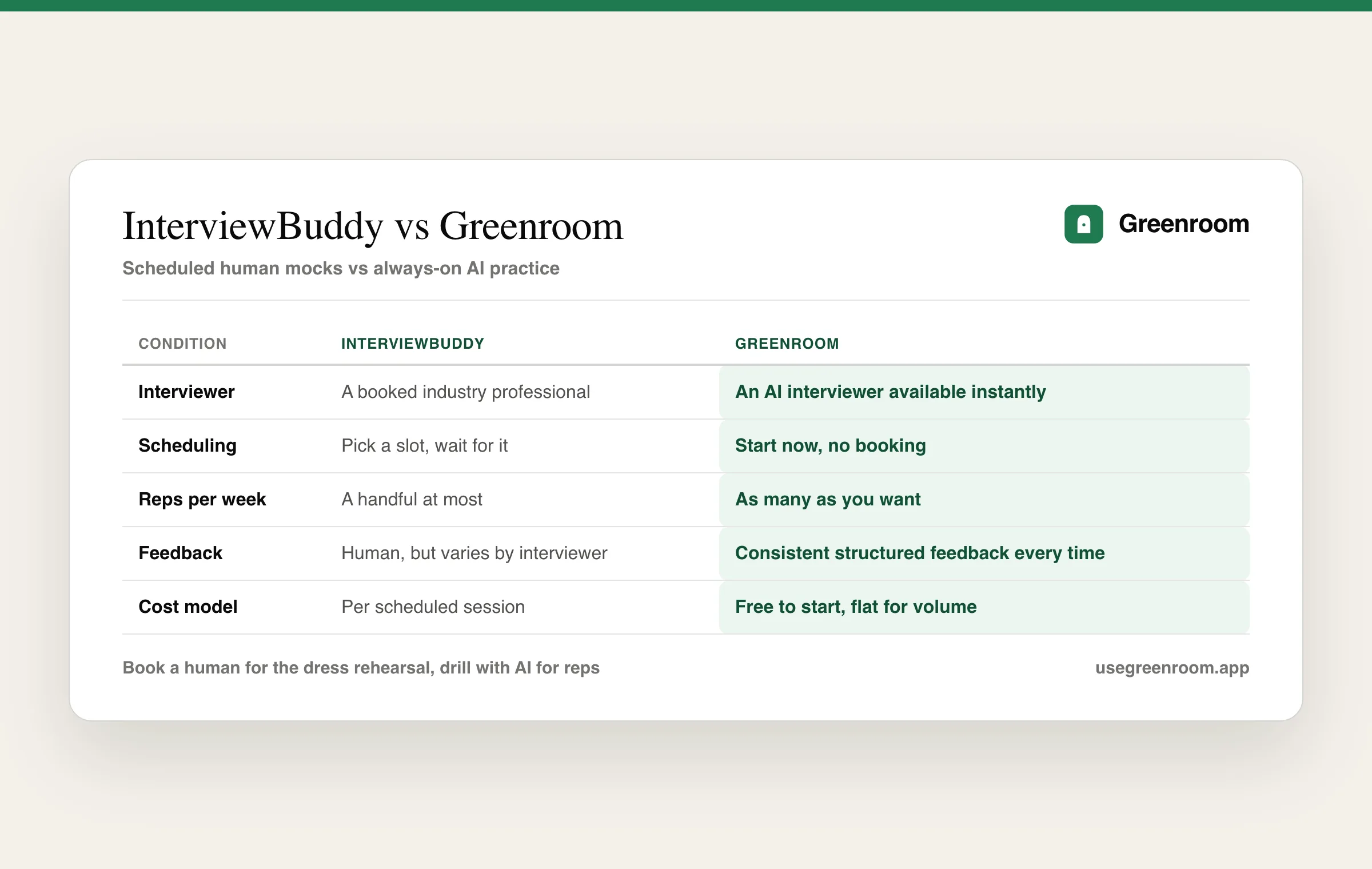
The decision comes down to fidelity-per-session versus reps-per-week — and most candidates need both, in different amounts.
Interviewer
InterviewBuddy gives you a real industry professional — nuanced, experienced, human. Greenroom gives you a consistent AI interviewer that adapts and always asks follow-ups. For lived-experience judgment, the human wins; for reliability and availability, the AI does.
Scheduling
InterviewBuddy needs a booked slot around the interviewer's calendar. Greenroom starts instantly — decisive when real interviews land with 48 hours' notice during placement season.
Reps per week
With a paid human service, most people manage a handful of sessions total. With an on-demand AI tool, you can do that many before lunch. Since fluency is a volume game, this quietly decides how prepared you actually are.
Feedback consistency
InterviewBuddy's feedback is human but varies with the interviewer. Greenroom's is the same format every time, which is what lets you measure whether one specific weakness improved.
Cost model
InterviewBuddy charges per scheduled session; Greenroom is free to start and built for low-cost volume. On a student budget — the reality for most placement-season candidates — cost per rep matters enormously.
InterviewBuddy vs Greenroom by interview type
Which tool to lean on shifts a little depending on the round you're prepping. Here's the honest split.
HR and behavioral rounds
These are the bread and butter of campus placements — "tell me about yourself," "why this company," "what are your strengths," "describe a conflict." They're pure spoken fluency, and they reward high-frequency reps until the answers come out clean without effort. That's squarely Greenroom territory: drill them daily, fix the rambling and the missing structure, and re-test. A human session is a nice final check, but the dozens of reps that make these answers automatic have to happen somewhere cheap and repeatable.
Technical and coding rounds
Here a human professional's eye is valuable — a real engineer can probe your approach and catch subtle gaps. But the communication layer (explaining your approach out loud, narrating tradeoffs, not going silent when stuck) is exactly what an AI interviewer rehearses well and cheaply. Use a human session for a depth-check and the AI for the volume of "talk through your thinking" reps. Build the fundamentals from our DSA interview prep guide.
Domain-specific rounds
If your field has very specific expectations — a niche role, a particular company's known style — a matched industry professional on InterviewBuddy can speak to that from experience in a way a general tool can't. This is one of the clearest cases for spending on a human session.
Group discussions and aptitude
Neither tool is the primary fit for GD or aptitude rounds — those need their own prep. See our group discussion tips for that piece of the placement puzzle.
What a human session is genuinely irreplaceable for
It's worth stating plainly, because this isn't a "the AI wins everything" piece. A real human session does things an AI honestly can't. A seasoned professional brings lived judgment — they've sat on the other side of real interviews and can tell you how you'd actually land, not just how you scored against a rubric. They can read subtle interpersonal signals — that you come across as slightly arrogant, or that your nervousness reads as disinterest — that a tool may not surface the same way. They can have a real conversation about your specific situation, your career goals, the particular company. And the social pressure of a real person on camera is its own valuable stressor to rehearse against.
None of that is something we'd wave away. It's exactly why the recommendation isn't "use Greenroom instead of InterviewBuddy" — it's "use Greenroom for the volume, and InterviewBuddy for the human-only value." The two are complementary precisely because each does something the other can't. The error is using either one for the job the other does better: paying for scarce human sessions to drill basic fluency, or expecting an AI to replace the irreplaceable human read. Spend each where it's uniquely strong.
Common mistakes people make with InterviewBuddy
- Making it your only prep. A couple of scheduled sessions can't build fluency. Without cheap reps in between, you arrive having been diagnosed but not fixed.
- Showing up cold. Spending a paid session warming up wastes it. Drill on a free or cheap tool first so the professional sees your real ceiling.
- Not drilling the feedback. The session's value is realized afterward, when you grind the weakness it found. Skip that and you've paid to be told something you never acted on.
- Booking too late. A human session two days after your drive is feedback you can't use in time. Sequence it before the interviews that matter.
- Treating one professional's take as the whole truth. Interviewers vary; look for patterns across sessions and tools rather than over-weighting a single opinion.
Where InterviewBuddy still wins
- Real human, lived experience. An industry professional's "here's what I'd actually flag" is feedback no AI fully replicates, and it can reframe how you present yourself.
- True video-interview realism. A live person watching you rehearses the exact social pressure of the real round — body language, eye contact, the human pause.
- Domain-specific insight. A senior matched to your field can speak to that field's real expectations, not just generic interview craft.
- Accountability. A booked, paid session you'll actually show up for — useful if self-directed practice tends to slip.
For a high-stakes dress rehearsal before a dream-company interview, a human session is worth booking. Just don't make it your only practice.
Where Greenroom pulls ahead
- It's there the moment you need it. Interview tomorrow, decided to prep tonight? No slot exists for that — except an AI tool.
- The reps that build fluency. Cheap and unlimited means you can actually do the twentieth rep, which is the one that makes an answer automatic.
- Consistent, measurable feedback. Same rubric every time, so progress is visible instead of a vibe.
- Zero pressure to fail. Blank, restart, sound terrible, try again — no human watching, which is where people take the risks that lead to improvement. Helpful if nerves are the issue; see how to stay calm in interviews.
- It fits a student budget. Free to start, built for volume — the right economics for placement season.
Which should you actually use?
For most Indian candidates in placement season, the winning combination is clear:
- Daily reps (most of your prep): Greenroom. On-demand, cheap, scored. Fix one weakness at a time and build fluency on the questions you'll actually be asked.
- A human dress rehearsal: book one or two InterviewBuddy sessions close to an important drive, once your answers are already solid, to pressure-test them against a real expert.
- If budget is zero: do all reps on the AI tool and add a free Pramp peer session for the human element.
The mistake to avoid is making a scheduled, paid human session your entire plan — you'll do too few of them, too late, and walk into the real interview under-rehearsed. Volume first, polish second.
How an InterviewBuddy session actually flows
The experience is built to mirror a real interview. You browse and book a slot with an interviewer in your domain, around their availability. At the appointed time you join a live video call and run a real-time mock — the professional asks questions, you answer, they probe, exactly as a real interviewer would. Because it's a live human on camera, you get the full social texture: the eye contact, the pauses, the pressure of a real person waiting for your answer.
Afterward, the interviewer gives you feedback — verbally and often in a written summary — covering how you came across, where you were strong, and what to improve. For many candidates, that human, role-specific feedback is the highlight: a real practitioner telling you, from experience, what would and wouldn't fly in an actual interview. The two structural constraints are the ones any scheduled human service has: you practise on the interviewer's calendar, not yours, and each session costs money, so the number of reps you can do is naturally limited. Feedback also varies somewhat with which professional you draw.
How a Greenroom session actually flows
Greenroom is built for the rhythm InterviewBuddy can't economically serve: frequent, on-demand reps. You open it, set the role and seniority to your real target job, and start — no booking, no waiting. Ari asks a question out loud; you answer out loud; it asks adaptive follow-ups based on what you said. When you finish, you get a structured report: a 1–10 score plus specifics on pace, filler words, structure, and content.
Then the multiplier a once-a-week human session can't offer: fix one thing and run it again, immediately. Saw that your "tell me about yourself" rambled? Redo it in two minutes, tighter, and watch the score move. Because it's available and affordable, it changes how much you practise — and the volume of corrected reps is what actually turns a shaky answer into a fluent one. We detail the loop in how to use an AI mock interview tool. The two session flows reveal the whole story: InterviewBuddy optimizes the fidelity of an occasional rehearsal; Greenroom optimizes the frequency of everyday training.
A tale of one placement season
Picture Sneha, a final-year student, three weeks from her first campus drives. She knows mock interviews matter, so she books an InterviewBuddy session. It's genuinely excellent — the professional points out that she undersells her project work and freezes on "why should we hire you." Great feedback. But it was one session, it cost money, and her next free slot with a good interviewer is ten days out. Between then and her first drive, she has no cheap way to actually drill the two things she learned — so she shows up to drive number one having identified her weaknesses but never having fixed them. She freezes on "why should we hire you," exactly as predicted.
Now run it the better way. Sneha books that same one InterviewBuddy session — but she surrounds it with daily Greenroom reps. Before the human session, she's already drilled her common answers, so the professional's feedback is about subtle things, not basics she could've fixed herself. After it, she takes the two weaknesses the expert flagged and grinds them on Greenroom — rebuilding her "why should we hire you," re-running until it's automatic, tightening her project story. By drive number one, she's not just been told her weaknesses; she's fixed them. Same single expensive session, dramatically better outcome — because the cheap, repeatable reps did the work the expensive session can't afford to. For the placement-specific playbook, see our campus placement interview guide.
Which one fits you?
The placement-season fresher
Compressed timelines, many drives, a tight budget — you need volume above all. Lead with daily Greenroom reps and book one InterviewBuddy session, if budget allows, as a human checkpoint. The thing that sinks freshers is freezing on known questions, and only reps cure that. More in our fresher interview questions and answers.
The candidate before a single high-stakes interview
If one specific interview matters enormously, a human dress rehearsal is worth it — book an InterviewBuddy session a few days out, with your answers already drilled on the AI, so the feedback is about polish.
The very nervous candidate
If a live person spikes your anxiety, build fluency privately on Greenroom first, then add a human session once your answers are solid and only the social pressure remains to acclimate to. Pair with how to stay calm in interviews.
The zero-budget candidate
Do all your reps on the AI tool and substitute a free Pramp peer session for the human element. You'll lose the expert polish but keep the thing that matters most — volume.
The cost math, honestly
The honest metric isn't "free vs paid" or even "cheap vs expensive" — it's cost per useful rep. An InterviewBuddy session delivers high value per session but at a per-session price that caps how many you'll do; realistically, a student books a handful across a placement season. An AI tool delivers good, consistent value per rep at a price built for volume, so you can do that many in a few days.
Since interviewing skill is built through repetition with correction, the number of corrected reps you can afford quietly sets your ceiling. The implication for a budget-conscious candidate is clear: spend most of your prep on the tool you can repeat cheaply, and reserve paid human sessions for the specific moments only a human adds value — the final calibration, the dress rehearsal, the domain-specific insight. The rule that falls out is the same one that holds across every comparison in this series: buy human time for what only a human can give, and do the volume on the tool built for volume.
What actually builds interview skill
The learning research settles the strategy. Deliberate practice — focused work on a specific weakness, with immediate feedback, repeated with correction — is how durable skill forms. A great InterviewBuddy session gives you the "specific weakness" with a human's clarity; what it can't give you affordably is the "repeated with correction" part, which needs a cheap, instant tool. Add the spacing effect (distributed practice beats cramming) and the production gap (saying an answer aloud under pressure is a harder, different skill than knowing it), and the optimal design is obvious: many spaced, spoken, corrected reps, punctuated by occasional human calibration. InterviewBuddy supplies the calibration; an on-demand AI supplies the spacing and the volume. We put numbers on the volume question in how many mock interviews you actually need.
A prep plan that uses both
A three-week placement-season plan that spends each tool well:
- Week 1 — build the base (AI). Daily Greenroom reps across HR, behavioral, and your core technical area. Diagnose, fix one thing per session, re-test. No money spent yet.
- Week 2 — human checkpoint. One InterviewBuddy session once your answers are decent, so the professional's feedback is about depth, not basics. Bring the findings home and drill them on the AI.
- Week 3 — polish and rehearse. Heavy AI volume on whatever the expert flagged, then one full dress-rehearsal session a day or two before your first drive. Rest the night before.
How to get the most out of each
For InterviewBuddy: come in already warmed up so you don't spend a paid session shaking off rust; ask the interviewer the one high-value question — "what's the single thing that would most improve how I come across?"; and write down every piece of feedback to drill afterward. For Greenroom: set the real role, run it like it counts, take the follow-ups seriously, and isolate one weakness per re-run — the workflow in how to prepare for a mock interview. The meta-rule: let the cheap, repeatable tool find and fix the obvious things, and save the paid human session for the subtle, role-specific ones only a person can give.
Greenroom vs InterviewBuddy: myths, debunked
- "A human mock is always better than an AI one." A human is better for nuanced, role-specific judgment — but a scheduled session you do twice can't build the fluency that twenty AI reps can. "Better per session" isn't "better for your preparation."
- "One good mock interview is enough." One session diagnoses; it rarely fixes. Fixing needs repetition, which a single booking can't provide.
- "AI feedback is too generic for my field." You set the role and seniority, and the follow-ups react to your actual answers — and for the universal layers (structure, pace, fillers, clarity) the feedback is exactly on point regardless of field.
- "If I'm paying, I should rely on the paid tool." Paying for a session doesn't make it the right tool for volume. Use paid human time for calibration, not for the reps you could do cheaply.
A longer worked example: rebuilding "why should we hire you"
Let's make the combination concrete with the single most-dreaded HR question: "why should we hire you?" Suppose your current answer is the generic one almost everyone gives — "I'm a hard worker, I'm a fast learner, and I'm passionate about this field" — three claims that are simultaneously true, unprovable, and identical to what the previous forty candidates said.
An InterviewBuddy session is great at diagnosing this. A seasoned professional will tell you, from experience, exactly why it falls flat: it's generic, it offers no evidence, and it could be copy-pasted into any candidate's mouth for any company. That's valuable, credible feedback — the kind that lands harder coming from a real industry person. But here's the limit: the session ends, and now you have to actually build and rehearse a better answer, possibly several times, until it's fluent. Your next InterviewBuddy slot is days away and costs money, so the rebuilding is on you, alone, with no feedback loop.
This is exactly where Greenroom picks up. You rebuild the answer around specifics — "In my final-year project I cut our API's response time by 40% by adding caching, which is the kind of measurable backend work this role is about; I can do that here from day one" — and you run it. Greenroom follows up: "you mentioned the caching work — what was the tradeoff you considered?" Now you have to defend the specific, which forces the answer to be real. You run it again, tightening. You drill it five times across two days until it comes out clean and confident, without sounding rehearsed. By the time of your next human session — or the real interview — you don't just have feedback on a bad answer; you have a genuinely good answer, grooved into memory.
That's the division of labor in miniature: InterviewBuddy's professional told you the answer was generic with a credibility an AI can't match, and Greenroom let you fix it with a volume of corrected reps a scheduled human session can't provide. Neither tool does the whole job as well as the two together. The full structure for this specific question is in how to answer "why should we hire you?"
The science of why volume wins
The "do most of your reps on the AI, calibrate with the human" advice rests on how skill actually forms, and it's worth seeing the mechanics so you trust the plan. Retrieval practice means producing an answer from memory strengthens your ability to produce it again — and it compounds with repetition, so the candidate who does twenty spoken reps builds far stronger recall than one who does two, regardless of how good those two were. Spacing means those reps work best distributed across days rather than crammed, which favors a tool you can pick up daily over a session you book occasionally. Desensitization means interview nerves fade through repeated exposure, so more reps literally make you calmer in the real room. And the feedback loop means improvement requires knowing what to fix and re-testing it — which needs reps you can repeat immediately.
Every one of those mechanisms rewards frequency, and frequency is precisely what a scheduled, paid human service can't economically provide. This isn't a knock on InterviewBuddy — a human session delivers a kind of feedback quality and realism the AI can't match. It's just that the quantity dimension, which the science says matters enormously, belongs to the tool built for quantity. The optimal design falls right out of the research: many spaced, spoken, corrected reps on the affordable tool, punctuated by occasional high-fidelity human calibration. We put numbers on the volume side in how many mock interviews you actually need.
Common questions about combining the two
A few practical questions come up whenever candidates try to run both. "How many InterviewBuddy sessions do I actually need?" For most candidates, one or two, placed after you've drilled the basics — enough to get a human's calibration without it becoming your expensive volume tier. "Should I do the human session before or after the AI reps?" Do a round of AI reps first so the professional sees your real ability and the feedback targets your subtle weaknesses rather than basics. "What if the human and AI feedback disagree?" On the big things they rarely do; where a human adds nuance the AI can't (how you come across, role-specific expectations), trust the human, and treat agreement as strong confirmation. "Can I get by with only the AI if I'm broke?" Yes — pair it with a free Pramp peer session for the human element, and you'll cover most of what matters. "When should I book the human session relative to my drive?" A few days before — late enough that your answers are polished, early enough to act on the feedback. The thread through all of these: human time is the scarce, premium input, so spend it late and deliberately, and do the volume cheaply.
Different placement scenarios, different mixes
The right blend shifts with your situation, so here are a few common ones. If you're facing mass-recruiter drives (the big service companies that interview hundreds), the rounds are heavily HR and aptitude, the bar is about not making mistakes, and sheer volume of spoken reps matters most — lean almost entirely on the AI, with maybe one human session for nerves. If you're targeting product companies with tougher technical and behavioral loops, the calibration of a human professional becomes more valuable, so budget for a session or two while still doing your daily reps on the AI. If you have one specific dream-company interview, treat it like an athlete treats a final: weeks of AI volume to build fluency, then a human dress rehearsal a few days out to pressure-test under realistic conditions. And if you're very early and just building confidence, start free — Google Interview Warmup or a few AI reps — before spending on any human session at all. The constant across every scenario is that the AI carries the volume and the human adds the polish; only the ratio changes. For the placement-wide game plan, our campus placement interview guide ties it together.
Quick reference: which to open when
The shortcut: open Greenroom for the daily reps — any time you want to drill an answer, fix a weakness, build fluency, or calm your nerves before a drive, as often as you like, for a fraction of a human session's cost. Book InterviewBuddy when your answers are already solid and you want a real industry professional's calibration, the realism of a live video interview, or a high-fidelity dress rehearsal before an interview that genuinely matters. Add a free Pramp peer session if you want a human in the loop on zero budget. The recurring mistake — and the one that quietly sinks placement-season prep — is making a scheduled, paid human session your entire plan: you'll do too few of them, too late, and arrive under-rehearsed. Volume first, polish second.
Is InterviewBuddy worth the money?
The straight answer: yes, for the specific job it does well, and no, as a substitute for volume. A live session with an experienced professional gives you something an AI honestly can't — a human read on how you come across, lived insight into what a real interviewer in your field is looking for, and the realism of being evaluated by a person on camera. For a candidate who has already built fluency and wants a high-fidelity checkpoint before an interview that matters, that's money well spent, and the credibility of hearing "you undersell yourself" from a real industry person can shift how you present yourself in a way no rubric quite manages.
Where it stops being worth the money is when you ask it to be your entire preparation. At a per-session price, the few sessions you'll realistically book can't deliver the dozens of corrected reps that build fluency — so leaning on InterviewBuddy alone leaves you diagnosed but under-rehearsed, which is the worst of both worlds: you know your weaknesses and never drilled them. The value-maximizing move is to treat it as a premium garnish on a base of cheap, high-volume practice: do the reps on an affordable tool, then spend on a human session or two exactly when a human's judgment adds something the reps can't. Bought that way, it's worth it; bought as a replacement for volume, it's an expensive way to stay under-prepared.
The bottom line
InterviewBuddy gives you a real human expert and a realistic video interview — excellent as an occasional, high-fidelity rehearsal, and worth booking before an interview that really matters. Greenroom gives you the unlimited, on-demand, consistently-scored, instantly-repeatable reps that actually build fluency, at a price that fits a student budget. They aren't rivals; they're the dress rehearsal and the daily training. Do most of your reps on the tool you can repeat, add a human session or two for the polish only a person can give, and you'll walk into your drives genuinely rehearsed — not just booked.
What to look for in any mock interview tool
Stepping back from these two specific products, it's worth knowing what actually separates a useful mock interview tool from a forgettable one — because the criteria explain why the AI-plus-human combination keeps winning. There are really five things that matter.
First, does it make you speak out loud? Silent prep doesn't transfer; both InterviewBuddy and Greenroom pass this, which already puts them ahead of question banks. Second, does it ask follow-ups? Real interviews are driven by the second and third question, so a tool that only asks a flat list of questions rehearses a gentler game than the one you'll play — a live human does this naturally, and a good AI interviewer does it by design. Third, does it give you specific, actionable feedback? "That was good" is useless; "your answer ran ninety seconds too long and never reached a result" is gold. Fourth, can you repeat it enough to build fluency? This is the dimension cost and scheduling quietly decide, and it's where on-demand tools dominate. Fifth, does it match your real role and level? Generic practice wastes time; the closer the questions are to your actual interview, the more the practice transfers.
Run InterviewBuddy and Greenroom through that checklist and you can see exactly why they're complementary: the human session is unbeatable on feedback nuance and realism, the AI is unbeatable on repeatability and availability, and they both clear the speaking and follow-up bars. The tool that fails most of these is the one you should drop — and "reading a PDF of questions" fails four of the five. Whatever you choose, judge it against this list rather than against marketing.
The real cost of walking in under-rehearsed
It's easy to treat prep as optional polish, so it's worth being blunt about the stakes, especially in placement season. An interview you fail isn't a neutral event you can simply redo next week — in campus placements, a single fumbled drive can mean missing a company that won't return for a year, watching peers get placed while you don't, and the compounding hit to your confidence that makes the next drive harder. The cost of being under-rehearsed isn't abstract; it's measured in offers, in starting salaries, and in months of additional searching.
Against that, the cost of over-preparing is essentially nothing — at worst, a few extra hours of practice you didn't strictly need. When the downside of one path is "I lost an offer I could have gotten" and the downside of the other is "I practised a bit more than necessary," the rational move is obvious: err heavily toward more reps. This is precisely why making a scarce, scheduled human service your only prep is so risky — it caps your reps at a number that's almost certainly too low — and why pairing it with a tool you can use as much as you want is the safer bet. The candidates who treat preparation as a volume problem, not a one-session event, are the ones who walk into their drives genuinely ready. The mindset that gets you there is the same one in practice like you play.
Final thoughts for placement season
If you take one thing from this comparison into your placement season, let it be a reframe: stop thinking about interview prep as a thing you schedule and start thinking about it as a thing you do daily. The candidates who clear drives aren't usually the ones with the most raw talent or the most expensive coaching — they're the ones who, by the time the drive arrives, have simply said their answers out loud so many times that nerves can't shake them loose. That's a volume game, and volume is built on a tool you can open any night, not a session you book once a fortnight.
So use InterviewBuddy for what it's genuinely great at — a real human's calibration and the realism of a live video interview, ideally a few days before a drive that matters. But let your day-to-day be the cheap, repeatable reps that actually compound: diagnose a weakness, fix it, re-test, repeat, across the weeks before your drives. Add a free peer session for human texture if budget is tight. Do that, and you'll walk into your interviews not hoping you remember your answers, but knowing them cold — which, in a high-pressure placement room full of equally qualified candidates, is very often the entire difference between the offer and the polite rejection. The rest of our campus placement guide covers the surrounding strategy; this piece was about the one decision that quietly determines whether all that strategy gets a chance to show.
Other alternatives worth knowing
- Pramp — free peer-to-peer mocks with another job-seeker (comparison here).
- interviewing.io — paid mocks with real senior engineers, strong for global tech roles (comparison here).
- Final Round AI — an AI copilot aimed at live assistance, a different philosophy (comparison here).
- Google Interview Warmup — free, transcribes your answers but doesn't grade them (comparison here).
- ChatGPT — fine for drafting answers in text (details here).
Practise before the slot opens up
An InterviewBuddy session is a great rehearsal — but the candidate who nails it is the one who'd already practised a dozen times before booking. Greenroom is a spoken AI mock interviewer that asks real questions, follows up like a live interviewer, and gives specific feedback on every answer, the moment you need it — no slot, no per-session bill. Do one diagnostic today, fix the weakness it surfaces, and walk into your next drive already warmed up.
Frequently asked questions
What is InterviewBuddy?
InterviewBuddy is a platform, popular in India, that connects you with industry professionals for live, face-to-face mock interviews over video. You book a slot with an interviewer in your domain, do a real-time interview, and receive human feedback afterward. It is widely used by students and freshers preparing for placements and early-career roles. The value is the realism of a live human interview and expert feedback; the tradeoffs are scheduling, cost per session, and feedback quality varying with the interviewer.
Is Greenroom or InterviewBuddy better?
They serve different needs. InterviewBuddy gives you a live human industry expert and the realism of a scheduled video interview, which is excellent for an occasional high-fidelity rehearsal. Greenroom is an on-demand AI mock interviewer with adaptive follow-ups, consistent structured feedback, and a score, built for unlimited low-cost reps any time you want. For the volume of practice that builds fluency, Greenroom wins; for a realistic human dress rehearsal, InterviewBuddy has the edge. Many candidates use AI for daily reps and a human session before a big interview.
Does InterviewBuddy use real human interviewers?
Yes. The core of InterviewBuddy is live mock interviews with real industry professionals over video, followed by their feedback. That human element is its main strength — a real person can read nuance, react to your specific answers, and share role-specific insight. The limitations are practical: you have to schedule around the interviewer's availability, each session costs money, and because feedback depends on who you are matched with, its depth and style can vary from one session to the next.
Is an AI mock interview as good as a human mock interview?
For different things. A human mock like InterviewBuddy gives nuanced, role-specific judgment that AI cannot fully match, so it is the better dress rehearsal. An AI mock like Greenroom gives consistent, instant, judgment-free feedback you can get as often as you like, which is what actually builds fluency through volume. The most effective preparation uses both: AI for the many reps that make answers automatic, and a human session or two for the final, high-fidelity calibration before an important interview.
Which is cheaper, Greenroom or InterviewBuddy?
Greenroom is designed for low-cost volume: it is free to start and priced so you can run many sessions without paying per interview, which matters when fluency comes from doing dozens of reps. InterviewBuddy charges per scheduled session with a human interviewer, so the cost scales with how many mocks you book. If your budget is tight or you need a lot of practice, the AI model is far cheaper per rep; if you only want one or two polished human sessions, the per-session model can make sense.
Should I use Greenroom and InterviewBuddy together?
Yes, and that is the smartest approach. Use Greenroom for the bulk of your preparation — frequent, on-demand, scored sessions where you fix one weakness at a time and build fluency cheaply. Then book an InterviewBuddy session or two close to an important interview to pressure-test your now-solid answers against a real human expert and get the nuanced feedback only a person can give. The AI supplies the volume; the human supplies the final polish.