This is the one that happens in real time: you're mid-interview, a wave of panic rises, your chest tightens, your thoughts scatter, and you can feel yourself losing the thread. You don't need long-term advice in that moment — you need something you can do in the next ten seconds. This guide is the in-the-moment toolkit. Learn these before, so they're available when it counts.
What's happening (in one paragraph)
Panic is your fight-or-flight system firing hard. Adrenaline spikes, your heart rate jumps, blood moves away from the “thinking” part of your brain, and your attention tunnels. It feels like an emergency. It isn't — it's a false alarm, and it passes. Your only job in the moment is to tell your body the alarm is false. These techniques do exactly that.
Technique 1: The long exhale (your fastest reset)
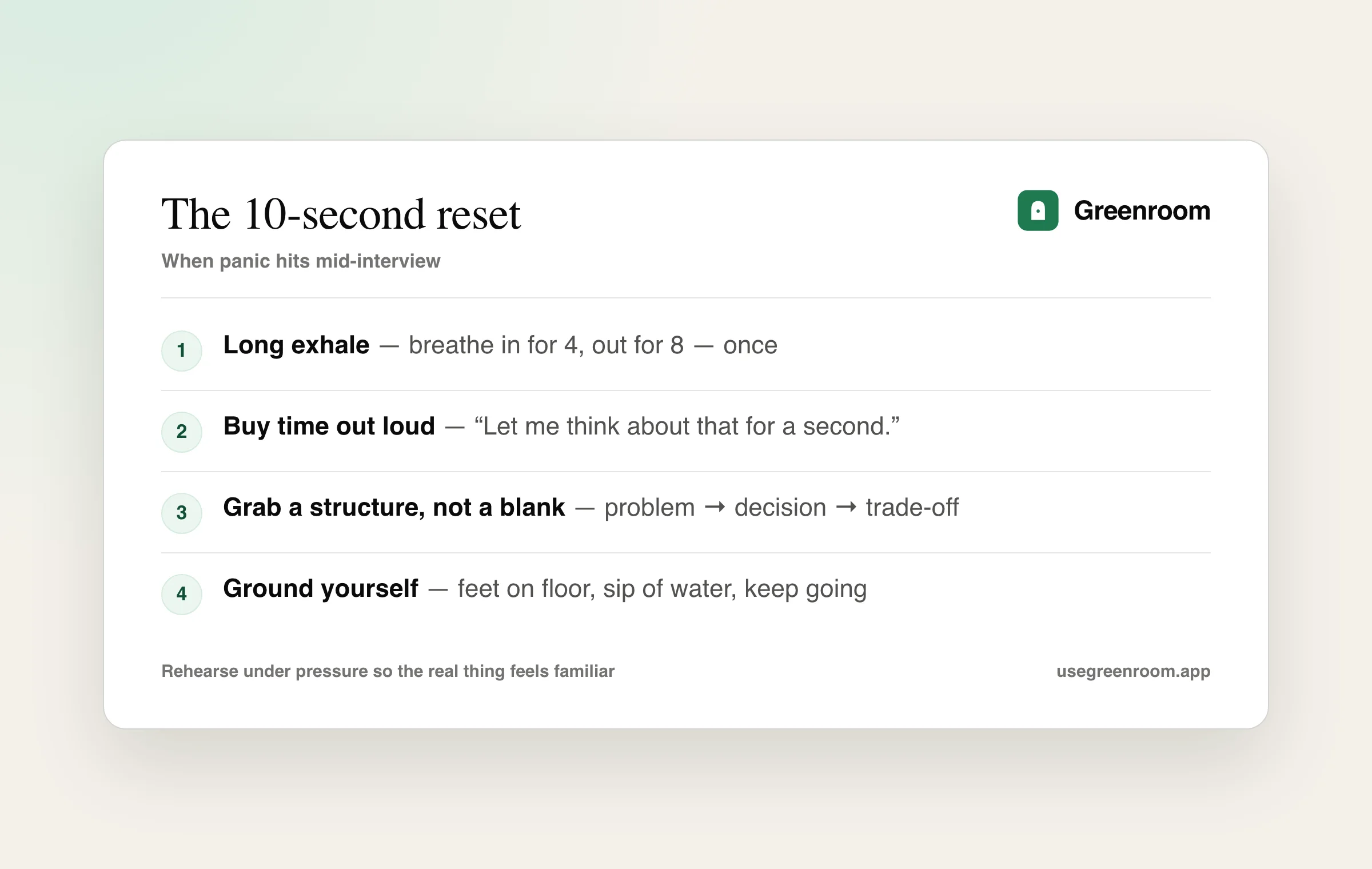
The single most reliable in-the-moment tool is a long, slow exhale. Breathe in for about 4 seconds, then out for about 6–8. The extended out-breath activates the part of your nervous system that calms you down — within two or three cycles your heart rate starts to drop. You can do this silently while the interviewer is speaking, or behind a sip of water. If you remember nothing else: exhale slowly, longer than you inhale.
Technique 2: Buy time out loud
Panic gets worse when you feel rushed, so remove the rush. It is completely acceptable — and reads as confident — to say:
“That's a good question — let me take a moment to think about it.”
Then actually take the moment. Three or four seconds of silence feels like an eternity to you and like normal thoughtfulness to them. This single sentence is the most useful thing you can have ready, because it converts panic-time into thinking-time.
Technique 3: Reach for a sip of water
Always have water in reach (in person and on video). Reaching for it is a socially invisible reset: it gives you a breath, a pause, and a small physical action that interrupts the spiral — without anyone reading it as anything but a sip of water.
Technique 4: Ground yourself in the physical
Panic lives in runaway thoughts about the future (“I'm blowing this”). Pull yourself back to the present with your senses: feel your feet on the floor, your hands on the desk, the chair against your back. A quiet, private version of the 5-senses grounding trick. It moves attention out of the catastrophe and into the room.
Technique 5: Grab a structure, not a blank
When panic scatters your thoughts, don't stare into the void — reach for a rail. For a behavioral question, start with the situation (STAR). For a project question, start with “the problem was…”. You don't need the whole answer; you need the first sentence, and a structure always gives you one. Momentum returns once you start talking.
If you fully blank
Sometimes panic wins for a second and your mind goes empty. That's recoverable, and recovering smoothly often impresses interviewers more than never wobbling. Say something honest and composed — “Sorry, I lost my thread for a second, let me restart that” — and begin again. We have a full guide to recovering from blanking.
Make panic less likely in the first place
In-the-moment tools are your safety net, but the real fix is familiarity — panic fades as the situation stops feeling novel. That comes from doing the thing, under pressure, many times. Greenroom lets you rehearse real spoken interviews on your own projects as often as you like, so the actual interview feels like rep number thirty, not number one. Free tier to start. See also: dealing with interview anxiety and why you freeze and how to stop.
Frequently asked questions
How do I stop panicking during an interview?
Use fast physical resets: breathe out slowly for longer than you breathe in to calm your nervous system, buy time out loud with “let me take a moment to think about that,” reach for a sip of water to create a natural pause, ground your attention in physical sensations, and grab a structure (like STAR) for your first sentence. These create calm rather than requiring it.
What do I do if my mind goes blank from panic in an interview?
Stay composed and say something honest like “Sorry, I lost my thread for a second — let me restart that,” then begin again using a structure for your opening sentence. Recovering smoothly often impresses interviewers more than never stumbling at all.
Is it okay to pause and take a moment in an interview?
Yes — pausing reads as thoughtful, not weak. Saying “that's a good question, let me think for a moment” and taking three or four seconds of silence feels long to you but completely normal to the interviewer, and it converts panic into thinking time.
How can I prevent panicking in interviews altogether?
Panic is driven by the situation feeling novel and threatening. The most effective prevention is repeated, realistic practice — doing spoken mock interviews under pressure many times so the real one feels familiar. Familiarity is what stops the fight-or-flight response from firing.