The first time you try Google Interview Warmup, it feels like a small miracle. You click a question, you talk, and a few seconds later your own words appear on screen, neatly transcribed, with little highlights showing which "talking points" you hit and which words you lean on. You think: oh, this is good, I'm actually practising. Then you do it again. And again. And somewhere around the fifth question you realize it's never going to tell you whether any of your answers were actually good — it just keeps cheerfully transcribing you into the void, like a very polite friend who nods at everything and offers zero opinions.
That's not a knock — it's the whole design, and it's where the Greenroom vs Google Interview Warmup comparison starts. Google Interview Warmup is a free, frictionless warm-up: speak your answers, see them transcribed, get gentle insights. Greenroom is a full AI mock interview: adaptive follow-ups, a real evaluation of how good the answer was, a score, and a loop for fixing what's weak. They're not competitors so much as two rungs on the same ladder. Here's exactly where one stops and the other picks up.
Why both of these tools exist
A little context explains why these two aren't really rivals. The single biggest barrier to interview prep isn't knowledge — it's that most people never practise out loud at all. They read notes silently, decide they "know it," and discover on the live call that knowing an answer in your head and saying it to another human are different skills. Both of these tools exist to break that silence; they just stop at different points.
Google Interview Warmup was built by Google's Grow with Google initiative to remove the very first barrier — the friction and fear of speaking an answer aloud. Make it free, no sign-up, no judgment, no score, and suddenly anyone can take that scary first spoken rep. Its design goal is access, and on that goal it succeeds beautifully. By deliberately not grading you, it stays unintimidating.
Greenroom starts from the next problem: once you're comfortable speaking, how do you actually get better? That requires the things Warmup intentionally leaves out — follow-up questions, an honest evaluation of how good the answer was, a score to chase, and a loop to fix and re-test. Its design goal is improvement, which necessarily means a tool that's willing to tell you when an answer was weak. So one lowers the barrier to starting; the other raises the ceiling on how far you get. That's a ladder, not a fight.
What Google Interview Warmup actually is
Google Interview Warmup is a free browser tool from Google's Grow with Google initiative. You pick a field, it serves a short set of common interview questions (background, behavioral, and some role-specific ones), you answer out loud, and it transcribes your response in real time. Afterward it shows lightweight insights: the talking points it detected in your answer, the words you used most, and job-related terms you mentioned.
What makes it genuinely good is what it removes: there's no sign-up, no cost, and no judgment. For someone who has never once said an interview answer out loud — who only ever "practises" by reading notes silently — that frictionless first rep is exactly the right on-ramp. Hearing your own answer played back as text is a small but real wake-up call: you notice the rambling, the "ums," the sentence that went nowhere. As a confidence-builder and ice-breaker, it does its one job well.
But that one job is the whole job. Warmup doesn't score you, doesn't tell you whether an answer was strong or weak, doesn't ask follow-up questions, and doesn't adapt to your level. You can use it fifty times and never learn that your "tell me about yourself" has no structure, because nothing in the tool is built to tell you. It's a warm-up. It says so on the tin.
What Greenroom does differently
Greenroom is built for the part Warmup deliberately skips: evaluation and pressure. It's a voice-based AI interviewer — Ari — that asks questions out loud, listens, and asks adaptive follow-up questions based on what you actually said. Give a vague answer and it probes; give a strong one and it pushes. That follow-up dynamic is the single biggest thing a static question list can't reproduce, and it's where most real interviews are decided.
Afterward, instead of a neutral transcript, you get structured feedback: how your answer was organized, your pace, your filler words, whether your claims were backed up, and a score on a 1–10 scale. Then you do the thing that actually creates improvement — pick one weakness, re-run the session targeting only that, and watch the number move. That loop is the core of deliberate mock interview practice, and it's covered in detail in how to use an AI mock interview tool.
Honest framing: Warmup wins on pure simplicity and on being free with no account. If all you want is to hear yourself talk once, it's lighter-weight than firing up a full mock. Greenroom asks more of you because it gives more back — it's the workout after the warm-up, not a heavier version of the same thing.
Greenroom vs Google Interview Warmup, head to head
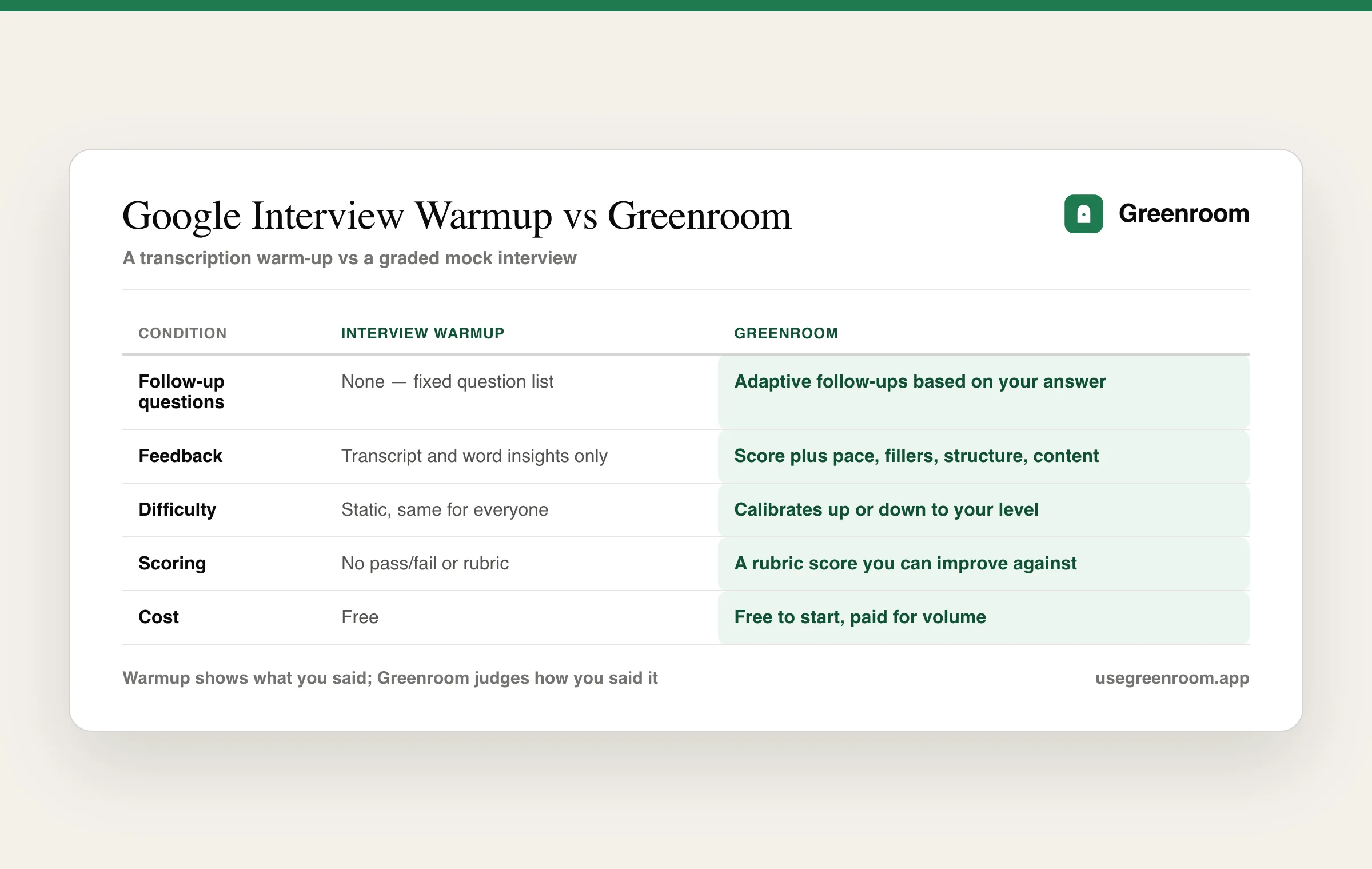
The differences cluster around one question: does the tool just record you, or does it actually evaluate you?
Follow-up questions
Warmup uses a fixed list and never probes. Greenroom asks adaptive follow-ups — "and why did you choose that?" — which is the pressure that real interviews run on and the part you most need to rehearse. More on that skill in how to think out loud in interviews.
Feedback vs. transcription
Warmup transcribes and lists words; it never says "this rambled" or "this had no result." Greenroom evaluates structure, content, and delivery and tells you specifically what to fix. One is a mirror; the other is a coach.
Difficulty
Warmup's questions are static and the same for everyone. Greenroom calibrates up or down to your level and the role you set, so a senior backend candidate and a fresher get different sessions.
Scoring and progress
Warmup has no score, so you can't measure improvement. Greenroom's consistent rubric lets you watch one weakness get better across sessions — the difference between practising and just performing.
Cost and friction
Warmup is free with no account — its biggest advantage. Greenroom is free to start and paid for volume, but it's doing materially more work per session.
What Warmup's insights actually measure
It's worth being precise about what Warmup's "insights" are, because the word makes them sound more evaluative than they are. After you answer, Warmup highlights three things: talking points (it detects whether your answer touched on themes like experience, goals, or skills), most-used words (a frequency count, which surfaces verbal crutches and repetition), and job-related terms (industry vocabulary it recognized in your answer). These are genuinely interesting — seeing that you said "basically" nine times, or that your "tell me about yourself" never mentioned a single concrete skill, can be a real nudge.
But notice the ceiling: every one of these is descriptive, not evaluative. Warmup will tell you which words you used; it won't tell you whether your answer was good. It detects that you mentioned "a goal"; it doesn't judge whether the goal was relevant, specific, or well-told. It's the difference between a fitness tracker that counts your steps and a coach who tells you your running form is going to hurt your knees. The step count is useful information, but it won't fix your form. Warmup hands you the data; it leaves the interpretation — and the fix — entirely to you, which is exactly the gap a graded tool fills by telling you not just what you did but how good it was and what to change.
The same answer, run through both tools
Make it concrete. Imagine your answer to "tell me about yourself" is a meandering, three-minute tour of your life that starts in school, wanders through every project you've ever touched, and trails off without a point. Here's what each tool does with it.
Google Interview Warmup transcribes the whole thing faithfully, shows you that your most-used words were "like," "stuff," and "basically," and notes that you hit the talking points "experience" and "skills." All true. All useful-ish. But it says nothing about the fact that the answer was twice as long as it should be, had no structure, buried your strongest selling point in the middle, and never connected to the job. You finish the session having learned that you say "basically" a lot — and you'd be forgiven for thinking the answer was basically fine.
Greenroom listens, then tells you: the answer ran long and lost focus; it lacked a clear present-past-future structure; the strongest point arrived too late; and it never tied back to the role. It scores the response, and — critically — when you answer, it follows up with a pointed question that exposes whether your claims hold up. Then you rebuild the answer using a tighter structure, run it again, and watch the score climb. One tool told you about your vocabulary; the other rebuilt your answer. That's the entire difference between a warm-up and a workout, in a single question. For the structure that fixes this specific answer, see how to answer "tell me about yourself".
Is Warmup the same as an AI mock interview?
This is the most common point of confusion, so let's settle it: no. Google Interview Warmup is a speaking warm-up with transcription and light insights. A true AI mock interview — the category Greenroom is in — simulates an actual interview: it adapts questions to your role, asks follow-ups based on your answers, evaluates content and delivery against a rubric, gives you a score, and supports the fix-and-re-test loop. Warmup is to an AI mock interview what humming in the shower is to a vocal lesson: same raw activity, completely different feedback and outcome. If what you actually want is to know how you'd do in a real interview and to get better at it, you want the mock, not the warm-up. If you just want to stop freezing when you open your mouth, the warm-up is a perfect, free first step. We unpack the full category in AI mock interview: how it works in 2026.
Where Google Interview Warmup still wins
- It's completely free, with no sign-up. Open it, talk, done. The lowest-friction way to take your very first spoken rep.
- It's perfectly non-intimidating. Nothing scores you, so there's zero anxiety about "failing" — ideal if interview nerves are your main blocker. If that's you, pair it with how to deal with interview anxiety.
- It's a great ice-breaker. Hearing your own rambling answer transcribed is a surprisingly effective nudge to tighten up.
- It's backed by Google. No worries about a fly-by-night tool; it's a free public resource.
If you've literally never practised out loud, start here today — it costs nothing and removes the scariest barrier, which is the first rep.
Where Greenroom pulls ahead
- It tells you if the answer was actually good. The thing Warmup can't do is the entire point of practising — knowing what to fix.
- It rehearses follow-ups. The real interview's hardest moments are the probes, and only an adaptive tool trains them.
- It gives a measurable score. You can see progress instead of guessing, which keeps you honest and motivated.
- It adapts to your role and level. Generic questions waste a senior's time; Greenroom matches the job you're actually interviewing for.
- It judges delivery. Pace, fillers, and structure — the things interviewers quietly weigh — get named, not just transcribed. See the best tools to practise interview speaking.
Which should you actually use?
The honest answer is a sequence, not a winner:
- If you've never practised aloud: start with Google Interview Warmup this week. Get comfortable hearing a question and producing a full spoken answer without freezing.
- Once that feels natural: move to Greenroom for the real work — follow-ups, scored feedback, and fixing one weakness at a time until your answers are fluent.
- Before an important interview: run a full Greenroom dress rehearsal with the role and seniority set correctly, a day or two ahead.
Warmup gets you talking; Greenroom gets you good. Most people who plateau are the ones who stayed on the warm-up and never moved to the workout.
How a Google Interview Warmup session actually flows
The whole experience is refreshingly simple. You go to the site — no account, no payment — and pick a field (the catalog covers things like general, data analytics, IT support, project management, and a few others). It presents a question from a fixed set, you press the button and answer out loud, and it transcribes your speech as you talk. When you finish, it shows the transcript plus a few insights: the talking points it detected, your most-used words, and job-related terms you mentioned. You move to the next question. Repeat for the handful of questions in the set.
That's it — and the simplicity is the feature. There's nothing to configure, nothing to be scored on, and nothing to feel anxious about. It's the lowest-friction way in existence to go from "I've never said an interview answer out loud" to "I've now said five." But notice what the flow doesn't include: it never asks a follow-up, never reacts to what you said, never tells you the answer was too long or had no structure, and never gives you a reason to do it again differently. It records; it doesn't coach. Once you've internalized that, you understand exactly what it's for and exactly where you'll outgrow it.
How a Greenroom session actually flows
Greenroom picks up precisely where Warmup stops. You set the role and seniority so questions match your real target job, then start. Ari asks a question out loud; you answer out loud; and then the thing Warmup never does — it follows up, based on what you actually said. Vague answer? It probes. Strong answer? It pushes into tradeoffs. That single difference rehearses the exact part of a real interview that makes people stumble.
When you finish, you don't get a neutral transcript — you get an evaluation: a 1–10 score plus specifics on structure, pace, filler words, and whether your claims held up. Then the loop that creates improvement: pick one weakness, run the session again targeting only that, and watch the number move. We walk through it in how to use an AI mock interview tool. Where Warmup shows you a mirror, Greenroom hands you a coach with a clipboard — more demanding, and far more useful once you're ready for it.
The warm-up-to-workout ladder
The most useful way to think about these tools isn't "which wins" but "which rung am I on." Interview prep has a natural progression, and each tool serves a rung:
- Rung 1 — break the silence. You've never practised aloud. Goal: say full answers without freezing. Tool: Google Interview Warmup. Free, frictionless, perfect for this.
- Rung 2 — get evaluated. You can speak, but you don't know if your answers are any good. Goal: find out what's weak. Tool: Greenroom. Diagnostic feedback and a score.
- Rung 3 — fix and re-test. You know your weaknesses. Goal: drill them until fluent. Tool: Greenroom's re-test loop.
- Rung 4 — human pressure. Your answers are solid. Goal: feel real social stakes. Tools: a Pramp peer or, for senior technical depth, interviewing.io.
- Rung 5 — dress rehearsal. Goal: one full run as if it's real, a day or two before. Tool: Greenroom, role set correctly.
The mistake most people make is camping on rung 1 — doing endless warm-ups — and mistaking comfort for progress. Warmup is a brilliant rung 1 and a poor rung 3, because it has no way to tell you what to fix. Climb deliberately.
A tale of two candidates
Take Nikhil and Anjali, both new to interviewing, both two weeks out. Nikhil discovers Google Interview Warmup and loves it — it's free and it feels productive. He does it most days, watching his words get transcribed, and arrives at his interview having spoken aloud a lot. But because nothing ever told him his "tell me about yourself" rambled for three minutes and never reached a point, he delivers exactly that, live, and loses the room in the first ninety seconds. He practised speaking; he never practised improving.
Anjali starts on Warmup too — for three days, just to get comfortable hearing herself. Then she moves to Greenroom. The first session tells her, bluntly, that her intro is too long and has no structure. She rebuilds it, re-runs, and tightens it to forty-five clean seconds. She does the same for two more weak answers. She arrives having not just spoken aloud but fixed the specific things that would have cost her. Same starting point, same two weeks — the difference was a tool that was willing to tell her the truth. Warmup got Nikhil talking; it was the graded loop that would have gotten him good.
Which one fits you?
The complete beginner
If speaking aloud still feels terrifying, start on Warmup this week — its zero-friction, zero-judgment design is the perfect on-ramp. Then graduate.
The anxious candidate
If nerves are your main blocker, Warmup's no-score format avoids triggering "fail" anxiety while you build comfort — then move to Greenroom once you're steadier, paired with how to deal with interview anxiety.
Anyone with an interview actually approaching
If a real interview is days away, you need feedback and follow-ups now, not just transcription. Go straight to Greenroom; you don't have time to discover your weaknesses by accident.
The candidate who keeps "practising" but not improving
If you've done plenty of reps and still feel stuck, the missing ingredient is almost always evaluation — exactly what Warmup lacks and Greenroom provides.
What actually builds interview skill
Learning research explains why a warm-up alone plateaus. Deliberate practice — focused work on a specific weakness, with immediate feedback, repeated with correction — requires feedback, and Warmup, by design, gives none of the evaluative kind. You can do a thousand warm-ups and never trigger the mechanism that actually improves skill, because nothing tells you what to change. The production gap — the gulf between recognizing a good answer and producing one under pressure — is real, and Warmup helps you cross the very first inch of it by getting you talking. But closing the gap needs the feedback-and-correction loop, which is the part a graded tool provides. In short: Warmup satisfies the "spoken practice" condition; only an evaluating tool satisfies the "with feedback, repeated with correction" condition that makes practice actually work. We size the volume question in how many mock interviews you actually need.
A prep plan that uses both
A two-week plan that starts free and climbs the ladder:
- Days 1–3 — break the silence (free). Google Interview Warmup, a few questions a day. Goal: speaking full answers without freezing. No pressure.
- Days 4–6 — diagnose. Move to Greenroom. Full sessions to find your three biggest weaknesses. Read the feedback; don't fix yet.
- Days 7–10 — drill. One weakness per day, re-running until each answer is clean and survives the follow-up.
- Days 11–12 — human rep. A Pramp peer session to feel real social pressure on now-solid answers.
- Days 13–14 — rehearse and rest. One full Greenroom dress rehearsal, then taper. Walk in warmed up and actually improved.
How to get the most out of each
For Google Interview Warmup: don't just read the transcript — listen to yourself as you answer and notice the rambles and fillers in real time; treat it purely as a confidence on-ramp and don't expect it to tell you what to fix. For Greenroom: set the real role, run it like it counts, take the follow-ups seriously, and isolate one weakness per re-run rather than trying to fix everything at once — the full workflow is in how to use an AI mock interview tool. The meta-point: use the free tool to start, the graded tool to improve, and don't confuse the two jobs.
Greenroom vs Google Interview Warmup: myths, debunked
- "It's free, so it's all I need." Free gets you the first rep, not the fix. If a tool can't tell you what's wrong, it can't get you past your current ceiling — no matter how many times you use it.
- "Transcription is feedback." Seeing your words isn't the same as knowing whether they were good. A transcript is a mirror; feedback is a verdict plus a direction.
- "More reps automatically means improvement." Reps without correction just groove your current habits, good and bad. Improvement needs the fix-and-re-test loop.
- "A Google tool must be the most advanced." Warmup is deliberately minimal — a public, no-frills warm-up, not a full mock interviewer. Different goal, different depth.
The science of why a warm-up alone plateaus
It's worth understanding why a transcription warm-up, however pleasant, eventually stops improving you — because the reason isn't a flaw in Warmup, it's a feature of how skill works. Three mechanisms explain it, and together they make the case for graduating.
The first is retrieval practice: producing an answer from memory, out loud, strengthens your ability to produce it again. Warmup does deliver this — you are genuinely retrieving when you speak — which is exactly why it's a good first step and beats silent note-reading. So far so good. But retrieval builds familiarity and fluency; on its own it doesn't tell you whether what you're fluently producing is any good. You can become very practised at delivering a weak answer.
That's where the second mechanism, the feedback loop, becomes decisive — and where Warmup, by design, stops. Improvement (as opposed to mere familiarity) requires knowing specifically what to change and then changing it. Without evaluative feedback, you have no error signal: nothing tells you the answer rambled, lacked structure, or dodged the question, so there's nothing to correct, and you plateau at your current level no matter how many reps you log. Warmup gives you a transcript; it doesn't give you an error signal. A graded tool does, which is the entire reason it can take you past the ceiling Warmup leaves you at.
The third is the production gap under pressure. Real interviews aren't just "speak an answer" — they're "speak an answer, then handle a follow-up you didn't see coming, while being evaluated." Warmup rehearses the first half (speaking) but not the second (adaptive pressure), because it never follows up or reacts. So even at its best, it trains a gentler version of the real skill. Closing that gap requires a tool that probes and pushes the way a real interviewer does. None of this makes Warmup bad — it makes it a first rung. The science simply says that retrieval without feedback, and speaking without pressure, will carry you a useful distance and then stop, which is precisely the point where a graded mock takes over.
A 30-day plan from zero to interview-ready
To make the progression concrete, here's how someone who has genuinely never practised aloud could go from terrified to interview-ready in a month, using each tool on its right rung.
Days 1–5 — break the silence (Warmup). The only goal is to stop freezing when you open your mouth. Do a few Google Interview Warmup questions a day, listen to yourself, and get used to the strange feeling of hearing your own answers. No pressure, no scoring — you're just crossing the hardest barrier, which is starting.
Days 6–12 — diagnose and confront (Greenroom). Now switch to a graded tool. Run full mock sessions and read the feedback honestly. This is the uncomfortable but crucial week where you discover that the answers you got comfortable with on Warmup have specific problems — the rambling intro, the story with no result, the filler words. Write down your three biggest weaknesses.
Days 13–22 — drill (Greenroom). One weakness at a time. Rebuild the answer, run it three to five times until it's clean and survives the follow-up, then move to the next. This is where the actual improvement happens, and it's the phase Warmup structurally can't support. By the end, your weak answers are now your rehearsed ones.
Days 23–27 — pressure-test (human). Add a human rep or two — a free Pramp peer session, or a paid professional if budget allows — to feel real social pressure on answers that are now solid.
Days 28–30 — rehearse and rest. One full dress-rehearsal Greenroom session with the real role set, then taper and rest. You'll walk in having travelled the whole distance from "can't speak without freezing" to "rehearsed and calm" — a journey Warmup starts beautifully and a graded tool finishes.
Who should skip the warm-up entirely
For honesty's sake: not everyone needs the warm-up rung at all. If you can already speak an answer out loud without freezing — if your blocker isn't comfort but quality — then Warmup has little to offer you, and starting there is just a detour. The same is true if your interview is imminent: with days to go, you can't afford to spend a week on a tool that won't tell you what's wrong, and you should go straight to a graded mock to find and fix your weaknesses fast. And anyone preparing for senior or highly technical rounds will find Warmup's general, static questions far too shallow to be useful. The warm-up is genuinely valuable for the specific person who has never practised aloud and needs to cross that first barrier gently — and genuinely skippable for everyone who's already past it. Knowing which group you're in saves you time. If you're unsure, the tie-breaker is simple: if you want to know how good your answers are, you're past the warm-up.
Quick reference: which to open when
The shortcut: open Google Interview Warmup when your single goal is to get comfortable speaking answers out loud, for free, with zero pressure — it's the perfect first rung and nothing else. Open Greenroom the moment you want to know whether your answers are actually good and to get better at them: adaptive follow-ups, a real evaluation, a score, and the fix-and-re-test loop that creates improvement. Add a human rep — a Pramp peer or a paid professional — once your answers are solid and you want real social pressure. The one mistake to avoid is camping on the warm-up and mistaking comfort for readiness; the candidates who get offers are the ones who climbed to the rung where a tool finally told them the truth.
A final word for the anxious beginner
If you're reading this as someone who genuinely dreads interviews — who freezes, whose mind goes blank, who has been avoiding practising out loud because it's uncomfortable — then hear this clearly: Google Interview Warmup is a wonderful place to start, and starting is the hardest part. There's no judgment, no score, no one watching; just you, getting used to the sound of your own answers. Use it for a few days and you'll cross a barrier that stops a huge number of capable people in their tracks. Genuinely, do it today.
But don't let comfort become the destination. The reason to move on to a tool that evaluates you isn't that you're failing — it's that you deserve to know how good your answers actually are while there's still time to make them better. The discomfort of being told "this rambled" is small and temporary; the discomfort of finding out in the real interview, when the offer is on the line, is neither. The kindest thing you can do for your nervous future self is to graduate from the warm-up to real, evaluated practice early — so that by the time it counts, you're not hoping you're ready, you're sure. If anxiety is the core of it, work both ends at once with how to deal with interview anxiety alongside your reps.
The bottom line
Google Interview Warmup is the best free way to take your very first spoken reps — frictionless, judgment-free, and genuinely good at the one job it's designed for: getting you comfortable talking. Greenroom is the tool that takes you from "comfortable" to "good," with the follow-ups, evaluation, score, and re-test loop that Warmup deliberately omits. They're rungs on the same ladder, not competitors. Start free on Warmup if you're brand new; move to Greenroom the moment you want to know whether your answers are actually any good — which, if an interview is coming, is now.
Why "free" can quietly cost you
"It's free" is Warmup's headline advantage, and it's a real one — but it's worth being clear-eyed about what free does and doesn't buy, because the wrong read can cost you the thing that matters most: time before an interview. Free buys you access and a first rep with zero barrier, which is genuinely valuable. What free does not buy is feedback, follow-ups, or improvement — and if you mistake "I'm using a free tool a lot" for "I'm preparing well," the cost shows up later, in the interview, as the rambling answer nobody ever told you to fix.
The subtler trap is false confidence. Because Warmup never says anything is wrong, repeated use can feel like steady progress while your actual answer quality stays flat. You can walk into an interview feeling prepared because you've practised a lot, and that feeling is partly an artifact of a tool that's constitutionally incapable of discouraging you. A graded tool sometimes feels worse in the moment — it tells you your answer was a 5/10 — but that discomfort is the price of actually improving. The honest framing is that Warmup's free price reflects its job: it's a free warm-up, not a free coach. The most expensive thing in interview prep isn't a subscription — it's the offer you lose because no one told you what to fix. Weighed against that, the question isn't "free vs paid," it's "comfortable vs prepared."
Common questions about Google Interview Warmup
A few questions come up so often they're worth answering directly. "Does Google Interview Warmup score my answers?" No — it transcribes them and shows descriptive insights (talking points, most-used words, job-related terms), but it never judges quality or assigns a score. "Does it work for technical or software roles?" It has some role categories, but the questions are general and it can't evaluate technical depth or ask coding follow-ups, so for technical prep it's only useful as a speaking warm-up, not a mock. "Can I use it on my phone?" Yes, it's a simple web tool with no install — part of its low-friction appeal. "Is it the same as the AI mock interviewers people talk about?" No — it's a warm-up with transcription, not an adaptive, evaluating mock interview; the difference is the entire subject of this article. "If I only have three days before my interview, should I use it?" Briefly, to shake off nerves — but spend the bulk of those three days on a graded tool that can actually tell you what to fix, because you don't have time to discover your weaknesses by accident. "Is it enough to get me an offer?" As a starting point, it's great; as your whole preparation, no — it can't give you the feedback and follow-up practice that turn a comfortable speaker into a strong candidate.
Does Warmup work for non-technical roles?
Worth a quick note, since not everyone reading this is a software engineer. Google Interview Warmup's question sets span several fields — general, data analytics, IT support, project management, and others — so a candidate in a non-technical or support role can absolutely use it to get comfortable speaking. The same ceiling applies, though: it'll transcribe your answers and surface word-level insights regardless of field, but it still won't tell you whether your answer was good or ask the follow-ups a real interviewer in your domain would. For non-technical roles especially — where so much rides on communication, storytelling, and how you come across — the evaluative feedback a graded mock provides is arguably more important, not less, because polish and clarity are a bigger part of what's being judged. So the recommendation holds across fields: warm up here, then move to a tool that can actually coach your delivery, whatever role you're targeting.
Other alternatives worth knowing
- Pramp — free peer-to-peer mocks with a real human (comparison here).
- interviewing.io — paid mocks with real senior engineers (comparison here).
- Final Round AI — an AI copilot aimed at live assistance, a different philosophy (comparison here).
- InterviewBuddy — scheduled mocks with professionals, popular in India (comparison here).
- ChatGPT — handy for drafting answers in text (details here).
Is Google Interview Warmup enough on its own?
Short answer: for getting comfortable, yes; for actually preparing, no. It's worth being honest about both halves of that. As a confidence-builder, Warmup is genuinely sufficient — if your only goal this week is to stop freezing when you have to speak, a few sessions will get you there, and that's a real, valuable outcome that too many candidates skip entirely.
But "comfortable speaking" and "ready to interview" are different finish lines. Because Warmup never evaluates you, it has a structural blind spot: it cannot tell you that you're comfortably giving a bad answer. You can become perfectly relaxed at rambling for three minutes, and Warmup will cheerfully transcribe all three minutes without a hint that anything's wrong. Comfort without correction can even be counterproductive — it can cement bad habits and give you false confidence walking into the real thing. That's the trap: the tool feels like preparation, and the absence of any negative feedback feels like success, right up until the real interviewer's face tells a different story.
So the honest verdict is that Warmup is a great start and a poor finish. Use it to clear the first hurdle, then move to a tool that will tell you the truth about your answers and help you fix them — because the candidates who get offers aren't the ones who got comfortable, they're the ones who got good. If an interview is genuinely approaching, don't let "I've been practising on Warmup" stand in for the evaluated, corrective reps that actually move your performance. We lay out what that fuller preparation looks like in how to prepare for an interview.
What "good" looks like once you've graduated
One reason Warmup can't take you all the way is that it never shows you the target — so it's worth spelling out what a genuinely strong answer looks like, the thing a graded tool actually pushes you toward. Take the universal opener, "tell me about yourself." A weak version (the kind Warmup will happily transcribe) wanders chronologically, lists everything, and has no point. A strong version is tight and deliberate: it follows a present-past-future arc, opens with what you do now and why it's relevant to this role, gives one or two pieces of concrete evidence, and closes by connecting to where you want to go — all in 60 to 90 seconds, with no filler. The difference isn't vocabulary; it's structure, concision, and relevance, none of which a transcription tool can coach.
The same pattern holds across every question. A strong behavioral answer has a clear situation, your specific action, and a measurable result — not a vague group narrative. A strong "why this company" names something specific you couldn't say about any other employer. A strong technical explanation states the approach, the tradeoff, and the complexity out loud, rather than just arriving at an answer. These are the standards a graded mock holds you to and tells you when you miss — and they're exactly the standards Warmup, by design, stays silent about. Knowing what "good" looks like is half the battle; having a tool that tells you when you've hit it is the other half. That's the whole reason to climb from the warm-up to a tool that actually scores you against these targets, and you can study the targets themselves in our answer guides like how to answer "tell me about yourself" and behavioral questions and answers.
Move from warm-up to workout
If Google Interview Warmup got you comfortable speaking out loud, you've cleared the hardest barrier — now make the reps count. Greenroom is a spoken AI mock interviewer that asks real questions, follows up the way a live interviewer would, and tells you exactly how good each answer was and what to fix. Do one diagnostic session today and you'll learn more about your answers in twenty minutes than a month of transcripts could tell you.
Frequently asked questions
What is Google Interview Warmup?
Google Interview Warmup is a free web tool that asks you a short set of common interview questions by field, lets you answer out loud, and transcribes your response. It then surfaces simple insights — the talking points it detected, your most-used words, and job-related terms you mentioned. It is designed as a low-pressure warm-up to get you used to speaking your answers, not as a graded mock interview. It does not score you, ask follow-up questions, or adapt difficulty to your level.
Is Greenroom or Google Interview Warmup better?
They sit at different points on the same path. Google Interview Warmup is an excellent free first step for getting comfortable speaking answers out loud, with zero friction and no sign-up. Greenroom is a full mock interview: it asks adaptive follow-up questions, evaluates your delivery and content against a rubric, gives you a score, and lets you re-test specific weaknesses. If you have never said an answer aloud, start with Warmup; when you want feedback that actually tells you how good the answer was, move to Greenroom.
Does Google Interview Warmup give feedback or a score?
Not in the evaluative sense. Google Interview Warmup transcribes your answer and shows informational insights — detected talking points, most-used words, and relevant terms — but it does not judge whether the answer was good, give a score, or tell you what to fix. It is deliberately non-judgmental. A tool like Greenroom does the opposite: it assesses structure, pace, filler words, and content, returns a score, and points you to the single weakness to work on next.
Does Google Interview Warmup ask follow-up questions?
No. Google Interview Warmup works from a fixed list of questions and moves to the next one regardless of what you said. Real interviews are driven by follow-ups — the second and third question that probes your first answer — which is exactly the pressure that makes people stumble. Greenroom asks adaptive follow-up questions based on your actual answer, so it rehearses the part of the interview that a static question list cannot.
Should I use Google Interview Warmup before Greenroom?
That is a reasonable progression. Use Google Interview Warmup for a few sessions to break the ice — to get used to hearing the question and speaking a full answer out loud without freezing. Once that feels natural, switch to Greenroom for the real work: adaptive follow-ups, scored feedback, and the fix-one-thing-and-re-test loop that actually improves your answers. Warmup gets you talking; Greenroom gets you good.
Is Google Interview Warmup enough to prepare for an interview?
For getting comfortable speaking, it is a fine start, but on its own it is not enough. Because it does not score you, ask follow-ups, or tell you what to improve, you can use it repeatedly and never find out that your answers ramble or lack structure. Real preparation needs feedback you can act on and the pressure of follow-up questions, which is what a full mock interview tool like Greenroom provides. Treat Warmup as the warm-up and a graded mock as the workout.