Voice interview और coding out loud की प्रैक्टिस is the most underrated skill in technical interview preparation. You can solve LeetCode Hard problems in silence and still fail interviews. You can solve LeetCode Medium problems while narrating your thinking clearly and pass rounds at companies that rejected stronger coders. Verbal communication in technical interview settings is not a soft skill — it is a core interview skill that most Indian engineers have never deliberately practiced.
This guide is about how to fix that gap. Whether you are a fresher or a senior engineer with years of experience, if you have never practiced thinking out loud under interview conditions, you have a significant preparation gap. Let's close it.
Why Indian engineers specifically struggle with this
This is not a stereotype — it is a pattern that shows up consistently. Most Indian engineering education focuses on getting the correct answer, not on explaining your reasoning. Exams are written. Labs are individual. Even in interviews in India, most technical screening historically involved written tests, not live coding conversations.
Product company interviews — especially at FAANG, funded startups, and global product companies — are conversational. You are expected to narrate your thought process, ask clarifying questions, respond to hints, and pivot out loud when your approach is wrong. If you have spent your entire preparation typing solutions into a code editor with headphones on, you have built exactly the wrong muscle.
What "talking through code" actually looks like
Good coding interview communication tips start with understanding what you are supposed to say. Here is an example of what strong narration sounds like during a LeetCode-style question about finding the longest substring without repeating characters:
"Okay, so I need the longest substring without repeating characters. My first instinct is brute force — check every possible substring. That would be O(n²) or O(n³). Let me think if I can do better. If I use a sliding window with a hash set to track characters in the current window — I can expand right until I see a repeat, then shrink from the left. That would be O(n). Let me trace through the example to verify before I code."
This narration tells the interviewer: you understand the problem, you considered multiple approaches, you know the complexity trade-offs, and you validate before committing. None of that shows up if you just start typing.
The 5-phase approach to every coding interview
For strong talking through code interview performance, use this structure every time:
Phase 1: Clarify (2 minutes)
Repeat the problem in your own words. Ask about edge cases: "Can the input be empty? Can there be negative numbers? Is the array sorted?" Most interviewers will answer these and some answers change your approach entirely.
Phase 2: Brute force first (2 minutes)
State the obvious solution even if you know it is too slow. "The brute force would be O(n²) — nested loop comparing every pair. Can we do better?" This shows structured thinking and gives the interviewer a chance to say "Yes, think about X" if you are stuck.
Phase 3: Optimize out loud (5 minutes)
Talk through your optimization. "If I sort the array first, I can use binary search here, bringing it to O(n log n)." "If I use a hash map to store complements, I can solve this in one pass." Let the interviewer see your reasoning.
Phase 4: Code while narrating (15 minutes)
Do not go silent while coding. Say what you are doing: "I'm initializing a sliding window with two pointers, left and right." "This condition handles the case where the window needs to shrink." "I'll handle the edge case of empty input here." Short, clear, continuous.
Phase 5: Test and edge cases (5 minutes)
Walk through your solution with the example. Then test an edge case out loud: "Let me check what happens with a single-character input." "What if all characters are the same?" This shows engineering maturity.
STAR method for behavioral rounds
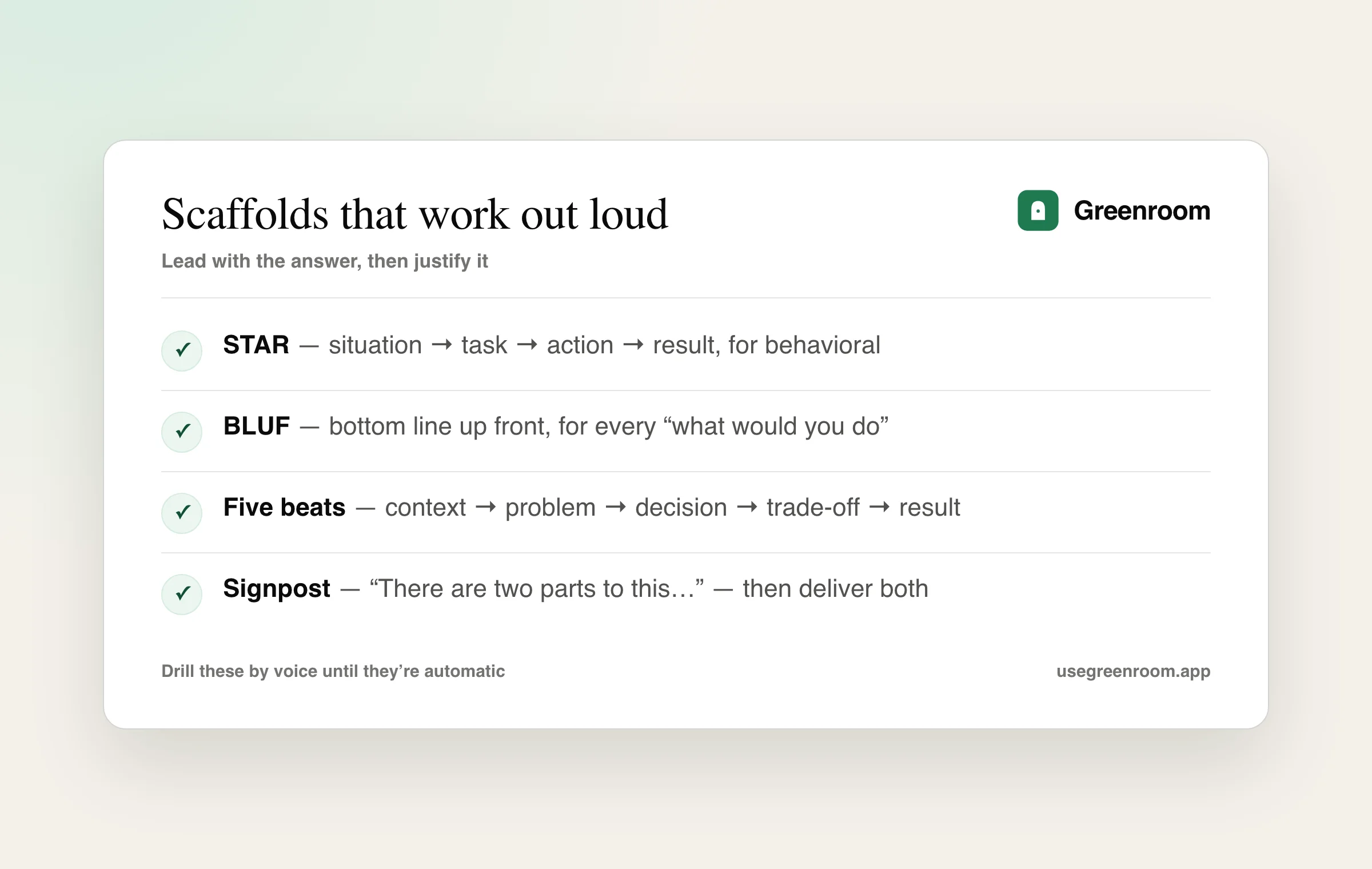
The star method interview india application is straightforward but consistently underprepared. STAR = Situation, Task, Action, Result. Every behavioral question gets a STAR answer:
- Situation: Set the context. One or two sentences max. "We were three weeks from a product launch."
- Task: What was your specific responsibility? "I was responsible for the payment integration."
- Action: What did you do? Be specific. Use "I," not "we." "I identified that the third-party SDK was causing a 300ms latency spike and built a caching layer that reduced it to 40ms."
- Result: What happened? Quantify where possible. "The payment flow was under our 200ms target. We shipped on time."
For behavioral interview for senior engineers, the Action component needs to show ownership and judgment, not just execution. "I decided to rewrite the component because the existing abstraction would not scale" is stronger than "I was asked to fix the performance issue."
How to practice voice interview skills
The only way to build verbal communication in technical interview skills is to practice speaking, not reading about it. Concrete methods:
- Solve problems out loud alone. Put a LeetCode problem on screen, set a timer, and narrate your solution to nobody. Record it. Watch it back and notice where you went silent.
- Peer mock interviews. Find someone prepping for similar roles and do 30-minute mocks twice a week. Each person takes turns interviewing and being interviewed.
- AI voice mock interviews. Tools like Greenroom put you in a real voice conversation where you have to think and speak simultaneously — closer to the actual interview than anything you can do alone.
Frequently asked questions
How do I talk through code during an interview?
Narrate decisions, not keystrokes: state the approach before typing, flag trade-offs as you make them ("a hash map costs memory but gets us O(n)"), and summarize complexity at the end. Silence is the thing interviewers penalize most.
Why do Indian engineers struggle with interview communication?
Mostly practice asymmetry, not English ability: years of solo typed practice and exam-style schooling build strong silent problem-solving but few reps of spoken technical reasoning. The fix is voice practice, not more LeetCode.
What is the 5-phase approach to a coding interview?
Clarify the problem, state your approach and get buy-in, code while narrating, test out loud with edge cases, then state complexity and possible improvements. Each phase is a chance to score communication points the silent candidate misses.
How can I practice speaking during coding without a partner?
Solve problems while narrating out loud and record yourself, or use a voice AI interviewer. Greenroom drills exactly this — it asks about your real code and pushes follow-ups until explaining out loud feels normal.