It is 11:40pm, the night before a technical interview, and you are standing in front of a bathroom mirror saying the word "scalability" for the fortieth time. Not because you don't know what it means — you've built systems that scale, you've read the papers, you could draw the architecture diagram blind. You're saying it forty times because somewhere between your brain and your mouth, the word keeps coming out as "scale-uh-bility" with the stress on the wrong syllable, and you are now fairly convinced the interviewer is going to notice this one specific word and silently judge your entire career.
This is not a unique form of insanity. It is, in fact, one of the most common pre-interview rituals among non-native English speakers preparing for technical interviews — and if you've done it, you're in extremely good company, including people who are now senior engineers at companies whose products you use daily. The mirror-rehearsal, the muttering on the metro, the moment mid-sentence where your brain reaches for a word in Hindi or Tamil or Bengali because that's where the thought actually lives, and your mouth has to scramble to translate it on the fly while a stranger on a video call watches you think — these are not signs that something is wrong with you. They're signs that you're doing a genuinely hard cognitive task (real-time interview performance) in a second or third language, under time pressure, while being evaluated. That's hard for anyone. It's a specific, fixable kind of hard, and that's what this guide is about.
This is a mock interview for non-native English speakers guide — covering the real anxieties, what interviewers are actually trained to evaluate, concrete practice techniques that work, and why spoken English practice for interviews has to be spoken, out loud, under at least a little pressure, to actually move the needle. We'll get into accent interview anxiety, the filler-word spiral, glossary-building for technical vocabulary, and the case for a structured spoken English mock interview over silently rereading a PDF of questions for the fifth time.
The anxieties are real, and they're specific
Let's name them properly, because vague anxiety is much harder to fix than a specific, well-described problem.
The accent self-consciousness. You know your accent is intelligible — your friends understand you fine, your colleagues understand you fine — but somewhere you've absorbed the idea that an interviewer hearing an Indian, Nigerian, Filipino, or Eastern European accent will mentally subtract points before you've even answered the question. This fear gets worse, not better, the more technical and high-stakes the interview is, because now there's a second layer: you're not just worried about being understood, you're worried about being taken seriously while sounding "foreign" in a domain (engineering) that has its own gatekeeping culture around who "sounds like" an engineer.
Real-time translation lag. If you learned to code, to do math, or to think about your domain primarily in your first language, a lot of your conceptual vocabulary lives there — not in English. So when an interviewer asks "walk me through how you'd handle race conditions in this design," your brain might generate the actual reasoning in Hindi or Telugu first, and then you have to translate that reasoning into English while still talking, live, with no pause button. That's two cognitive tasks stacked on top of each other — solving the problem, and translating the solution — and it's exactly why people who are completely fluent socially in English still freeze up technically. Technical vocabulary in a second language often wasn't acquired the same way conversational vocabulary was; it was read silently in textbooks, not spoken aloud in casual conversation, so the "spoken muscle memory" for words like "idempotent," "eventual consistency," or "garbage collection" is much thinner than for everyday words.
Mispronouncing technical terms specifically. This is its own special anxiety because technical terms are exactly the words you're most likely to be tested on, and exactly the words that didn't come up in your day-to-day English practice growing up. "Kubernetes," "nginx," "Mutex," "asynchronous," "heuristic," "ubiquitous" — these are words plenty of native English speakers mispronounce on a first attempt, but the fear hits differently when you're already worried your accent is being scrutinized.
Mid-sentence code-switching under pressure. You start a sentence in English, hit a concept that's clearer in your first language, and for a fraction of a second your mouth almost says it in Hindi before catching itself. Under low pressure this never happens. Under interview pressure — clock ticking, stranger watching, stakes attached — it happens more, because stress narrows your access to whichever retrieval path is least effortful, and for many bilingual brains under stress, that's the first language, not the one you're performing in.
The filler-word spiral. "Actually," "so basically," "like," "I mean," "you know" — every speaker uses some filler, but under stress, non-native speakers often lean on filler words specifically as a stalling mechanism while their brain finishes translating the next clause. The cruel irony is that the more nervous you get about sounding fluent, the more filler creeps in, which then makes you more self-conscious, which produces more filler. It's a feedback loop, and it's one of the few interview anxieties that's almost entirely solvable with deliberate practice — more on that below.
The "smart in my language" gap. There's a particular flavor of frustration that's hard to explain to anyone who's only ever interviewed in their first language: the feeling of knowing, with total certainty, that you are articulate, funny, precise, and persuasive when you speak Hindi, Marathi, Tagalog, or Yoruba — and then watching a flattened, hesitant, simplified version of yourself show up in the English-language interview instead. It's not that your English is bad. It's that your expressive range in your first language is built from a lifetime of use, while your expressive range in interview-context English is much newer and thinner, even if your conversational English is fully fluent. People mistake this gap for a competence problem when it's actually a range problem — and range, unlike raw competence, responds extremely well to targeted practice.
The "will they think I'm less competent" spiral. Underneath most of the anxieties above sits one shared fear: that a halting, accented, or occasionally mistranslated answer will be read by the interviewer as a signal about your technical ability, rather than a signal about language production under pressure. This fear is rational in the sense that unconscious bias absolutely exists and some interviewers do conflate the two. But it's also frequently overestimated, because the candidate experiencing it is sitting inside their own nervous system, magnifying every stumble, while the interviewer — who is listening to dozens of candidates a month — is usually far more focused on whether your reasoning holds up than on a single mispronounced word. Knowing this doesn't delete the fear, but it's worth holding in mind as you read the next section, which gets into exactly what trained interviewers are actually listening for.
None of these are character flaws or signs you're not cut out for the role. They're the predictable output of doing a high-stakes verbal task in a non-primary language. The fix isn't "be less Indian" or "lose your accent" — it's building specific spoken-language muscle for the specific situation of a technical interview. Let's get into why that distinction (accent vs. clarity) actually matters to the person sitting across from you.
Interviewers are trained to grade clarity, not accent
Here's the part that should genuinely change how you feel walking into the room: most structured interview processes — the kind used at FAANG-style companies and any organization that's invested in reducing interviewer bias — explicitly instruct interviewers to evaluate communication clarity, not accent. This isn't a feel-good claim; it's baked into how interview rubrics and interviewer training are written.
The reasoning is straightforward and well-established in communication research: accent and intelligibility are not the same thing. An accent is a marker of where someone learned to speak a language; intelligibility is whether the listener can understand what's being communicated. Linguistics and communication research — including work associated with bodies like the Linguistic Society of America — has long distinguished between "accentedness" (how different a speech pattern sounds from a reference standard) and "comprehensibility" (how easy it actually is to understand), and the research consistently shows these are separate dimensions. A strong accent does not automatically mean low comprehensibility, and a "neutral" accent doesn't automatically mean high comprehensibility either — clarity comes from pacing, structure, enunciation of key terms, and reducing verbal noise (filler, run-on sentences, buried key points), not from sounding like a news anchor from a particular region.
Well-run interview loops train for this explicitly because accent bias is a known, well-documented failure mode of unstructured interviewing — it's one of the easiest ways for an interviewer to unconsciously downgrade a strong candidate for reasons that have nothing to do with their ability to do the job. Structured rubrics exist precisely to catch and correct for that. When a rubric says "communication clarity," it's asking: did the candidate explain their reasoning in a way I could follow? Did they structure their answer? Did they flag the key decision points? Could I, the interviewer, summarize their answer back accurately? It is not asking "did this sound like it came from a specific region."
That doesn't mean every interviewer in the world is bias-free — individual bias absolutely exists, and you can't control for it perfectly. But it does mean the thing you should actually be training for is structurally different from "neutralizing your accent." You should be training for clarity: getting to the point, signposting your structure out loud ("there are three parts to this — first, second, third"), pausing instead of filling dead air with noise, and making sure your most important words — the technical terms that carry the actual content of your answer — land clearly. That's a learnable, practiceable skill, independent of your accent, and it's the skill that actually moves your evaluation.
It's worth being specific about what a "communication clarity" rubric item is actually checking, because the vagueness of the phrase is part of why it feels intimidating. In practice, structured interview scorecards tend to break it into a handful of concrete sub-questions: Did the candidate state their approach before diving into details, or did they launch straight into specifics with no roadmap? Could the interviewer accurately summarize the candidate's answer back to them without asking for clarification? Did the candidate flag when they were uncertain, rather than mumbling through it? Did key technical terms — the nouns and verbs actually carrying the content — come through clearly, even if surrounding words were accented or occasionally re-ordered? None of these sub-questions are about accent. All four are entirely within your control with practice, and all four are exactly what the practice techniques in this guide target.
There's a second, less-discussed reason interviewers are trained this way: comprehensibility research has repeatedly found that listener effort matters more than listener perception of "foreignness." A mildly accented but well-structured, clearly-paced answer is easier to follow than a native-accent answer that rambles, buries the main point on the fourth sentence, and never signals where it's going. Interviewers — like all listeners — get fatigued by high cognitive load, and a rambling structure produces more of that fatigue than an accent does. This is genuinely good news for you: structure and pacing are skills you can build deliberately in weeks, while accent is, for most adults, far slower and harder to change — and structured interviewing was specifically designed to reward the skill that's actually learnable on your timeline.
Why silent reading doesn't fix any of this
If clarity is a spoken skill, then the obvious — and commonly made — mistake is preparing for it the way you'd prepare for a written exam: reading. Reading a PDF of "100 common interview questions," rereading your notes, watching YouTube videos of other people answering questions, scrolling through a glossary of technical terms with their definitions. All of this builds knowledge. None of it builds the specific motor and cognitive skill of producing that knowledge out loud, at speaking speed, under time pressure, in response to a question you didn't see coming.
Here's the gap, concretely. When you read a technical explanation silently, your brain processes it visually and semantically — you understand the idea. But speaking requires an entirely different production pathway: your brain has to retrieve the right words, sequence them grammatically, control your breath and pacing, and articulate the sounds, all in real time, with no backspace key. These are genuinely different skills, run by overlapping but distinct cognitive and motor processes. This is the same reason a student can read a textbook chapter and feel like they understand it cold, then freeze when a teacher calls on them to explain it out loud — recognition is not the same as recall, and recall is not the same as fluent verbal production.
This is also why a friend doing a casual mock interview over video call — while genuinely useful and free — only gets you partway. A friend mock is usually low-pressure (you both know it's not real, you can laugh it off, there's no follow-up rigor), which is great for confidence but doesn't train you for the actual stress response you'll have in the real interview. It's practice for the content of your answer, not for performing under the specific cocktail of nerves, a stranger, and a clock that the real interview brings.
ChatGPT or another chatbot "interview me" prompt, similarly, gets you reps on content and even some structure, but it's still a text exchange — you're typing, which means you get to pause, edit, and backspace in a way the real interview never allows. Typing doesn't train your mouth, your breath control, or your real-time filler-word habit, because typing doesn't have any of those failure modes in the first place.
Generic English-speaking practice apps and accent-reduction courses are useful for general spoken fluency and confidence, and if accent anxiety is genuinely holding you back day-to-day, they're worth the time. But they're built around conversational, everyday English — ordering coffee, small talk, travel scenarios — not the specific vocabulary and format of a technical interview. They won't teach you to say "asynchronous," "idempotency," or "the trade-off between consistency and availability" clearly under a 45-minute clock with a follow-up question waiting.
None of these alternatives are bad. They're just solving adjacent problems. The actual problem — performing clearly, out loud, on technical content, under mild real-time pressure, with someone asking you a follow-up you didn't prepare for — needs practice that matches all four of those conditions at once: spoken, technical, timed, and followed-up. That's a narrow, specific kind of practice, and it's worth being honest that most of the obvious options don't hit all four.
ESL and general accent-reduction courses deserve a closer look too, because they're often the first thing people reach for when they decide "I need to fix my English for interviews." These courses are genuinely good at what they're built for — broad conversational fluency, pronunciation drills for common sound confusions (like the v/w distinction for many Indian-language speakers, or th-sounds for many East Asian and Slavic-language speakers), and general speaking confidence. If you've never had any structured spoken-English coaching, a few months of this can meaningfully raise your floor. The honest limitation is specificity: a generic course has no idea what "horizontal scaling" or "tail latency" means, won't drill you on explaining a system design trade-off in two minutes, and won't simulate a follow-up question that pokes at a gap in your reasoning. It builds the general instrument; it doesn't rehearse the specific performance.
Reading transcripts of "best answers" to common interview questions is another popular but quietly weak strategy, for the same reason reading the questions themselves is weak — you're absorbing someone else's words, in someone else's voice, with someone else's phrasing, and then trying to reproduce something like it live, from memory, under stress. What usually happens in the actual interview is a stilted, partially memorized recitation that falls apart the moment a follow-up question deviates from the script you half-memorized — which, ironically, often produces more visible nervousness and code-switching than just answering honestly in your own words would have, because now you're also working to recall a script instead of just reasoning out loud.
Build a personal glossary — with pronunciation
Before you can fix how you say technical terms, you need an honest list of which ones trip you up. Most candidates have never actually written this list down — they just feel a vague dread around "those words" without naming them, which makes the dread bigger than it needs to be.
Here's the exercise: over the next week, every time you read or hear a technical term related to your target role and feel even a flicker of "I'm not 100% sure how to say that out loud," write it down. Don't filter for "is this embarrassing to not know" — the whole point is that this list is private. By the end of a week most candidates have 20-40 words. Common offenders for software engineering candidates: asynchronous, ubiquitous, heuristic, idempotent, paradigm, Kubernetes, nginx, Mutex/mutex, cache (and cache invalidation), queue, deque, eventual consistency, throughput, latency, garbage collection, polymorphism, recursion, memoization, vis-à-vis, ephemeral, deterministic.
For each word, do three things:
- Write the phonetic breakdown. Not formal IPA — just break it into syllables the way it's actually said: "i-DEM-po-tent," not "idempotent." Look up a pronunciation if you're unsure (most dictionary sites have an audio play button) — don't guess and lock in a wrong pronunciation through repetition.
- Say it out loud ten times, slowly the first few, then at normal speaking speed. This matters more than it sounds like it should — pronunciation is a motor skill, and motor skills are built through repetition, not understanding.
- Use it in a full sentence you'd actually say in an interview, out loud. "The cache invalidation strategy we used was time-based" lands very differently in your mouth than the word "invalidation" said alone. Words behave differently embedded in sentences than in isolation — your glossary needs to train the sentence, not just the word.
Keep this glossary in a notes app and revisit it weekly, adding new words as they come up. This single habit — turning vague dread into a concrete, shrinking list — does more for accent-related confidence than almost anything else, because it converts "I'm generally anxious about my pronunciation" into "I have 12 words left to practice, and I knew all of them last week."
A useful extension once your core list shrinks: add acronym and abbreviation expansion to the glossary too. Non-native speakers often know what "REST," "CI/CD," "ORM," or "SLA" stand for and what they mean, but have never actually said the full expanded phrase out loud — "representational state transfer," "continuous integration and continuous delivery," "object-relational mapping," "service-level agreement" — and stumble badly the one time an interviewer asks "what does that actually stand for?" Treat acronym expansions the same way you treat hard technical words: write them out, say them in a sentence, move on.
It's also worth building a second, shorter list specifically for numbers and scale — saying "ten to the power of nine," "a hundred and twenty-five thousand requests per second," or "ninety-ninth percentile latency" out loud, fluently, at speed, trips up an enormous number of candidates regardless of native language, but disproportionately non-native speakers who are simultaneously translating quantities. If your domain involves discussing scale, throughput, or statistics, drill saying numbers out loud the same way you drill vocabulary — it's a narrow, easy win most people never think to practice.
Shadow real technical talks
"Shadowing" is a well-established language-learning technique: you play a recording of someone speaking, and you repeat what they say almost simultaneously, matching their pace, their stress patterns, and their pauses, rather than translating or paraphrasing. It's used heavily in interpreter and second-language training because it builds something reading never can — the rhythm and intonation patterns of fluent technical speech, absorbed into your own mouth through repetition.
For interview prep specifically, shadow technical talks, not general English content — conference talks, engineering podcasts, product walkthroughs, or recorded tech interviews on YouTube. Pick a 3-5 minute segment, play it at normal speed, and speak along with it as closely as you can, pausing and replaying sections that trip you up. Don't worry about sounding exactly like the speaker — you're not trying to acquire their accent, you're training your mouth on the rhythm of fluent technical explanation: where fluent speakers pause, how they stress key words, how they signpost ("there are two ways to think about this...").
Do this for 10-15 minutes, three or four times a week, with content relevant to your field. Over a few weeks you'll notice your own explanations start picking up some of that same rhythm — not because you're imitating an accent, but because you're absorbing the cadence of clear technical speech, which is exactly the thing interviewers are listening for.
A practical tip for picking source material: choose speakers who are themselves clear and well-paced rather than fast or jargon-dense — a senior engineer giving a measured conference talk is a better shadowing source than a rapid-fire panel discussion or a heavily edited highlight reel. You're trying to absorb a clarity pattern, not a speed pattern, so optimize your source material for the trait you're trying to build. It's also fine, and often more motivating, to shadow speakers who themselves have an accent different from the "neutral" American or British standard — hearing a clearly understood Indian-English, Singaporean-English, or Nigerian-English technical speaker is direct proof that clarity and a regional accent coexist easily, which is a useful thing to internalize alongside the mechanics of the exercise itself.
Slow down deliberately — speed is not the goal
Almost every non-native speaker under interview pressure speeds up, not slows down — it feels like getting through the sentence faster will end the discomfort sooner. It does the opposite: speaking faster while nervous compounds every problem above. It gives you less time to retrieve the right word, it makes mispronunciations more likely (rushed articulation is sloppier articulation), and it makes filler words more likely, not less, because your mouth needs something to say while your brain searches at speed.
The deliberate fix is to practice speaking measurably slower than feels natural — most people, when they consciously "slow down," are still speaking at a completely normal pace; what feels glacially slow to you usually sounds completely normal to the listener. A simple practice drill: record yourself answering a question at your normal pace, then record the same answer again deliberately 20% slower, and play both back. Almost everyone is surprised that the "slow" version doesn't sound slow at all to an outside listener — it sounds confident and considered. That gap between how slow you feel and how slow you sound is exactly why this needs practice with playback, not just an instruction to "speak slower" that you try to follow blind in the moment.
Slowing down also buys you something practically important: more processing time per sentence, which directly reduces the translation-lag pressure that causes code-switching and filler-word spirals in the first place. It's not a cosmetic fix — it's addressing the actual mechanism.
The pause-instead-of-filler technique
This is the single highest-leverage habit change in this entire guide, and it's almost entirely learnable in two to three weeks of deliberate practice.
The mechanism is simple: filler words ("actually," "so basically," "like," "umm") exist to fill the silence while your brain is still working — they're a stalling tactic that feels necessary because silence feels like failure mid-sentence. But silence isn't failure. A brief, intentional pause while you think reads to most listeners as considered and confident — it's a feature of how careful speakers actually talk. The discomfort is almost entirely on your end, not the listener's.
The technique: every time you feel the urge to say "actually" or "so basically" or "like" as a stall, replace it with a silent pause of one to two seconds instead. That's it. It feels enormous the first dozen times you try it — like you're leaving an awkward, exposed gap — and it almost never reads that way to the person listening.
You cannot learn this technique by reading about it; you have to feel the discomfort of the pause in real practice and notice that it doesn't actually go badly, repeatedly, until your nervous system updates. This is exactly why recording yourself answering real questions out loud, on a timer, with no script, is the practice format that works — you need real instances of "I paused, and it was fine" stacking up, not a hypothetical understanding that pausing is okay.
A useful tracking exercise: record a 60-90 second answer to a real interview question, then play it back and literally count your filler words with a tally mark. Most people are shocked at the count the first time — six, eight, sometimes more in 90 seconds. Then redo the same answer, consciously trying to swap fillers for pauses, and count again. Most people cut their count by half or more on the second take, just from one round of conscious awareness plus a single retry. Do this exercise weekly, with different questions, and track the count trending down over time — it's one of the few interview-prep metrics you can watch improve in real numbers, which is motivating in a way "just feel more confident" never is.
It also helps to know your own personal "trigger points" for filler words — most people don't filler randomly throughout an answer, they cluster fillers at specific moments: right after the question is asked and before they've decided how to start ("so basically, um, I think the way I'd approach this..."), right before naming a technical term they're slightly unsure of, or right when they're about to admit uncertainty ("actually, I'm not 100% sure, but..."). Once you notice your own pattern from a few recordings, you can pre-plan a specific alternative for that exact moment — a one-second pause before starting, a confident "let me think about that for a second" instead of stalling fillers, or simply naming the uncertainty directly ("I haven't worked with that specific tool, but here's how I'd reason about it") instead of hedging your way into it with noise. Targeting your specific trigger points is far more efficient than trying to suppress filler words generally, which is hard to do consciously while also thinking about the actual content of your answer.
A realistic weekly practice routine
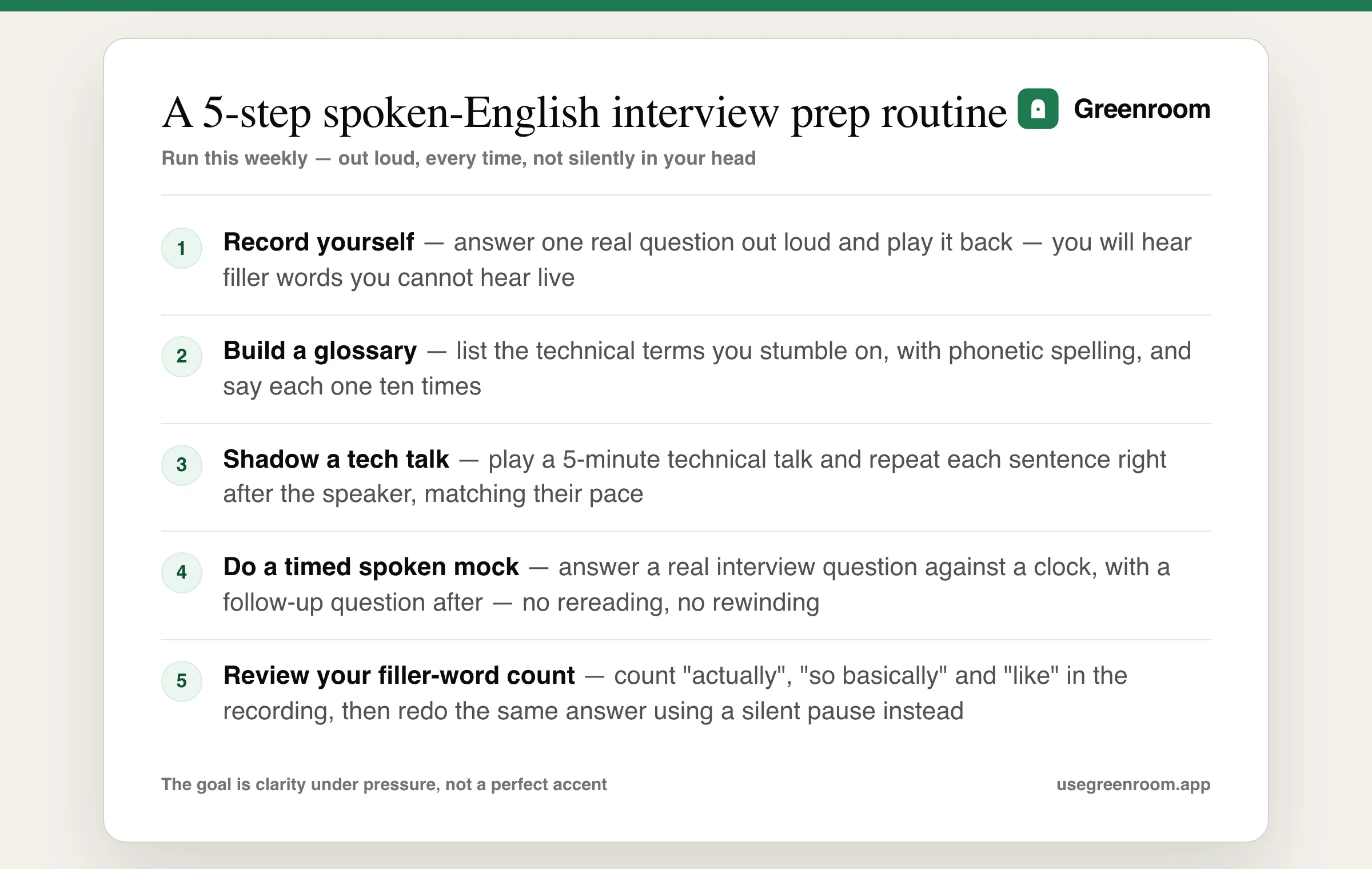
Putting the pieces together, here's a routine that takes about 45-60 minutes a week, spread across a few short sessions, that addresses all of the mechanisms above:
- Glossary pass (10 min, twice a week): Review your personal pronunciation glossary, add any new words from the week, say each one out loud five times in a full sentence.
- Shadowing (15 min, twice a week): Pick a fresh technical talk segment and shadow it, focusing on rhythm and stress, not exact replication.
- One timed spoken mock (15-20 min, once or twice a week): Answer one real interview question out loud, against a clock, ideally with a follow-up question afterward so you're forced to think on your feet rather than deliver a memorized monologue.
- Filler-word review (5 min, after each mock): Play back the recording, tally filler words, and immediately redo the same answer once, swapping fillers for pauses.
The order matters less than the consistency — what actually moves the needle is the repetition of speaking out loud under at least mild pressure, week after week, with feedback loops (your own ears, plus ideally an external listener) telling you what to adjust. This is also exactly where most self-directed prep quietly falls apart: people do the glossary and the shadowing (which feel comfortable, solo, low-stakes) and skip the timed spoken mock with follow-ups (which feels exposed and uncomfortable) — but the timed spoken mock with follow-ups is the part doing most of the actual training, because it's the only piece that replicates real interview pressure.
It's worth setting expectations honestly on timeline: most candidates who run this routine consistently for three to four weeks report a noticeable, real drop in self-consciousness and a measurable drop in their own filler-word counts. Six to eight weeks is a more realistic horizon for the glossary and shadowing work to meaningfully change how technical vocabulary feels in your mouth — these are motor-skill and vocabulary-acquisition timelines, not overnight fixes, and treating them that way prevents the discouragement that comes from expecting a week of practice to undo years of a different speaking pattern. The good news is that the trend is usually visible early, even if the destination takes longer — and a visible downward trend in filler-word counts after just one or two weeks is often enough to break the anxiety spiral on its own, independent of how far along the underlying skill actually is.
One more practical note: don't try to fix everything in this guide simultaneously in your first week. Pick one mechanism — most people get the fastest emotional payoff from the filler-word counting exercise, because it's concrete and produces a number you can watch drop — and run it consistently before layering on the glossary and shadowing work. Stacking five new habits at once is how most self-improvement routines quietly die within ten days; one habit run consistently for two weeks beats five habits attempted for two days.
Why a spoken AI mock interview is built for exactly this problem
This is where the format you choose for practice stops being a minor detail and starts being the whole game. Everything above — slowing down, pausing instead of filling, surfacing your real filler-word count, practicing technical vocabulary in full sentences under time pressure — requires you to actually speak out loud, under at least mild real-time pressure, with something unpredictable (a follow-up question) keeping you honest. A PDF of questions can't do that. A silent flashcard app can't do that. Even a text chatbot, however smart its questions are, removes the speaking entirely.
Greenroom runs spoken mock interviews with an AI interviewer, Ari, that asks real follow-up questions based on what you actually said — not a fixed script — and gives feedback scored across dimensions like technical accuracy, communication clarity, and structure. That combination matters specifically for the anxieties in this guide: because Ari asks unscripted follow-ups, you can't get through a session by reciting a memorized, pre-translated answer — you have to generate language in real time, which is the exact skill silent prep never trains. And because the feedback explicitly separates "clarity" from "technical correctness," you get direct, honest signal on whether your filler words, pacing, or structure are actually getting in the way of your answer landing — distinct from whether your answer was right — instead of guessing.
Practically, that means you can run the exact weekly routine above — timed spoken answer, immediate playback, filler-word count, retry — without needing to schedule a friend's time or pay for a human mock interviewer every single week. It's not a replacement for every kind of practice in this guide (the glossary work and shadowing are solo exercises you should keep doing regardless), but it's specifically suited to the piece most people skip: the timed, spoken, followed-up mock that actually replicates interview pressure. Being honest about the trade-off — an AI interviewer doesn't replace the value of feedback from a human mentor who's hired engineers from your background before, and you should still seek that out if you can — but for the specific, repeatable, on-demand drilling this guide describes, spoken AI practice closes a gap that text-only or silent prep simply can't.
There's also a quieter benefit worth naming directly: doing this kind of practice with an AI interviewer removes a specific social-anxiety layer that can otherwise make even a well-intentioned friend mock feel high-stakes — the fear of sounding unpolished in front of a person whose opinion of you matters socially. With a friend, a mentor, or a senior colleague, some part of your brain is tracking "what will they think of me," which is a real cost on top of everything else you're managing. An AI mock interview removes that specific layer while keeping the parts that actually matter for training — the clock, the unscripted follow-up, the requirement to speak rather than type. That makes it a lower-friction way to get in the repetitions that actually build the skill, especially in the early weeks when your filler-word count and hesitation are at their highest and the most exposed-feeling. Once you've built some baseline fluency and confidence through repeated spoken practice, graduating to mocks with real people — friends, mentors, or paid mock interviewers who've hired for your target role — adds a different and valuable layer: real human reaction, rapport-building practice, and the chance to ask "how did that actually come across to you?" Both stages matter; they're just suited to different points in your prep timeline.
Pair the speaking practice with the structural side of communication — see how to improve communication skills for interviews and how to speak confidently in interviews for the framing and language-choice side of this same problem. If filler words specifically are your main struggle, coding interview communication tips has more drills for narrating your thinking clearly while solving a problem live. And if accent anxiety is tangled up with broader interview nerves, how to deal with interview anxiety covers the wider anxiety-management side. If you're prepping specifically for Indian campus placements, the campus placement interview guide covers the format and rounds you'll actually face.
Frequently asked questions
Will my accent hurt me in a technical interview?
Generally, no — well-run interview processes train interviewers to evaluate communication clarity (can they follow your reasoning) rather than accent. Linguistics and communication research consistently shows accent and intelligibility are separate dimensions — a strong accent doesn't mean low clarity, and a neutral one doesn't guarantee high clarity. What actually affects your evaluation is pacing, structure, and how clearly your key technical terms land, all of which are trainable independent of your accent.
How do I stop translating in my head during an interview?
You reduce translation lag mainly by building direct spoken fluency in the technical vocabulary itself, rather than only knowing it conceptually in your first language. A personal pronunciation glossary (write the term, its phonetic breakdown, and a full practice sentence) and shadowing real technical talks both train your mouth to produce English technical language directly, instead of composing it in your first language and translating live.
Why do I use filler words like "actually" and "so basically" more when I'm nervous?
Filler words function as a stalling mechanism while your brain finishes composing the next part of a sentence, and stress increases how often your brain needs that extra processing time — especially when you're also translating between languages live. The fix that actually works is the pause-instead-of-filler technique: deliberately replacing the urge to say a filler word with a silent one-to-two-second pause, practiced repeatedly until the discomfort of pausing fades.
What's the best way to practice spoken English for interviews if I don't have a practice partner?
Record yourself answering real interview questions out loud against a timer, then play the recording back and count filler words, pacing, and any mispronounced technical terms. Pair that with shadowing real technical talks for rhythm and a personal pronunciation glossary for vocabulary. An AI mock interview that asks real follow-up questions adds the piece a solo recording can't — unscripted pressure that forces you to generate language in real time rather than recite a memorized answer.
Does reading interview questions silently actually help with spoken fluency?
It helps you learn content, but it doesn't train the separate cognitive and motor skill of producing that content out loud, at speaking speed, under time pressure. Recognizing an answer when you read it is a different skill from recalling and articulating it live — which is why people who've read dozens of answers can still freeze when asked to explain one out loud to a stranger.
Can an AI mock interview really help with accent or English-speaking anxiety?
It helps with the underlying skill gap — speaking technical English fluently and clearly under real-time pressure — rather than the accent itself, which doesn't need to change. A spoken AI mock interview that asks unscripted follow-ups forces you to generate answers live instead of reciting memorized ones, and feedback that separates communication clarity from technical correctness shows you concretely whether pacing, filler words, or structure are the actual thing holding your answers back.