Short answer: yes. If you prompt it well, ChatGPT will role-play an interviewer for almost any role, ask questions, react to your answers, and even give feedback. It's free, instant, and surprisingly good at the preparation phase. But there are four specific things it does badly. And knowing them is the difference between practice that helps and practice that builds bad habits.
This guide gives you the exact prompts that work, then the honest limits.
The prompt that actually works
The mistake most people make is a lazy prompt like “interview me for a backend role.” You'll get a generic, agreeable chatbot. Instead, give it a role, a rubric, and a rule to stay in character:
You are a senior engineer interviewing me for a [Backend Engineer] role at a [mid-stage SaaS company]. Ask one question at a time and wait for my answer before continuing. Stay in character, do not coach me mid-answer. Ask realistic follow-ups that probe my reasoning. After 25 minutes, stop and give me written feedback: what was strong, what was thin, and what a real interviewer would have flagged.
The three phrases doing the work are “one question at a time” (stops it from dumping a list), “stay in character” (stops it from being a helpful tutor), and “realistic follow-ups” (forces depth instead of breadth).
For behavioral rounds
Add: “Use the STAR format to evaluate my answers. If I give a vague answer, push back and ask for specifics: numbers, my exact role, the trade-off I made.”
For system design
Add: “Give me one open-ended design prompt. Don't accept hand-waving: ask me to justify each component, estimate scale, and name a failure mode.”
Where ChatGPT genuinely shines
- Generating likely questions. Paste a job description and ask for the 20 questions most likely to come up. It's excellent at this.
- Drafting and tightening answers. Write a rough answer, ask it to make it more concise and structured. Great editor.
- Explaining concepts you're shaky on. “Explain consistent hashing like I'll have to teach it back” works well.
- Endless patience. It never gets tired of your fifth attempt at the same answer.
The four things it does badly
These are structural limits, not prompt problems. You can reduce them but not remove them.
1. It's text, so it doesn't train the real skill
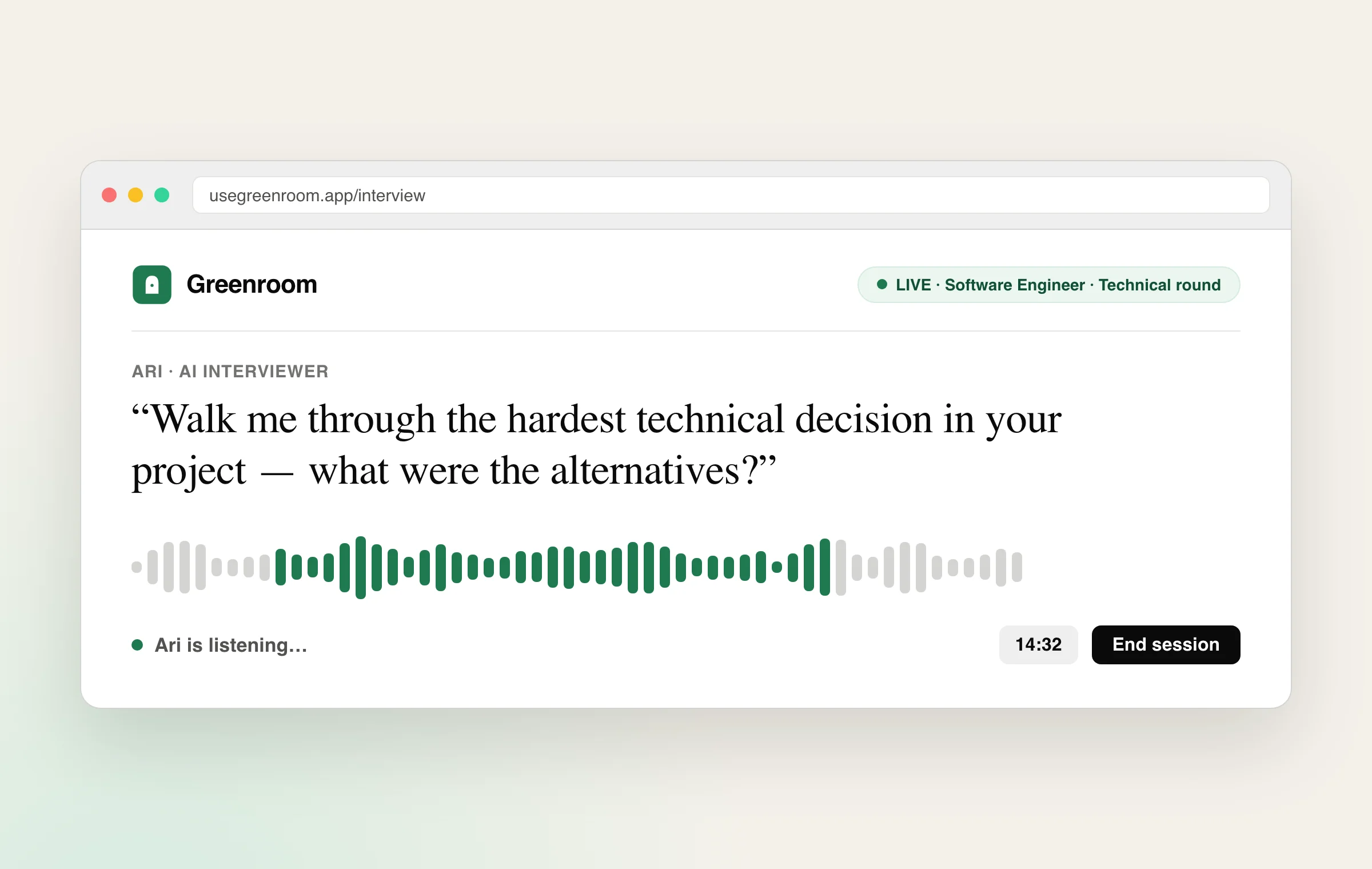
Interviews are spoken. The freeze, the filler words, the losing your thread halfway through a sentence — none of that shows up when you type a tidy paragraph you can edit before sending. Typing answers to ChatGPT rehearses the wrong muscle. The hard part of most interviews is verbal, and text practice skips it entirely. That gap is exactly what a purpose-built AI mock interview tool is built to close.
2. It wants to please you
ChatGPT is tuned to be helpful and encouraging. Real interviewers are not. Even with “stay in character,” it drifts back toward reassurance, accepts vague answers, and rarely makes you genuinely uncomfortable, which is exactly the state you need to practice in.
3. It doesn't know your actual work
The hardest interview questions are about your projects: “why did you choose that queue?”, “what broke in production?” ChatGPT can't ask these unless you paste your whole codebase in every session. And even then it's guessing. Talking about your own GitHub projects is where candidates most often freeze, and it's the part ChatGPT can't rehearse.
4. It loses the thread
In a long session it forgets what you said earlier, contradicts its own rubric, and breaks character. Real interviews build on your earlier answers; ChatGPT often doesn't.
When to use a purpose-built tool instead
If you want the rehearsal half (voice, pressure, questions about your real code) a dedicated tool does it without prompt engineering. Greenroom reads your GitHub before each session, runs the interview by voice, stays in role, and gives you a feedback report at the end. We wrote a full Greenroom vs ChatGPT comparison if you want the side-by-side. The honest recommendation: use ChatGPT to prepare, and a voice tool to practice.
Frequently asked questions
Can ChatGPT do a mock interview?
Yes. If you prompt it to act as an interviewer for a specific role, ask one question at a time, stay in character, and give feedback at the end, it runs a usable text mock interview. Its limits are that it's text-based, tends to be agreeable rather than apply pressure, doesn't know your real projects, and loses the thread in long sessions.
What's the best prompt for a ChatGPT mock interview?
Specify the role and company stage, tell it to ask one question at a time and wait for your answer, instruct it to stay in character and not coach you mid-answer, and ask for written feedback at the end covering what was strong, what was thin, and what a real interviewer would flag.
Is ChatGPT good enough to prepare for a real interview?
It's excellent for preparation, generating likely questions and drafting answers. It's weaker for rehearsal, because interviews are spoken and project-specific. For that, a voice tool that reads your GitHub and applies real pressure is a better fit.
Can ChatGPT do a voice mock interview?
Its voice mode can hold a spoken conversation, but it isn't structured as an interview: no pre-read of your code, no rubric, no feedback report. Purpose-built tools like Greenroom are designed around exactly that flow.