Picture two candidates with the same interview tomorrow. The first one spends tonight running spoken mock sessions: answering out loud, getting told her STAR story has no result, fixing it, trying again until it's clean. The second one sets up an AI "copilot" that will whisper suggested answers onto a second monitor while the real interview happens. The next morning, candidate one walks in and just... knows her material. Candidate two walks in, glances at the screen on the first hard question, the interviewer notices the half-second eye flick and the suddenly-polished phrasing, and asks a pointed follow-up that the copilot can't save. One of them built a skill. The other rented one for fifty minutes.
That's the heart of Greenroom vs Final Round AI. They both have "AI" and "interview" in the pitch, but they're aiming at opposite philosophies. Greenroom is a practice-first AI mock interview coach: you rehearse before the interview and get feedback that makes you better. Final Round AI is best known for an interview copilot that assists you during the live interview, alongside AI mock and resume features. Here's the honest difference — including the part about risk.
Why both of these tools exist
The split makes more sense with a little context. As remote interviews became the norm, two very different products grew out of the same anxiety — "I'm scared I'll freeze on a question I can't answer."
One answer was: what if you never had to face that moment unaided? If an AI can transcribe the interviewer's question and generate a strong answer in real time, you could read from it and never freeze. That's the interview-copilot lineage Final Round AI is best known for — assistance during the live interview. It treats the interview as the problem to get through.
The other answer was: what if the freezing is a symptom, and the cure is preparation? People freeze because they've never produced the answer out loud under pressure. Give them a way to rehearse exactly that — many times, with feedback — and the freeze disappears on its own, with nothing to hide. That's the practice-first lineage Greenroom belongs to. It treats being unprepared as the problem to solve, before the interview ever starts.
Same fear, opposite philosophies: one tries to carry you through the moment, the other tries to make sure you don't need carrying. Everything else — the risk, the durability, the cost — flows from that fork. Worth knowing which fork you're actually choosing.
What Final Round AI actually is
Final Round AI is a suite of AI interview products. Its headline feature — the one the brand is known for — is an interview copilot: it listens to your live interview and generates suggested answers in real time on your screen, so you can read from them as you respond. The suite also includes AI mock interviews, a resume builder, and other job-search tooling.
The appeal is obvious and immediate: in a high-pressure moment, having an AI quietly hand you a structured answer feels like a lifeline. For a question you half-know, it can turn a stammer into something coherent. That's a real, in-the-moment benefit, and it's why the product exists.
But the model has real costs that are worth naming plainly. It doesn't build skill. Reading an answer off a screen isn't the same as knowing it; the moment the copilot is gone — the on-site whiteboard round, the next company, the actual job — you're exactly as unprepared as before. It carries risk. Many companies consider live AI assistance a form of cheating, monitored platforms and proctoring are increasingly common, and the tells (reading eyes, unnatural pauses, polished-then-collapsing answers) are noticeable to experienced interviewers. And it's brittle under follow-ups — the second "why did you choose that?" question, asked about an answer you didn't actually generate, is where it falls apart.
What Greenroom does differently
Greenroom is built on the opposite premise: that the only thing that helps you in every future interview is actually getting better. It's a voice-based AI interviewer — Ari — that you use before the interview. It asks questions out loud, listens to your spoken answers, asks adaptive follow-up questions, and afterward gives you structured feedback on pace, filler words, structure, and content, plus a score. You fix one weakness, re-run the session, and watch it improve. The mechanics are in how to use an AI mock interview tool.
The output isn't a script you read in the moment — it's fluency you carry in your head. When the real interviewer asks the hard follow-up, you have an answer because you've actually said it five times, not because a tool is feeding it to you. There's nothing to detect, nothing to hide, and nothing that evaporates when the call ends. It's the difference between studying for the exam and trying to sneak the textbook in.
To be fair to the comparison: Final Round AI does offer a mock-interview feature, and used purely for practice, that's closer to Greenroom's territory. The distinction is one of design and focus — Greenroom is built end to end around spoken rehearsal and delivery feedback you act on, while Final Round AI's identity and headline product centre on live assistance. We'd genuinely rather you practise with their mock feature than rely on the copilot live.
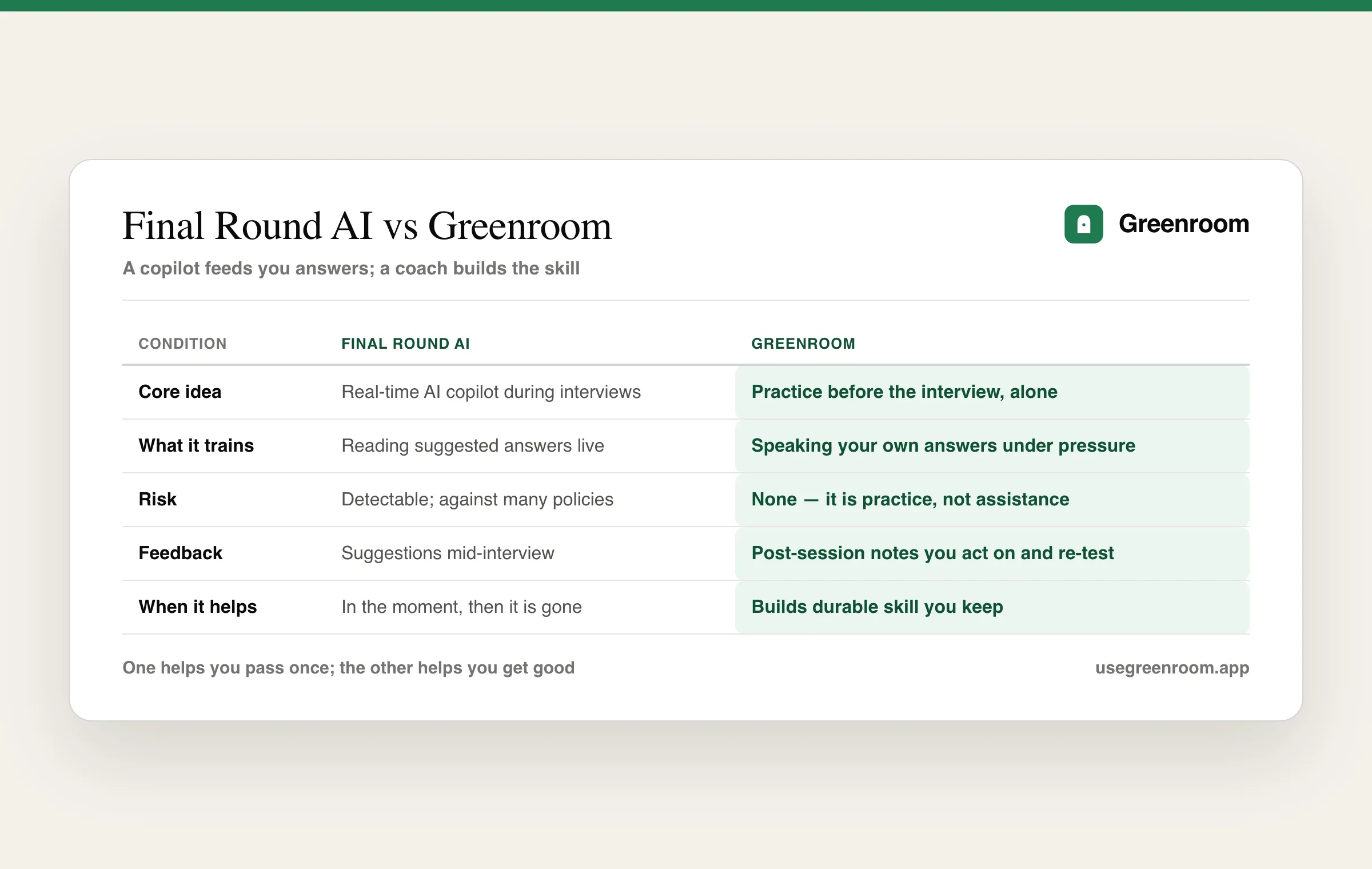
Greenroom vs Final Round AI, head to head
The comparison only makes sense once you separate "help me pass this one" from "help me get good."
Core idea
Final Round AI's signature is real-time assistance during the interview. Greenroom is practice before it. One operates while you're being evaluated; the other operates while you're safely rehearsing.
What it actually trains
A copilot trains you to read suggested answers under pressure — a skill with a shelf life of one interview. Greenroom trains you to generate your own answers under pressure, which is the skill the interview is actually testing and the one that lasts.
Risk
This is the dimension people underweight. Live AI assistance is detectable and, at many companies, a policy violation that can cost the offer. Practice has zero risk because it happens before, in private. If integrity in the process matters to you — and it matters to employers — it's not close. We write about how seriously the industry takes this in cheating signals and integrity.
Feedback you can use
A copilot gives you suggestions mid-interview that vanish afterward. Greenroom gives you a post-session report you can study, act on, and re-test — the deliberate-practice loop covered in how to prepare for a mock interview.
What you're left with
After a copilot session, you have a transcript and the same skill level. After Greenroom sessions, you have answers you can deliver cold, in the on-site, at the next company, on the job. One compounds; the other resets.
How interviewers are catching AI assistance in 2026
One reason the copilot bet is riskier than it looks: the people on the other side of the table aren't naive, and the whole industry has spent the last couple of years specifically adapting to live AI assistance. A few of the countermeasures now common:
- Heavier follow-up probing. The single most effective tell is the follow-up cliff. Interviewers increasingly ask "walk me through your reasoning," "what would you change?" and "why not approach X?" — questions that are trivial if the answer is yours and impossible if you read it off a screen.
- "Explain it back" checks. Asking a candidate to re-explain their own answer in different words, or to extend it, instantly separates understanding from recitation.
- Eye-tracking awareness. Interviewers are coached to notice consistent off-camera glances and the rhythmic pause-then-fluent-burst pattern that signals reading.
- Proctored and lockdown platforms. More technical screens run in environments that restrict second screens, monitor focus changes, or record the session for review.
- Live collaboration over recall. The shift toward "build this with me" and pair-programming formats makes a static answer-feed far less useful, because the interview is a moving conversation, not a Q&A.
The uncomfortable arithmetic: as detection improves, the expected value of a copilot drops, while the value of actually being prepared only rises. You're betting against a counter-effort run by the exact people deciding your offer. Practising until you don't need the crutch sidesteps the entire arms race — there's simply nothing to catch.
A safer way to use AI in your interview prep
None of this means "avoid AI." It means use AI where it makes you better rather than where it puts you at risk. The dividing line is before vs. during, and there's a lot of legitimate, powerful AI prep on the "before" side:
- Rehearse out loud with an AI interviewer. The core practice loop — questions, follow-ups, feedback, re-test — is exactly what builds the fluency that makes live help unnecessary.
- Use AI to draft and refine answers, then internalize them. Brainstorming a STAR story or a "why this company" answer with a model is fine; the key is that you then rehearse it until it's yours, not read it live. We cover the prompts in can ChatGPT do mock interviews?
- Use AI to generate likely questions for your role. Have it produce the twenty questions most likely for your specific job, then practise them on a spoken tool.
- Use AI for résumé and story structuring. Polishing your résumé or tightening a project narrative is preparation, not assistance.
Every one of these makes you genuinely more capable and leaves nothing to hide. The only AI use that carries the risk is the one that happens during the live interview — so move all your AI leverage to the prep side, and walk in clean. That's the whole philosophy behind practising like you play.
Where Final Round AI has a point
Credibility means admitting the appeal is real:
- In-the-moment confidence. For someone paralysed by nerves, knowing a safety net exists can lower anxiety enough to function — even if the better fix is rehearsing until the net isn't needed.
- It's genuinely impressive technology. Real-time transcription and answer generation is hard, and it works.
- The mock and resume tools are legitimate. Used for practice and résumé polish — not live assistance — those parts of the suite are useful and uncontroversial.
If what you want from that suite is the practice and résumé features, great. The part we'd steer you away from is leaning on the live copilot as a substitute for being prepared.
Where Greenroom pulls ahead
- It makes you better, permanently. Every rep raises your baseline. The skill shows up in the on-site round where no tool can follow you.
- Zero risk. Nothing to detect, nothing to disclose, no policy to violate. You walk in clean and prepared.
- It survives follow-ups. Because you generated and rehearsed your answers, the "why did you do it that way?" question is a chance to shine, not a trap.
- It builds confidence that's real. Calm in the room comes from having actually done the thing before — see how to speak confidently in interviews — not from a screen you're hoping nobody notices.
- It works on the job too. The ability to explain your thinking clearly under pressure doesn't stop mattering after you're hired.
Which should you actually use?
If your goal is to build a durable interviewing skill — and to walk in without anything to hide — practise beforehand with a tool like Greenroom, and if you want extras like a résumé builder, use those features wherever you find them. Reserve any "live help" instinct for what it really is: a sign you don't feel prepared yet, which is solved by more reps, not a second monitor. The candidates who do well long-term are the ones who got good, not the ones who got assisted.
How an interview copilot actually works
To weigh the risk fairly, it helps to understand the mechanism. A live AI copilot typically listens to your interview audio, transcribes the interviewer's question in real time, sends it to a language model, and displays a suggested answer on your screen within a few seconds. You read or paraphrase it back. For coding rounds, some versions can even generate code. The pitch is seductive: a safety net that means you're never truly stuck.
The problems are structural, not incidental. First, there's latency and unnaturalness — there's a beat between the question and the on-screen answer, and your eyes have to leave the camera to read it, producing the classic "reading off-screen" tell that experienced interviewers clock immediately. Second, there's the follow-up cliff: the copilot can hand you a polished first answer, but when the interviewer asks "why did you choose that?" about something you didn't actually reason through, you have nothing — and the contrast between the slick first answer and the blank second one is itself a red flag. Third, there's detection: more interviews run on proctored platforms, and even without proctoring, the human across the table notices delivery that doesn't match your spontaneous speech.
So the tool works, technically — but "works" means "produces a suggested answer," not "gets you hired without consequence." Those are very different claims.
How a Greenroom session actually flows
The practice-first loop is almost the opposite experience. You open Greenroom before the interview, set the role and seniority, and start. Ari asks a question out loud; you answer out loud, unaided; it asks adaptive follow-ups — including the exact "why did you choose that?" probes that sink a copilot user. Because you're generating the answers yourself, the follow-ups make you stronger, not exposed.
Afterward you get a structured report — score, pace, filler words, structure, content — and you do the thing that builds durable skill: fix one weakness and run it again. After a handful of reps, the answer comes out clean on its own. Walk into the real interview and there's no screen to read, no latency, no tell, and crucially no cliff when the follow-up comes — because you actually know the material. The copilot optimizes the fifty minutes of the interview; the coach optimizes you, permanently. We detail the loop in how to use an AI mock interview tool.
A tale of two candidates
Return to the two candidates from the opening, and play it all the way out. Priya preps with a copilot; Sana preps with practice. Same role, same week.
Priya's first screen goes okay — the copilot feeds her a clean answer to "tell me about a hard bug," and she reads it well enough. She's thrilled. But round two is an onsite: a whiteboard, an engineer in the room, no laptop to read from. The safety net is gone, and she's never actually practised producing answers unaided — so she freezes exactly the way she would have without the tool, except now she's also rattled because the thing she relied on isn't there. The copilot got her past the screen and abandoned her at the round that mattered.
Sana's first screen goes well because she's rehearsed her stories a dozen times on Greenroom; the answers are hers and they're fluent. Round two — the same whiteboard, the same engineer — goes well too, because the skill she built doesn't live on a screen she might lose. When the engineer probes "why this approach?", she has a real reason, because she reasoned through it during practice. Same starting talent, opposite outcomes — decided entirely by whether the prep built a skill or rented one. The moral is uncomfortable but simple: a tool that only works while it's running is a tool that fails you exactly when the stakes are highest.
The real cost of getting caught
It's worth being concrete about the downside, because the marketing never is. Using live AI assistance isn't a victimless shortcut with only upside if it works:
- The offer, gone. If an interviewer suspects live assistance, you don't get a warning — you get a quiet "no," and you'll never know that was why. Months of effort, ended by a half-second eye flick.
- Reputation, in a small world. Tech communities and recruiting networks are more connected than they look. A candidate flagged for cheating can find doors quietly closing elsewhere.
- The job itself. Suppose it works and you get hired for a role you can't actually do. Day one, the copilot is gone and the gap is real — now you're underwater in a job, which is a far worse place to discover you weren't ready.
- Policy and platform bans. Many companies' interview policies explicitly prohibit unauthorized assistance, and proctored platforms can flag and ban accounts.
Compare that risk profile to practice, which has a downside of, essentially, nothing — at worst you spent twenty minutes rehearsing. When one option's worst case is "I lost the offer and my reputation" and the other's is "I practised," the expected value isn't close. We've written about how seriously the industry treats this in cheating signals and integrity.
Which one fits you?
Different situations, but the answer rhymes:
The nervous candidate who's tempted by a safety net
The instinct is understandable — but the safety net is the trap. The thing that actually calms nerves is having genuinely done the thing before. Build that on Greenroom and pair it with how to stop panicking mid-interview; the calm you build is real and yours.
The candidate interviewing for a stretch role
If you're reaching slightly above your current level, a copilot papers over the gap for one call and then drops you into a job you can't do. Practice actually closes some of the gap, and tells you honestly where you still stand.
The candidate who wants the résumé and prep features
Final Round AI's résumé builder and mock-interview feature are legitimate. Use those freely. Just don't let the live copilot be the part you lean on.
The repeat interviewer
If you'll interview many times over your career, building durable skill compounds across every future loop. A copilot resets to zero each time; practice banks.
Final Round AI's legit features vs the copilot
Fairness matters, so let's separate the suite. Final Round AI isn't only the copilot — it also ships an AI mock-interview feature and a résumé builder, and used as practice and polish, those are perfectly fine, even useful. The mock feature, in particular, is philosophically much closer to what Greenroom does: rehearsing answers before the interview. If you're already in that ecosystem, lean on the practice side.
The single distinction we'd draw is between preparing and being assisted. Every feature that helps you get better before the interview is a good feature. The one feature that helps you during the interview is the one that carries the risk, the brittleness, and the no-lasting-benefit problem. It's not "Final Round AI bad, Greenroom good" — it's "practice good, live assistance risky," and that line runs through Final Round AI's own product line, not just between the two brands.
Greenroom vs Final Round AI: myths, debunked
- "Everyone's using copilots now, so I'm behind if I don't." Interviewers are also adapting — more live coding, more follow-ups, more proctoring, more "explain this back to me" — precisely to surface assisted candidates. The arms race favors being genuinely good.
- "It's just like having notes." Notes you wrote yourself reflect your own understanding. An answer generated live by a model is something you're reading cold, which is why it collapses under one follow-up.
- "If it gets me the job, who cares how?" The job cares — because on day one you have to actually do it, and the copilot doesn't come to work with you.
- "Practice takes too long; the copilot is instant." A few focused reps fix most answers. The copilot feels instant but leaves you permanently dependent; practice is a slightly slower path to never needing it.
What actually builds interview skill
The research is unambiguous, and it points away from shortcuts. Deliberate practice — focused work on a specific weakness, with immediate feedback, repeated with correction — is how durable skill forms. A copilot is the antithesis: it removes the struggle that creates learning, so you finish an "assisted" interview no better than you started. The production gap matters here too: reading an answer (recognition) is a fundamentally easier act than generating one under pressure (production), and the interview tests production. A copilot trains the easy skill and skips the one that's actually measured. Practice trains the hard, real one. There's no shortcut around the fact that getting good at producing answers requires producing answers. More on the philosophy in how to speak confidently in interviews.
A prep plan that builds real skill
A week that makes a copilot unnecessary, assuming an interview next Monday:
- Sunday — diagnose. A full Greenroom session; note your three weakest answers.
- Monday–Wednesday — drill. One weakness per day: rebuild the answer, run it three to five times until it's clean and survives the follow-up.
- Thursday — integrate. A full mixed session with everything you've fixed; confirm the score moved.
- Friday — pressure-test. Optionally a human rep (a Pramp peer or a mentor) to feel real social pressure on now-solid answers.
- Weekend — rehearse and rest. One dress-rehearsal session, then stop. Walk in Monday knowing your material cold, with nothing to hide.
How to wean yourself off the urge for a safety net
If the temptation to use a copilot is strong, that urge is itself useful information: it's a precise readout of where you don't feel prepared. Instead of suppressing the symptom with live assistance, treat the urge as a to-do list. Notice which questions make you reach for the net — "tell me about a time you failed," a particular system-design prompt, anything about your weakest project — and those are exactly the answers to drill until the urge disappears.
Practically: run a diagnostic session and flag every question where you thought "I'd want help with that one." Then, one at a time, rehearse those until the thought is replaced by "I've got this." The goal isn't to white-knuckle through unprepared — it's to eliminate the conditions that make a safety net feel necessary. A candidate who has genuinely rehearsed their weak spots doesn't crave a copilot, because the fear it was meant to soothe is gone. That's a far better place to be than walking in dependent on a tool that might be detected, might lag, and definitely won't follow you to the on-site. The fastest route there is the boring, reliable one: identify the weakness, drill it, re-test, repeat — the loop in how to prepare for a mock interview.
The confidence question
There's a subtler reason practice beats a copilot, and it's about how confidence actually works. The appeal of a safety net is that it promises to lower your anxiety — "I'll be calm because help is there." But borrowed confidence is fragile: underneath it, you still know you can't do this unaided, and that knowledge leaks out as exactly the nervous, hesitant delivery interviewers read as weakness. You're calm in the way someone is calm holding a parachute they've never tested.
Earned confidence is the opposite. When you've said your answer out loud a dozen times and handled the follow-up, your calm isn't a hope — it's a memory. You're not hoping you can answer the question; you know you can, because you already have. That kind of confidence shows up in your voice, your pacing, and your willingness to pause and think without panicking. No copilot manufactures it, because it's a product of having done the work, not of having a backup. If nerves are your real obstacle, the durable fix is reps plus the techniques in how to speak confidently in interviews — not a screen you're praying nobody notices.
What it costs you in the long run
Zoom out past the single interview and the gap widens. The skill you build practising — producing clear, structured answers under pressure — doesn't expire at the end of the call. It serves you in the next interview, in salary negotiations, in standups, in design reviews, in the moment you have to explain your work to a skeptical stakeholder. It's a career skill that the interview just happens to test.
A copilot, by contrast, produces nothing you keep. Every benefit it offers ends when the session ends, which means every future interview starts from zero — and every on-the-job moment where you need to think on your feet finds you exactly as unpracticed as before. One path compounds into a lasting capability; the other rents a temporary illusion, repeatedly, forever. Framed over a career rather than a single Tuesday afternoon, "the practice takes longer" stops being a downside and becomes the entire point: you're building something that lasts. That's the same logic behind doing the reps in how many mock interviews you actually need.
A longer worked example: the follow-up that breaks a copilot
Let's watch the failure mode in slow motion, because it's the crux of the whole comparison. Suppose the interviewer asks, "Tell me about a challenging technical problem you solved." A copilot transcribes it and, a couple of seconds later, displays a clean, structured answer about, say, optimizing a slow database query. You read it back, more or less fluently. So far, so good — the copilot did its job.
Then the interviewer does what every competent interviewer now does: they follow up. "Interesting — why did you choose to add an index there rather than denormalize the table? And what was the read-write tradeoff?" This is the moment everything hinges on. The copilot can generate another answer, but now there's a problem: the new answer has to be consistent with the specific details you just claimed, it has to arrive fast enough to not leave a dead silence, and you have to read it convincingly while appearing to reason in real time. The latency shows. The seams show. And if the follow-up goes one layer deeper — "walk me through what you'd do differently if the table were ten times bigger" — you're now improvising on top of a foundation you never actually built, and it collapses. The contrast between your polished first answer and your floundering third is itself the loudest possible signal that something is off.
Now run the same exchange for the candidate who practised on Greenroom. Because they generated and rehearsed the database-optimization story themselves — including the AI's own follow-ups about indexing tradeoffs and scaling — the interviewer's probe isn't a cliff, it's a ramp. They actually chose the index, so they can actually explain why; they actually thought about scale, so the ten-times-bigger question is a chance to shine. The follow-up that breaks the copilot user is the moment that makes the prepared one. Same opening question, opposite outcomes — and the divergence happens precisely at the follow-up, which is exactly where modern interviews are designed to probe. That's why "it produces a good first answer" is such a hollow promise: real interviews are won or lost on the second and third question, and that's the question a copilot can't truly help you with.
The deeper science: why there's no shortcut
Step back and the reason a copilot can't deliver lasting value isn't about this product or that policy — it's about how skill actually forms, and it's worth understanding so the choice feels obvious rather than preachy.
The production gap is the heart of it. Cognitive science draws a sharp line between recognition (you read an answer and it seems right) and production (you generate the answer yourself, under pressure, from scratch). These are different skills with different neural demands, and recognition is dramatically easier. A copilot trains recognition — you're reading and approving an answer — while the interview measures production. So even a copilot session that "goes well" leaves your production ability untouched. Practice is the opposite: it's pure production, every rep, which is exactly the skill being tested.
Retrieval practice compounds this. Every time you produce an answer from memory, you strengthen the path to produce it again. A copilot short-circuits retrieval — you never retrieve, you just read — so nothing gets stronger. After ten copilot-assisted interviews you're exactly as capable as before; after ten practice sessions, the answers are grooved into memory. Desensitization seals it: nerves fade through repeated exposure to the stressor, but a copilot is an avoidance strategy — it lets you sidestep the very experience that would build your tolerance, so your underlying anxiety never resolves; it just gets postponed to the moment the tool isn't there. Three independent mechanisms, all pointing the same way: there is no shortcut around producing answers yourself, because producing answers yourself is the skill. A tool that does it for you isn't a shortcut to the skill — it's a detour around it.
What employers actually think about interview copilots
It's easy to treat "is this cheating?" as an abstract ethics debate, but it's more useful to think concretely about the people on the other side, because they're the ones deciding your offer. From an employer's point of view, an interview is an attempt to predict whether you can do the job. When a candidate uses a live copilot, they're not just bending a rule — they're corrupting the very signal the interview exists to measure, which is why companies react to it so strongly. A hire made on a faked interview is expensive: onboarding, ramp-up, and the eventual discovery that the person can't do what the interview suggested they could.
That's why the response, when assistance is detected, tends to be swift and final rather than a gentle warning — and why interview processes are adding the countermeasures covered earlier. It also means that even the perception of assistance hurts you: an interviewer who merely suspects you're reading off-screen will quietly downgrade you, and you'll never get the chance to defend yourself, because they won't say why. Practising beforehand sidesteps all of this. A genuinely prepared candidate gives the interviewer exactly what they're looking for — a clear, honest signal that yes, this person can do the job — which is the outcome that's good for everyone, including you on day one. The integrity question isn't just moral; it's practical, and the practical answer is that being real is also being smart.
Building a complete, zero-risk AI prep stack
If you like the idea of AI in your corner — and you should — here's what a powerful, completely legitimate AI-assisted prep stack looks like, none of which involves live assistance. Use a language model to generate the twenty most likely questions for your specific role and company, so you're practising the right material. Use it to brainstorm and structure your STAR stories and your "why this company" answer, then rehearse them until they're genuinely yours. Use a spoken AI interviewer like Greenroom to run mock interviews with follow-ups and feedback, drilling each weak answer until it's fluent. Use AI to polish your résumé and tighten your project narratives. And use it to research the company and role so your questions and answers are specific.
Every one of those uses happens before the interview, makes you genuinely more capable, and leaves nothing to hide. Stacked together, they're far more powerful than a copilot — because they build a candidate who doesn't need one. The candidate who has done all of that walks in calm, fluent, and able to handle any follow-up, while the copilot user walks in hoping the latency isn't noticeable. One of those is using AI to become better; the other is using it to fake being better, for fifty minutes, at considerable risk. Choose the stack that compounds. For the prompt-level details on the conversational piece, see can ChatGPT do mock interviews?
Quick reference: which to open when
The shortcut to remember: use Greenroom (or any genuine practice tool) before the interview, as often as you can — to drill answers, rehearse follow-ups, build fluency, and calm your nerves, so you walk in needing no help at all. Use Final Round AI's practice and résumé features the same way if you're in that ecosystem. Avoid leaning on any live, in-the-interview assistance, because that's the only use that carries detection risk, collapses under follow-ups, builds no lasting skill, and drops you into a job you may not be ready for. The whole philosophy reduces to one line: put every bit of your AI leverage on the prep side of the interview, and walk in clean. If you want a human in that prep mix, a free Pramp peer or a paid interviewing.io session adds real value with zero risk.
A final word on doing it the real way
It's worth being honest that the appeal of a copilot comes from a real, sympathetic place: interviews are stressful, the stakes feel enormous, and the promise of a safety net is genuinely soothing. Nobody reaches for one because they're lazy — they reach for one because they're scared. So this isn't a lecture about virtue; it's a practical argument that the scared part of you is better served by preparation than by a parachute you've never tested. The calm that practice gives you is real and it's yours, in every future interview and on the job; the calm a copilot gives you is borrowed, fragile, and gone the moment the tool isn't there.
Choose the harder, slower, real path and you get something nobody can take away: the genuine ability to walk into a room, think on your feet, and explain yourself clearly under pressure. That capability outlasts any single interview, any single job, and any single tool. It's the thing the interview is actually trying to measure — so the most reliable way to pass is simply to become the person it's looking for. Do the reps, and you won't need anything to hide.
The bottom line
Final Round AI's copilot offers to carry you through one interview in real time — with detection risk, a follow-up cliff, no lasting benefit, and a job on the other side you may not be ready for. Greenroom offers something less flashy and far more valuable: the practice that makes you genuinely good, with zero risk and skill you keep across every future interview and into the job itself. Use Final Round AI's mock and résumé features if you like them; just don't outsource the interview to a screen. The candidates who win, over a career, are the ones who got good — not the ones who got assisted.
The technology is impressive — that's not the question
One last point of fairness, because it's easy to mistake this comparison for "the AI copilot doesn't work." It works — real-time transcription and answer generation is genuinely impressive engineering, and the company has clearly built something capable. But "does the technology work?" was never the right question. A lock-picking set also works; that doesn't make it the right tool for getting into your own house. The question that actually matters for you is whether the tool builds the thing you need — durable skill, with no risk, that shows up when it counts — and on that question, live assistance and genuine practice give opposite answers regardless of how slick the technology is.
This is why the comparison ultimately isn't about which company has better AI. It's about which use of AI serves your actual goal, which is to walk into interviews — and the job that follows — genuinely able to do the thing. Practice-first tools serve that goal; live assistance undermines it, however well it's built. Judge the tools by what they make you capable of when the tool isn't there, not by how clever they are while it is. By that measure, the impressive technology of a copilot is beside the point, and the unglamorous repetition of practice is the whole game.
Other alternatives worth knowing
- Pramp — free peer-to-peer practice; a real human, no risk (comparison here).
- interviewing.io — paid mocks with real senior engineers, the gold standard for human feedback (comparison here).
- Google Interview Warmup — free, low-key warm-up with no grading or follow-ups (comparison here).
- InterviewBuddy — scheduled mocks with professionals, popular in India (comparison here).
- ChatGPT — useful for drafting answers to then rehearse, not for live help (details here).
Build the skill, skip the risk
The fastest way to never need an interview copilot is to walk in already prepared. Greenroom is a spoken AI mock interviewer that asks real questions, follows up the way a live interviewer would, and gives you specific feedback on every answer — all before the interview, with nothing to hide. Do one diagnostic session today, fix the weakness it surfaces, and be the candidate who knows the material rather than the one reading it off a screen.
For why that distinction matters more in 2026, see our proxy interviews and the deepfake crackdown guide.
Frequently asked questions
What is the difference between Greenroom and Final Round AI?
Greenroom is an interview coach: you practise spoken answers before the interview, alone, and it gives you feedback so you build durable skill. Final Round AI is best known for an interview copilot that listens to a live interview and suggests answers in real time, plus AI mock and resume tools. The core philosophical difference is build-the-skill versus assist-in-the-moment: Greenroom makes you better for every future interview, while a live copilot tries to help you through one specific interview as it happens.
Is using an AI interview copilot like Final Round AI cheating?
Using an AI assistant that feeds you answers during a live interview falls into a serious grey area, and many companies treat it as cheating. Interviews increasingly happen on monitored platforms, eye movement and unnatural pauses are noticeable, and getting caught can cost you the offer and your reputation. It also leaves you exposed the moment the tool is gone — in the on-site or on the job. Practising beforehand with a tool like Greenroom carries none of that risk because it is rehearsal, not real-time assistance.
Does Final Round AI have a mock interview feature?
Yes. Alongside its real-time copilot, Final Round AI offers AI mock interviews and resume tools. If you use that mock feature for genuine practice, it is closer to what Greenroom does. The distinction worth understanding is one of focus and design: Greenroom is built end to end around spoken practice and delivery feedback that you act on and re-test, whereas Final Round AI's headline product and marketing centre on live assistance during the real interview.
Which is better for actually improving at interviews?
For genuinely getting better, a practice-first tool wins. Skill comes from repetition: speaking your own answers under pressure, getting feedback, fixing one weakness, and trying again. A live copilot does not build that skill — it substitutes for it in the moment and disappears afterward, leaving you no better prepared for the next round. Greenroom is designed for that build-the-skill loop, which is why it helps you across every interview rather than carrying you through one.
Can interviewers detect AI interview assistants?
Increasingly, yes. Experienced interviewers notice the tells: eyes flicking to read off-screen, answers that are suspiciously polished then collapse under a simple follow-up, and a delivery that does not match the candidate's spontaneous speech. Some platforms also add proctoring. The safer and more durable strategy is to walk in genuinely prepared, which is what practising answers out loud beforehand achieves — there is nothing to detect because you actually know your material.
Is Greenroom or Final Round AI better value?
It depends on what you are buying. Final Round AI sells help in the moment plus mock and resume features; Greenroom sells durable improvement through unlimited spoken practice and feedback. If you want a skill you keep — one that works in the on-site, the next company, and on the job — practice is the better value because it compounds. A copilot's benefit ends when the call ends, while every Greenroom rep makes you permanently a little more fluent.