It's 1:40 a.m. the night before a final-round interview, and you're seven tabs deep into "ai mock interview" on Google. One tab is a YouTube video of someone "interviewing ChatGPT." Another is a PDF a friend sent you eleven months ago, half-filled-in. A third is a Reddit thread arguing about whether Pramp is dead. You close all of them, open a blank document, and type "Tell me about yourself" to yourself, out loud, in an empty room, at 1:41 a.m. It does not go well. Nobody claps. Your roommate yells through the wall to keep it down.
This is, unfortunately, how most people "practice" for interviews — alone, at the worst possible hour, with no feedback except their own anxiety. An AI mock interview exists specifically to replace that scene with something that actually works: a structured, repeatable, spoken practice session that talks back. This guide covers what an AI mock interview actually is, how the good ones (including Greenroom's) work under the hood, an honest comparison of the tools people search for next to this term — Pramp, interviewing.io, Final Round AI, Yoodli, and plain ChatGPT — and where AI mock interviews still fall short of a real human in the room.
What is an AI mock interview?
An AI mock interview is a simulated job interview conducted by an AI system instead of a human interviewer — usually voice-based, sometimes text-based, designed to ask realistic questions, react to your answers, and (in the better tools) score or critique your performance afterward. The category sits between two older options that both have real problems: reading interview questions off a list silently (no practice at speaking, which is the actual skill being tested) and scheduling a mock with a human, which requires finding someone qualified, available, and willing to do it for free or for money, at the exact time you need it.
The "AI" part isn't marketing dressing — it specifically refers to a large language model generating the interviewer's questions and follow-ups in real time, rather than a fixed script. A static FAQ page is not an AI mock interview. A chatbot that asks one question per message with no spoken component is a weaker version of one. The strongest implementations — Greenroom included — run on real-time voice (so you practice the part that actually breaks under pressure: producing a coherent spoken answer, live, with no backspace key) and adapt their follow-up questions based on what you just said, the same way a real interviewer pushes on a vague answer instead of accepting it and moving on. If you're still weighing whether the category deserves your prep time at all, whether AI mock interviews actually work gets a full evidence-based answer of its own.
How an AI mock interview actually works
Strip away the branding and every credible AI mock interview tool runs the same four-step loop. Here's what that looks like end to end, and what Greenroom specifically does at each step.
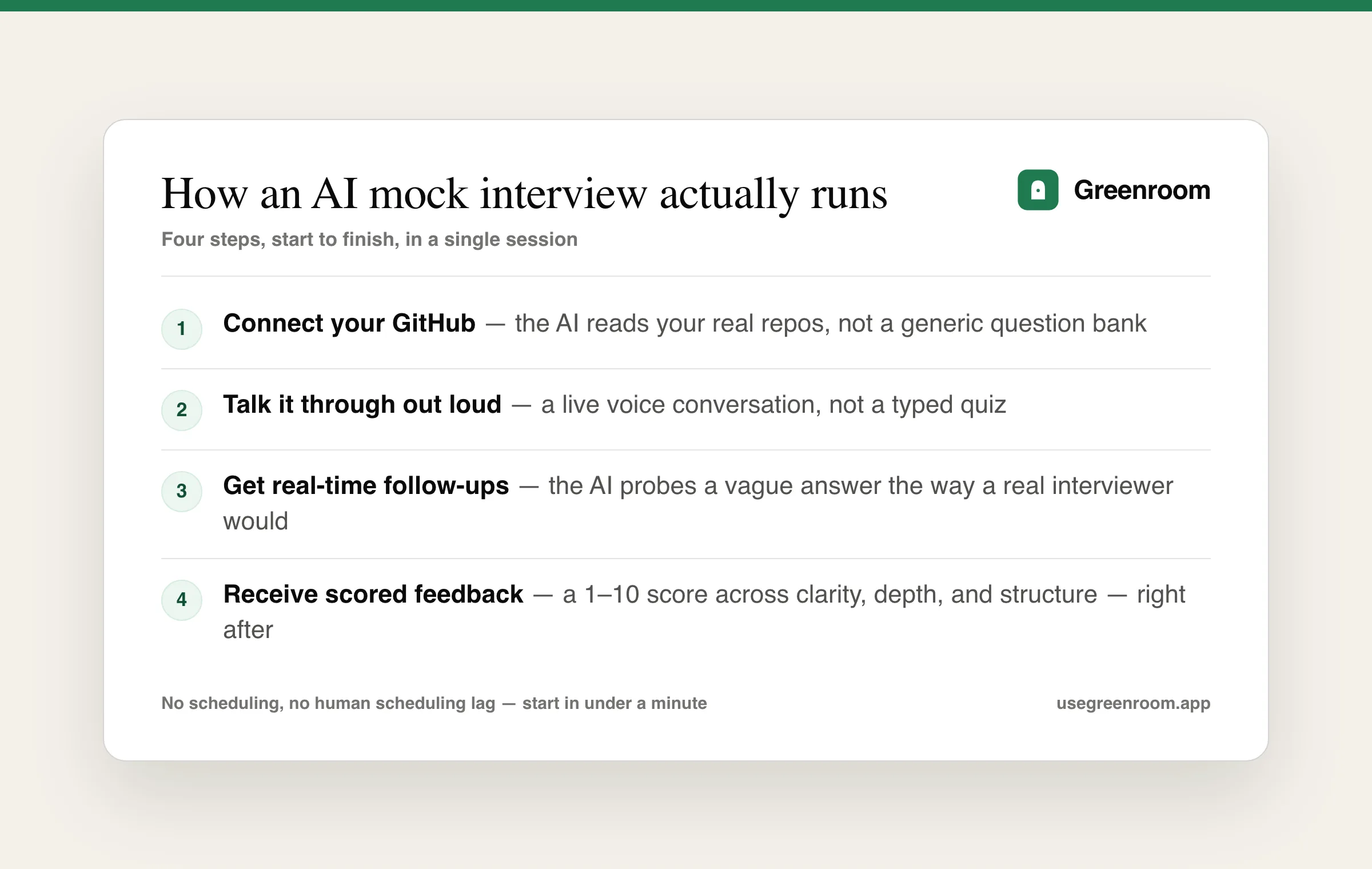
- Connect context, not just a job title. Generic AI mock interview tools ask which role you're practicing for and pull from a static question bank. Greenroom instead reads your GitHub — your actual repos, languages, commit history — and generates questions about your real projects, the same way a sharp interviewer would skip the textbook question and ask "walk me through this specific function in your auth module." This is the single biggest difference between a generic AI quiz and something that resembles a real loop: real interviewers go off-script the moment they see your resume or repo.
- A live spoken conversation. You talk; the AI listens, transcribes, and replies — out loud, in real time, the way a real screen works over Zoom or phone. This matters more than it sounds: reading a question and silently composing an answer in your head is a fundamentally different skill from producing a fluent spoken answer under mild social pressure, with someone (even an AI) waiting on the other end. Typing your answer into a text box doesn't train the skill that actually fails people in real interviews — the live, verbal performance.
- Real-time follow-up questions. This is where most "AI interview" tools quietly stop, and where the difference between a toy and a useful one shows up fastest. If you give a vague or surface-level answer, a real interviewer doesn't shrug and move to question two — they push: "okay, but what would happen if that input was empty?" A scripted quiz can't do this because it doesn't understand your answer; it's just advancing a list. An LLM-driven interviewer can listen to what you actually said and generate a follow-up that probes the specific gap, which is the entire reason interviews have follow-ups in the first place.
- Scored, specific feedback — immediately. After the session, you get a breakdown instead of a vague "good job" — typically a numeric score (Greenroom scores 1–10 across dimensions like clarity, technical depth, and structure) plus a transcript you can review line by line. The point of practice is knowing exactly what to fix before the real thing, not finishing a session and feeling vaguely better.
What does an AI mock interview actually ask?
The questions vary by tool and by role, but a competent AI mock interview session generally moves through three layers, escalating in specificity:
- Warm-up / behavioral. "Tell me about yourself," "walk me through a time you disagreed with a teammate," "why this company" — the same opening beats a real screen uses to settle nerves and get a baseline read on communication. A good AI interviewer doesn't just collect an answer here; it listens for structure (is there a clear situation → action → result, or is it a ramble) and may follow up if the answer is too generic.
- Technical / role-specific. For an engineering mock, this is where data structures, system design, or language-specific questions show up — and where the gap between tools is largest. A static question bank asks the same "explain a closure" question to everyone with "frontend" in their profile. A GitHub-aware interviewer like Greenroom instead asks about a specific function in your actual repo, the library you chose and why, or a tradeoff visible in your commit history — questions a generic bank literally cannot generate because it doesn't know your code exists.
- Adaptive follow-up. Whatever you answer in either layer above gets probed if it's thin. Say "I optimized the query" and a real follow-up is "optimized how, and what was the before/after on latency?" — the same way an actual interviewer would refuse to let a vague claim pass. This layer is the clearest dividing line between a true AI mock interview and a quiz wearing a chat interface: a quiz has no mechanism to generate that follow-up because it isn't reasoning about what you just said, it's just advancing to the next pre-written item.
Knowing this structure in advance is itself useful prep: if you walk in expecting three escalating layers instead of a flat list of unrelated questions, you're less likely to be thrown when round two of follow-ups arrives.
AI mock interview vs. every other way people "practice"
Before comparing AI tools to each other, it's worth being honest about what an AI mock interview is replacing, because most of the alternatives have the exact same flaw.
- A LeetCode/GeeksforGeeks-style question dump. Useful for building pattern recognition on the content of coding questions, close to useless for practicing how you'd actually explain your approach out loud while someone watches you think. These build silent, written fluency — the opposite skill from what an interview tests.
- A friend's WhatsApp PDF of "100 interview questions." Free, well-intentioned, and exactly as stale as the day it was forwarded. No feedback loop, no follow-ups, no way to know if your answer to question 47 was actually good or just felt fine to you at 11 p.m.
- Prompting ChatGPT directly. Genuinely useful for generating questions and even decent written feedback if you type out an answer — Greenroom has a full breakdown of which ChatGPT prompts actually work for mock interviews — but a generic chat window isn't built for low-latency spoken conversation or for asking adaptive follow-ups the way a purpose-built voice interviewer does.
- Reading model answers silently. This trains recognition ("yes, that's a good answer") not production ("I can say that out loud, fluently, on the first try"). Recognition and production are different skills, and interviews only test the second one.
- A real human mock interview — a senior engineer friend, a paid coach, a structured peer-mock platform. This is the gold standard for judgment calls an AI still can't fully replicate (culture fit, reading a room, genuinely surprising curveball questions) — see the full honest comparison of AI mock vs. a real engineer mock — but it requires finding someone qualified, available, and willing, which is exactly the friction an AI mock interview removes. The two aren't mutually exclusive: most strong candidates use AI mock interviews for volume and drilling, and a human mock for a final gut-check before the real thing.
The honest summary: an AI mock interview's edge over every free alternative above is the same edge in every case — a structured, repeatable feedback loop on your spoken answers, available at 1:41 a.m. without needing anyone else awake.
AI mock interview tools compared (2026)
There isn't one "best" AI mock interview tool — the right pick depends on whether you want pure spoken practice, communication coaching, peer-to-peer coding rounds, or a recruiter-facing screening product. Here's an honest breakdown of where each one actually fits, drawn from Greenroom's deeper India-focused tools comparison and the separate ranking of free options.
| Tool | Format | Personalized to your real code/projects | Live AI follow-up questions | Free tier | Best for |
|---|---|---|---|---|---|
| Greenroom | Voice, real-time | Yes — reads your GitHub repos | Yes — adaptive, based on your actual answer | Yes, no card required | Technical interviews where your real projects come up |
| Pramp | Voice, real-time | No | No (human peer drives the questions) | Yes | Free peer-to-peer practice if you can find a partner |
| interviewing.io | Voice, real-time | No | Depends on interviewer | Limited free, paid for senior engineers | Anonymous mock interviews with real engineers, with a hiring angle |
| Final Round AI | Mixed (live-assist + practice) | No | Yes, generic question bank | Limited free | Real-time interview "co-pilot" assistance, not pure practice |
| Yoodli | Voice, real-time | No | No, focused on delivery analysis | Yes | Speech-coaching feedback (filler words, pace, eye contact) over interview content |
| ChatGPT (prompted) | Text, or voice via app | No, unless you paste in your own project details | Only if explicitly prompted to follow up | Yes (with usage limits) | Quick, free written practice and question generation |
A closer look at each tool
Greenroom is built around one idea: the most realistic question an AI interviewer can ask is one based on your actual work, not a generic bank. It connects to your GitHub, generates spoken questions about your real repos, runs the conversation as a live voice call rather than a typed quiz, and produces a 1–10 scored feedback report with a full transcript right after. The tradeoff is that it's most useful for technical/engineering interviews where a GitHub history exists to read from — it's less of a fit if you're practicing a purely behavioral or non-technical round with no code to anchor questions to.
Pramp pairs you with another real person practicing for the same kind of interview, and you take turns interviewing each other — genuinely free, genuinely human on both ends, which means genuinely real follow-up judgment. The cost is scheduling: you need to find a partner who's free at the same time, the questions are typically generic bank questions rather than personalized to your background, and session quality varies with who you're paired against.
interviewing.io connects you anonymously with real, often senior, engineers for paid mock interviews, with an explicit secondary goal of helping standout performers get noticed by hiring companies. It's closer to a true human-mock experience than anything AI-driven, with the tradeoffs of any human-scheduled service: cost, availability windows, and no guarantee your specific tech stack is covered by whoever's available.
Final Round AI is best known for real-time "co-pilot" assistance during a live interview (suggesting answers as you go) rather than pure beforehand practice — a meaningfully different, more controversial use case than the rehearsal tools in this comparison, and worth knowing about specifically so you don't conflate it with a practice tool when comparing options.
Yoodli focuses narrowly and well on delivery: filler words, speaking pace, eye contact, vocal variety, using your own webcam and mic to analyze how you come across, not what you said. It's a strong complement to a content-focused mock interview rather than a substitute for one — pairing Yoodli's delivery coaching with a technical AI mock interview covers more ground than either alone.
ChatGPT, prompted well, is the most flexible and fully free option — you can paste in a job description, ask it to role-play a specific interviewer persona, or request written feedback on a typed answer. What it doesn't do natively is low-latency spoken conversation with adaptive follow-ups tuned for interview pacing, though voice-mode access narrows that gap somewhat. The exact prompt patterns that work best are broken down separately.
A few honest caveats on that table: Pramp and interviewing.io put you with real engineers, which is closer to a true human mock than anything AI-driven — their tradeoff is scheduling and availability, not quality. Yoodli is excellent at the specific, narrow job of giving you delivery feedback (pace, filler words, confidence signals) but isn't trying to be a technical interviewer. Final Round AI's most-discussed feature is real-time answer assistance during a live interview, which is a different (and more controversial) use case than practicing beforehand. ChatGPT is the most flexible free option but requires you to do the prompting and project-context work yourself — the exact prompts that get it closest to a real mock interview are covered separately. And if you're skeptical the format works at all, the research on AI mock interviews is worth a look.
Is there a free AI mock interview option?
Yes — most of the tools above, including Greenroom, offer a free tier specifically because the entire point of removing the human-scheduling bottleneck is removing the cost bottleneck too. Greenroom's free tier requires no credit card and starts a real voice session in under a minute, generating questions from your connected GitHub. Paid tiers across the category generally unlock more sessions per month, longer interviews, or more detailed feedback reports rather than gating "AI mock interview" as a feature behind a paywall entirely. If budget is the only constraint, start free, and only consider paying once you know exactly which feature (volume, depth of feedback, specific role tracks) you're actually missing. The short version: yes, you can run a genuine AI mock interview free of charge today — the limits show up in volume, not in whether the core interview works.
Who actually benefits from an AI mock interview
- Freshers and campus placement candidates practicing for the first loop of their life, who don't yet have a network of senior engineers to mock them for free — this is the highest-leverage use case, since the alternative is genuinely zero practice.
- Career switchers moving from a service company into a product company, where the question style, depth expectations, and pace are different enough that even experienced engineers benefit from a few reps before the real thing.
- Anyone interviewing again after a long gap — verbal fluency under pressure decays fast if you haven't done it in a year, even if your technical skills haven't.
- Non-native English speakers specifically practicing spoken fluency and pacing rather than content — covered in detail separately, since interviewers grade clarity, not accent, and that distinction is easy to lose sight of under nerves.
- Anyone prepping for a specific, high-stakes loop (FAANG-style onsites, a final round) who wants several low-stakes reps before the one rep that counts.
Less obviously, AI mock interviews are also useful as a diagnostic even for strong candidates: a 1-10 score and transcript will surface a pattern (rambling answers, weak structure on behavioral questions, going too deep on irrelevant detail) that's hard to notice about yourself without an outside read.
What an AI mock interview still can't do
Credibility requires saying this plainly: AI mock interviews are excellent at drilling structure, fluency, and technical depth, and they are not yet a full substitute for a human in every dimension.
- Genuine surprise. A skilled human interviewer can throw a true curveball that has nothing to do with the script in front of them, reacting to something only a human would notice (your tone shifting, a slightly evasive answer). AI follow-ups are adaptive but still operate within the bounds of what it can reasonably infer from your transcript.
- Culture and team fit signals. Whether you'd actually be a good teammate for this specific group of people is a read that depends on context an AI mock interview doesn't have, and isn't really trying to simulate.
- The exact panel you'll face. No mock — AI or human — perfectly predicts which interviewer you'll get, how they grade, or their personal pet questions.
This is also why structured AI interviews, used the right way, aren't trying to fully replace the human round — Google's own People Analytics research (published via their re:Work initiative) has long argued that structured interviews with consistent questions and a clear rubric outperform unstructured "gut feel" interviews on predicting actual job performance. An AI mock interview is, in effect, a way to rehearse against exactly that kind of structure before facing it for real, not a claim that AI itself should be making the hiring decision.
Common mistakes people make with AI mock interviews
- Doing it silently, in their head, then typing a summary. This defeats the entire point. If the tool supports voice, use voice — the skill being tested is producing a fluent answer out loud, live, not composing a good answer privately and then transcribing it.
- Treating a low score as the AI being "wrong." A 4/10 with a specific note ("answer lacked a concrete example") is more useful than a vague "good job" — resist the urge to dismiss critical feedback as the AI misunderstanding you before actually re-reading the transcript.
- Only ever practicing the same one or two questions. Repeating "tell me about yourself" until it's smooth is useful, but it builds confidence in a narrow, predictable lane. Let the session go where it goes, including the harder follow-ups, since real interviews don't let you pick the topic.
- Skipping the technical depth because it's "just practice." Giving a deliberately lazy answer because "the AI won't really judge me" trains the wrong habit — the value only shows up if you treat each session with the same effort as the real thing.
- Doing one session and calling it done. A single mock interview reveals a snapshot, not a pattern. Real improvement shows up across three or four sessions where you can compare your own transcripts and watch a specific habit (rambling intros, weak structure, going too deep on irrelevant detail) actually change.
AI mock interview practice: how to get the most out of every session
Everything in this guide runs online, in the browser — a mock interview with AI needs a microphone, a quiet room, and about twenty minutes, not an app install or a scheduling link. Which means the bottleneck isn't access anymore; it's how deliberately you run each rep. The people who improve fastest treat AI mock interview practice like training, not like a vibe check:
- Treat it like the real thing, not a quiz. Sit upright, use your actual interview setup (headset, lighting, webcam if relevant), and resist the urge to pause and "think it through" silently before speaking — real interviews don't give you that pause.
- Don't skip the follow-up. If the AI pushes back on a vague answer, that's the entire value of the session — answering the follow-up properly is the practice, not an annoying extra step.
- Read the transcript afterward, not just the score. The score tells you that something was off; the transcript tells you what — a specific sentence where you rambled, a question you answered too narrowly.
- Do more than one. A single session tells you about one bad night; three or four across a week reveal an actual pattern you can fix. How many mock interviews you actually need before the real one depends on your timeline and prep stage, but the number is rarely "one."
- Pair it with project review, not just question drilling. If the AI mock interview is reading your GitHub, spend equal time making sure your repos and READMEs would survive a closer human look too — building a portfolio that holds up under questioning matters as much as the verbal rehearsal.
- Use a human mock as the final step, not the first one. Burn through the awkward, mistake-heavy early reps with an AI mock interview where nothing is on the line, then spend a scarcer human mock-interview favor on polish, not on discovering you ramble.
Increasingly the real interview is with software too: our how to pass an AI interview guide covers what AI screening rounds score and how to answer them.
Frequently asked questions
What is an AI mock interview?
An AI mock interview is a simulated job interview run by an AI system instead of a human — typically voice-based, asking realistic questions, reacting to your answers with live follow-ups, and scoring your performance afterward. The strongest versions, like Greenroom, generate questions from your real projects (via GitHub) rather than a generic, static question bank.
Is an AI mock interview actually useful, or just a gimmick?
It's useful specifically for the part of interview prep that's hardest to practice alone: producing fluent, structured spoken answers under mild pressure, with realistic follow-up questions. It's not a full replacement for a human mock interview's judgment calls (culture fit, genuine curveballs), but for drilling structure, technical depth, and verbal fluency before the real thing, it closes a gap that silent studying or a static question list can't.
Are there free AI mock interview tools?
Yes. Greenroom offers a free tier with no credit card required, and most major AI mock interview tools — Pramp, ChatGPT, Yoodli — have a free option too, usually with usage limits. A full ranked comparison of free options is here.
How is an AI mock interview different from just using ChatGPT?
ChatGPT can generate interview questions and give written feedback if you type out your answers, but it isn't purpose-built for real-time spoken conversation or adaptive follow-ups the way a dedicated voice-based AI interviewer is. The specific prompts that get ChatGPT closest to a real mock interview are covered separately — it's a reasonable free starting point, just a different tool than a purpose-built one.
Can an AI mock interview read my actual GitHub projects?
With Greenroom, yes — it connects to your GitHub and generates questions about your real repos and code, the way a sharp human interviewer would go off-script after looking at your resume, rather than asking the same generic question bank everyone else gets.
How many AI mock interviews should I do before the real one?
There's no single number — it depends on your timeline and how much real interview experience you already have. As a starting point, a real number by scenario (fresher, 3-5 YOE career switch, FAANG loop) is broken down here, but the consistent finding is that one session is rarely enough to surface and fix a real pattern.
Can an AI mock interview replace a real human mock interview entirely?
Not entirely. AI mock interviews are excellent for volume, drilling structure, and verbal fluency under pressure — available any time, with no scheduling. They're not yet a full substitute for the judgment a skilled human brings to genuine curveball questions or culture-fit reads. The honest breakdown of what each is good at, and when to use which, is here — most strong candidates use AI mock interviews for repetition and a human mock as a final-step gut check.
What's the biggest mistake people make in an AI mock interview?
Practicing silently and only typing a written summary afterward, which skips the actual skill being tested — producing a fluent, structured answer out loud, live. The second most common mistake is doing a single session and assuming it's enough; one session shows a snapshot, not a pattern, and the real value comes from comparing transcripts across three or four sessions.
Which is the best AI mock interview platform?
There's no single best — it depends on what you're practicing. Greenroom is the strongest choice if you want a voice interview built from your own GitHub projects; Google Interview Warmup is the best totally-free starting point; Final Round AI suits copilot-style live assistance. Most candidates get further with one platform used repeatedly than with three used once.
Is an AI mock interview useful for freshers in India?
Yes — arguably most useful there, because campus placement rounds are spoken (HR screen, technical viva, group discussion) and most freshers have never practiced answering out loud under pressure. An AI mock interview gives unlimited spoken reps without needing a senior engineer to volunteer their evening.
What is the best mock interview AI?
For spoken practice tied to your own work, Greenroom is the strongest mock interview AI in 2026 — it reads your GitHub, runs a live voice interview with adaptive follow-ups, and scores you 1–10 afterward. If you only want zero-cost text practice, Google Interview Warmup or ChatGPT will do, but both are weaker on the spoken follow-ups where real interviews are actually won or lost.
How does an AI mock interviewer decide what to ask next?
A modern AI mock interviewer runs on a large language model that reads your last answer before generating the next question — so a vague answer triggers a probing follow-up and a strong one moves the interview forward, the way a human interviewer would. Tools that simply advance through a fixed question list aren't really AI interviewers; they're quizzes with a voice.
Can I do a mock interview with AI for free?
Yes. Greenroom's free tier runs a full spoken mock interview with AI, no credit card required, and Google Interview Warmup is entirely free. Free tiers usually cap session count or feedback depth, but they're more than enough to discover where your answers actually break down before you pay for anything.
Can I take an AI mock interview online without installing anything?
Yes — every serious tool in this guide, Greenroom included, runs the AI mock interview online in your browser. You need a working microphone, a reasonably quiet room, and about twenty minutes per session; there's no app to download and nobody to schedule around.