Most software engineers over-prepare the coding round and under-prepare the behavioral one — then lose the offer in the conversation about teamwork, conflict, and impact. Behavioral interview questions are where companies decide whether you're someone they want to work with, and they're far more predictable than the algorithm questions. Prepare the right stories and you can walk into almost any behavioral round ready.
Below are the 30 most common behavioral interview questions for software engineers, grouped by what they're really testing, plus how to answer them.
Teamwork and collaboration
- Tell me about a time you had a conflict with a teammate.
- Describe a time you had to work with a difficult colleague.
- Tell me about a time you disagreed with a technical decision.
- How did you handle feedback you disagreed with in a code review?
- Describe a time you helped a struggling teammate.
Ownership and impact
- Tell me about your most significant technical achievement.
- Describe a project you owned end to end.
- Tell me about a time you went beyond your assigned scope.
- Describe a time you improved a system's performance or reliability.
- Tell me about a time you reduced technical debt.
Failure, mistakes and learning
- Tell me about a time you caused a production incident.
- Describe your biggest professional failure.
- Tell me about a time you missed a deadline.
- Describe a time you received hard critical feedback.
- Tell me about a decision you'd make differently now.
Judgment and prioritization
- Tell me about a time you had to make a trade-off under time pressure.
- Describe a time you had too many priorities — how did you choose?
- Tell me about a time you pushed back on a requirement.
- Describe a time you shipped despite incomplete information.
- Tell me about a time you had to say no to a stakeholder.
Communication and leadership
- Tell me about a time you explained something technical to a non-technical audience.
- Describe a time you influenced a decision without authority.
- Tell me about a time you mentored someone.
- Describe a time you drove a project across teams.
- Tell me about a time you changed your mind after hearing an argument.
Motivation and fit
- Why do you want to work here?
- Why are you leaving your current role?
- What does your ideal team and manager look like?
- Where do you see yourself in three years?
- What are you most proud of in your career?
How to answer any behavioral question
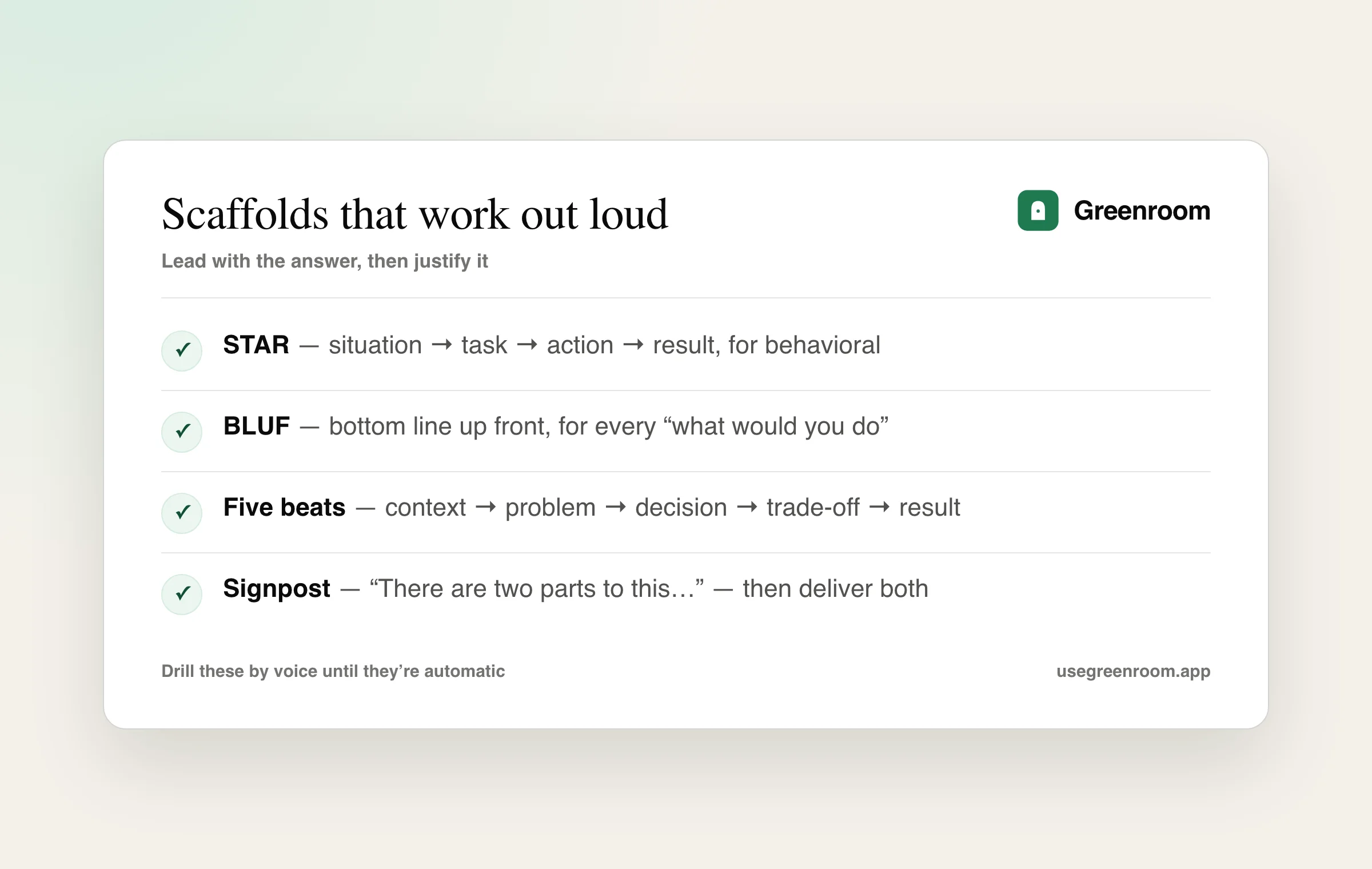
Almost all of these map to the STAR structure: Situation, Task, Action, Result. Three rules separate strong answers from forgettable ones:
- Lead with the point. Don't build suspense — state the outcome, then explain how you got there.
- Stay in the first person. Interviewers are scoring you, not your team. Use "I" for your actions.
- Quantify the result. A number ("cut build time 35%", "onboarded 4 engineers") makes the story credible and memorable.
Rehearse them out loud
Behavioral answers fall apart spoken, even when they read well on paper — you ramble, lose the thread, or freeze on a follow-up. The only fix is reps with your mouth, not your eyes. Greenroom runs a realistic spoken behavioral interview that asks these questions, follows up like a real interviewer, and scores your structure and specificity. See also improving communication skills for interviews and why you freeze and how to stop.
Frequently asked questions
What are the most common behavioral interview questions for software engineers?
The most common are about conflict with a teammate, your biggest failure, a project you owned end to end, a time you disagreed with a technical decision, a hard trade-off under pressure, and why you want the role. Most companies draw from this same pool, so preparing six to eight strong stories covers the majority of them.
How many stories do I need for a behavioral interview?
Six to eight well-chosen, quantified stories are usually enough. Pick examples that cover a conflict, a failure, a major achievement, a leadership or mentoring moment, and a difficult trade-off. Most behavioral questions can be answered by reframing one of these stories rather than inventing a new one.
How do I structure a behavioral interview answer?
Use STAR: Situation, Task, Action, Result. Keep the situation and task brief, spend most of the answer on the specific actions you personally took, and end with a quantified result. Lead with the outcome rather than building suspense, and stay in the first person so the interviewer can see what you contributed.
Are behavioral interviews important for engineers, or is it all coding?
Behavioral rounds are often the deciding factor, especially at senior levels and at companies like Amazon. Strong coding gets you through the technical screen, but the behavioral round decides whether the team wants to work with you, and many otherwise strong candidates are rejected here for vague or team-credit answers.