A candidate walks into a Myntra technical round fresh off three weeks of grinding the same fifty LeetCode "Top Interview Questions" everyone else in their batch is also grinding, expecting another two-sum-with-a-twist. The interviewer opens with: "Let's design the system behind 'frequently bought together' on a product page during the End of Reason Sale, when traffic is fifteen times normal." The candidate's prepared mental model (graph problem, probably trees, maybe a DP twist) doesn't fit. This is a recommendation, caching, and load problem wearing a system-design costume, and half the battle is just recognizing that before reaching for the wrong toolbox.
Myntra's interviews sit at an interesting intersection: it's a fashion e-commerce platform owned by Flipkart (itself owned by Walmart), so its interview loop blends classic product-company DSA rigor with system design questions that lean hard into catalog scale, seasonal traffic spikes (sale events are a real, named thing interviewers ask about), personalization, and the unglamorous-but-critical mechanics of inventory and returns. This guide covers the Myntra interview questions that actually come up in 2026 (the hiring process, DSA topics, fashion-e-commerce system design, behavioral and HR rounds) with real questions, real answers, and an honest comparison to prepping for Flipkart, Amazon, or other Indian e-commerce companies.
The Myntra interview process
What does the Myntra hiring loop actually look like end to end?
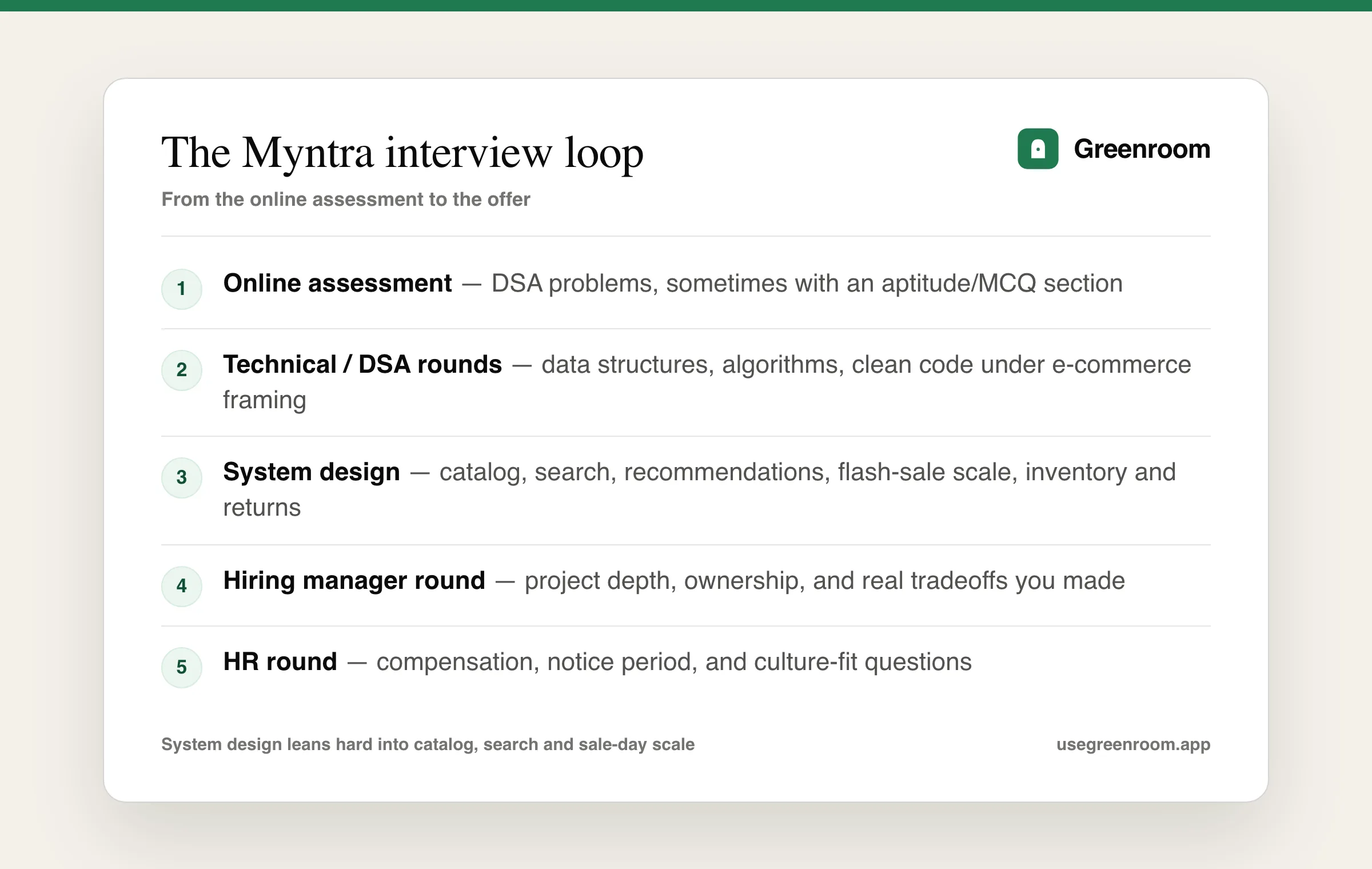
For SDE roles, the loop typically runs: an online assessment (2-3 DSA problems plus sometimes an aptitude/MCQ section, especially for off-campus and fresher hiring), two technical/DSA rounds focused on data structures, algorithms, and increasingly your ability to extend a working solution when the interviewer changes the constraints mid-conversation, a system design round (for SDE-2 and above, and increasingly for strong SDE-1 candidates too) that leans on e-commerce-flavored problems, a hiring manager round that mixes technical depth with project ownership and "why Myntra" framing, and an HR/culture-fit round covering compensation, notice period, and basic behavioral questions. The exact count and order shifts by team and hiring season: sale-season hiring pushes (ahead of End of Reason Sale, Big Fashion Festival) sometimes compress the loop to move faster, but the content tested doesn't change.
How is interviewing at Myntra different from Flipkart or Amazon, given Myntra is part of the Flipkart Group?
The DSA bar is broadly similar across all three: clean code, correct complexity analysis, and clear communication of your approach before you start typing. Where Myntra's interviews diverge: system design questions are more consistently catalog and fashion-domain flavored than Flipkart's broader marketplace questions or Amazon's famously leadership-principle-heavy behavioral rounds: expect prompts around product variants (size, color, fit), visual search, try-and-buy logistics, and styling/recommendation features that are specific to fashion retail rather than generic e-commerce. Amazon's interviews additionally weight the 16 Leadership Principles far more heavily in every single round, including technical ones — Myntra's behavioral questions are more conventional STAR-format without a fixed published framework you're expected to map every answer to.
Does Myntra hire freshers and off-campus candidates, or mostly lateral hires?
Both, through different channels: campus hiring at target colleges follows a similar campus placement loop to other product companies (online test, then technical rounds), while off-campus and lateral hiring runs through referrals, direct applications, and hiring drives, often with a slightly heavier weight on DSA fundamentals for off-campus candidates since there's no campus reputation signal backing the application. Fresher rounds lean more on fundamentals (data structures, basic OOP, a guided system design conversation rather than an open-ended one) while 2+ years experienced hires are expected to drive the system design round mostly unprompted and discuss real production tradeoffs from their own past work.
Myntra DSA and coding questions
What data structure and algorithm topics come up most in Myntra's technical rounds?
Arrays and strings (substring and subarray problems are common, often framed around product titles, search queries, or SKU codes to keep it loosely on-theme), hash maps (frequently for "frequently bought together" or co-occurrence style problems), trees and graphs (category hierarchies are a literal tree —expect questions framed around navigating or building one), and dynamic programming for problems like discount/coupon stacking optimization or inventory allocation— all standard topics covered in depth in our DSA interview prep guide and recursion and backtracking guide, just wrapped in an e-commerce-flavored word problem rather than an abstract one.
Worked example: "Given a list of products with a category hierarchy, find all products under a given category, including its subcategories."
This is a tree traversal problem wearing a catalog costume, recognizing that fast is the actual signal. Model the category hierarchy as a tree (or more realistically, a DAG if a subcategory can belong to multiple parents, which is worth asking about explicitly), then a DFS or BFS from the target category node collects every product attached to that node or any descendant.
def products_under_category(category_tree, products_by_category, target):
    result = []
    stack = [target]
    while stack:
        node = stack.pop()
        result.extend(products_by_category.get(node, []))
        stack.extend(category_tree.get(node, []))  # children
    return result
The interview-ready follow-up to volunteer before being asked: "what if the hierarchy isn't a strict tree — say, 'Sneakers' sits under both 'Men's Footwear' and 'Sportswear'?" That's the DAG case, and the fix is tracking visited nodes to avoid double-counting or infinite loops if the structure ever has a cycle (which shouldn't happen in a well-formed catalog, but is worth naming as an edge case you'd validate against, not assume away).
Worked example: "Apply the best available discount for a cart, given multiple overlapping coupon rules."
This tests whether you reach for brute force or recognize the optimization structure underneath. A naive approach tries every combination of applicable coupons and picks the best total — fine for a small number of coupons, but exponential as the rule count grows. The better framing: if coupons can stack and each affects different items or has different conditions (minimum cart value, category-restricted, max discount cap), this is close to a variant of the knapsack problem. You're choosing a subset of applicable, non-conflicting rules that maximizes total discount subject to constraints. Naming "this resembles knapsack, here's the simplification I'd make for the actual constraint shape" is a far stronger answer than just writing brute-force nested loops without commenting on complexity.
What's the most common live-coding mistake candidates make at Myntra, specifically?
Treating the word-problem framing (products, carts, coupons, categories) as flavor text and not actually checking it for real-world wrinkles before coding — a candidate who immediately writes a clean tree traversal for the category question above, without asking "can a category have multiple parents?", solves the stated easy version while missing the follow-up the interviewer was already planning to ask. The fix is the same one tested in coding interview communication: ask a clarifying question about the data shape before writing code, especially when the problem is dressed up in a specific domain rather than presented as an abstract data structure exercise.
Myntra system design questions
"Design the product catalog and search system for a fashion e-commerce platform", how do you structure this?
Work it like any system design interview: clarify requirements first (scale of catalog —millions of SKUs with variants for size/color easily multiplies a single "product" into dozens of purchasable units— and the read/write ratio, which for a catalog is read-heavy by orders of magnitude), then build up layer by layer. Data modeling: separate the abstract "product" (a t-shirt design) from its purchasable "variants" (size M in blue, size L in red), since search, browsing, and inventory all need to reason about both levels differently. Search: a dedicated search index (Elasticsearch or similar) rather than querying the primary database directly, since fashion search needs faceted filtering (size, color, brand, price range, fit) and fuzzy/typo-tolerant text matching that a relational database isn't built for efficiently, see our Elasticsearch interview guide for the indexing mechanics underneath this. Caching: category pages and popular search results are prime candidates for aggressive caching, since they're read by enormous numbers of users and change relatively infrequently outside of sale-event price updates. Personalization: a separate recommendation service that re-ranks or supplements search/browse results based on user history, kept as a layer on top of base search rather than baked into the core search index, so search stays fast and correct even if personalization is temporarily degraded.
"Design 'frequently bought together' or 'similar styles' recommendations", what's the actual design conversation?
Start by clarifying what data is available and the latency budget — recommendations shown inline on a product page need to return in low tens of milliseconds, which rules out anything computed live from scratch per request. The standard real-world shape: offline computation of co-occurrence or similarity data (which products are frequently purchased together, or which products have similar embeddings from a vision/text model trained on product images and descriptions) runs as a batch job, writing results to a fast key-value store keyed by product ID. At request time, the product page does a fast lookup against that precomputed store rather than computing anything live. The interview-ready tradeoff to name: precomputed recommendations go stale between batch runs (a newly added product has no co-occurrence data yet: the classic cold-start problem), so production systems usually blend precomputed results with a fallback (same-category, similar-price-range items) for new or low-data products.
"Design the system for a flash sale event with 15x normal traffic", what changes from designing for normal load?
This question is really testing whether you understand that flash-sale traffic isn't just "more of the same". It's a fundamentally different load shape: a massive, near-simultaneous spike concentrated on a small number of "hero" products, rather than evenly distributed traffic across the whole catalog. The design response: aggressive caching and even static-page generation for the specific sale-landing and hero-product pages (these don't need live personalization at that moment —consistency loses to availability here), a queueing or waiting-room mechanism in front of checkout for the highest-demand items so the system degrades gracefully (a queue position) rather than failing outright under load, and inventory systems that favor eventual consistency with idempotent reservation over strict locking— a brief, bounded window where overselling is possible is usually a better tradeoff than a checkout flow that grinds to a halt under lock contention at fifteen times normal concurrency. Naming CAP-theorem-style tradeoffs explicitly here (the same way our system design guide covers for general scale questions) is exactly the depth interviewers are listening for.
"Design the inventory and stock-management system, accounting for returns", what's the tricky part?
The deceptively tricky part isn't tracking stock going down on a purchase. It's correctly handling the full lifecycle: an item reserved at checkout but not yet paid (should it be held, for how long, and released back to available stock if payment fails or times out?), a returned item that needs a quality check before it's back in sellable inventory (a returned product isn't instantly available again: there's a real-world delay and state in between), and inventory that needs to reconcile across multiple warehouses or seller-fulfilled stock if Myntra's marketplace model includes third-party sellers, which it does for a meaningful share of catalog. The strong answer models inventory as a state machine per unit (Available → Reserved → Sold → Returned-Pending-QC → Available-or-Discarded) rather than a single decrementing counter, since a counter can't represent "this unit exists but isn't currently sellable for a specific, trackable reason" — exactly the kind of detail that separates a surface-level answer from one that reflects real operational understanding.
Behavioral and HR round questions
What behavioral questions come up, and how should answers be structured?
Standard STAR-format questions ("tell me about a time you disagreed with a teammate," "describe a project you're proud of and your specific contribution," "how do you handle a tight deadline with unclear requirements") without a single published framework like Amazon's Leadership Principles to map answers against. The practical prep is the same as any behavioral round: structure answers with situation, task, action, result, keep them concrete and specific to a real project rather than generic, and be ready for a genuine follow-up that probes the "result" — interviewers increasingly ask "what would you do differently" as a standard follow-up, which rewards honest reflection over a story that sounds too perfectly resolved.
What does the hiring manager round typically probe beyond raw technical skill?
Project ownership and depth: can you explain not just what you built but why you made specific decisions, what tradeoffs you considered, and what you'd change with hindsight. Fashion e-commerce specifically rewards candidates who show genuine interest in the retail/consumer domain rather than treating it as interchangeable with any other backend system: being able to speak to why personalization, catalog scale, or sale-event load are interesting specifically in this domain, not just generically "interesting engineering problems," reads as more genuine than a rehearsed "I'm passionate about your mission" line.
What should I expect on compensation and offer negotiation?
Standard for Indian product companies: expect a base, variable/bonus component, and equity (RSUs, given the Flipkart Group/Walmart structure) discussed in the HR round, with room to negotiate within the band for your level, especially with a competing offer in hand. Our salary negotiation guide for engineers covers the scripts and timing that apply here without anything Myntra-specific changing the fundamentals.
How to prepare — and how Myntra prep differs from generic FAANG prep
Most candidates prepare for Myntra the same way they'd prepare for any product-company interview: grind a fixed LeetCode list, skim a system-design primer, and hope the questions land close enough to what they rehearsed. That gets the DSA rounds covered reasonably well, since the algorithmic bar genuinely is similar across most Indian product companies. It under-prepares the system design round specifically, because generic system-design prep skews toward URL shorteners, chat apps, and rate limiters: useful foundational practice, but not the same shape as "design recommendations for a fashion product page" or "design checkout for a flash sale," which reward domain-specific thinking about catalog structure, variant modeling, and seasonal load that a generic primer doesn't cover.
Reading Myntra's engineering blog and Flipkart's engineering blog (Myntra being part of the Flipkart Group) is a genuinely useful, under-used prep step: real posts about their actual search, recommendation, and scale challenges give you concrete, specific talking points an interviewer will recognize as informed rather than generic. A friend's "Myntra interview questions" PDF or a generic question-bank site gets you a question list, but rarely the live system-design conversation format, where the interviewer keeps changing constraints ("now it's sale day, what changes?") and grades how you adapt, not just your first answer.
Greenroom runs spoken mock interviews that include live system-design exercises with realistic follow-up pressure, and DSA rounds with the same "explain your approach before you code" expectation real Myntra interviewers have. Pairing DSA-specific prep with rehearsed, spoken system-design practice, not just reading model answers, covers the actual gap most candidates have walking into an e-commerce-flavored design round.
Practise the system design conversation, not just the DSA
You can clear every LeetCode-style DSA round and still stumble in a Myntra system design interview if your only practice has been reading model system-design answers rather than building one out loud while an interviewer pushes back with changing constraints. Greenroom runs spoken mock interviews with live system-design exercises and realistic follow-up questions, plus DSA rounds that grade your communication and approach, not just your final code. Pair it with how to prepare for FAANG interviews from India for the broader prep timeline, and the service-to-product company switch guide if Myntra is part of a larger move from a services background into product companies.
Frequently asked questions
What is the Myntra interview process for software engineers?
Typically an online assessment (DSA problems, sometimes an aptitude section), two technical/DSA rounds, a system design round for SDE-2 and above (and often strong SDE-1 candidates), a hiring manager round covering project depth and ownership, and an HR/culture-fit round covering compensation and basic behavioral questions. The exact structure varies by team and whether you're hired through campus, off-campus, or lateral channels.
How is Myntra's interview different from Flipkart's or Amazon's?
The DSA bar is broadly similar across all three. Myntra's system design questions lean more consistently into fashion-e-commerce-specific scenarios (product variants, catalog hierarchy, visual/styling recommendations, sale-event load) compared to Flipkart's broader marketplace framing or Amazon's heavily Leadership-Principle-driven behavioral rounds that show up in every interview stage, not just the dedicated behavioral round.
What system design topics should I prepare specifically for Myntra?
Catalog and search architecture (including faceted search and the product-vs-variant data model), recommendation systems with realistic latency and cold-start constraints, flash-sale and seasonal-traffic scaling (queueing, caching, eventual consistency tradeoffs), and inventory/returns lifecycle modeling. Generic system-design primers (URL shorteners, chat systems) build useful foundations but don't cover these domain-specific scenarios directly.
Does Myntra ask Amazon-style Leadership Principle questions?
No — Myntra's behavioral round uses conventional STAR-format questions without a single published framework every answer is expected to map to. Standard, well-structured behavioral preparation works without needing to study a specific principles list the way Amazon candidates do.
How much DSA difficulty should I expect at Myntra compared to FAANG companies?
Generally medium difficulty, similar to most Indian product companies and comparable to Flipkart: typically a notch below the hardest FAANG bar (rare hard-only rounds), but with real expectations around clean code, correct complexity analysis, and clearly communicating your approach, especially when the problem is framed around e-commerce data (catalogs, carts, coupons) rather than presented as an abstract algorithm.
Is it worth reading Myntra's or Flipkart's engineering blog before the interview?
Yes: it's an under-used prep step that gives concrete, specific talking points about real search, recommendation, and scale challenges the company has actually written about, which reads as far more informed in a system design round than generic primer knowledge. It won't replace DSA or system-design practice, but it sharpens your domain-specific answers noticeably.