You have been working at TCS, Infosys, or Wipro for two or three years. You are delivering projects, maintaining client code, attending standup calls — but somewhere along the way you realized that the work is not making you grow the way you wanted. You want to be at a product company, maybe a startup, maybe a FAANG adjacent firm. The problem is: you do not know exactly where to start.
This guide is the roadmap you need. It is written specifically for service company engineers — people doing service company engineer ka product company mein switch — not for fresh graduates or people already in product roles. The path is different, the gaps are specific, and the good news is that they are fixable.
Why the switch feels hard (and why it is actually possible)
The biggest misconception about a career switch to a product company India is that service engineers are "behind." That is not accurate. What is accurate is that the skills tested in product-based company interviews are different from what most service company roles require day to day.
At TCS or Infosys, you may be working with well-defined requirements, using established frameworks on client infrastructure, with minimal ownership of architecture decisions. Product companies — and especially startups — want engineers who think about trade-offs, own systems end to end, and can talk clearly about how they built something under real constraints.
The gap is not talent. The gap is preparation and practice. And both are completely closable in 3 to 6 months with the right roadmap.
Step 1 — Honest self-assessment (Week 1–2)
Before you touch LeetCode or system design resources, spend one week doing an honest audit of where you stand. Answer these questions in writing:
- Can you implement a binary search from scratch without reference?
- Can you explain the time complexity of your most recent project's core logic?
- Have you ever designed a system — even a small one — from scratch?
- Can you talk about a real engineering decision you made and defend the trade-off?
This is not about feeling bad. It is about knowing which of the four pillars — DSA, system design, communication, or project depth — needs the most work. Most service engineers are weak on DSA and system design, moderately strong on project work, and almost universally unpracticed at talking through technical decisions out loud. That last one is usually the most underestimated gap.
Step 2 — DSA foundations (Month 1–2)
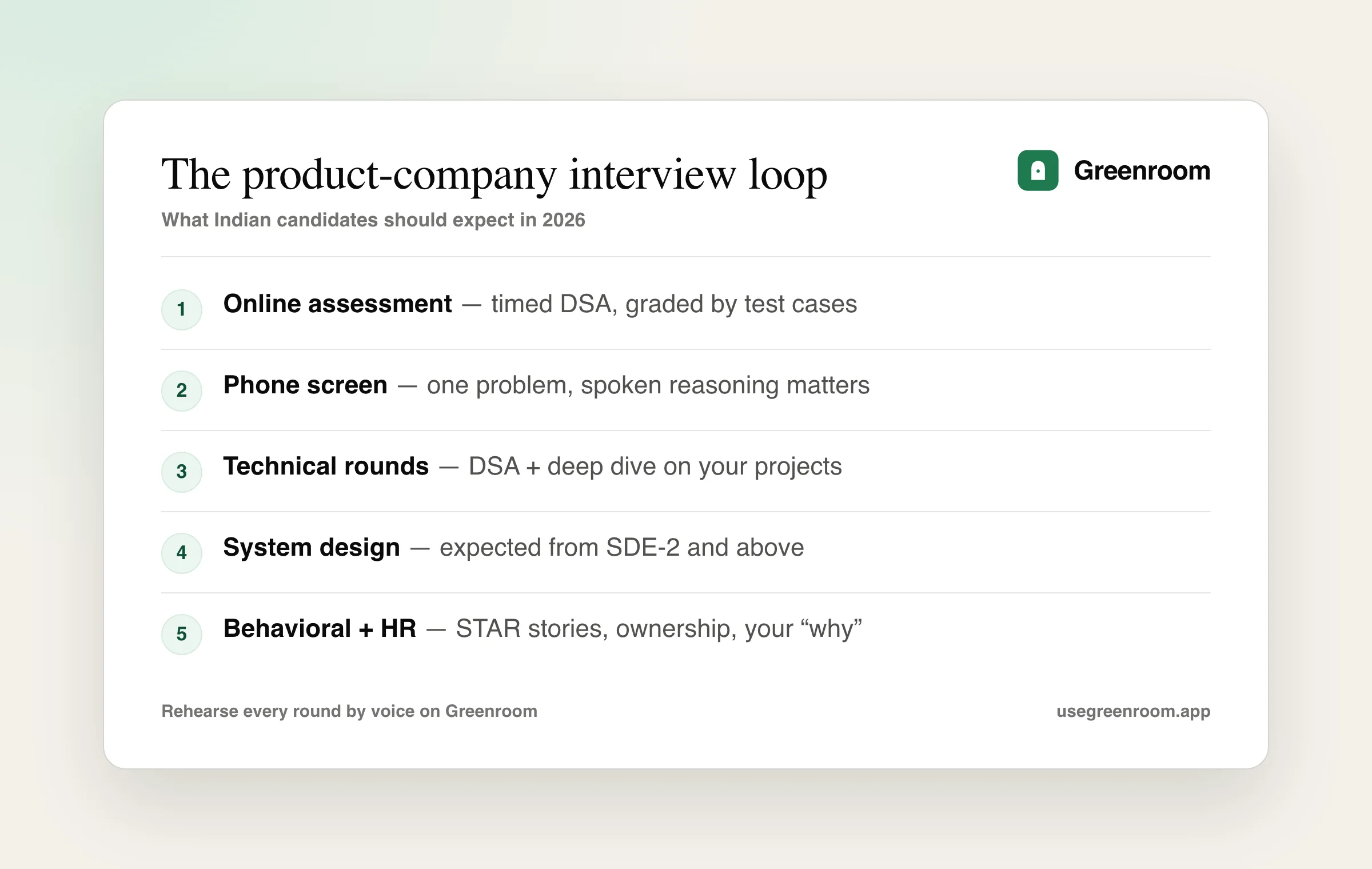
For a product vs service company interview India, the most visible difference is the presence of data structures and algorithms questions. Product companies — startups included — almost universally have a coding round. Service companies largely do not.
You do not need to solve 500 problems. You need to solve 150–200 quality problems with real understanding. The pattern to follow:
- Arrays and strings — two pointers, sliding window, prefix sums
- Trees and graphs — BFS, DFS, shortest paths (Dijkstra)
- Dynamic programming — 1D DP, 2D DP, memoization patterns
- Heaps and hash maps — frequency problems, top-K patterns
- Recursion and backtracking — subsets, permutations
For dsa interview preparation, use NeetCode 150 as your structured list. It is curated specifically for product company interview patterns. Supplement with Striver's A2Z sheet for Indian company patterns. Do not blindly grind — after every problem, write down in one line what pattern it used and why your solution worked.
Step 3 — System design basics (Month 2–3)
System design interview India questions are the second biggest gap for service engineers. At TCS or Infosys you are often working within an already-decided architecture. At a product company, you will be asked to design one from scratch in 45 minutes.
Start with the fundamentals before any resource:
- How does DNS resolution work?
- What is the difference between SQL and NoSQL, and when do you choose each?
- What is horizontal vs vertical scaling?
- What is a load balancer and why does it exist?
- What is a message queue and what problem does it solve?
Once you have the concepts, practice designing real systems: URL shortener, Instagram feed, notification service, ride-sharing backend. The best resource for system design for beginners in the Indian context is the "System Design Interview" book by Alex Xu, combined with the ByteByteGo YouTube channel. Give yourself 6 to 8 weeks on this, overlapping with your DSA practice in month 2.
Step 4 — Project depth and GitHub portfolio (Month 3–4)
One of the most underused advantages service engineers have is real project experience. You have worked on production systems. The problem is most engineers cannot articulate what they did clearly — they describe what the system does, not the decisions they made building it.
For a strong portfolio for software engineer interview, you need at least 2 personal GitHub projects that demonstrate independent thinking. These do not need to be impressive in scope. They need to show that you made real decisions:
- Why did you choose this database?
- What would break at 10x traffic and how would you fix it?
- What did you get wrong in v1 and improve in v2?
Build something real — even small. A job queue, a webhook handler, a CLI tool. Push it to GitHub with a clear README. Interviewers at product companies will ask about your GitHub projects for interview India-style questions: "Walk me through your architecture." Practice that answer out loud, not in your head.
Step 5 — Mock interviews and communication practice (Month 4–6)
This is where most service engineers fail even after all the preparation above. They know the answers but cannot deliver them under pressure, in spoken form, in real time.
The product based company interview preparation that actually works is not reading more resources. It is doing more reps under realistic conditions. This means:
- Talking through your solution before writing code — narrate your thought process
- Practicing behavioral answers using the STAR method (Situation, Task, Action, Result)
- Doing timed mock interviews at least 3 times a week
An infosys to startup interview requires you to show ownership and independent thinking — not just technical correctness. Prepare 5 to 7 stories from your service company experience that demonstrate initiative: a time you identified a performance issue, a time you pushed back on a bad decision, a time you learned something under pressure. Those stories work at any product company.
Realistic timeline for the full switch
- Month 1–2: DSA foundations, 2 problems/day
- Month 2–3: System design fundamentals + 1 personal project
- Month 3–4: Start applying to 5–10 companies, continue DSA
- Month 4–6: Heavy mock interview practice, refine behavioral stories, negotiate offers
The it professional job change tips that matter most: do not wait until you feel "ready." Start applying by month 3 even if your prep is incomplete. Real interview feedback is the best teacher. You will learn more from two live interviews than from two weeks of additional LeetCode.
Made the switch? Our notice period negotiation guide covers the long service-company notice periods that complicate these moves, and the first 90 days guide covers landing well once you arrive.
This is the switch with the largest compensation jump: our how much hike to ask when changing jobs in India guide covers what is realistic and how to justify it.
Many people make both moves at once: our how to switch to an AI engineer role in India guide covers the AI half.
There is a third option many people miss: our GCC jobs in India guide covers global capability centres and how their interviews differ from both.
Repositioning starts with the profile: our LinkedIn profile tips for software engineers guide covers writing what you built rather than the client project code.
Frequently asked questions
Can I switch from TCS, Infosys or Wipro to a product company?
Yes — it happens every hiring cycle, including after 5+ years of service experience. The switch needs four to six months of deliberate prep: DSA foundations, system design basics, one or two defensible projects, and spoken interview practice.
Will my service company experience count at product companies?
It counts if you present it as ownership: what you decided, debugged and improved — not which client account you sat on. Many switchers undersell genuinely good experience by describing it in ticket-and-process language.
Do I need to take a pay cut to move to a product company?
Usually the opposite — product companies in India typically pay 1.5–3× service-company compensation for the same years of experience. The real cost is the months of preparation, not the offer.
What's the biggest mistake service engineers make in product interviews?
Practicing only DSA and walking in unrehearsed for everything spoken: project deep-dives, design discussions, behavioral rounds. Voice mocks on your own projects close that gap faster than more problem grinding.