The biggest misconception about system design interviews is that they're testing whether you know how Kafka works, or what consistent hashing is, or how to shard a database. They're not, really. Those are vocabulary words. You need to know them to participate in the conversation, the same way you need to know what a noun is to write a sentence. But the conversation isn't a vocabulary quiz.
I've given probably a hundred and fifty system design interviews. The candidates I've passed and the ones I've failed have not, on average, differed in how much trivia they knew. They've differed in three other things, all of which you can practice without a partner.
What the interview is actually evaluating
1. Can you size the problem before you solve it?
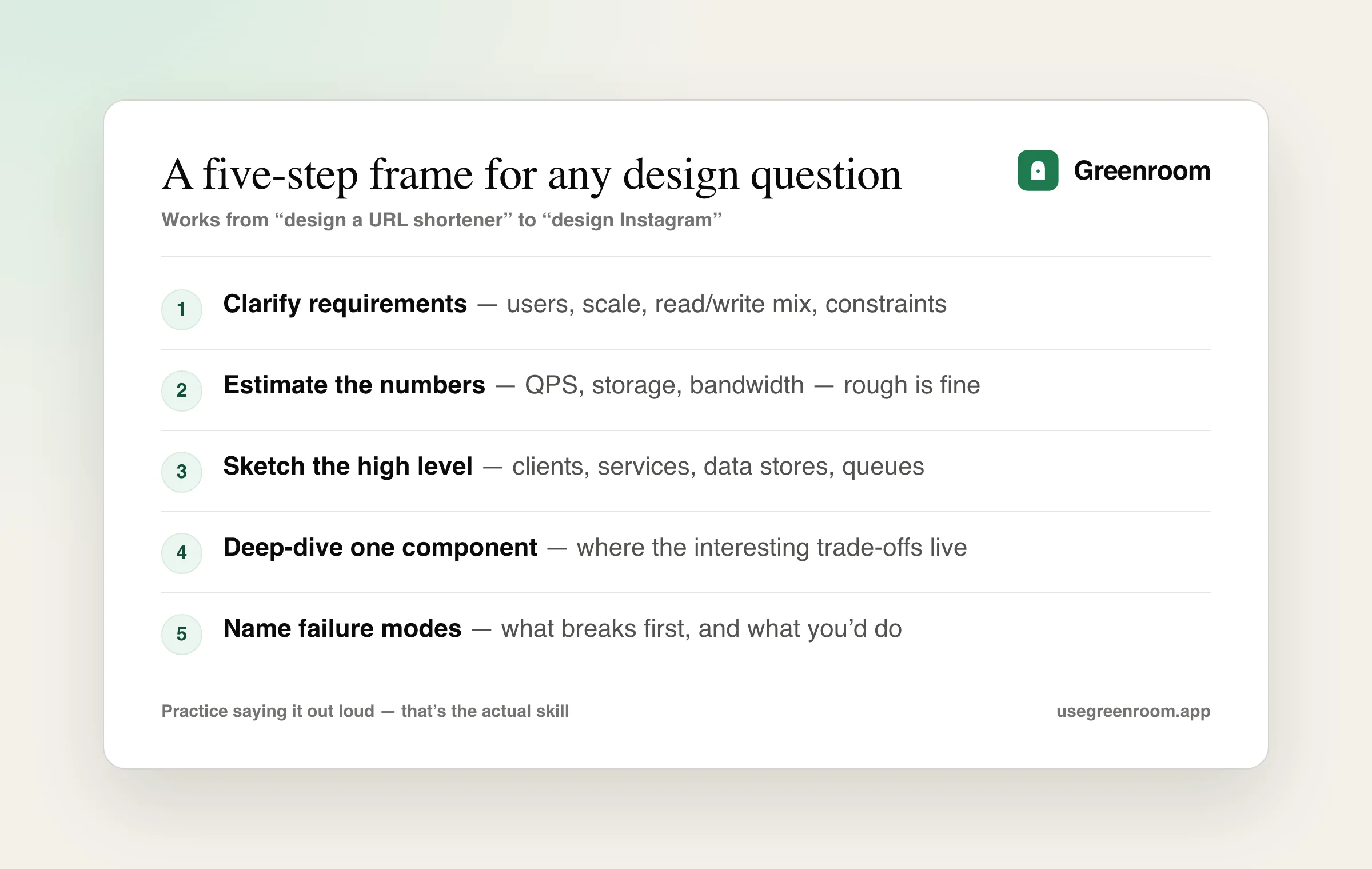
The bad answer to "design Twitter" starts by drawing a load balancer. The good answer starts by asking how many users, how many tweets per second, what the read-to-write ratio is, what the latency target is. Not because you'll plug those numbers into a formula — you mostly won't — but because the numbers tell you what kind of system you're designing.
A read-heavy system at 100x read amplification is a different shape than a write-heavy one. A 10M-user system has different bottlenecks than a 100M one. If you can't tell me roughly the order of magnitude you're designing for, you can't make defensible architectural choices. You're just throwing tools at the wall.
2. Can you make decisions and explain why?
This is the actual core of the interview. Every choice you make — relational vs document DB, push vs pull, cache vs no-cache, async vs sync — should be a decision, not a default. "I'd use Postgres" is a default. "I'd use Postgres because the data has strong relational structure and the read patterns are predictable; if writes became the bottleneck I'd shard by user_id" is a decision.
Interviewers are calibrating, in real time, whether you understand why you're saying what you're saying. If you state a choice and they ask "why not X?" and you can't articulate the trade-off, that's a much bigger red flag than just not knowing X.
3. Can you handle the part where it gets harder?
Every system design interview has a difficulty ratchet. You'll design the happy path. The interviewer will introduce a complication — "what about when this service goes down?" or "how do you handle the same user logged in from two devices?" — and watch how you respond. They're looking at:
- Do you panic, or do you take a beat?
- Do you bolt on a quick fix, or step back and acknowledge it changes some earlier assumption?
- Do you know what you don't know? Can you say "I'd want to think about that for a few minutes" without it sounding like a stall?
This is the part textbooks can't really teach you. You learn it by reps.
The pattern I see junior engineers get wrong
They jump to the solution too fast. They've practiced enough that they have a default architecture in their head for "social feed" or "messaging app" or "ride-share matching," and they just start drawing it. The interviewer asks one clarifying question and the candidate's whole structure collapses, because it wasn't built from the requirements — it was retrieved from memory.
The fix isn't to memorize more architectures. It's to practice the derivation from scratch every time, even when you've done a similar problem before. The skill is "I can build the right architecture from the constraints in front of me" — not "I remember what the architecture for this problem looks like."
The pattern I see senior engineers get wrong
They know too much and skip the basics. They start with "okay, you'd want a write-ahead log and a CDC pipeline into the read replicas" before they've established what the problem even is. Even when this is right, it reads as a confident person guessing at the answer based on the problem name.
Senior candidates should be the most disciplined about working from requirements. The interviewer is partly testing whether you can resist the urge to perform expertise.
How to practice this without a partner
Step 1: Have a list of 8-10 problem prompts
Use one of the standard sets — Hello Interview, the Alex Xu book, Donne Martin's GitHub — and pick maybe 8 that span shape: a feed product (Twitter, IG), a messaging system, a ride-share matcher, a payments flow, a search system, a storage system (Dropbox, S3), a notifications system, and a rate-limiter. That covers most of the territory.
Step 2: For each one, do a 40-minute solo session
Set a timer. Open a blank page (paper, Excalidraw, whatever). Talk out loud — record audio. Walk through the problem from scratch:
- 5 min: Clarifying questions. List the things you'd ask, in order. Estimate the numbers (you can look them up later — for now, guess).
- 5 min: Sketch the simplest possible architecture that meets the core requirements. Just boxes and arrows.
- 15 min: Add depth. Pick the two or three components most likely to be interrogated and zoom in. Storage layer details, API shape, key data structures.
- 10 min: Bottleneck pass. For each component, ask: what breaks first? At what scale? What's the next move?
- 5 min: Failure pass. For each component, ask: what happens if this goes down? What's the recovery path?
Step 3: Listen back to the recording
The first listen-back is brutal. You'll hear yourself trail off, use placeholder language ("we'd probably want some kind of, um, cache thing here"), skip past the parts you're vague on. That's the information you need. Mark the spots where you got vague. Those are your next study targets.
Step 4: Re-do the same prompt three days later
This is the part most people skip. Doing 20 different problems once each is much less effective than doing 5 different problems four times each. The second pass reveals what you actually learned vs. what you talked your way through. The fourth pass is where you start to sound like someone with a sense for the problem.
What to read (and what to skip)
Worth reading
- Designing Data-Intensive Applications by Kleppmann. Once. The whole thing. Yes, it's long. The mental model it builds is genuinely useful — you'll think about replication, partitioning, and consistency differently after.
- The High Scalability blog archives. Real architectures, real numbers. Skim the post-mortems and "how X scales" posts; they give you concrete reference points.
- One textbook of your choice (Alex Xu, Educative, etc.) — for vocabulary and the standard problem patterns. Don't read more than one. They mostly say the same things.
Skip
- Anything that promises "100 system design questions and answers." The answers are usually one of three architectures with the names swapped. Worse, you'll start pattern-matching by problem name instead of by constraints.
- Architecture diagrams from FAANG marketing pages. They're sanitized for the brand. The real systems are messier and the cleanups are interesting.
- Endless YouTube walkthroughs. Passive learning gives you the illusion of progress without the work. Watch one or two as scaffolding, then start producing.
The thing that's surprisingly hard to fake
Estimation. "Roughly how many requests per second is this system handling?" "How big is one user record on disk?" "How many machines would you need?" Interviewers ask these because they reveal whether you've ever actually thought about real systems or only read about them. The numbers don't have to be right, they have to be in the right order of magnitude and justified.
How to handle the "I don't know" moment
You'll get a question where you genuinely don't have an answer. This is fine — it happens to everyone. What matters is how you handle it. The wrong response is to invent something confident-sounding. The right response is to think out loud:
"Okay, so the question is how to handle session affinity across regions. I haven't designed that exactly, but let me reason from what I know. The two ways I'd think about it are: pin a user to a region at login and route from there, or replicate state across regions. The first is simpler, the second is more available. Given the latency requirements we discussed, I'd lean toward the first and add cross-region failover. Does that sound right?"
Notice the moves: name the gap, name the approaches, pick one with a reason, invite correction. That's how senior engineers actually work on real systems. The interview just gives you a high-stress place to demonstrate the skill.
The meta-skill, again
People who do well in system design interviews tend to be people who, when they encounter a new system at their day job, can ask the right questions about it within 20 minutes. The interview tests for the same thing: can you walk into ambiguity with enough structure to make progress, without enough certainty to be dangerous? That's a real skill, and it gets sharper with deliberate practice. Not just exposure — deliberate practice. Recordings, re-runs, marked gaps, follow-through.
Frequently asked questions
What are system design interviews actually testing?
Judgment under ambiguity: whether you clarify requirements, reason about trade-offs with rough numbers, and know where your design breaks. Tool name-dropping without trade-offs is precisely what they're designed to filter out.
Do I need to know Kafka, Kubernetes and every database?
No — you need to know when and why you'd reach for a queue, a cache or a particular consistency model. "A log-based queue fits here because we need replay" beats naming Kafka with no reasoning.
How can I practice system design alone?
Pick a system, design it out loud in 35 minutes, then attack your own design: what fails at 10× load, what's the blast radius of each component dying? Recording yourself — or using a voice AI interviewer that asks the follow-ups — turns this into real practice.
What's the most common system design mistake?
Jumping to architecture before requirements. Juniors skip clarification entirely; seniors over-engineer for scale nobody asked about. Both lose to a candidate who spends three minutes nailing down what's actually being built.