Pranav had five Ownership stories. Five. He'd built a spreadsheet — tabs, color coding, a "backup story" column — and rehearsed each one in the shower until his roommate banged on the bathroom door asking if he was okay. He had Ownership covered from every conceivable angle: the time he fixed a teammate's broken cron job at 11pm, the time he took over an orphaned migration nobody wanted, the time he flagged a billing bug that wasn't even in his module. He walked into his Amazon loop feeling like a man with a loaded clip.
Then the interviewer leaned back and asked: "Tell me about a time you had to accomplish something with way less budget or time than you wanted."
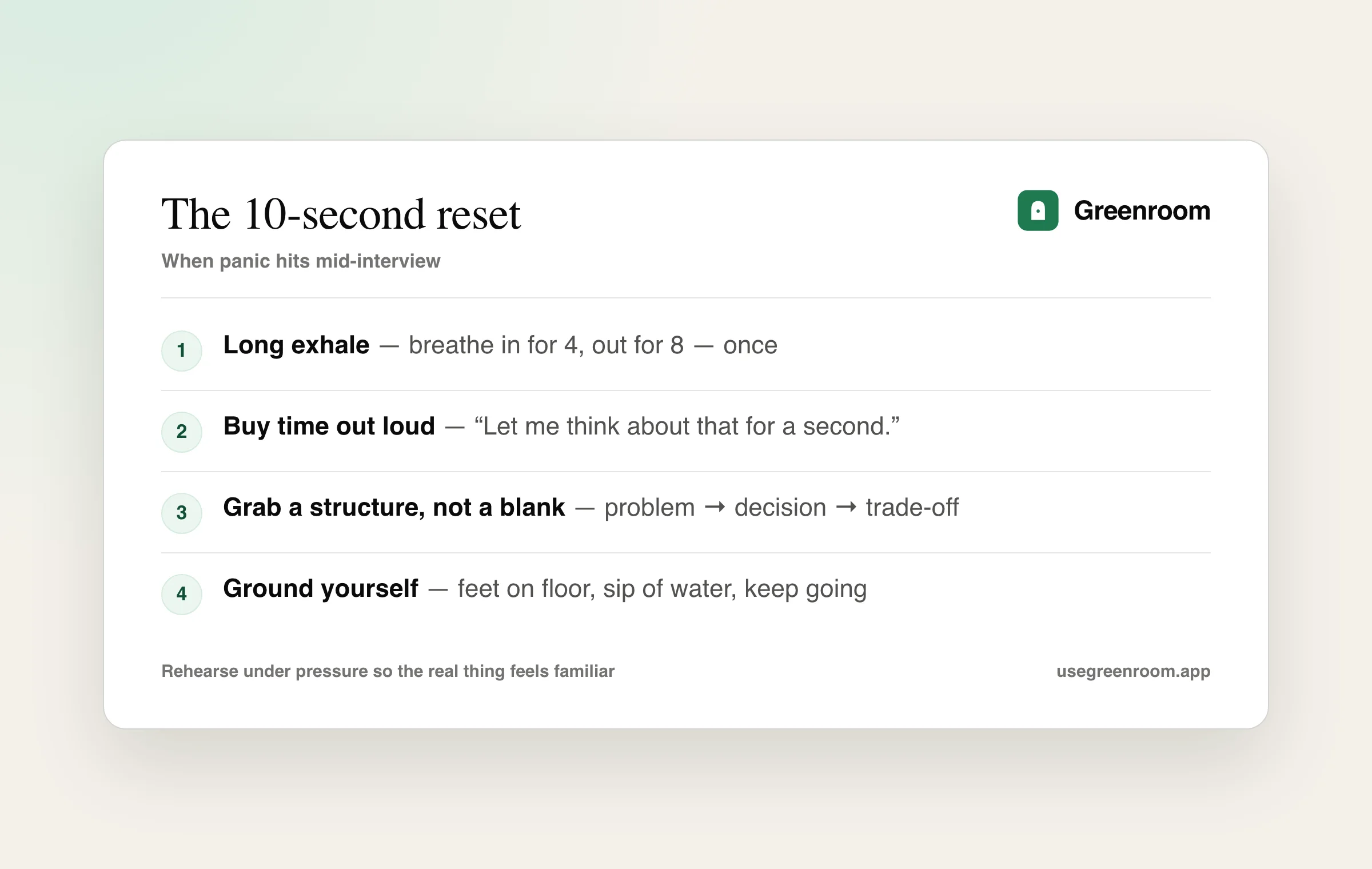
Pranav blinked. Frugality. Nobody had told him Frugality was a real question — he'd assumed it was for supply-chain candidates, not a backend engineer. He opened his mouth, said "So, um, actually—" and then, in a moment of pure panic, tried to retrofit his favorite Ownership story into a Frugality answer by just... talking about budget words louder. "We had limited resources, and I took ownership of those limited resources, resourcefully." The interviewer's pen didn't move. Somewhere in Seattle, a bar raiser's spirit-animal owl silently shook its head.
This guide exists so that doesn't happen to you. Amazon's Leadership Principles — the famous list of 16 that every single interview question in an Amazon loop is secretly built around — are not a "pick your five favorites" situation. They're the entire scoring rubric, and the interviewers assigned to grill you on Frugality, Earn Trust, or Strive to be Earth's Best Employer are just as serious as the ones assigned to Customer Obsession. We're going to go through what the Amazon Leadership Principles interview questions actually sound like for all 16 principles, what a real (not generic) answer looks like for several of them with full worked examples, exactly how Amazon bar raisers interrogate your story once you've told it, how to structure a STAR answer that survives that interrogation instead of collapsing under it, and how to build a story bank that covers all 16 principles without memorizing 16 separate stories — because nobody, not even Pranav with his spreadsheet, has the shower-time for that.
What are Amazon's Leadership Principles, really?
Amazon's 16 Leadership Principles aren't a poster on the breakroom wall that nobody reads twice. They're the literal rubric every interviewer in your loop is handed before they walk into the room. Each interviewer is pre-assigned two or three specific principles to probe — and only those — and after your interview, they write up evidence against each one, scored on a scale, with direct quotes pulled from your answers. The hiring committee and the bar raiser then read every interviewer's writeup side by side, like a panel of judges comparing scorecards after a diving competition, except the diver doesn't get to see the scores until weeks later, by email, usually with bad news in it.
Here's the part that changes how you should prepare: a single weak or vague answer doesn't just cost you one question. It can sink the specific principle an entire interviewer was sent in to evaluate — even if every other interview that day went brilliantly. If your Frugality interviewer leaves the room with nothing usable, "no hire" can get written against Frugality regardless of how well your Ownership and Dive Deep interviews went with two different people down the hall. You're not in five separate conversations. You're building one evidence file across five or six interviews that has to hold up when a stranger reads it cold, three days later, without your tone of voice or your nervous hand gestures to fill in the gaps.
That's also why "I have five great stories" — Pranav's mistake — is the wrong unit of preparation. Five stories that all demonstrate the same two or three principles leave you with nothing when the conversation goes somewhere else, and the conversation will go somewhere else, because Amazon interviewers are specifically trained to ask about principles candidates don't expect.
The 16 principles, what they really test, and the shape of a strong answer
Customer Obsession
The official line is "start with the customer and work backwards." In practice, interviewers are listening for whether you've ever made a decision that cost you something internally — time, a clean roadmap, a colleague's preference — because it was better for the end user. A weak answer talks about caring about users in the abstract. A strong answer's shape: you noticed a gap between what the team assumed customers wanted and what they actually needed (often from support tickets, usage data, or direct conversations), you pushed back on an internal plan because of it, and you can name the metric that moved afterward — adoption, churn, support ticket volume, NPS. The "I disagreed with the roadmap because of a customer signal" shape is the strongest version of this story.
A worked example. Imagine you're a backend engineer at a mid-size fintech app. Your team's roadmap for the quarter is "ship faster KYC verification" — a pure speed play, championed by a PM who has the metrics to back it. You're two weeks into the build when you notice, almost by accident, a recurring pattern in support tickets: users from smaller towns are failing verification not because the system is slow, but because the document-upload flow assumes a steady high-speed connection, and their photos are timing out mid-upload on patchy mobile data. Speed isn't the problem these users have — reliability on bad networks is. You pull thirty of the failed-verification tickets yourself, find that 60% of them share this exact pattern, and bring it to your PM with the data, arguing that shipping the speed improvement first while ignoring this would optimize for users who were never actually struggling. It's an uncomfortable conversation — you're asking to slow down a roadmap item that already has executive buy-in. You propose a chunked-upload retry mechanism instead, ship it as a fast-follow alongside the speed work, and verification failure rate for low-bandwidth users drops by 35% the following month. That's Customer Obsession: you found a customer signal nobody else had looked for, it cost you something (an uncomfortable scope conversation with your PM), and you can point to the number that moved.
Ownership
"Think long-term and act on behalf of the entire company, beyond just your own team" is the definition; "never say 'that's not my job'" is the practical test. The strongest Ownership stories describe a problem that had no clear owner — something that fell in the cracks between teams, or a bug/process gap nobody wanted to touch — and you picked it up anyway, often outside your formal scope, and saw it through to a real fix rather than just flagging it. The follow-up bar raisers always ask here is "why didn't someone else do this?" — your answer needs to show genuine gap-filling, not stepping on a teammate who was already handling it.
Invent and Simplify
This is not "I built something clever." It's the opposite: a strong story shows you found a simpler path that others had overlooked because they were anchored on the existing complex solution. Think: replacing a six-step manual process with one automated step, cutting a config system down to three options instead of twenty, or killing a feature nobody used instead of maintaining it. Interviewers want to hear you name the complexity you removed and what you measured afterward — fewer support tickets, faster onboarding, less code to maintain.
Are Right, A Lot
The official phrasing is "strong judgment and good instincts," but the real test is whether you actively seek out information that might prove you wrong before committing. A strong story isn't "I made a call and I was right" — it's "I had a strong initial view, I deliberately sought out the person most likely to disagree with me, changed my approach based on what I learned, and the outcome validated the adjusted plan." The humility to look for disconfirming evidence is the actual signal, not the batting average.
Learn and Be Curious
This principle gets tested through a "tell me about something you learned recently that changed how you work" or "describe a time you went outside your expertise" question. The shape that lands: you identified a real gap in your own knowledge that was blocking something concrete (not just generic curiosity), you went and closed it — a course, a mentor, reading the actual source code of a dependency, shadowing another team — and you can point to a specific way that new knowledge changed a decision you made afterward.
Hire and Develop the Best
For senior and lead candidates, this principle is tested directly: "tell me about a time you developed someone" or "describe how you've raised the bar on a team." The strongest stories describe a specific person, the specific skill gap, the specific thing you did (structured feedback, pairing, a stretch assignment, an honest performance conversation), and where that person ended up afterward. For individual contributors with no formal reports, a strong substitute is mentoring a junior teammate, writing a guide that changed how the team onboards, or giving feedback that changed a peer's approach — ownership of someone else's growth, even informally.
Insist on the Highest Standards
This is distinct from Deliver Results — it's about refusing to ship something mediocre even under pressure to move on. A strong story: you caught a quality issue (in code, in a process, in a launch) that others were willing to let slide because it wasn't blocking, you raised the bar anyway — even at the cost of timeline or friction with stakeholders — and you can describe the standard you set that stuck after you left the project. Weak answers describe perfectionism without a concrete bar or a concrete cost you accepted to hold it.
A worked example. Say you're a QA-minded engineer on a small team shipping a checkout redesign. Three days before launch, everything passes the test suite, the designers are happy, and the team Slack channel is in full "ship it Friday" mode. You notice, almost as an afterthought while clicking around, that the new error states for failed payments are visually identical to the success states — same green checkmark icon, different text underneath that's easy to miss on a small screen. Nobody flagged it because the happy-path demo never triggers a failed payment. You raise it in standup. The reaction is lukewarm — "it's an edge case, ship now, fix next sprint" — because nobody wants to touch the launch date three days out. You push back specifically: you pull last quarter's payment failure rate (4% of all transactions, which at this app's volume is hundreds of confused users a week), mock up a 20-minute fix using an existing red-state icon already in the design system, and offer to own the fix yourself so it doesn't block anyone else's Friday. The team agrees, the fix ships same-day, and "does the error state actually look like an error" becomes a checklist item the design lead still cites in reviews eighteen months later. That's the standard sticking after you left the project — the actual signal bar raisers are listening for.
Think Big
Interviewers are listening for whether you can describe a bigger version of a problem than the one you were assigned, and whether you actually pursued it rather than just thought about it. A strong story shows you took a narrow ask — "fix this one report" — and proposed (and ideally built) the platform-level fix that solved the whole category of problem, with a sense of the larger opportunity you were chasing, not just incremental improvement.
Bias for Action
The official framing is "speed matters in business — many decisions are reversible and do not need extensive study." The test is whether you can tell a story where you deliberately chose speed over certainty because the decision was a "two-way door" (reversible), distinct from a one-way-door decision where slowing down was correct. Strong answers name the specific reasoning for why that decision was reversible, not just "I moved fast and it worked out."
Frugality
This is one of the most under-prepared principles — Pranav's downfall — because candidates assume it only applies to supply-chain or cost-cutting roles. The real test is "accomplish more with less": a strong story describes solving a real problem without asking for more headcount, budget, or a new tool, often by repurposing something that already existed. Bar raisers specifically probe whether you considered the cheap option first before reaching for the expensive one.
A worked example. Imagine your team needs a way to monitor a flaky third-party API integration — alerts when it's slow or failing, a dashboard for the on-call engineer. The "proper" fix everyone assumes is the answer: buy an observability platform subscription, budget approval required, a six-week procurement cycle. Instead, you notice your company already pays for a logging tool nobody's using past its free tier, and it has a basic alerting feature buried in settings that nobody had configured. You spend an afternoon wiring up custom log lines and threshold alerts using the tool you already have, write a two-paragraph runbook, and the team has working alerting by Thursday instead of by next quarter — for zero additional spend. Three months later when the team does eventually need a dedicated observability platform for a much bigger reason, your scrappy version has already been quietly catching incidents the whole time. That's Frugality: the cheap option was actually evaluated and chosen on its merits, not as a consolation prize.
Earn Trust
This principle covers listening, being "vocally self-critical," and treating others with respect even under disagreement. The strongest stories describe a moment you admitted a mistake to your team or manager before being caught, or gave a colleague hard feedback in a way that didn't damage the relationship. Interviewers are specifically listening for self-criticism that isn't performative — a real cost you bore for being honest, not a humble-brag dressed up as a flaw.
Dive Deep
"Stay connected to the details, audit frequently, be skeptical when metrics and anecdote differ" — the test is whether you can describe a real moment you didn't trust a dashboard or a summary and went and pulled the raw data or read the actual logs yourself, found something the surface-level view missed, and changed a decision because of it. The strongest version names the specific discrepancy between what the metric said and what was actually happening.
Have Backbone; Disagree and Commit
This is two principles in one and bar raisers test both halves. The first half: did you actually voice disagreement, with the specific person who outranked you, rather than going along to avoid conflict? The second half, which candidates forget: once the decision was made against your view, did you commit fully rather than quietly undermine it or say "I told you so" later. A strong story shows both halves explicitly — the disagreement, the way you raised it respectfully, and the genuine commitment afterward even though you didn't get your way. If this is the principle you're weakest on, our guide on disagreeing with your boss walks through the framing in more depth.
Deliver Results
This is the most generic-sounding principle and the easiest to answer with platitudes, which is exactly why bar raisers probe it hardest for specifics. A strong story names the actual obstacles that came up mid-project (not a clean, frictionless success story), how you adjusted, and a quantified result at the end — a number, a date, a percentage. "We shipped it" is not a Deliver Results story; "we hit a vendor delay three weeks before launch, I renegotiated scope to ship the core flow on time and the rest two weeks later, and we still hit the quarter's number" is.
Strive to be Earth's Best Employer
A newer principle that candidates rarely prepare for, which makes it a good differentiator if you have a real story. It's tested through questions about building an inclusive team environment, supporting a struggling teammate, or improving team culture — not grand gestures, but a concrete action that made the day-to-day experience of working with you better for someone else. A story about noticing a teammate was burning out and restructuring work to help, or making a process more accessible to a quieter team member, fits well here.
Success and Scale Bring Broad Responsibility
The least commonly tested in early-career loops, more common at senior and principal levels, this principle covers thinking beyond your immediate team's success to the broader impact of what you build — security, fairness, unintended consequences at scale. A strong story describes a time you flagged a risk in something that was working well and scaling fast, because the scale itself created a new kind of responsibility (a privacy implication, a fairness issue, a dependency risk) that wasn't visible at smaller scale.
How Amazon bar raisers actually probe your answers
A bar raiser's job is not to listen to your story once and score it — it's to interrogate it until they're confident it's real, specific, and actually yours. This is also the part of the loop most candidates never rehearse, because reading a list of questions on Reddit teaches you what's asked, not what happens after you answer. Expect this pattern, in roughly this order:
- "Tell me more about your specific role." This is the single most common follow-up, and it exists because candidates default to "we" when describing team projects. If your initial answer doesn't clearly separate what you did from what the team did, expect to be asked directly: "what did you, personally, do, versus the rest of the group?" This is also the exact question that would have caught Pranav's panicked Frugality-flavored Ownership story — the moment a bar raiser asks "okay, but specifically what did you decide," a retrofitted story runs out of road fast.
- "What was the alternative, and why didn't you choose it?" This tests whether you actually weighed options or just did the first thing that came to mind. A real decision-maker can name the road not taken and why it was worse.
- "What would you do differently?" This isn't a trick question looking for a confession of failure — it's testing self-awareness. An answer of "nothing, it went perfectly" reads as either dishonest or incurious. A strong answer names one genuine, specific adjustment, not a vague platitude like "communicate more."
- "How did others react?" Bar raisers ask this to check whether your story accounts for the human reaction to what you did — pushback, disagreement, gratitude — because real workplace situations almost always have one. An answer with zero friction from anyone else is a flag.
- "Walk me through exactly what you said in that conversation." When a story involves disagreement or persuasion, expect to be asked to replay the actual dialogue. Vague summaries ("I explained my reasoning and they came around") get pushed on until you produce something concrete enough to sound like a real memory rather than a reconstructed narrative.
- Checking "I" vs. "we" consistently. Bar raisers track pronoun usage across your whole answer, not just the headline. If your STAR answer says "I" in the Task but slides into "we" for the entire Action section, that's read as a sign the achievement was team-driven and you're claiming individual credit you may not be entitled to. Candidates who count their own "we"s mid-answer and try to self-correct live ("I — er, we — well, I specifically...") are at least showing they know the rule, which is a small data point in their favor, but it's a much better sign if your story just naturally has a high "I" density because you genuinely drove the action.
The net effect: a fabricated or borrowed story falls apart under two or three of these follow-ups, because the details don't hold together under pressure. A real story, even an imperfect one, gets more specific the more you're pushed on it — which is exactly the signal bar raisers are trained to detect. This is also precisely the gap between reading prep material and rehearsing out loud, which we'll come back to.
How candidates actually prepare for this — and where each approach falls short
Before we get to the structure of a good answer, it's worth being honest about how people actually prepare for Amazon's Leadership Principles loop today, because most of the popular methods get you partway there and then quietly stop.
The Blind/Reddit megathread. Search "Amazon Leadership Principles interview questions" and you'll land on a years-old Blind or Reddit megathread with hundreds of comments listing exact questions candidates were asked, often broken down by team and level. This is genuinely useful for one thing: knowing the question phrasing Amazon actually uses, which is more specific and more varied than the generic "tell me about a time you led a team" prompts you'll find in generic interview-prep listicles. Glassdoor's interview-question database for Amazon serves a similar purpose, often with more recent postings tagged by specific team and level, which is worth cross-referencing against the older Blind threads since Amazon's exact phrasing drifts year to year. The limitation, on both sites, is that a thread full of questions doesn't tell you whether your answer to any of them is any good, and neither one can push back on you. You can read three hundred comments and still walk in with a Pranav-style gap in your prep, because the thread tells you what's asked, not what happens when your answer is thin.
A friend's shared "stories that worked" Google Doc. Common in college placement-cell circles and alumni networks — someone who got an Amazon offer shares a doc with their actual STAR stories, sometimes annotated with which principle each one hit. These are genuinely well-written, because they got someone an offer. The problem is structural, not a quality issue: it's their story, written in their voice, with their specific role. The moment you adapt someone else's story to sound like your own experience, you've created exactly the kind of narrative that collapses under "tell me more about your specific role" — because you don't actually remember the granular details a bar raiser asks for, since you didn't live them.
Generic ChatGPT STAR-answer generation. Typing "write me a STAR answer for Ownership" into a chatbot produces something structurally correct — Situation, Task, Action, Result, all present, often genuinely well-organized — but generic in exactly the way that fails the loop. It's optimized to sound plausible, not to be a memory you can be pushed on. The honest use case here is good: it's a fine tool for understanding the shape of a strong answer for a principle you're struggling to frame, or for drafting a first pass of your own real story that you then edit to be true. It's a bad tool for generating the actual content of your answer wholesale, because a bar raiser's "walk me through exactly what you said in that conversation" question has no good answer if the conversation never happened.
A paid LP-prep course. Structured courses (often bundled with general behavioral-interview prep) walk through all 16 principles methodically, sometimes with example answers and exercises to map your own experience to each one. These are legitimately useful for the mapping exercise — turning "things I've done" into "things tagged against each Leadership Principle" is exactly the structured thinking this guide also walks through below. Where they fall short: most are reading- or writing-based, not speaking-based, and the actual failure mode in Amazon loops is rarely "I didn't know the framework" — it's "I knew the framework on paper and froze when the bar raiser interrupted me mid-sentence with a follow-up I hadn't rehearsed answering out loud."
The honest throughline across all four: reading, copying, generating, or studying a story is a different skill from producing one verbally, under mild real-time pressure, while someone is actively trying to find the soft spot in it. That's the gap Greenroom is built to close — it runs a real spoken mock interview that asks Amazon-style "tell me about a time" questions and then actually follows up the way a bar raiser would, live, so the first time your story gets pressure-tested isn't in the actual loop. It won't write your stories for you, and it shouldn't — the stories have to be yours, lived and specific. What it does is the part none of the four alternatives above can: catch you saying "we" twelve times, or catch the moment your "what would you do differently" answer goes vague, before a real bar raiser does.
How to structure a STAR answer that survives follow-ups
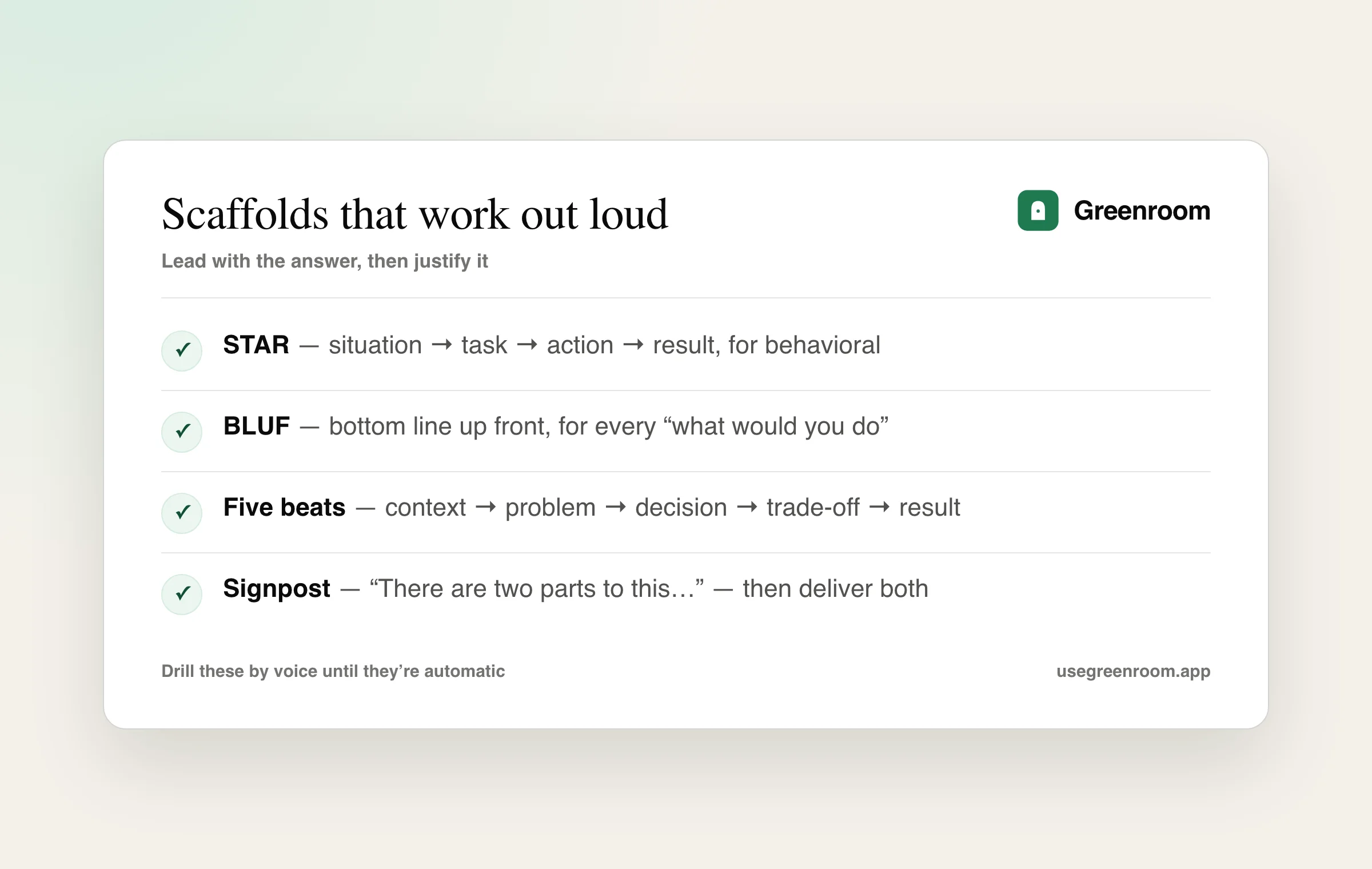
Amazon explicitly asks for the STAR format — Situation, Task, Action, Result — and most candidates know the acronym but get the proportions wrong under pressure. Use this allocation as a rough guide for a 90-second-to-2-minute spoken answer:
- Situation (10–15%). One or two sentences of context — company, team, the problem that existed. Resist the urge to set the scene for thirty seconds; the bar raiser doesn't need the org chart, they need to know enough to understand the stakes.
- Task (10%). What you were specifically responsible for, stated in one sentence. This is where you plant the "I" — "my task was to..." not "our team needed to..."
- Action (50–60%). The bulk of the answer, told as a sequence of decisions and actions you took, narrated in first person with concrete verbs: "I proposed," "I tested," "I pushed back," "I convinced." This is the section bar raisers grade hardest, because it's where ownership and judgment actually show up. Walk through at least two or three discrete steps, not one big leap from problem to solution.
- Result (15–20%). A quantified outcome — a percentage, a dollar figure, a time saved, a metric that moved — followed by one sentence of reflection or learning. "We cut p99 latency 40%, and the lesson I took was to instrument before optimizing, not after" lands far better than just the number alone.
The most common STAR mistakes, in order of how often they sink an otherwise-good story:
- Spending too long on Situation and Task. If you're 45 seconds in and still describing context, you've lost half your answer before the part that actually gets scored begins.
- An Action section with no real decisions in it. "We had a meeting, then we built the feature, then we shipped it" describes a timeline, not a decision-maker. Bar raisers are listening for moments where you chose between two real options.
- Vague or missing metrics in the Result. "It went well" or "the team was happy" isn't a result Amazon will credit — if you genuinely don't have a number, say the closest proxy you do have ("we went from constant escalations to zero in the following month") rather than nothing.
- Forgetting which principle the question is actually testing. A perfectly good story about hard work can still score "no hire" on Ownership if it never shows you taking on something beyond your assigned task. Before you answer, silently identify which principle the question is fishing for, and make sure your Action section gives direct evidence of that principle specifically, not just a generally impressive achievement. This is also the trap that ate Pranav: he knew his own stories cold, but he hadn't rehearsed recognizing a question for a principle he hadn't prepped, so when Frugality showed up unannounced, he had no fallback besides desperately repurposing what he had on hand.
It's worth saying explicitly what "rehearsed out loud" should actually feel like, because a lot of candidates conflate "I've thought about this story a few times" with "I've rehearsed it." Thinking about a story silently lets you skip over the awkward parts — the exact words you used in a hard conversation, the moment your plan almost didn't work, the part where a colleague was annoyed at you. Saying it out loud, especially to something or someone that interrupts you, forces those gaps to surface before the interview does. If you've never once said your Dive Deep story out loud from start to finish without a script, you don't actually know if it's two minutes or five, and you don't know if your "I" count holds up — you only know what it feels like in your head, which is not what the bar raiser is grading.
Building a story bank: 8–10 stories that cover all 16 principles
You don't need 16 separate stories — you need 8 to 10 real, well-chosen stories, each one mapped to two or three principles, because most genuine workplace situations demonstrate more than one principle at once. A single story about pushing back on a launch date because of a data quality issue you found can simultaneously demonstrate Dive Deep (you found the issue in the raw data), Have Backbone; Disagree and Commit (you pushed back on the date), and Insist on the Highest Standards (you refused to ship with the known issue).
To build your bank: list 8–10 of the most significant things you've actually done — a project, a conflict, a failure, a mentoring relationship, a process you fixed, a hard call you made under deadline pressure. For each one, run it against the full list of 16 principles and tag every principle it genuinely demonstrates, not just the obvious one. Most candidates stop at the first matching principle and miss that the same story also covers two more. Pranav's mistake, again, was the inverse of this: he had five stories all pre-tagged to the same one or two principles, instead of fewer stories spread wider.
A practical way to do this tagging exercise: write each of your 8–10 candidate stories as a one-paragraph summary, then go down the list of all 16 principles and ask, for each one, "does any part of this story — even a part I wasn't planning to emphasize — actually demonstrate this?" You'll often find a story you thought was purely a Deliver Results story also has a hidden Earn Trust angle, because partway through you admitted to your manager that your original estimate was wrong, before being asked. That's free coverage you'd otherwise have missed.
Once you have your 8–10 stories tagged, check the resulting coverage map against all 16 principles — if Frugality or Strive to be Earth's Best Employer has zero stories tagged, that's a gap to specifically dig for, because those are exactly the principles candidates are least prepared to discuss when asked, which is also exactly why bar raisers like asking about them. If you genuinely don't have a strong Strive to be Earth's Best Employer story, think smaller than you'd expect — helping a teammate after a layoff scare, restructuring a meeting so a remote teammate in a different timezone wasn't always the one losing sleep, making documentation accessible to a non-native English speaker on your team. The bar for this principle is "made the day-to-day experience better for a specific person," not "ran a company-wide wellness initiative."
A failure story deserves special attention in your bank, because at least one Amazon interviewer will almost certainly ask for one directly — it's one of the most reliable ways to test Earn Trust and Learn and Be Curious simultaneously. If you don't already have one rehearsed, our guide on answering "tell me about a time you failed" is worth reading before your loop, because a weak failure story (one with no real cost, or one that's secretly a humble-brag) is almost as damaging as having none at all.
Then rehearse each story out loud in full STAR form, because a story you've only ever told yourself silently will fall apart the first time a bar raiser interrupts you mid-sentence with "tell me more about your specific role." Rehearsing doesn't mean memorizing a script word-for-word — a memorized script is brittle and obviously memorized the moment a follow-up knocks you off the rails you planned. It means knowing the real shape of the story (the situation, the decision points, the actual numbers) well enough that you can answer an unscripted follow-up about any part of it without needing to invent details on the spot, because you're describing something that actually happened to you rather than reciting something you wrote.
A few principle pairs candidates consistently confuse
Because the 16 principles overlap in places, it's worth flagging the pairs that bar raisers see candidates mix up most often, because getting caught confusing them mid-answer is its own small red flag about how deeply you actually understand the framework.
Ownership vs. Deliver Results. Ownership is about scope — did you take on something beyond what you were explicitly assigned. Deliver Results is about follow-through under obstacles — did you actually finish despite friction. A story can have one without the other: someone who picks up an orphaned bug outside their team (Ownership) but never actually fixes it isn't a Deliver Results story; someone who grinds through a brutal but fully-assigned project to the finish line (Deliver Results) without ever stepping outside their lane isn't an Ownership story.
Bias for Action vs. Are Right, A Lot. Bias for Action is specifically about reversible decisions where speed beats certainty. Are Right, A Lot is about judgment quality and seeking disconfirming evidence, regardless of speed. A story where you moved fast on something irreversible isn't a good Bias for Action story (it's arguably a recklessness story), and a story where you took weeks of careful analysis to reach the right call isn't a Bias for Action story even if you were, in fact, right a lot.
Insist on the Highest Standards vs. Dive Deep. These often live in the same story (as in the checkout-error-state example above) but test different things. Dive Deep tests whether you went and found the actual ground truth yourself instead of trusting a summary. Insist on the Highest Standards tests whether, once you found a problem, you actually pushed to fix it even when it cost you something. You can Dive Deep into data and find a real issue, then shrug and let it slide — that's Dive Deep without Insist on the Highest Standards, and bar raisers notice the difference.
Earn Trust vs. Have Backbone; Disagree and Commit. Both involve friction with another person, which is exactly why candidates blur them together. Earn Trust is fundamentally about honesty and self-criticism — admitting you were wrong, giving hard feedback respectfully, listening genuinely. Have Backbone is about holding a position under social pressure and then genuinely letting go of it once a decision is made. A story where you confessed a mistake before being caught is Earn Trust; a story where you pushed back on a senior stakeholder's plan and then executed their version anyway once overruled is Have Backbone. Some stories do carry both, but naming which half of the story is doing the work for which principle is exactly the kind of precision that separates a candidate who memorized the list from one who actually understands it.
Practise explaining your stories, not just listing them
Reading this list of 16 principles is not the same as being able to produce a tight, specific STAR answer on demand when a bar raiser interrupts you mid-story. The real interview is spoken and adaptive — the follow-ups land in real time, and silent prep leaves you exposed the moment you're pushed for "your specific role" or "what you'd do differently." A Reddit megathread tells you what's asked. A friend's doc tells you what worked for someone else. A chatbot tells you the shape an answer should have. None of them tell you whether you, talking out loud under mild pressure, can actually hold your story together — that only shows up when something pushes back on you in real time, which is the exact gap Pranav discovered the hard way when Frugality showed up uninvited.
Greenroom runs a real spoken behavioral interview that asks Amazon-style "tell me about a time" questions, follows up on your answers the way a bar raiser would, and gives you feedback on structure and specificity — so practising explaining your stories out loud happens before the real interview, not during it. Pair it with our guides on answering "tell me about yourself", explaining a project without rambling, and behavioral STAR answers for senior engineers if you're further along in your career and the bar for "Action section" specificity is even higher.
Preparing the technical half too? Our Amazon backend interview questions guide covers how these principles are scored inside the coding and system design rounds.
Frequently asked questions
How many Amazon Leadership Principles interview questions should I prepare for?
Prepare 8 to 10 real stories from your own experience, each tagged to two or three Leadership Principles. Because most stories map to more than one principle, that pool lets you cover all 16 principles across a full interview loop without scrambling for a new example each time.
What is the STAR method and does Amazon expect it?
STAR stands for Situation, Task, Action, Result. Amazon explicitly asks candidates to answer behavioral questions in this format. Keep Situation and Task to roughly a quarter of the answer combined, spend the majority of the answer on the Action using 'I' rather than 'we', and end with a quantified Result plus a one-line learning.
What does the Amazon bar raiser do?
The bar raiser is a trained interviewer from outside the hiring team who has veto power over the hire. They score whether your answers give specific behavioral evidence of the Leadership Principles, and they probe with follow-up questions like 'tell me more about your specific role,' 'what was the alternative,' and 'what would you do differently' to test whether your story holds up under pressure.
Which Amazon Leadership Principles do candidates most often forget to prepare for?
Frugality, Earn Trust, Strive to be Earth's Best Employer, and Success and Scale Bring Broad Responsibility are the most commonly under-prepared, because candidates default to rehearsing only the most famous principles like Customer Obsession, Ownership, and Bias for Action. Bar raisers are aware of this pattern and specifically probe the less-rehearsed principles to separate prepared candidates from those reciting memorized stories.
How do I know which Leadership Principle a question is actually testing?
Listen for the verb in the question. 'Tell me about a time you disagreed' points to Have Backbone; Disagree and Commit. 'Describe a time you found a simpler solution' points to Invent and Simplify. 'Tell me about a time you dug into data' points to Dive Deep. Before answering, silently name the principle you think is being tested, and make sure your Action section gives direct evidence of that specific principle, not just a generally impressive achievement.
Is it cheating to reuse a story from a Reddit or Blind thread, or a friend's prep doc?
It's not cheating, but it usually doesn't work. A bar raiser's follow-up questions — 'tell me more about your specific role,' 'walk me through exactly what you said' — are designed to surface granular details that only exist if you actually lived the story. A borrowed story can sound polished on the first pass and then fall apart on the second or third follow-up, because you're reconstructing someone else's memory instead of recalling your own. Use other people's stories to understand the shape a strong answer takes, then build your own from your real experience.
How do I practise for an Amazon behavioral interview?
Rehearse your STAR answers out loud, not in your head, and use something that follows up on your answers the way a real interviewer would. A voice-based AI mock interview that asks 'tell me about a time' questions and pushes back with bar-raiser-style follow-ups is the closest simulation of the real interview experience.