There is a very specific species of panic that hits at 1:47am, eleven hours before a real interview, when you suddenly decide the responsible thing to do is six mock interviews back to back before sunrise. You open a tab. You open four more tabs. You message a friend who is asleep and will not see "bro can we mock rn" until 9am, which is also roughly when your interview starts. You settle for talking to your own reflection in a dark laptop camera, asking yourself "tell me about a time you showed leadership" in a voice that does not sound like your own, and answering in a voice that sounds even less like it. By mock interview number three, you have started rambling about a hackathon from 2019 with the structural integrity of a Jenga tower mid-collapse. You are not more prepared than you were at 1:47am. You are just more tired, and now also slightly unsettled by the sound of your own voice saying "synergy."
This is what happens when "how many mock interviews should I do" gets answered with a number pulled out of panic instead of a number pulled out of a plan. So here is the plan, with actual numbers, broken down by who you are and how much time you have — because "it depends" is true in the most useless way possible, and you didn't come here for that.
It's also worth admitting upfront that the 1:47am scenario isn't a rare edge case. It's closer to the median experience of someone Googling this exact question. The search "how many mock interviews should I do" spikes, predictably, the night before and the morning of real interviews, which tells you almost everyone asking it is already too late to act on a calm, well-paced answer and is instead looking for permission to do something right now. If that's you, reading this at 2am with an interview in nine hours: do one mock, a short one, then sleep. The number that actually moves your odds tonight is hours of rest, not mocks crammed before sunrise. If you've got more runway than that, keep reading, the rest of this is for you.
The real number, up front
If you want the one-line answer before the reasoning: most candidates need somewhere between 6 and 20 mock interviews total, split across behavioral and technical formats, spaced out over at least a week and ideally three to six weeks, with the last one or two happening 48+ hours before the real thing, never the night before. The exact number inside that range depends on your experience level, the kind of interview loop you're facing, and how much runway you have. Below is the breakdown by scenario, then by timeline, then the part that actually matters more than the count: how to tell the reps are working instead of just accumulating.
This is also where it's worth being honest about what "mock interview" means in this post. It means a full, timed, spoken rehearsal with a question you didn't write yourself and a follow-up you didn't expect — not silently reading a list of likely questions, and not whispering an answer to yourself while scrolling a PDF. A surprising number of people who say "I've done fifteen mock interviews" actually mean "I've read fifteen sets of answers," which is a different activity with a much lower return. Keep that distinction in your head for the rest of this post; it changes the math.
By scenario: how many mock interviews you actually need
"It depends" is true, but it depends on a small number of knowable things, not an infinite fog of variables. Here's the breakdown by the four situations almost everyone reading this falls into.
Fresher prepping for campus placements
Target: 8-12 mock interviews, weighted roughly 40% HR/behavioral, 60% technical/aptitude, run across the 3-4 weeks before placement season starts.
Campus placements are unusual because the format is highly predictable: TCS, Infosys, Wipro, Cognizant, Capgemini, Accenture and the rest run a near-identical pipeline (online aptitude test, technical interview on CS fundamentals and a couple of academic projects, then an HR/managerial round) and the question pool, while large, is well documented. That predictability is exactly why freshers under-rehearse the verbal part: they grind aptitude questions and LeetCode-easy problems for weeks, then walk into the technical round and freeze the first time someone asks "walk me through your final-year project" out loud, live, with a stranger watching them think.
The fix is lopsided on purpose. You don't need 12 mocks of "explain OOP concepts": you need 3-4 technical mocks that drill your ability to explain your own projects and basic CS fundamentals without re-reading notes, and 4-6 behavioral/HR mocks that get your "tell me about yourself," "why this company," and one or two STAR stories from a project or internship down to something that doesn't wander. Our campus placement interview guide for India breaks down the actual round structure if you haven't mapped your specific pipeline yet, and aptitude test preparation for placements covers the written round this post deliberately skips, since that part isn't a "mock interview" problem.
There's a specific fresher failure mode worth naming because it's almost universal: the "final-year project" answer that was written, once, as a paragraph for the resume, and has never once been spoken out loud in full before the actual interview. It reads fine on paper. It falls apart in real time because spoken explanation requires a different kind of organization than written summary: you need to decide, live, what to mention first, how much detail is too much, and what to skip when the interviewer's eyes start to glaze over forty seconds in. The only way to fix that is rehearsing the spoken version specifically, multiple times, ideally with someone (or something) asking "can you explain that part again, simpler?" the way a bored or confused interviewer actually does. That single rehearsal (your own project, explained out loud, three or four times, with a follow-up each time) is worth more than an extra week of aptitude practice for most freshers, because the aptitude score gets you the interview; the spoken explanation is what gets you through it.
3-5 YOE engineer prepping for a product-company switch
Target: 10-16 mock interviews, split roughly evenly between behavioral/STAR and technical (DSA + light system design), run across 4-6 weeks.
This is the trickiest band, because 3-5 YOE candidates are usually competent enough at the actual engineering to clear a take-home or a casual chat, but the formal loop at a product company (Flipkart, Razorpay, Atlassian, the better-paying SaaS shops, anyone running a structured Amazon-style loop) tests something most service-company-to-product-company switchers have never had to do: defend technical decisions out loud, under time pressure, to someone actively looking for gaps. If you're coming from a service-company background, our guide on the service-to-product company switch covers the gap in expectations in more depth than this post can.
The behavioral side deserves more reps than people give it at this level, because by year 3-5 you have enough real stories that the bottleneck isn't material, it's compression — turning an 8-minute ramble about a production incident into a 90-second STAR answer that lands. That's a rehearsal problem, not a content problem, and it needs 5-7 dedicated behavioral mocks minimum, not "I'll wing it, I lived it." The technical side needs roughly the same number split between DSA-style rounds and a couple of lighter system-design conversations if the target company runs them at this level (many don't until senior, but check the loop in advance rather than assuming).
There's also a confidence trap specific to this band worth calling out directly: 3-5 YOE is exactly the experience level where candidates have done enough real engineering to feel like the interview should be "easy" relative to the actual job, and then get blindsided by how different defending a decision under live questioning feels from just having made the decision well at work. At work, nobody interrupts you mid-explanation to ask "why not just use a queue instead of polling?" the way an interviewer will, on purpose, to see if you actually understand the trade-off or just picked the first solution that worked. Mock interviews are the only realistic way to rehearse being interrupted mid-explanation and recovering cleanly — reading about the STAR method doesn't train that at all, because nobody interrupts a paragraph.
FAANG-style loop (multi-round, system design included)
Target: 16-25 mock interviews total across the full prep cycle, because you're rehearsing for 4-6 different round types, not one interview repeated.
This is the scenario where "how many mock interviews" gets misunderstood the most, because people count it like it's one kind of rep when a FAANG-style loop (Amazon, Google, Microsoft, Atlassian, Cisco, the bigger fintechs running similar processes) is really 3-4 separate skills stacked into one process: DSA coding rounds, a system design round, behavioral rounds graded against a rubric (Amazon's leadership principles being the most explicit version of this), and sometimes a bar-raiser or culture round that's behavioral in disguise. Each of those needs its own rep count. You cannot system-design-mock your way into being good at leadership-principle behavioral answers, and vice versa.
A realistic split for a 5-week FAANG-style prep cycle: 8-10 DSA mocks (these need the most volume because pattern recognition under time pressure is the actual skill, not knowing any single algorithm), 4-6 system design mocks (fewer reps needed per round, but each one should run the full 45-60 minutes, not a rushed 15-minute version), and 5-6 behavioral mocks specifically rehearsing the leadership-principle or values-based framing the company uses. If Amazon leadership principles interview questions or system design interviews: what they actually test are relevant to your target loop, read those alongside this. They tell you what to rehearse; this post tells you how much.
Worth a specific warning for this scenario: candidates targeting a FAANG-style loop are also the most likely to over-invest in one round type at the expense of the others, almost always coding at the expense of behavioral, on the theory that "the code is the real test." It frequently isn't, especially at companies running explicit competency-based rubrics: a candidate who solves the problem cleanly but gives flat, unstructured answers in the behavioral and bar-raiser rounds can lose a loop that a slightly weaker coder with sharp, well-rehearsed behavioral answers wins. If your mock count for behavioral rounds is sitting at zero while you've done fifteen LeetCode-style mocks, that imbalance is the single most common, most fixable reason a strong technical candidate gets a "no hire" they don't see coming.
General product/startup roles (not FAANG-scale, not campus)
Target: 6-10 mock interviews, since the loop is usually 2-3 rounds total and doesn't justify the volume the bigger scenarios need. Most of these candidates over-prepare on content and under-prepare on the actual live conversation: 6 well-spaced spoken mocks (3 behavioral, 3 technical or role-specific) outperforms 20 hours of reading "common interview questions" articles, including, somewhat ironically, parts of this one if you stop reading and never actually rehearse out loud.
Startup loops also tend to include something the bigger scenarios above don't always have: a founder or hiring-manager round that's loosely structured, conversational, and almost impossible to fully script for. That unpredictability is exactly why a moderate number of varied mocks beats a larger number of repetitive ones here: you're not drilling a known rubric, you're building general comfort improvising under a real human's specific, idiosyncratic curiosity. If you can, mix in at least one or two mocks that intentionally throw an odd, off-script question at you ("what's a belief you've changed your mind about?" "what would your last manager say is your biggest weakness?") rather than only rehearsing the predictable list — startup interviewers love exactly these kinds of curveballs precisely because they're hard to prep for in the conventional sense.
By timeline: one week, one month, three months
Scenario tells you the type of prep you need. Runway tells you how much of it you can realistically fit without burning out or cramming into uselessness. Here's the same logic split by how much time you actually have left.
One week out: 3-4 mock interviews
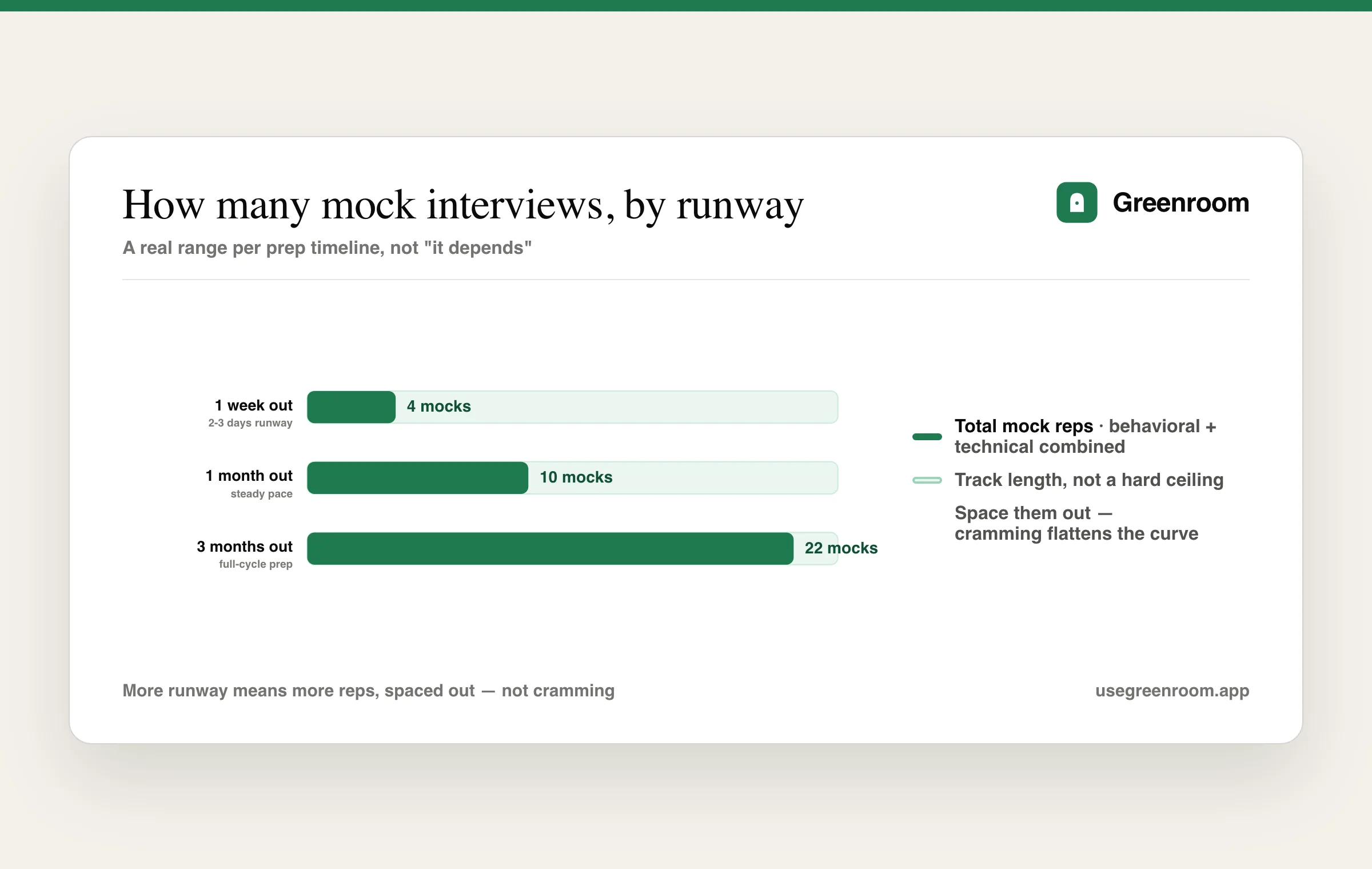
With a week, you are not building a skill from scratch. You're sharpening what's already there and patching the most obvious gaps. 3-4 mocks is the realistic, useful number: one early in the week to find out what's actually broken (not what you assume is broken: these are reliably different lists), one or two mid-week targeting the specific gap the first one surfaced, and one final mock 48 hours out, never the night before. Our week-before-interview checklist covers the rest of that week's prep (logistics, research, sleep: yes, sleep is on the checklist and yes, people skip it anyway), but the mock count specifically should stay in that 3-4 range. Doing 8 mocks in 7 days isn't "more prepared," it's "less rested and answering on autopilot by Friday," which we'll get to in the diminishing-returns section below.
One month out: 8-12 mock interviews
A month is the sweet spot for most of the scenarios above: enough time to do a real diagnostic mock, identify 2-3 specific weak spots (a STAR story that runs too long, a system-design round where you jump to the database schema before clarifying requirements, a tendency to go quiet when a follow-up catches you off guard), drill each one specifically, and still have buffer for a realistic final-week taper. 8-12 mocks spread across four weeks, roughly 2-3 a week, gives you space between reps to actually absorb feedback, which matters more than the raw count (more on this below too).
Three months out: 20+ mock interviews, but paced
Three months is enough runway to treat this like training for an actual event rather than cramming for a quiz, and the number goes up accordingly — 20-25 mock interviews across the full window is reasonable for someone targeting a FAANG-style loop or making a significant career jump. But the pacing matters more here than at any other timeline: this should look like 1-2 mocks a week for the first six weeks while you're still building fundamentals, ramping to 3-4 a week in the final three weeks as you tighten execution, then tapering hard in the final week back down to 1-2. A flat 20 mocks crammed into the last two weeks of a three-month window is just a one-month plan with eight wasted weeks before it: the early weeks should be doing something different (study, project review, resume work) while mock volume stays low.
Diminishing returns: why 10 mocks in 2 days is worse than 4 spread over 2 weeks
Here's the uncomfortable part of the 1:47am scenario from the intro: cramming mock interviews doesn't just fail to help past a certain point, it can actively make you worse, and there's a real mechanism behind why.
A mock interview only improves you if you have time to process the feedback before the next rep: notice what went wrong, understand why it went wrong, and consciously try something different next time. Run mock #2 forty minutes after mock #1 and your brain hasn't done any of that processing; you're not practicing a corrected version of the skill, you're just practicing the same mistake twice with extra fatigue layered on top. Sports science calls this the difference between massed practice (cramming reps together) and distributed practice (spacing them out): distributed practice produces measurably better retention and skill transfer in essentially every domain it's been studied in, from motor skills to language learning to, yes, interview performance, because the gaps between sessions are when consolidation actually happens, not dead time.
There's a second, more visible failure mode with cramming: rambling gets worse, not better, the more tired you are. A fresh STAR answer is compressed and intentional. A STAR answer delivered on mock #7 of the day, after three hours of talking, with your voice starting to fray, regresses toward whatever's easiest to say: usually the longest, least structured version of the story, because compression takes cognitive effort you no longer have. If you've ever wondered why your fourth mock of a cram session felt worse than your first, that's why: you weren't getting better, you were getting tired, and tired sounds a lot like unprepared.
The practical rule: never run more than 2 mock interviews in a single day, and leave at least a few hours, ideally a full day, between them so you can actually do something with the feedback before the next one. If you've got 10 mocks to fit into a week, that's roughly 1-2 a day with rest days mixed in, not a Saturday-Sunday marathon. This is also, not coincidentally, the exact failure mode that makes scheduling 10 human mock interviews in 2 weeks nearly impossible in the first place, which we'll get to in a minute.
There's a third failure mode worth naming, subtler than fatigue: false confidence from repeating the same question. If your mock interviews keep recycling the exact same three behavioral prompts because that's what's easy to ask yourself or easy to find online, you're not training adaptability, you're memorizing a script. And scripts crack the instant a real interviewer phrases the question slightly differently or asks an unexpected follow-up your memorized version doesn't cover. The candidates who feel blindsided in a real interview despite "doing a ton of mock prep" are disproportionately the ones who ran the same handful of questions on repeat rather than varying the prompt pool. Volume only compounds if each rep is at least somewhat novel (a new question, a new follow-up angle, a new interviewer style) not just a faster recitation of yesterday's answer.
Put differently: the goal of spacing and variety isn't comfort with repetition, it's comfort with uncertainty. A candidate who's done six wildly different mocks, each with a question they didn't fully expect, walks into the real interview having already practiced the actual skill being tested, thinking on your feet, six separate times. A candidate who's done twelve mocks of the identical three questions has practiced recitation twelve times, which is a different and much more fragile skill that the real interview, with its unpredictable phrasing and unscripted follow-ups, is specifically designed to expose.
Mock types don't need equal reps
The other place the "just do N mock interviews" framing breaks down is treating every mock as interchangeable. They're not, and they don't need the same number of reps to get good at, because they're testing different skills with different learning curves.
Behavioral/STAR mocks have a fast initial improvement curve and a real ceiling. The skill being trained is mostly compression and structure: most people already have the raw material (real projects, real conflicts, real wins) and the actual gap is turning an 8-minute story into a tight 90-second answer with a clear situation, action, and result. That's a skill that improves fast with 4-6 focused reps and then plateaus; the 10th behavioral mock on the same handful of stories has much lower marginal value than the 3rd, unless you're specifically rehearsing a new story or a trickier follow-up angle. Our guide on behavioral STAR answers for senior engineers and the broader behavioral interview questions and answers post both go deeper into the structure itself. This post is about volume, and the volume answer is: fewer reps than you think, but make every one count by varying the story and the follow-up, not repeating the same one five times.
Technical/DSA mocks have a slower, flatter improvement curve that rewards more total volume, because the skill being trained is pattern recognition across a wide problem space, not compression of material you already know. Recognizing "this is a sliding-window problem" or "this needs a monotonic stack" under time pressure, live, while talking through your reasoning out loud, takes more reps to internalize than any single behavioral story does. Which is why the scenario breakdowns above weight DSA mocks the heaviest of any category for technical roles.
System design mocks sit in between, but lean toward fewer-but-longer rather than more-but-shorter. A rushed 15-minute system design mock barely gets past requirements clarification before time runs out, so it trains almost nothing about the parts that actually get evaluated: trade-off reasoning, scaling decisions, handling a curveball requirement mid-conversation. 4-6 full-length (45-60 minute) system design mocks beat 15 rushed ones, because the skill lives in sustained reasoning under a long arc, not quick-fire recall.
The shape to aim for, roughly: behavioral mocks front-loaded early in your prep window (fix the structural issues first, they're fast to fix), technical/DSA mocks spread evenly across the whole window (steady volume, because the skill builds slowly), system design mocks back-loaded slightly (you need the DSA reasoning skills somewhat warmed up before a design conversation goes well, and each rep takes longer to run anyway).
It's worth adding a fourth category that doesn't get its own line in most "how many mocks" advice but probably should: culture-fit and curveball questions: "why are you leaving your current role," "what's a time you failed," "what would your manager say is your weakest area." These show up in almost every loop regardless of company size, and they have their own improvement curve, closer to behavioral mocks than technical ones, but with a specific trap: they're the questions candidates rehearse least because they feel like they should be easy to answer off the cuff. They aren't. "What's your biggest weakness" answered honestly-but-badly in real time ("I guess I don't have one, ha ha") is a worse outcome than a slightly over-rehearsed but coherent answer, and the only way to find your honest, coherent version is saying a few attempts out loud before the real interview, not after.
How to know you're actually ready (the signals, not the vibes)
"I feel ready" is not a signal. It's a mood, and moods lie. Here are the actual, checkable signals that mean your mock reps have done their job, versus the ones that mean you've just gotten comfortable hearing yourself talk.
You can answer without re-reading your notes. Not "I remember the gist and reconstruct it live" — actually retrieving the structure of your answer from memory, under the mild stress of someone waiting for you to start talking. If you still need to glance at a doc before answering "tell me about a time you disagreed with a teammate," you're not rehearsed, you're familiar, and those are different states that perform very differently live.
You ramble less, measurably. This is one of the few interview-prep signals you can actually quantify: time your answers. A STAR-format behavioral answer that lands well typically runs 60-90 seconds: long enough to cover situation, task, action, and result with one or two concrete details, short enough that the interviewer doesn't start formulating their next question out of boredom halfway through your situation setup. If your "tell me about a challenging project" answer is still running past two and a half minutes by your sixth mock, that's not a content problem anymore, it's a structure problem, and it's the single most fixable thing in this entire post: practice cutting the story down, out loud, until it fits.
Your STAR story lands under 90 seconds, consistently, across different versions of the same question. Not once, by luck, when you happened to phrase it well — consistently, even when the interviewer's exact wording shifts ("tell me about a conflict" vs. "tell me about a time you disagreed with a decision" vs. "describe a difficult stakeholder situation") and you have to recognize it's the same story underneath a different prompt. That recognition-and-redeploy skill is exactly what real interviewers test for and exactly what repeated, varied mock prompts build.
Follow-up questions stop derailing you. The first few mocks, a good follow-up ("what would you have done differently?" "how did the other person react?") often produces a visible stumble: a pause, a "uh," a restart. By the point you're actually ready, follow-ups feel like a continuation of the same story you're already holding clearly in your head, not an ambush you have to improvise around from zero. If a single well-placed follow-up still reliably knocks your answer apart, that's a real signal you need more reps on that specific story, not a sign to move to a new question.
You can explain a technical decision without immediately listing every possible alternative out of nerves. A common tell of under-rehearsal in technical interviews: when asked "why did you choose X," the under-prepared answer lists six options and trails off without landing on a clear "because." The ready answer commits to a reason, states the trade-off honestly, and stops — confidence under follow-up, not exhaustive hedging.
Your filler-word rate drops, and you can hear it yourself. This sounds minor and isn't. "Um," "like," "so basically," and the increasingly common verbal tic of starting every answer with "yeah, so" are all symptoms of buying time while you figure out what you're actually trying to say. As your structure solidifies through repetition, the need to stall disappears, and filler drops as a side effect rather than something you consciously suppress. If you record yourself (most mock-interview tools, including AI ones, will do this automatically) and listen back, a falling filler-word count across sessions is one of the most objective, least subjective signals available, far more reliable than "it felt better that time."
You stop needing the warm-up question to find your footing. Early in mock prep, most people's first answer of any session is noticeably worse than their third or fourth. They're still finding their rhythm. By the point you're genuinely ready, your first answer in a cold-start mock is about as solid as your last one, because the skill has actually transferred rather than just being temporarily activated by the session itself. This is a useful self-check the night before a real interview too: if your very first practice answer that day is shaky, that's useful information, not a reason to panic-add five more mocks before lunch.
You can sit with a pause instead of filling it. Counterintuitively, one of the clearest signs of readiness is comfort with silence — taking two full seconds to actually think before answering a hard question, instead of starting to talk immediately to avoid the discomfort of a quiet beat. Under-rehearsed candidates fear silence and rush into a weaker, less organized answer to avoid it. Well-rehearsed candidates have enough confidence in their own structure to pause, organize the answer in their head, and then deliver it cleanly: and most interviewers read a brief, intentional pause as composure, not hesitation.
If you're hitting most of these signals consistently across your last 3-4 mocks, you're at the point of diminishing returns described above: additional reps now should be specifically targeting a known remaining gap, not generic "more practice," and your final 48 hours should be tapering rest, not adding volume.
Mock interviews vs. the alternatives people actually use
It's worth being honest about what most people do instead of structured mock interviews, because the comparison is where the actual case for doing this properly gets made — not through hype, through arithmetic.
Reading a question-and-answer dump (GeeksforGeeks-style lists, a friend's shared WhatsApp PDF of "100 interview questions asked at X company") is the single most common substitute for mock interviews, and it's genuinely useful for content — knowing what gets asked, knowing the shape of a good answer. What it can't do is train delivery, because reading an answer and producing one verbally, live, under a stranger's eye contact, are different skills running on different neural pathways. You can recognize a great STAR answer on a page and still freeze producing your own version of it out loud — recognition and recall are not the same competency, and this is the single most common reason "I studied so much" candidates underperform relative to their prep time.
LeetCode grinding solves a real and necessary part of technical prep (pattern recognition, raw problem-solving reps) but it's almost entirely silent and untimed-for-conversation by default. Solving a problem in your IDE with no one watching trains a meaningfully different skill than solving the same problem while explaining your reasoning out loud to an interviewer who's deciding, in real time, whether your thought process is hireable. Pairing LeetCode reps with actual spoken mocks (even just narrating your solution out loud, alone, before doing a real mock) closes a surprising amount of that gap.
Asking ChatGPT or another LLM to "interview me" is a meaningful step up from passive reading, it's at least interactive, but it has two structural weaknesses worth naming honestly. First, generic prompting rarely asks a real follow-up the way a human or a purpose-built mock-interview product does; it tends to move to the next question rather than dig into a weak spot in your last answer, which is exactly the muscle real interviews exercise hardest. Second, there's no spoken component unless you specifically set one up (voice mode, careful prompting), so most people end up typing answers to ChatGPT, which is closer to the reading-a-PDF problem than an actual mock.
A friend's mock interview over a video call is the closest thing to the real format, and genuinely good when you can get one: a real human, real follow-ups, real stakes from not wanting to look unprepared in front of someone you know. The problem is almost never the quality when you get one; it's the quantity and scheduling friction. Coordinating even one 45-minute slot with a friend who has their own job and life takes days of back-and-forth, and getting to the 8-12 mocks a one-month timeline calls for, scheduled with friends or paid human mock-interview services, runs into real calendar and cost limits fast — most paid human mock platforms charge anywhere from a few hundred to several thousand rupees per session, which makes hitting double-digit mock counts an expensive proposition even before you factor in availability.
This is the honest, non-hypey case for something like Greenroom: an AI mock interviewer (Ari) that runs spoken, voice-based mock interviews with real follow-up questions based on what you actually said, available at 1:47am if that's genuinely when you need to run one, with no scheduling and no per-session cost ceiling that quietly caps how many reps you can actually afford to do. It's not a replacement for the judgment of a great human mock partner who knows your specific target role intimately. It's a replacement for the volume problem, which the numbers throughout this post should make obvious is the actual bottleneck for most people. Getting to 10-20 properly spaced reps is realistic with unlimited cheap reps and basically unrealistic if every rep requires scheduling a stranger's calendar or paying per session. Pair the reps with how to practice mock interviews alone for the discipline side of solo practice, and how to prepare for a mock interview for what to do in the hour before each session so the rep itself isn't wasted on logistics.
It's also worth naming a real, recognizable authority here for grounding: LinkedIn's own talent research and most published hiring-manager surveys consistently rank "couldn't clearly explain past experience" and "rambling, unstructured answers" among the top reasons qualified candidates get rejected — not lack of skill, lack of rehearsed delivery. That's precisely the gap mock-interview volume closes, and precisely the gap a question-dump or a silent LeetCode grind doesn't touch.
There's a cost dimension worth being blunt about, since it's the part that actually decides whether someone hits their target mock count or quietly gives up around mock #4. A single paid human mock interview session realistically runs anywhere from a few hundred rupees on the cheaper end to several thousand on platforms staffed by working engineers at target companies: multiply that by the 10-20 sessions a serious prep window calls for and the math stops working for most candidates, especially students and early-career engineers, well before the mock count does what it's supposed to do. This is the quiet reason so many people end up doing 3 mocks instead of 12: not because 3 felt sufficient, but because 12 felt unaffordable or unschedulable, and the gap between "what the prep plan calls for" and "what's actually feasible" gets quietly closed by doing less, not by finding a cheaper way to do more. An AI mock interview removes that constraint specifically (not the judgment-quality constraint, the volume-and-cost constraint) which is exactly the constraint this entire post has been doing arithmetic against.
A simple way to plan your own number
If none of the four scenarios above match your situation exactly, here's the shortcut: count your interview rounds, multiply behavioral rounds by 4-6 reps each and technical/design rounds by 3-5 reps each, then divide that total across your available weeks at no more than 2-3 mocks per week. A candidate with a 3-round loop (1 behavioral, 1 technical, 1 system design) and three weeks of runway lands at roughly (1×5) + (1×4) + (1×4) = 13 mocks, spread across three weeks at about 4 a week — consistent with the one-month band above, slightly compressed. The formula isn't precise science, but it beats guessing, and it beats the 1:47am panic-math that opened this post.
Two worked examples make this more concrete than the formula alone. Take a final-year computer science student with five weeks until their first product-company interview, facing a loop of one behavioral round and two technical rounds (one DSA, one light system design). Behavioral gets 5 reps, DSA gets 5 reps, system design gets 4 reps: 14 mocks total, spread across five weeks at roughly 3 a week, front-loading behavioral in week one, keeping DSA steady throughout, and running the system design reps in weeks three through five once the reasoning skills from DSA practice have had time to transfer over. That lands almost exactly on the "one month" band from earlier, nudged slightly because the extra week of runway buys one additional system-design rep that a tighter four-week window wouldn't comfortably fit.
Now take a senior engineer with eight weeks before a FAANG-style loop running four rounds: two behavioral (including a bar-raiser), one DSA-heavy coding round, and one full system design round. Behavioral at 6 reps each (12 total, since the bar-raiser format specifically benefits from extra reps given how values-based and unpredictable its questions tend to be), DSA at 8 reps, system design at 5 reps — 25 mocks across eight weeks, averaging about 3 a week but distributed unevenly: roughly 1-2 a week for the first three weeks while building fundamentals, ramping to 4-5 a week in weeks four through six, then tapering back to 1-2 a week for the final two weeks as the interview approaches. That's the three-month band's logic compressed into eight weeks rather than twelve: same shape, same taper, just a steeper ramp in the middle because there's less total runway to spread the load across.
Notice what both examples have in common: the total comes from adding up round-specific rep targets, not from picking a round number that sounds appropriately serious. "I'll do 15 mocks" said in the abstract, with no breakdown by round type, is exactly the kind of soft, unaccountable target that quietly turns into 4 behavioral mocks and 11 redundant DSA mocks because DSA practice is more available online and behavioral practice requires an actual conversational partner. The formula's real value isn't the arithmetic, it's forcing you to commit, in advance, to a number per round type — which is the only way to notice you've under-invested in one category before the real interview makes that gap embarrassingly obvious in front of someone who's deciding whether to hire you.
Fitting them around a job is its own problem: our how to prepare for interviews while working full time guide covers the five-hour week.
Frequently asked questions
How many mock interviews should I do before a real interview?
Most candidates need 6-20 mock interviews total, depending on scenario and timeline — fewer (3-4) with only a week of runway, more (20+) with three months and a FAANG-style multi-round loop. Spread them out rather than cramming; never run more than 2 in a single day, and stop adding new mocks 48 hours before the real interview.
Is it possible to do too many mock interviews?
Yes: past a certain point, more mocks stop helping and start hurting, especially if they're crammed close together. Fatigue makes answers longer and less structured, not shorter, because compression takes mental energy you don't have left after several reps in a row. The fix isn't fewer total mocks, it's spacing them out so you have time to process feedback between sessions.
Should I do more behavioral or more technical mock interviews?
It depends on the round mix in your actual interview loop, but as a rule, behavioral/STAR mocks plateau faster (4-6 focused reps usually gets most people structurally solid) while technical/DSA mocks benefit from more total volume because pattern recognition under time pressure takes longer to internalize. System design mocks need fewer reps but each one should run the full 45-60 minutes to be useful.
How do I know when I've done enough mock interviews and I'm ready?
Look for concrete signals, not a feeling: you can answer without re-reading notes, your STAR stories consistently land under 90 seconds across different phrasings of the same question, and follow-up questions feel like a continuation rather than a derailment. If your last 3-4 mocks all hit those signals, additional mocks should target a specific known gap rather than add generic volume.
Are AI mock interviews as good as practicing with a friend or a human mock interviewer?
A great human mock partner who knows your target role well is hard to beat on judgment and nuance, but most people's real bottleneck is volume and scheduling, not quality of any single session — getting to 10+ properly spaced reps is expensive and logistically hard with human-only mocks. AI mock interviews like Greenroom solve the volume problem directly: unlimited spoken reps with real follow-up questions, available whenever you actually have time to practice, without per-session cost or calendar friction capping how many reps you can realistically fit in.
Does cramming mock interviews the night before an interview help?
No — it's close to the worst use of mock-interview time. Running multiple mocks back-to-back the night before an interview produces fatigue, not improvement, since there's no gap to process feedback between sessions, and tired delivery tends to ramble more, not less. The last mock should happen at least 48 hours before the real interview, leaving the final stretch for rest and light review instead of new reps.