The group discussion round eliminates more campus-placement candidates than any technical test — and it has nothing to do with how much you know. A GD is a communication and temperament test disguised as a debate. The loudest person usually loses. The person who enters cleanly, listens, adds one sharp point, and helps the group conclude usually wins. Here is how to be that person.
What evaluators are actually scoring
Recruiters sit on the side with a checklist. They are not counting how many times you spoke. They score:
- Clarity of thought — did your points make sense, or were you just making noise?
- Communication — clear, confident, audible, structured.
- Listening & teamwork — did you build on others or just bulldoze them?
- Leadership — did you help the group move forward and conclude?
- Composure — could you disagree without getting aggressive?
How to enter a group discussion
Most candidates either jump in chaotically or never speak. Both fail. The fix:
- If you know the topic well, initiate — but only with a structured opening: define the topic, then give your stance. Initiating well scores high; initiating badly tanks you.
- If you're unsure, enter second or third — agree or counter a previous point, then add something new. "I'd build on what she said, but also…"
- Never interrupt mid-sentence. Wait for a pause, raise your hand slightly, and come in with a clear voice.
How to stand out without dominating
- Quality over quantity. Three sharp, well-structured contributions beat ten interruptions.
- Bring data or a real example. "There's a statistic that…" or "In the Indian context…" instantly raises your credibility.
- Pull quiet people in. "I think Rohit was about to add something" — evaluators love this; it signals leadership.
- Be the one who concludes. If you summarise the group's points fairly at the end, you often walk away as the top scorer.
Common GD topics in placements
- Is AI a threat to jobs?
- Work from home vs work from office.
- Is social media doing more harm than good?
- Should India focus on services or manufacturing?
- Abstract topics: "Red", "The number 7", "A blank page" — these test creativity and structure.
How to practise for a GD
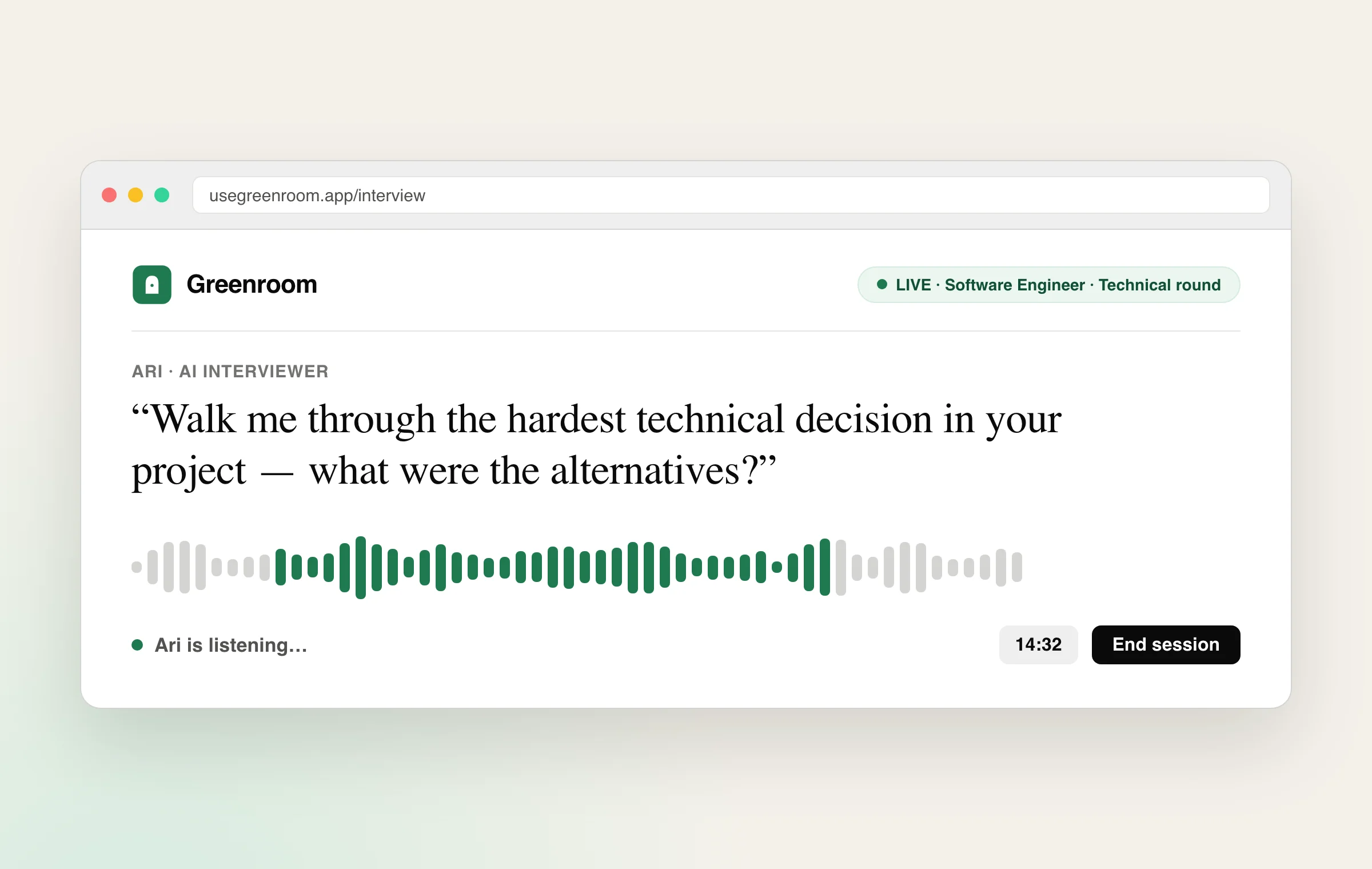
You cannot improve at speaking under pressure by reading about it. You improve by speaking under pressure — repeatedly — and hearing where you rambled, where your voice dropped, where you lost the thread. Greenroom is a voice-first interview trainer: it makes you talk through answers out loud, then shows you your filler words, pace and clarity — the exact muscles a GD demands. Pair it with our guides on speaking confidently and improving communication skills.
Frequently asked questions
What do evaluators look for in a group discussion?
GD evaluators score clarity of thought, communication, listening and teamwork, leadership, and composure under disagreement. They are not counting how often you speak — three sharp, well-structured points beat ten interruptions. Helping the group conclude and pulling in quieter members both score very highly.
Should I start the group discussion first?
Initiate only if you genuinely understand the topic and can open with structure — define the topic, then state your stance. A strong opening scores high, but a weak or rushed one hurts you. If you are unsure, enter second or third by building on or countering a previous point and adding something new.
How do I stand out in a GD without dominating?
Focus on quality over quantity: contribute a few sharp, structured points backed by data or a real example, build on what others say, bring quiet participants in, and offer a fair summary at the end. Dominating and interrupting reads as poor teamwork and usually lowers your score.
How can I practise for group discussions?
Practise by speaking out loud under time pressure and reviewing your clarity, pace and filler words — not just reading tips. A voice-based interview trainer that makes you articulate answers and gives feedback on communication builds the exact speaking-under-pressure muscle a GD tests.