The recruiter's face appears on screen, says a warm "Hi, thanks for joining!", and somewhere in your chest a small animal begins running on a wheel. Your mouth goes dry. The first question is "tell me a bit about yourself" — a question you have answered out loud in the shower forty times — and your brain helpfully replies with static and a faint ringing sound. You are, by every measure, qualified for this job. You just can't currently remember what your own job is.
If that is you, you are not broken and you are not uniquely doomed. Learning how to stay calm in interviews is not about becoming a person who never feels nervous — those people are rare and frankly a little unsettling. It is about building a protocol: a set of things you do the night before, the hour before, and the moment nerves spike, that keep the running animal from taking over the controls. Composure is a skill you rehearse, not a personality trait you are born with. This guide is the protocol.
Why you get nervous — and why that's normal
Interview nerves are your nervous system doing its job slightly too enthusiastically. Your brain reads "high-stakes social evaluation" as "potential threat" and fires the same fight-or-flight response your ancestors used for predators: adrenaline up, heart rate up, blood flow redirected away from the prefrontal cortex — the exact part you need for clear, articulate thinking. That is why you can know an answer cold and still blank: the panic isn't a knowledge gap, it's a retrieval gap caused by physiology. We unpack that mechanism in detail in why do I freeze in interviews?
The good news hidden in that biology: because the problem is physiological, the solution can be too. You cannot reason yourself out of a racing heart with willpower, but you can change your breathing, your preparation, and your framing in ways that lower the baseline. A small amount of nervousness is actually useful — it sharpens focus. The goal of staying calm in interviews is not zero arousal; it is keeping arousal in the productive zone instead of the panic zone.
The night before: lower the baseline
Calm on interview day is mostly decided the night before, and the biggest mistake is cramming. Frantically re-reading every data-structure or rehearsing answers until midnight raises your baseline anxiety and steals the sleep your memory needs to consolidate. By the evening before, the studying is done. Your job now is to lower the temperature.
- Prepare the logistics, not the content. Lay out your clothes, test your camera and mic, confirm the meeting link and time zone, charge your laptop. Removing morning-of uncertainty removes a whole category of panic.
- Run one short rehearsal, then stop. A single calm pass of your intro and one or two stories is enough to feel ready. More than that tips into cramming. If you want a structured last-week plan, our week-before-interview checklist covers the build-up.
- Protect your sleep. No screens that wind you up, no fourth coffee, no doom-scrolling job forums. Sleep is the highest-leverage performance enhancer available and it is free.
The hour before: warm up, don't cram
Athletes don't sprint a marathon to warm up for a race, and you shouldn't speed-read your notes to warm up for an interview. The hour before is for getting your body and voice into the productive zone, not for last-minute learning that will only spike your nerves.
- Move. A brisk ten-minute walk burns off excess adrenaline and tells your nervous system the threat is being handled. Even pacing the room helps.
- Warm up your voice. Talk out loud — call a friend, read something aloud, or say your intro once. The cracking-voice, first-word stumble happens when the interview is the first time you've spoken in hours.
- Hydrate, go easy on caffeine. A dry mouth makes you sound and feel more nervous; too much coffee amplifies the jitters. Water on the desk also gives you a legitimate pause-and-sip move mid-interview.
- Stop taking in new material. Nothing you learn in the final hour will help, and the act of cramming signals "danger" to your brain. Close the notes.
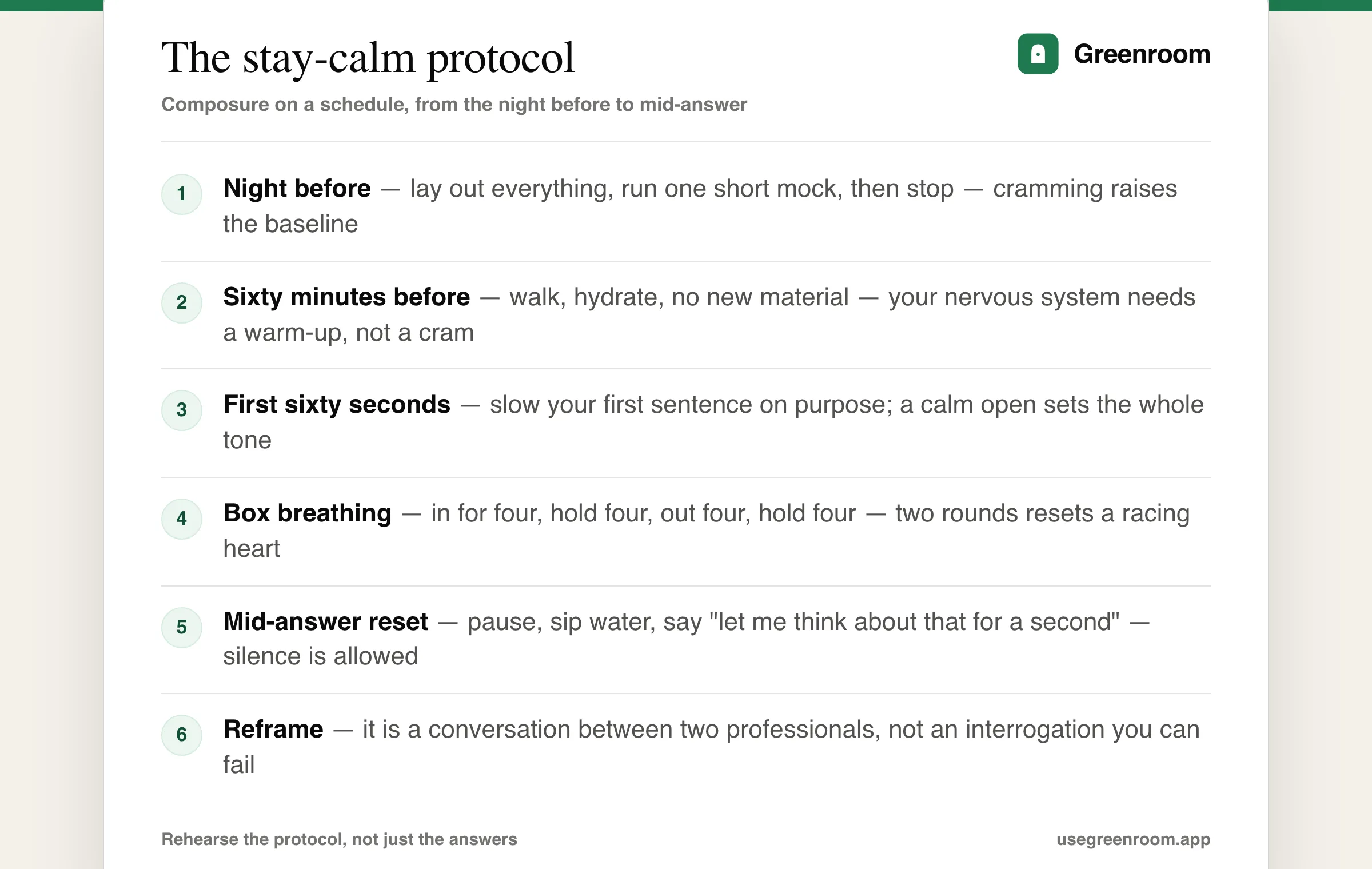
The stay-calm protocol, on one page
Here is the whole thing condensed — the schedule your composure runs on, from the night before down to the moment your heart starts pounding mid-answer. Rehearse the protocol, not just your answers, so that on the day it runs on autopilot.
In the room: box breathing and the first 60 seconds
The opening minute sets your physiological tone for the whole conversation, so spend it deliberately. The most reliable in-the-moment tool is box breathing: inhale for four counts, hold for four, exhale for four, hold for four. Two or three rounds, done quietly while the interviewer is talking or your camera is loading, measurably slows your heart rate by activating the parasympathetic "rest" system. It is the technique Navy SEALs and emergency responders use precisely because it works under real pressure.
Then, when you start speaking, slow your first sentence on purpose. Nerves make everyone rush, and rushing feeds more nerves in a loop. Deliberately delivering your opening line slower than feels natural breaks that loop and — bonus — reads to the interviewer as confidence. You are not faking calm; you are doing the one physical thing that produces it.
When nerves spike mid-answer: the reset
Sometimes the panic arrives in the middle, when you get a question you didn't expect and feel the blankness rising. You need a reset that buys time without looking like a meltdown. The move is simple and completely acceptable: pause, breathe, and narrate the pause.
Say "That's a good question — let me think about it for a second," then take an actual breath and a sip of water. Silence feels like an eternity to you and like two normal seconds to the interviewer. Interviewers do not penalize a thoughtful pause; they penalize panicked rambling. If you have genuinely blanked, our full recover-from-blanking playbook and the fast techniques in how to stop panicking mid-interview give you the exact words. The headline version: name that you need a moment, use it to breathe, and re-enter from the part of the question you do know.
Reframe the whole thing
A surprising amount of interview calm comes from one mental shift: stop treating the interview as an exam you can fail and start treating it as a conversation between two professionals figuring out if there's a fit. An exam has a right answer and a judge. A conversation has two people exploring whether to work together — and you are evaluating them as much as they are evaluating you. That reframe is not just a feel-good trick; it is accurate. You are deciding whether to give this company a year of your life.
Another reframe: the physical signs of nervousness — fast heart, alertness, energy — are nearly identical to the signs of excitement. Research on "anxiety reappraisal" shows that telling yourself "I'm excited" rather than "calm down" actually improves performance, because you are working with the arousal instead of fighting it. If interview anxiety is a persistent, heavy problem for you rather than ordinary nerves, our deeper guide on dealing with interview anxiety goes further than this protocol.
The thing that actually builds calm: rehearsal under pressure
Here is the part most "stay calm" advice skips. Breathing techniques and reframes manage nerves in the moment, but the durable fix is exposure. The reason your first interview of a job search is terrifying and your fifth is merely uncomfortable is not that you got smarter — it's that your nervous system learned the situation is survivable. Psychologists call this habituation, and you can manufacture it on purpose by doing realistic mock interviews before the real one.
This is exactly why people reach for mock interviews, and where the options differ. Rehearsing answers silently in your head builds almost no habituation, because the thing that makes you nervous — speaking under live scrutiny — never happens. A friend doing a mock helps, but friends go easy on you and aren't available at 11pm before a 9am interview. A generic ChatGPT text chat tests recall but not the live, spoken pressure that triggers the panic in the first place. A spoken AI mock interview like Greenroom reproduces the actual stressor — a voice asking you questions, following up when you're vague, with a clock running — so that by the time you're in the real room, your body has already been there. Calm isn't something you summon on the day; it's something you bank in advance. Pair this protocol with our guide on speaking confidently in interviews.
Frequently asked questions
How do I stay calm during a job interview?
Run a protocol rather than relying on willpower. The night before, prepare logistics and sleep instead of cramming. In the hour before, take a short walk, warm up your voice, and hydrate. In the room, use box breathing — inhale four, hold four, exhale four, hold four — and deliberately slow your first sentence. If nerves spike mid-answer, pause, sip water, say "let me think about that for a second," and re-enter from the part you know.
What is box breathing and does it really help in interviews?
Box breathing is inhaling for four counts, holding for four, exhaling for four, and holding for four, repeated two or three times. It activates the parasympathetic nervous system and measurably slows your heart rate, which is why emergency responders and military personnel use it under pressure. Done quietly in the minute before you start speaking, it pulls your physical arousal out of the panic zone and into a focused one.
Why do I freeze or go blank in interviews even when I know the answer?
Freezing is usually a retrieval problem, not a knowledge gap. Under high-stakes stress your body releases adrenaline and redirects resources away from the prefrontal cortex, the part you need to recall and articulate answers. That is why you can know something cold and still blank. Because the cause is physiological, the fixes are too — breathing, preparation, and especially realistic rehearsal that teaches your nervous system the situation is survivable.
Should I study right before an interview to feel more prepared?
No. Cramming in the final hour rarely teaches you anything useful and reliably raises your anxiety, because the act of cramming signals danger to your brain. By the night before, the studying should be done. Use the last hour to warm up instead — move your body, warm up your voice, hydrate, and close the notes. Feeling ready comes from rehearsal banked earlier, not from last-minute reading.
Is it okay to pause and take a moment to think in an interview?
Yes, and it is often better than answering instantly. A short, narrated pause — "that is a good question, let me think about it for a second" — reads as thoughtful, not weak. Silence feels far longer to you than to the interviewer. They penalize panicked rambling, not a deliberate pause used to gather a clear answer. Pausing also gives you a moment to breathe and reset.
How can I practise staying calm before a real interview?
Build exposure by doing realistic mock interviews out loud before the real one. The durable cure for nerves is habituation — your nervous system learning the situation is survivable — and that only happens when you reproduce the actual stressor of speaking under live scrutiny. A spoken AI mock interview that asks questions, follows up, and runs on a clock banks that calm in advance, so the real room feels familiar rather than threatening.