Picture two candidates given the exact same coding problem. The first stares at the screen in total silence for nine minutes, types furiously, and produces a correct solution. The second starts talking immediately — "okay, so this is a lookup problem, my first instinct is a hash map, let me check the constraints…" — narrates every step, hits one bug, talks through it, and finishes with a slightly messier but correct answer. The silent genius gets the rejection. The talker gets the offer. Welcome to the single most counterintuitive truth in technical interviewing.
Interviewers are not just grading your answer; they are grading how you got there, because in the real job they will work with your reasoning every day, not just your final commits. Learning how to think out loud in interviews — narrating your reasoning so a listener can follow it — is often the difference between two technically identical candidates. It feels unnatural at first, like describing your own breathing. This guide gives you a repeatable loop so it stops feeling weird and starts feeling like a skill.
Why interviewers want you to think out loud
When you solve a problem silently, the interviewer sees a black box: input goes in, an answer comes out, and they have no idea whether you reasoned your way there or got lucky. That is a terrible signal to hire on. When you narrate, you hand them a window into the exact thing they are trying to evaluate: how you break down ambiguity, what tradeoffs you weigh, how you respond to your own mistakes, and whether you'd be pleasant to debug a production incident with at 2am.
Thinking out loud also helps you. Verbalizing a problem forces structure onto vague thoughts, surfaces assumptions you'd otherwise leave buried, and — crucially — lets the interviewer course-correct you early. If you say "I'm going to assume the input is sorted" and they say "actually, don't assume that," you just dodged ten minutes down a wrong path. Silence forfeits all of that. This is the same muscle behind coding-interview communication and the Feynman technique: if you can explain it as you do it, you actually understand it.
The think-out-loud loop
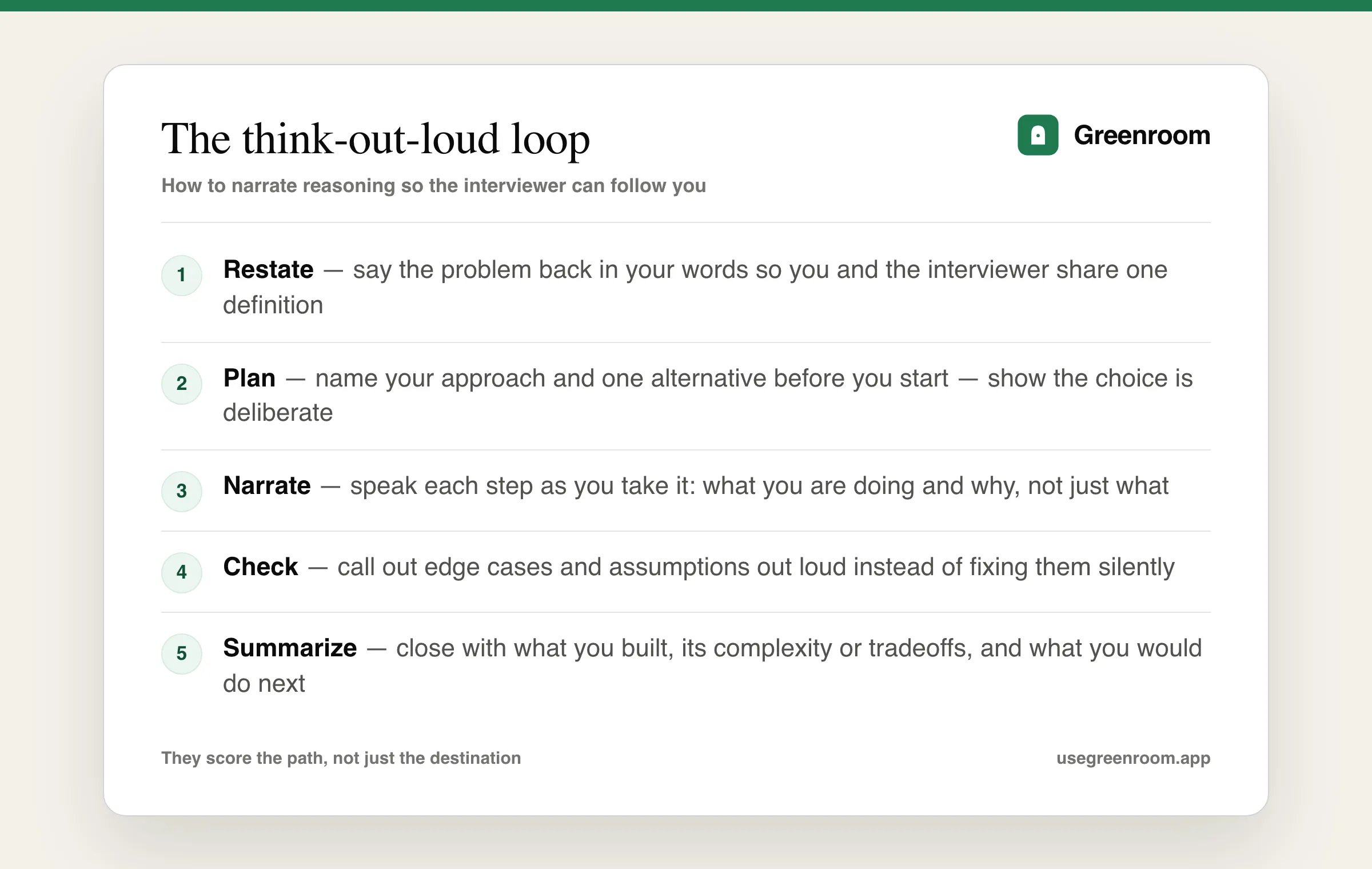
The reason narrating feels awkward is that "just say what you're thinking" is uselessly vague — your raw thoughts are a chaotic stream nobody wants to hear. What interviewers want is structured narration. Run this five-step loop and it gives your talking a backbone: restate, plan, narrate, check, summarize.
1. Restate the problem
Before touching the keyboard, say the problem back in your own words: "So I need a function that takes a list of transactions and returns the running balance, and I should handle the case where the list is empty — is that right?" This does three things at once: it confirms you understood, it gives the interviewer a chance to correct a misunderstanding before you waste time, and it buys you a few calm seconds to think. Restating is the cheapest, highest-value thing you can do, and almost nobody does it.
2. Plan before you build
Name your approach out loud and at least one alternative you're rejecting, with the reason. "I could brute-force this with nested loops at O(n²), but since I just need to check membership, a hash set gets me to O(n) — I'll go with the set." Now the interviewer knows your final choice was deliberate, not accidental, and they can nudge you if they were fishing for something else. Stating the alternative you didn't pick is what separates a senior-sounding answer from a junior one.
3. Narrate as you work
As you write code, draw a diagram, or work through a case, speak each step: what you're doing and why. "I'm initializing an empty map to store counts… now I'll iterate once, and for each element I'll increment its count…" Keep it to the meaningful beats — you don't need to read every semicolon aloud. The goal is that someone with their eyes closed could follow your logic. When you go quiet for a stretch of hard thinking, that's fine — just say "give me a second to think through this edge case" so the silence is labeled, not mysterious.
4. Check out loud
When you hit an edge case, an assumption, or a possible bug, voice it instead of silently fixing it. "Wait — what happens if the list has duplicates? Let me trace through… yeah, my current approach double-counts them, so I need a set here instead." Catching and narrating your own bug is not a weakness; it is one of the strongest possible signals, because debugging-while-explaining is literally the job. Silently backspacing a mistake hides the exact skill they're trying to see.
5. Summarize at the end
Don't just stop when the code runs. Close the loop: "So this works in O(n) time and O(n) space, it handles the empty list and the duplicates case, and if I had more time I'd add input validation and write a couple of unit tests." A clean summary of complexity, tradeoffs, and next steps leaves the interviewer with a tidy final impression and proves you can evaluate your own work — a skill that matters more the more senior the role.
Worked example: a coding round
Here's the loop applied to "find the first non-repeating character in a string," compressed to show the narration:
"Okay — so I need the first character that appears exactly once, scanning left to right, and I'll assume we return null or a sentinel if there isn't one. Let me confirm that's the expected behavior. [pause] Great. My first instinct is to count occurrences, then do a second pass to find the first with a count of one. I could do it in one pass with an ordered structure, but two passes with a hash map is clearer and still O(n), so I'll start there and optimize if we have time. I'm building the count map first… now the second pass, returning the first character whose count is one. Let me check edge cases out loud: empty string returns the sentinel — good; all-repeating returns the sentinel — good; what about case sensitivity, should 'A' and 'a' be the same? I'll treat them as different unless you'd prefer otherwise. So: O(n) time, O(k) space where k is the character set, handles the empty and all-repeating cases. If I had more time I'd add a unit test for Unicode."
Notice that the candidate never went silent for long, surfaced two assumptions the interviewer could correct, and ended with complexity and next steps. The actual algorithm is beginner-level — the narration is what makes it an offer-worthy answer.
Thinking out loud beyond coding
The loop isn't just for algorithms. In a system design round, narrating is the entire game: clarify requirements out loud, state your assumptions about scale, walk through your component choices and their tradeoffs, and call out bottlenecks before the interviewer does. In a behavioral round, a lighter version applies — signpost your structure ("let me give you the situation first, then what I did") so your story doesn't wander. Even in a case or product interview, the framework is the same: restate, structure, reason aloud, check, conclude. The container changes; the loop doesn't.
How practising this compares to other prep
Most interview prep is silent and solitary: you read solutions on LeetCode or GeeksforGeeks, watch a walkthrough video, nod along, and move on. That builds pattern recognition — genuinely useful — but it builds zero narration skill, because you never opened your mouth. Then you walk into an interview and discover that explaining your reasoning live, while solving and being watched, is a completely separate skill you never practised. This is the most common reason capable engineers underperform: they prepped the answer and skipped the talking.
The honest tradeoff between prep methods: solving problems on your own is essential for the underlying skill, and you should keep doing it. But narration only improves when you narrate to something that reacts. A study partner works if you have a patient, available one. A generic ChatGPT text session lets you practise writing out reasoning, but not the spoken, real-time version that interviews actually use. A spoken AI mock interview like Greenroom is built for exactly this gap — it listens while you think out loud, asks the follow-up questions a real interviewer would ("why did you pick the hash map over sorting?"), and gives feedback on whether your reasoning was actually followable, not just whether the answer was right. Pair it with our guide on explaining your project for the behavioral side.
Common mistakes when thinking out loud
- Narrating the trivial, skipping the hard part. Reading every line of syntax aloud while going silent for the one genuinely tricky decision is backwards. Talk most where the thinking is hardest.
- Mumbling a stream of consciousness. "Think out loud" doesn't mean "say every random thought." Use the loop so your narration has structure, not just volume.
- Going silent the moment you're stuck. The stuck moment is exactly when the interviewer most wants to hear you — that's where they see how you handle difficulty. Label the silence: "I'm thinking through two options here."
- Hiding your bugs. Silently fixing a mistake throws away your best signal. Catch it out loud; debugging-while-explaining is the job.
- Never checking in. Narrating at the interviewer without ever pausing to confirm direction wastes the live-feedback advantage. Ask "does that approach sound reasonable?" at decision points.
Make narration automatic
Thinking out loud is a performance skill, and performance skills get smooth through reps, not reading. The first time you narrate your reasoning should not be in the interview that decides your offer. Greenroom runs spoken mock interviews that make you think out loud, probe your reasoning with real follow-up questions, and tell you where your narration lost the thread. Combine it with improving your interview communication and a few mock sessions, and the loop becomes second nature — exactly what you want when the pressure is real.
The hardest moment to narrate is the one where you have run out of knowledge: our what to do if you don't know the answer in an interview guide has the four-step script for it.
Frequently asked questions
What does "think out loud" mean in an interview?
It means narrating your reasoning as you solve a problem instead of working in silence — saying what approach you are considering, why you chose it over alternatives, what each step does, and what edge cases you are checking. Interviewers ask for it because they are evaluating how you reason and handle ambiguity, not just whether the final answer is correct, since on the job they work with your thinking every day.
How do I think out loud without rambling?
Use a structure instead of a raw stream of consciousness. Run a five-step loop: restate the problem in your own words, plan your approach and name one alternative you are rejecting, narrate each meaningful step as you work, check edge cases and assumptions out loud, and summarize the result with its complexity and next steps. The loop gives your narration a backbone so it sounds deliberate rather than scattered.
Is thinking out loud important in coding interviews?
Yes — it is often the deciding factor between two candidates with similar technical ability. A silent solver is a black box; the interviewer cannot tell reasoning from luck. Narrating shows how you decompose problems, weigh tradeoffs, and recover from your own mistakes, and it lets the interviewer course-correct you early before you waste time on a wrong path. Many strong engineers get rejected purely for solving correctly but silently.
Should I keep talking even when I am stuck?
Yes, but label it. The stuck moment is exactly when the interviewer most wants insight into how you handle difficulty. You do not have to fill every second, but say something like "let me think through two options here" so the silence is intentional rather than mysterious. Going completely quiet when stuck forfeits your best chance to show resilience and structured problem-solving.
How is thinking out loud different in system design or behavioral rounds?
The same loop adapts. In system design, narrating is the whole exercise — clarify requirements aloud, state scale assumptions, walk through component choices and tradeoffs, and flag bottlenecks before the interviewer does. In behavioral rounds, a lighter version applies: signpost your structure so your story does not wander. The container changes, but restate, structure, reason aloud, check, and conclude stays constant.
How can I practise thinking out loud before an interview?
Practise out loud against something that reacts, not silently in your head. Reading solutions builds pattern recognition but zero narration skill. A study partner helps if one is available; a spoken AI mock interview is built for this exact gap — it listens while you reason, asks the follow-up questions a real interviewer would, and gives feedback on whether your reasoning was actually followable. Reps under realistic conditions are what make narration automatic.