Four rounds in, the candidate was cruising. The problems had been fair, the interviewers friendly, the whole thing suspiciously pleasant. Then a fifth name appeared on the calendar invite twenty minutes before it started, someone two levels above everyone he had met, who opened with: "Tell me about the hardest technical decision you have made, and who disagreed with you." Nobody had mentioned a fifth round. Nobody ever does.
That is the as-appropriate round, and it is the most under-prepared part of Microsoft backend interview questions. Microsoft's loop is broad and conversational — the coding bar is fair rather than brutal — but a senior leader joins at the end with the authority to extend an offer or end the process alone. I built Greenroom after walking out of an interview I had prepared hard for and underperformed in, so this guide covers what Microsoft asks and how to hold up in the round nobody warned you about.
The Microsoft backend engineer interview process in 2026
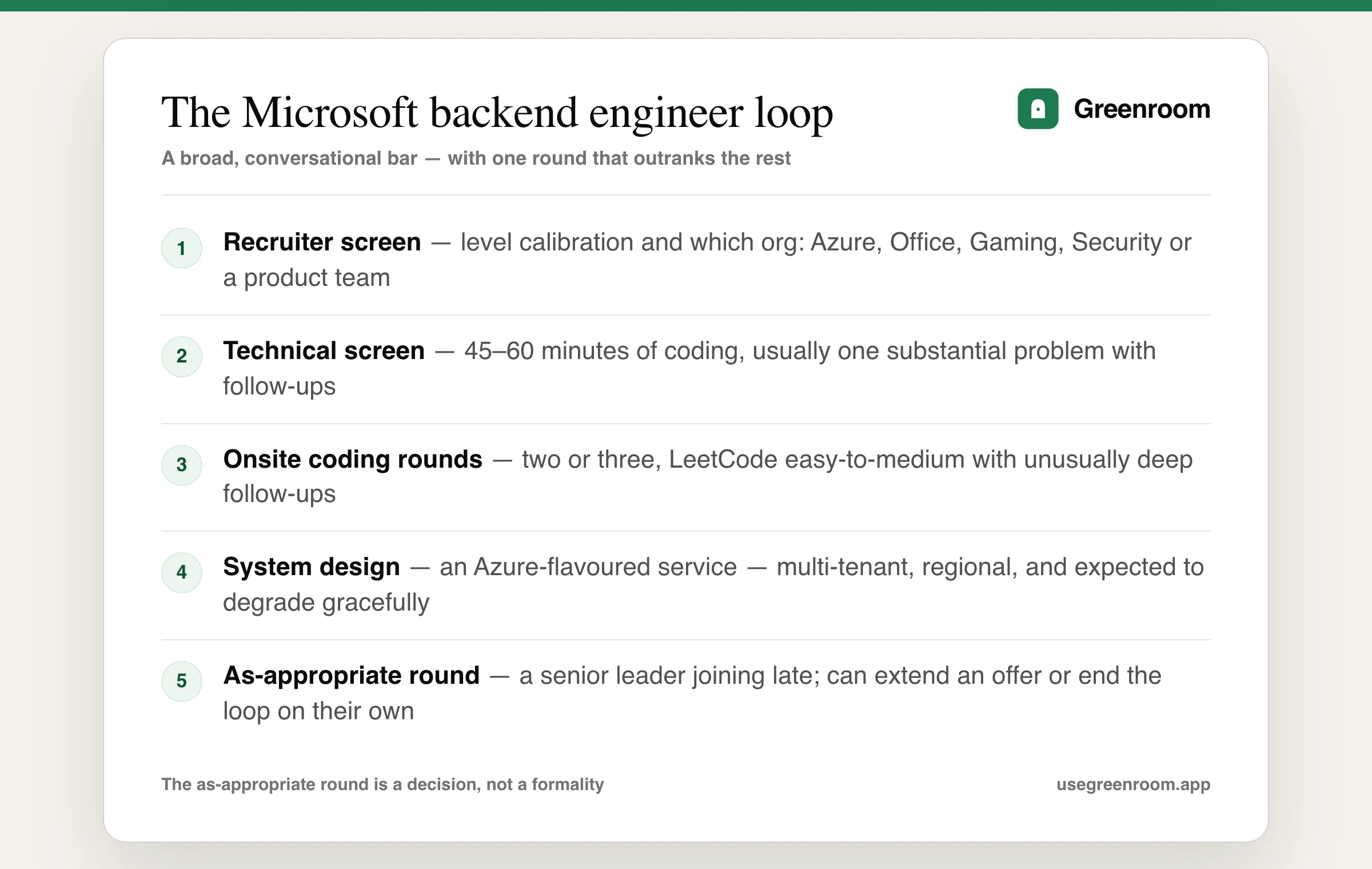
- Recruiter screen — level calibration and org matching. Microsoft is many companies wearing one badge; Azure, Office, Gaming and Security interview differently in emphasis.
- Technical screen — 45 to 60 minutes, usually one substantial coding problem with layered follow-ups rather than two rushed ones.
- Onsite (virtual) — two or three coding rounds and a system design round, with behavioral questions woven into each rather than isolated.
- As-appropriate round — a senior interviewer added at the end. They can approve, extend, or stop the loop.
- Debrief — the panel discusses you together, so consistency across rounds matters more than a single dazzling answer.
Our Microsoft interview preparation guide covers the company-wide loop and the Microsoft data engineer guide covers the data platform variant.
The coding rounds: easier problems, deeper follow-ups
Microsoft's problems skew LeetCode easy-to-medium — arrays, strings, hash maps, trees, two pointers, basic dynamic programming. The differentiation comes from what happens after you solve it. Expect: what if the input does not fit in memory, what if this runs across a cluster, what if it needs to be thread-safe, how would you test it, and what breaks in production.
That last one is a real Microsoft habit. They hire for engineers who ship and maintain software, so answers that mention edge cases, tests and operability score well.
// Microsoft-flavoured: solve it, then answer "make it thread-safe" without rewriting it
public sealed class Counter {
    private readonly ConcurrentDictionary<string, int> _counts = new();

    public void Add(string key) =>
        _counts.AddOrUpdate(key, 1, (_, current) => current + 1);  // atomic, no lock held

    public int Get(string key) => _counts.TryGetValue(key, out var v) ? v : 0;
}
Then say the follow-up answer before it is asked: "this is atomic per key, but a snapshot across all keys is not consistent — if the caller needs a consistent total I would need a different structure or an explicit lock." Volunteering the limitation is the move that scores. Our C# interview questions guide and DSA coding interview preparation guide cover the underlying material.
System design, Azure-flavoured
Microsoft's design prompts often carry a cloud-service shape: design a file storage service, a notification service, a metrics pipeline, a multi-tenant API with quotas, or a deployment system.
- Requirements and numbers first. Tenants, requests per second, payload size, retention. Then draw.
- Multi-tenancy explicitly. Noisy-neighbour isolation, per-tenant quotas and rate limits, and whether data is co-located or physically separated. This comes up more at Microsoft than almost anywhere else.
- Regions and availability. Which failures you survive — a node, a zone, a region — and what the recovery objectives are. Microsoft interviewers speak in RPO and RTO; using those terms correctly lands well.
- Storage choice with a reason. Blob versus queue versus relational versus a key-value store, and why. Our Azure interview questions guide covers the service vocabulary.
- Idempotency and retries. Every distributed operation gets retried; say how yours stays safe when it does.
- Backwards compatibility. How a schema or API change rolls out without breaking existing customers. Microsoft ships to enterprises who never upgrade on time, and they interview for it.
- Observability and operations. Metrics, alerts, a rollback plan, and what an on-call engineer sees at 3am.
Our distributed systems interview questions guide covers the failure vocabulary and the system design interview guide covers the structure.
.NET and backend fundamentals
If the role is .NET-facing, expect real depth rather than syntax questions:
- Async and await — what actually happens at an await point, the synchronization context, and why blocking on an async call deadlocks. This is asked constantly and answered badly.
- Memory and garbage collection — generations, large object heap, and where allocations hurt in a hot path.
- Collections and complexity — dictionary versus list versus concurrent collections, and the cost of each choice.
- Dependency injection and lifetimes — singleton, scoped, transient, and the classic bug of a scoped service captured by a singleton.
- SQL Server depth — indexes, execution plans, transaction isolation and deadlocks. Our SQL interview questions guide covers the query side.
- Testing — unit versus integration, and what you would actually mock. Microsoft asks this more than most.
The as-appropriate round and the behavioral thread
Behavioral questions are distributed across every round rather than isolated in one, and then concentrated in the as-appropriate round with a senior leader who is deciding rather than gathering data.
What that round probes: the hardest technical decision you made and who disagreed, a time you were wrong, how you handle a project that is late, how you deal with a peer who is not delivering, and why Microsoft specifically. Bring five stories with numbers and rehearse them out loud to two follow-ups deep. Our behavioral interview questions guide and tell me about a time you disagreed with your boss guide cover the recurring shapes.
LeetCode, Grokking, ChatGPT — where each fits
- LeetCode — easy-to-medium, Microsoft-tagged, but always continue past the solution into the follow-ups: memory limits, concurrency, testing.
- Designing Data-Intensive Applications — the best single source for the consistency and failure vocabulary the design round rewards.
- Microsoft Learn and the Azure architecture docs — free, official, and unusually well aligned with how their interviewers frame design problems.
- ChatGPT — useful for generating follow-ups on a problem you have already solved. It will not add a fifth round to your calendar twenty minutes before it starts.
- Greenroom — the spoken layer. Ari, the AI interviewer runs the round out loud, asks the deeper follow-up, and scores structure and clarity. Honest tradeoff: Ari will not review your C# line by line, so pair it with real code practice.
How to prepare for the Microsoft backend interview
- Week 1 — LeetCode easy-to-medium, but answer four follow-ups per problem out loud: memory limits, concurrency, testing, production failure.
- Week 2 — .NET and backend depth: async mechanics, GC, DI lifetimes, index selection, isolation levels, deadlocks.
- Week 3 — design a multi-tenant service, a notification pipeline and a file storage service out loud, with quotas, regions, RPO/RTO and a rollback plan in each.
- Final week — five behavioral stories with numbers rehearsed to two follow-ups deep, two full spoken mocks, and the role-specific prep page the night before.
Interviewing across comparable loops? The Google backend engineer guide covers a harder algorithm bar, the Meta backend engineer guide covers scale-first design prompts, and the Amazon leadership principles guide is useful drilling for behavioral depth.
Interviewing for a web role at the same company? Our Microsoft frontend interview questions guide covers the accessibility depth and the large-surface design round.
Frequently asked questions
What is the Microsoft backend engineer interview process?
Candidates report a recruiter screen, a technical screen of 45 to 60 minutes usually built around one substantial coding problem with follow-ups, and an onsite of two or three coding rounds plus a system design round, with behavioral questions woven through rather than isolated. A senior as-appropriate interviewer is often added at the end and can extend an offer or end the loop on their own, and the panel debriefs together afterwards.
What is the as-appropriate round at Microsoft?
It is a final round with a senior leader, frequently added to your calendar at short notice, and it is a decision rather than data-gathering — that interviewer can approve, extend or stop the loop. Expect questions about the hardest technical decision you have made and who disagreed, a time you were wrong, how you handle a late project or an underperforming peer, and why Microsoft specifically.
How hard are Microsoft coding questions?
The problems themselves skew LeetCode easy-to-medium — arrays, strings, hash maps, trees, two pointers and basic dynamic programming — and the difficulty lives in the follow-ups instead. Expect to be asked what happens if the input does not fit in memory, how you would make it thread-safe, how you would test it, and what breaks in production, and to score well by volunteering those limitations before being asked.
What system design questions does Microsoft ask?
Prompts usually have a cloud-service shape: a file storage service, a notification service, a metrics pipeline, a multi-tenant API with quotas, or a deployment system. Strong answers start from numbers, then address multi-tenancy and noisy-neighbour isolation, regional failure and recovery objectives, storage choice with a reason, idempotent retries, backwards-compatible rollout for enterprise customers, and what an on-call engineer sees at 3am.
What .NET and C# questions come up in Microsoft backend interviews?
For .NET-facing roles expect mechanism-level depth rather than syntax: what actually happens at an await point and why blocking on an async call can deadlock, garbage collection generations and the large object heap, dictionary versus list versus concurrent collections, dependency injection lifetimes and the scoped-service-captured-by-a-singleton bug, and SQL Server indexes, execution plans, isolation levels and deadlocks.
How many rounds is the Microsoft interview and how long does it take?
Most reported loops run four to five rounds — a technical screen, two or three coding rounds, a system design round and often an as-appropriate round — over roughly three to six weeks depending on the org and on scheduling. Because the panel debriefs together, consistency across rounds matters more than one outstanding answer.