Four rounds into his Microsoft loop, a candidate I'll call Arjun was quietly winning. SQL round: clean. Python round: clean. Then the recruiter said the sentence nobody warns you about — "one more, the as-appropriate round" — and a principal engineer who had read none of the previous feedback joined and said, "Forget Azure for a second. Why does your pipeline exist?" Arjun, who had spent three weeks memorising Azure Data Factory activity types, discovered he had never once said out loud what his own pipeline was for.
That gap is the whole story of Microsoft data engineer interview questions. The technical bar is fair and well-signposted — SQL, Python, and Azure-shaped architecture. The bar that surprises people is verbal: every round ends in "why," and one late round exists purely to test whether you can defend a design to a stranger. I built Greenroom after walking out of an interview knowing I'd underperformed on questions I actually knew, so this guide covers both what Microsoft asks and how to say it.
The Microsoft data engineer interview process in 2026
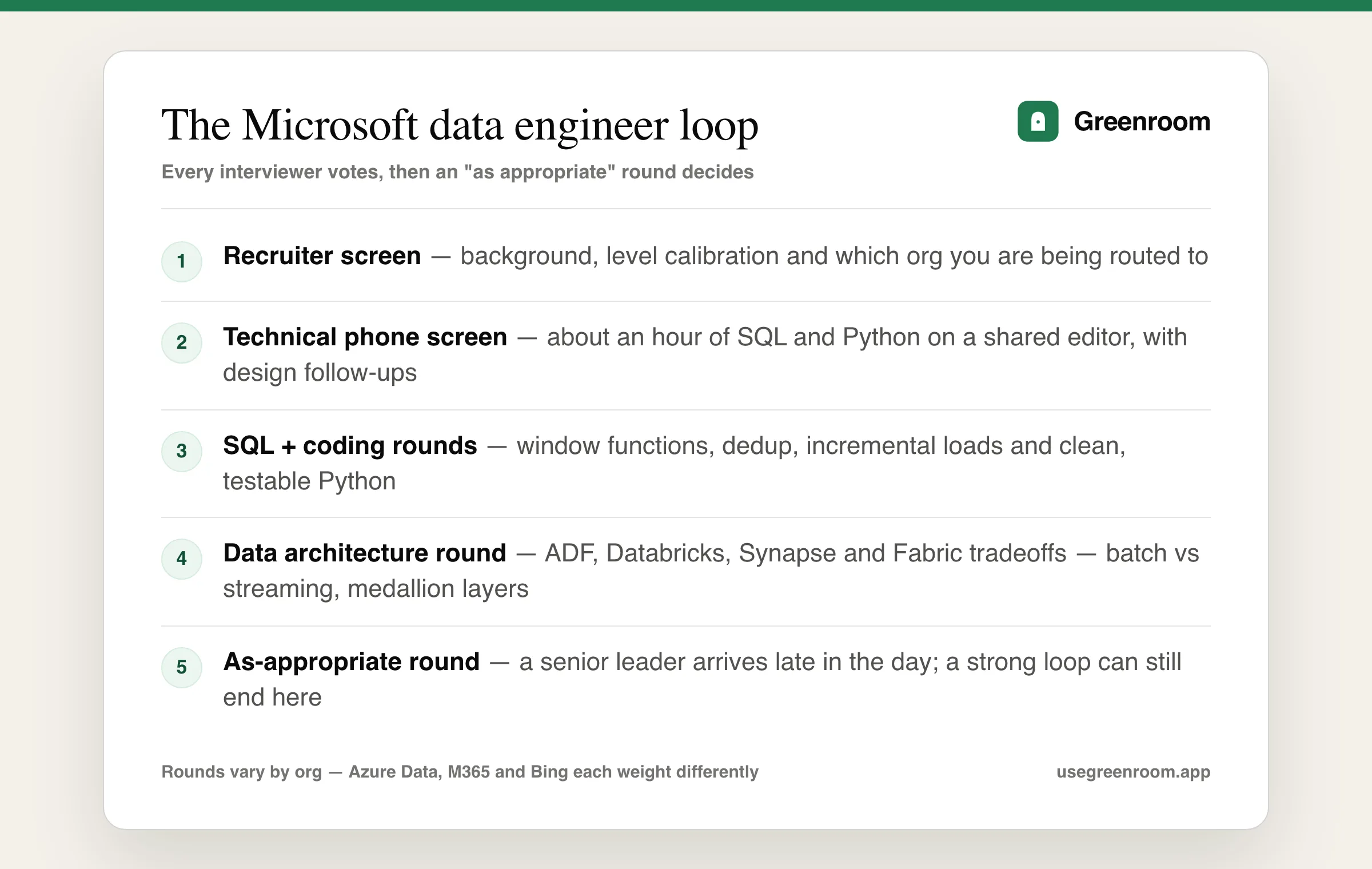
Microsoft is not one company for hiring purposes — Azure Data, Microsoft 365, Bing/Ads and Gaming each run their own loops with their own flavour. What candidates consistently report as the Microsoft data engineer interview process:
- Recruiter screen — background, level calibration (most DE hires land at 59–63), and which org you're being routed into. Ask which one; it changes everything downstream.
- Technical phone screen — roughly an hour of SQL plus Python in a shared editor, with design follow-ups tacked on if you finish early.
- Virtual onsite / "loop" — four to five rounds in a day: SQL depth, coding, data architecture, and behavioral.
- The as-appropriate round — a senior leader added late, sometimes same-day, sometimes a week later. It is not a formality. A strong loop can still end here.
The mechanic that matters: every interviewer submits independent written feedback and a hire/no-hire vote, and the as-appropriate interviewer is often the tiebreaker who reads all of it. So you're not persuading one person — you're leaving five people with the same clear story about how you think.
Microsoft data engineer SQL interview questions
The Microsoft data engineer SQL questions are less about exotic syntax than about correctness on messy, slowly-arriving data. Expect window functions, incremental loads and gap-and-island problems on telemetry-shaped tables.
Find each user's session boundaries from raw telemetry.
Sessionization is the single most-reported SQL shape in this loop — Microsoft runs on product telemetry, and telemetry arrives as an undifferentiated stream of events:
-- 30-minute inactivity gap starts a new session
SELECT user_id, session_id, MIN(event_ts) AS started_at,
       MAX(event_ts) AS ended_at, COUNT(*) AS events
FROM (
  SELECT user_id, event_ts,
         SUM(is_new) OVER (
           PARTITION BY user_id ORDER BY event_ts
         ) AS session_id
  FROM (
    SELECT user_id, event_ts,
           CASE WHEN event_ts - LAG(event_ts) OVER (
                  PARTITION BY user_id ORDER BY event_ts
                ) > INTERVAL '30 minutes'
                THEN 1 ELSE 0 END AS is_new
    FROM app_telemetry
  ) t
) s
GROUP BY user_id, session_id;
Then the follow-ups that actually decide the round: what happens when an event arrives four hours late, whether this can run incrementally instead of over the full history, and what it costs on a table with a billion rows a day. Our SQL interview questions guide drills the window-function family in depth.
Write an idempotent incremental load.
Say the words "merge" and "watermark" before you're asked. Microsoft's data stack is built on reruns, and a load that double-counts on retry fails the round no matter how elegant the query:
MERGE INTO dim_customer AS tgt
USING staging_customer AS src
  ON tgt.customer_key = src.customer_key
WHEN MATCHED AND tgt.row_hash <> src.row_hash THEN
  UPDATE SET tgt.is_current = 0, tgt.valid_to = src.loaded_at
WHEN NOT MATCHED THEN
  INSERT (customer_key, attrs, row_hash, is_current, valid_from)
  VALUES (src.customer_key, src.attrs, src.row_hash, 1, src.loaded_at);
That's a Type 2 slowly changing dimension in one statement — know why you'd close the old row rather than overwrite it, and when a Type 1 overwrite is the honest answer. The data engineer interview questions guide covers the modeling layer underneath.
Python and coding questions in the Microsoft DE loop
Microsoft weights coding more heavily than Meta or Netflix do for data roles — there is usually one round that is a genuine algorithms round, not a data-wrangling round. Keep it modest: strings, hash maps, heaps, two pointers, occasionally a graph traversal. Nobody is asking you to invent a segment tree.
import heapq

def top_k_errors(log_lines, k):
    """Most frequent error codes in a log stream, ties broken by code."""
    counts = {}
    for line in log_lines:
        code = line.get("error_code")
        if code:
            counts[code] = counts.get(code, 0) + 1
    return heapq.nlargest(k, counts.items(), key=lambda kv: (kv[1], kv[0]))
Narrate the complexity before they ask — O(n) to count, O(n log k) to select — and say what you'd change when the log stream doesn't fit in memory. That sentence alone separates "wrote working code" from "thinks like an engineer" in the written feedback. The Python interview questions guide covers the language layer.
Azure, Databricks and Fabric: the data architecture round
This is the round that is distinctly Microsoft. You will be asked to design something on the Microsoft stack, and while nobody expects you to have shipped every service, you're expected to know what each one is for:
- Ingestion — Azure Data Factory or Synapse pipelines for orchestration, Event Hubs for streaming ingest, and when you'd reach for each.
- Storage and compute — ADLS Gen2 as the lake, Delta Lake as the table format, Databricks or Synapse Spark for processing, and where Microsoft Fabric now sits across all of it.
- The medallion architecture — bronze/silver/gold layers. Be able to say what belongs in each and, more importantly, why the split exists at all rather than reciting the diagram.
- Batch vs streaming — name the freshness requirement first. "The dashboard is read every morning" and "the fraud rule fires in two seconds" are different systems, and choosing streaming without a reason is a mark against you.
- Cost and failure — what a rerun costs, how you'd backfill a corrupted week without taking dashboards down, and how you'd detect the corruption in the first place.
The best answers here are boring on purpose: state the requirement, propose the simplest architecture that meets it, then name what you'd change at 10× the volume. Our Azure interview questions guide covers the service-level detail, and the Microsoft data engineer prep page has a compact round-by-round checklist.
The behavioral and as-appropriate rounds
Microsoft's behavioral rounds are built around its growth-mindset language — the company culture that Satya Nadella has written about publicly leans hard on "learn-it-all, not know-it-all," and interviewers genuinely score for it. Practically, that means the failure question is not a trap; it's the question they most want a real answer to.
Expect: a time you were wrong and changed course, a time you disagreed with a partner team, a project that shipped late and what you owned. Two-minute stories, first person, real numbers. "We migrated the warehouse" is invisible; "I owned the migration, cut nightly runtime from 6 hours to 40 minutes, and broke two dashboards on day one that I'd failed to inventory" is a hire signal. Our tell me about a time you failed guide has the structure.
The as-appropriate round then does something different: it zooms out. Common openers are "explain your last project to me as if I know nothing," "what would you have done differently," and "why does this pipeline exist?" It's a communication test wearing a technical costume — and it's the round candidates most often lose after passing everything else.
LeetCode, DataLemur, Microsoft Learn — where each fits
An honest map of the prep stack for this specific loop:
- LeetCode — genuinely useful here, unlike at Netflix. Microsoft's DE coding round is real. Easy-to-medium, arrays/strings/hash maps/heaps, an hour a day. Skip hard DP.
- DataLemur and StrataScratch — the best written-SQL drills for window functions and sessionization. Their limit: they mark your query right or wrong, and Microsoft rounds are decided by the spoken follow-up.
- Microsoft Learn — free, official, and the single best source for the Azure and Fabric vocabulary. Read the data-engineering learning paths; you'll stop guessing which service does what.
- GeeksforGeeks and Blind interview experiences — useful for calibrating round formats. Treat them as anecdotes, not a syllabus.
- ChatGPT — fine for generating design prompts and critiquing written answers. It won't interrupt you at second 40 with "wait, why streaming?" — which is exactly what the architecture round does.
- Greenroom — the spoken layer. Ari, the AI interviewer, runs the round out loud, pushes follow-ups when a design answer hand-waves, and scores structure and clarity. Fair tradeoff: Ari won't teach you Delta Lake internals; pair it with Microsoft Learn.
How to prepare for the Microsoft data engineer interview
- Week 1: SQL — window functions, sessionization, gap-and-island, MERGE and SCD Type 2. Solve them written, then re-explain each aloud in ninety seconds.
- Week 2: Python daily on LeetCode easy-medium, always narrating complexity out loud. Add one data-wrangling problem a day.
- Week 3: Azure and Fabric — one Microsoft Learn data-engineering path, then design three systems aloud: a telemetry pipeline, a near-real-time fraud feed, and a nightly warehouse load.
- Final week: five behavioral stories in first person, two full spoken mocks including a "explain your project to someone who knows nothing" run, and the role-specific prep page the night before — not new material.
If other big-tech data loops are on your calendar, they rhyme but weight differently: the Amazon data engineer guide covers Leadership-Principles-in-every-round, the Google data engineer guide covers the hiring-committee version, the Netflix data engineer guide covers the culture-memo version, and the general Microsoft preparation guide covers the SWE track.
Frequently asked questions
What is the Microsoft data engineer interview process?
Candidates consistently report a recruiter screen, a technical phone screen of about an hour mixing SQL and Python, then a virtual onsite of four to five rounds covering SQL depth, coding, data architecture on the Azure stack, and behavioral. A final "as-appropriate" round with a senior leader is added late and can independently sink an otherwise strong loop. Each interviewer submits an independent written vote.
What is the as-appropriate round at Microsoft?
The as-appropriate round is a final interview with a senior leader — often a principal engineer or a skip-level manager — scheduled after the main loop, sometimes the same day and sometimes a week later. It is broader and more conversational than the technical rounds: expect "explain your last project to someone who knows nothing about it" and "what would you do differently." It is a real gate, not a formality.
What SQL questions does Microsoft ask data engineers?
Reported questions centre on telemetry-shaped data: sessionizing an event stream with an inactivity gap, gap-and-island problems, deduplication, incremental and idempotent loads using MERGE, and slowly changing dimensions. Follow-ups push on late-arriving data, whether the query can run incrementally, and what it costs at a billion rows a day.
Do I need Azure experience for a Microsoft data engineer interview?
Hands-on Azure experience helps a lot but is not always mandatory — Microsoft hires strong data engineers from AWS and GCP backgrounds. What is not optional is fluency in the vocabulary: what Azure Data Factory, Synapse, ADLS Gen2, Databricks, Delta Lake and Microsoft Fabric each do, and when you would choose one over another. Microsoft Learn covers this for free.
How hard is the Microsoft data engineer interview?
Moderately hard, and more predictable than most FAANG loops. The coding bar is real but sits at LeetCode easy-to-medium rather than hard, and the SQL is standard warehouse work done carefully. The genuine difficulty is verbal: five interviewers write independent feedback, so a technically correct answer explained vaguely reads as a weak answer across the whole loop.
How long does the Microsoft data engineer interview process take?
Most reported timelines run three to six weeks from recruiter contact to offer, with the scheduling gap before the onsite being the longest stretch. The as-appropriate round can add a week on its own if the leader's calendar is full. Use that waiting window for spoken practice on architecture prompts rather than more written SQL.