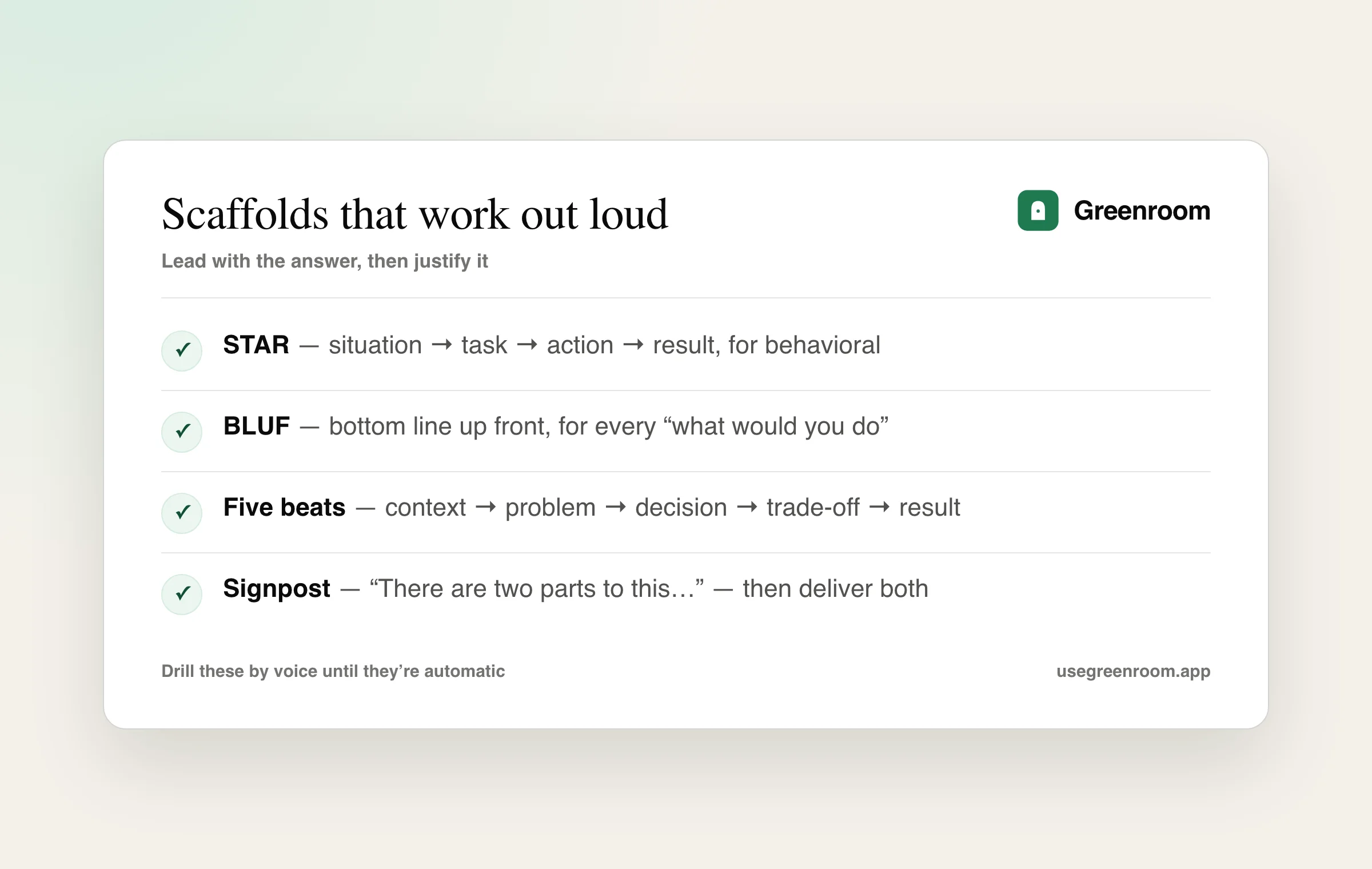
"Tell me about a time you disagreed with your manager" is a backbone-and-professionalism test. Interviewers want to see that you can push back when you believe you're right — using data and respect, not ego — and that you can disagree and commit. Saying "I never disagree with my boss" actually fails. Here's how to answer with STAR.
What they're testing
- Backbone — will you speak up, or just nod along?
- Professionalism — can you disagree respectfully?
- Judgment — did you use data and reasoning?
- Disagree and commit — can you support the final decision even if it's not yours?
Example answer
"My manager wanted to ship a feature without automated tests to hit a date. I disagreed — I thought the risk was too high. So I didn't just object; I pulled the numbers on our recent regressions and showed the likely cost of a bug in that flow, then proposed a lighter test suite as a middle ground that wouldn't blow the deadline. He agreed to it. But I want to be clear — if he'd still decided to ship without them after hearing me out, I'd have respected the call and supported it. We shipped on time with the safety net, and nothing broke."
The structure that works
- State the disagreement and why you held your view.
- Show you raised it respectfully and with evidence, not emotionally.
- Show the resolution — ideally a constructive outcome.
- Make clear you'd commit to the final decision regardless.
Mistakes to avoid
- "I never disagree with my manager." — Reads as spineless or dishonest.
- A story where you were combative or went over their head.
- Disagreeing on something trivial.
- An example where you were proven clearly wrong and dug in.
How to deliver it
Tone is critical here — you want to sound principled, not difficult. Rehearsing out loud gets the balance right. Greenroom asks behavioral questions like this in a real voice interview with follow-ups and feedback. Pair it with our guides on handling conflict and STAR answers.
Frequently asked questions
How do I answer 'tell me about a time you disagreed with your boss?'
Use STAR: state the disagreement and why you held your view, show that you raised it respectfully and backed it with data rather than emotion, describe the constructive resolution, and make clear you'd commit to the final decision even if it went against you. It tests backbone, professionalism and 'disagree and commit,' so show all of those.
Should I say I never disagree with my manager?
No. Claiming you never disagree reads as spineless or dishonest, because every employee occasionally has a different view. Interviewers want to see that you'll speak up respectfully when you believe you're right and use evidence, while still being able to support the final decision. A genuine, professional example is far stronger.
What example should I use for disagreeing with a boss?
Choose a meaningful but professional disagreement — over an approach, a risk or a priority — where you raised your view with data and respect and reached a constructive outcome. Avoid trivial disagreements, stories where you were combative or went over their head, and examples where you were clearly wrong and refused to back down.
What do interviewers look for in this question?
They look for backbone (willingness to speak up), professionalism (disagreeing respectfully), sound judgment (using data and reasoning), and the ability to disagree and commit (supporting the final decision regardless). The ideal answer shows you'll push back constructively when it matters and then get behind the team's call.