He solved it. Optimal complexity, clean code, twenty-two minutes. Then the interviewer asked what would happen if the input didn't fit in memory, and he said — reasonably — that the question hadn't mentioned that. "It didn't," the interviewer agreed. "I'm mentioning it now." That second question, not the first, is what went in the feedback.
Google backend engineer interview questions are famously algorithmic, and that reputation is only half right. The bar on data structures is genuinely high, but what gets written down is how you handle the extension, the ambiguity and the constraint you weren't given. This guide covers the loop, the DSA band, the system design round, Googleyness, and how the hiring committee actually decides.
The Google backend engineer interview process in 2026
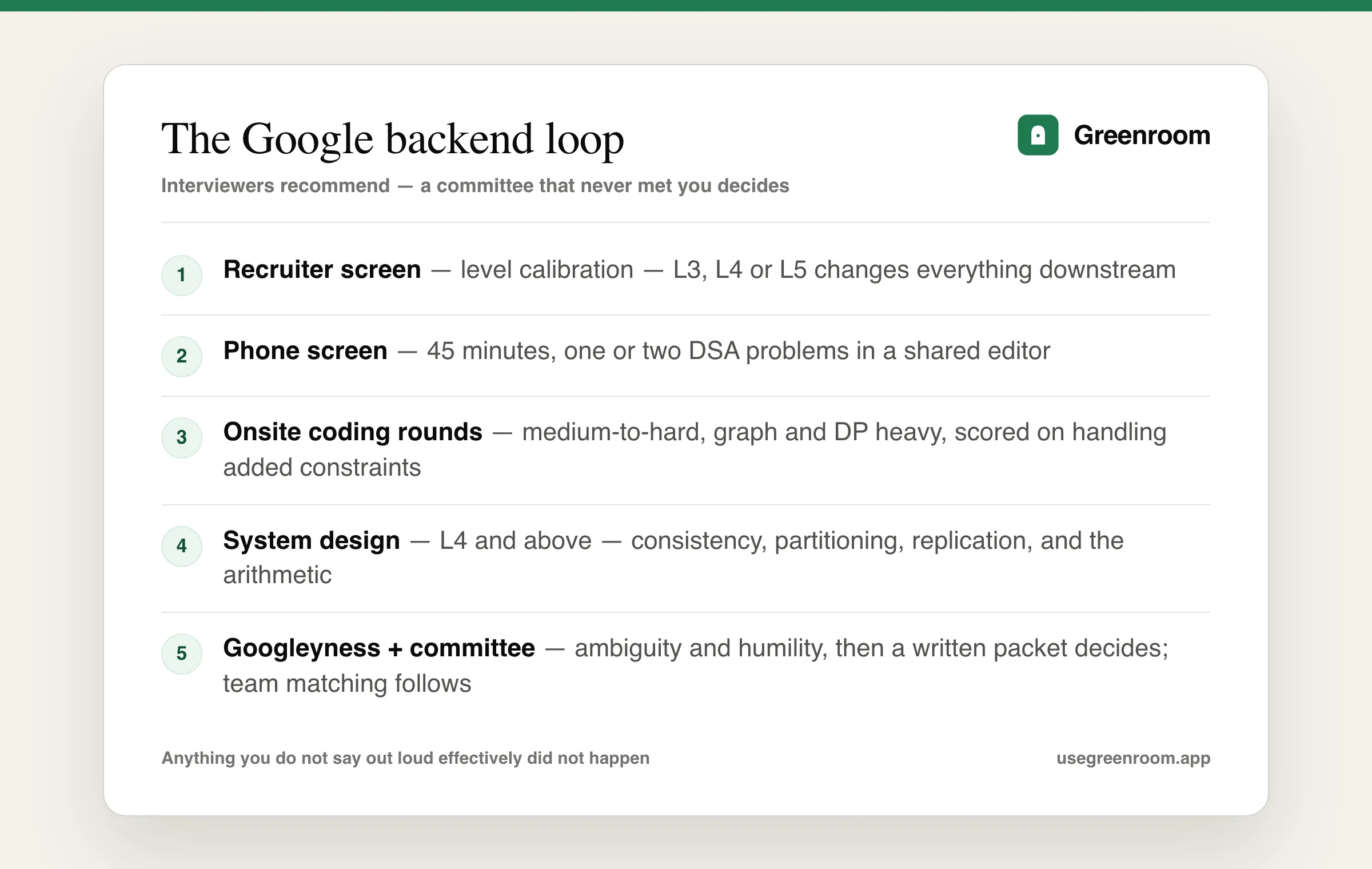
Google hires backend and general software engineers into effectively every product area, with large India presence in Bengaluru and Hyderabad. The Google backend engineer interview process:
- Recruiter screen — background and level calibration (L3 for new grads, L4 for a few years, L5 senior). Ask which level you are being considered for; it changes everything downstream.
- Phone / video screen — 45 minutes, one or two DSA problems in a shared editor.
- Onsite loop — typically four to five rounds: two or three coding, one system design (L4 and above), and one Googleyness and leadership round.
- Hiring committee — a committee that never met you reads the written feedback and decides. Your interviewers recommend; they do not decide.
- Team matching — after approval, you talk to teams with headcount. This can be fast or take weeks, and an approved packet without a match is a real outcome.
Two structural things follow from the committee model. First, your interviewer is writing notes for a stranger, so anything you do not say out loud effectively did not happen. Second, consistency matters — one weak round can be outweighed by four strong ones, which is why recovering well after a bad question is worth real points.
Google DSA interview questions: the real band
The coding rounds sit at LeetCode medium-to-hard, and the topic distribution is stable. What actually shows up:
- Graphs — BFS, DFS, topological sort, shortest path, union-find. Over-represented at Google relative to other companies.
- Trees — traversals, lowest common ancestor, serialisation, binary search tree properties.
- Dynamic programming — genuinely common here, unlike at many Indian product companies. Know the state-definition habit: say what
dp[i]means before writing a recurrence. - Heaps and intervals — top-K, merge intervals, meeting rooms, sliding-window maximum.
- Strings and hashmaps — the standard band, usually as a warm-up.
- Binary search on the answer — a recurring Google favourite that catches people who only recognise binary search on sorted arrays.
That last pattern is worth drilling because it looks nothing like a search problem. The shape: you cannot compute the answer directly, but given a candidate answer you can cheaply check whether it is feasible — so you binary search the answer space.
# Ship all packages within `days`; minimise the ship's capacity.
def least_capacity(weights, days):
    def feasible(cap):
        # Greedy: how many days does this capacity need?
        needed, load = 1, 0
        for w in weights:
            if load + w > cap:
                needed += 1
                load = 0
            load += w
        return needed <= days

    # Lower bound: must fit the heaviest item. Upper bound: ship everything at once.
    lo, hi = max(weights), sum(weights)
    while lo < hi:
        mid = (lo + hi) // 2
        if feasible(mid):
            hi = mid          # mid works — try smaller
        else:
            lo = mid + 1      # mid too small
    return lo               # O(n log(sum(weights)))
Say the two things interviewers listen for: why the search space is monotonic (if a capacity works, every larger one works — which is what makes binary search valid at all), and why lo and hi are those specific bounds. Candidates who produce the code without justifying monotonicity get pushed until they do.
The scoring dimensions are explicit at Google and worth knowing by name: coding ability, algorithmic thinking, communication, and problem-solving under ambiguity. That last one is why the interviewer adds constraints — the extension is the test, not an afterthought.
So the process to rehearse is: restate the problem, ask about input size and constraints (which is where "does it fit in memory?" gets answered before it is sprung on you), state a brute force and its complexity, improve it aloud, then write code — and finally test it on an example by hand, out loud, without being asked. Our data structures interview questions guide and recursion and backtracking guide cover the topic list, and how to think out loud in interviews covers the narration this format demands.
The Google system design round
System design appears for L4 and above and carries heavy weight for senior candidates. Reported prompts: design a URL shortener, a web crawler, YouTube or a video platform, Google Docs collaborative editing, a rate limiter, a distributed cache, an autocomplete/typeahead service, and a notification system.
Google's flavour is distinctive in two ways. It leans toward the fundamentals of distributed systems rather than a tour of named cloud products — talking exclusively in AWS service names lands poorly. And interviewers push on the theory underneath:
- Consistency models — strong, eventual, causal — and the CAP tradeoff stated precisely rather than as a slogan.
- Partitioning and rebalancing — consistent hashing, hot keys, and what happens when you add a node.
- Replication — leader-follower, quorums, and what a client observes during a failover.
- Back-of-the-envelope estimation — QPS, storage per year, bandwidth. Google interviewers genuinely want the arithmetic, and doing it unprompted is scored.
- Failure and degradation — what the system does when a dependency is down, not just when it is up.
Structure the round: clarify functional and non-functional requirements, do the estimation, sketch the high-level design, go deep on one or two components the interviewer steers you toward, then discuss bottlenecks and tradeoffs. Our system design interview guide for India covers the general structure, and the Google backend engineer prep page has a compact round-by-round checklist.
Googleyness and leadership
The behavioural round is real, and candidates who treat it as a formality lose offers at the committee stage because the write-up is thin. "Googleyness" covers comfort with ambiguity, bias to collaboration, intellectual humility, and doing the right thing when nobody is checking.
The questions are ordinary; the discipline is in the answers. Expect: a time you disagreed with a teammate, a time you failed, a time you had to make a decision without enough information, a time you gave or received difficult feedback, and how you handled a project whose requirements kept changing.
Use STAR, keep stories to two minutes, speak in first person singular about your own actions, and end with a measurable result and what you changed afterwards. The specific Google flavour: show that you updated your view when presented with better evidence. Candidates who describe every disagreement as one they won read badly here. Our tell me about a time you failed and STAR answers for senior engineers guides cover the structure.
How the hiring committee changes your preparation
This is the part most candidates never adjust for, and it is concrete:
- Say your reasoning out loud, always. The committee reads notes, not your screen. Silent brilliance is unrecorded brilliance.
- Ask clarifying questions early — it gets written down as handling ambiguity, which is a named scoring dimension.
- Recover visibly. "I went down the wrong path for four minutes; here's what made me change approach" reads as strong self-correction rather than as a mistake.
- Do not argue with the interviewer. They are writing the record. Disagree technically, respectfully, with reasoning.
- Consistency beats one brilliant round. A packet with four solids and one weak is stronger than two outstanding and two poor.
Also set expectations honestly on timelines: the committee and team-matching stages add weeks, and a rejection at committee after strong rounds is common enough that it should not be read as a verdict on your ability. Our Google interview preparation guide covers the company-wide process.
LeetCode, Cracking the Coding Interview, DDIA, ChatGPT — where each fits
- LeetCode — the correct primary tool here, unusually. Medium band with genuine hard coverage on graphs and DP. Google-tagged lists are worth using, but breadth beats memorising a list.
- Cracking the Coding Interview — still fine for structure and the interview process, though the problem difficulty now sits below the real bar.
- Designing Data-Intensive Applications — the single best preparation for Google's system design flavour, because it teaches the theory Google asks about rather than a catalogue of cloud services.
- The Google SRE book — free online, and unusually good preparation for the failure and degradation questions.
- Mock interviews with real engineers — genuinely valuable for this loop specifically, because the format rewards narration under pressure.
- ChatGPT — good for generating problems and explaining an approach. It will not add a constraint mid-answer and watch what you do, which is the actual test.
- Greenroom — the spoken layer. Ari, the AI interviewer, runs coding narration, system design and Googleyness rounds out loud, adds the constraint you were not given, and scores structure and clarity. Fair tradeoff: Ari will not replace LeetCode volume — do both.
How to prepare for the Google backend interview
- Weeks 1–4: LeetCode medium daily with real depth on graphs, trees and DP. Every problem solved out loud: restate, clarify constraints, brute force, optimise, code, hand-test.
- Weeks 5–6: system design, one per day spoken, always including back-of-the-envelope numbers and a failure discussion. Read DDIA alongside.
- Week 7: Googleyness — write six STAR stories, each two minutes, first person, with a measurable result and a lesson that changed your behaviour.
- Week 8: full mock loops end to end, including someone adding a constraint halfway through your solution. Then rest the day before.
Preparing across Big Tech and Indian product companies? The Google interview preparation guide covers the company-wide process, the Google data engineer guide covers the data track, the Meta and Microsoft guides cover the nearest comparisons, and the PhonePe backend engineer guide covers a strong Indian product-company alternative.
Frequently asked questions
What is the Google backend engineer interview process?
The process is a recruiter screen with level calibration, a 45-minute phone or video screen with one or two DSA problems, an onsite loop of four to five rounds covering two or three coding rounds plus system design for L4 and above and a Googleyness and leadership round, then a hiring committee that reads the written feedback and decides, and finally team matching with teams that have headcount.
What DSA topics does Google ask backend engineers?
The coding rounds sit at LeetCode medium-to-hard. Graphs are over-represented compared with other companies, covering BFS, DFS, topological sort, shortest path and union-find. Trees, dynamic programming, heaps and intervals, strings and hashmaps all appear regularly, and binary search on the answer is a recurring Google favourite that catches candidates who only recognise binary search on sorted arrays.
What system design questions does Google ask?
Reported prompts include designing a URL shortener, a web crawler, a video platform like YouTube, collaborative editing for Google Docs, a rate limiter, a distributed cache, an autocomplete or typeahead service and a notification system. Google's flavour emphasises distributed systems fundamentals such as consistency models, partitioning, replication and quorums over naming specific cloud products, and interviewers expect back-of-the-envelope estimation.
What is Googleyness and how do you prepare for that round?
Googleyness covers comfort with ambiguity, collaboration, intellectual humility and doing the right thing without supervision. Prepare six two-minute STAR stories in first person about disagreeing with a teammate, failing, deciding without enough information, giving or receiving difficult feedback, and handling changing requirements. The specific Google flavour is showing that you updated your view when given better evidence, so avoid framing every disagreement as one you won.
How does the Google hiring committee affect how I should interview?
Because a committee that never met you decides based on written notes, anything you do not say out loud effectively did not happen. Narrate your reasoning constantly, ask clarifying questions early since handling ambiguity is a named scoring dimension, and recover visibly by explaining why you changed approach rather than going quiet. Consistency across rounds also matters more than one outstanding performance.
Is the Google backend engineer interview harder than other companies?
The algorithmic bar is genuinely among the highest, with more graph and dynamic programming depth than most Indian product-company loops. But the differentiator is not raw difficulty — it is that you are scored on handling constraints introduced mid-problem, and that a committee decides from written notes rather than your interviewer. Strong coders who solve silently and do not narrate frequently fail this loop.