Integrity tooling should be transparent. Interview systems often overpromise "cheat detection" without explaining what they actually see or how teams are supposed to interpret those signals. That gap is dangerous in both directions: it lets vendors sell magic that doesn't exist, and it tempts teams into treating a probabilistic hint as a confession. This is a plain account of what we monitor, what it means, and — just as importantly — what we refuse to do with it.
The honest premise: signals are not proof
Start here, because everything else follows from it. A tab switch, a paste event, an unusually long silence, a fullscreen exit — none of these is evidence of cheating on its own. A candidate might alt-tab to check the time, paste a link they were asked for, or go quiet because they're thinking hard. Treating any single signal as a verdict produces false accusations, and a false accusation against an honest candidate is one of the most damaging things a hiring process can do.
What signals actually mean
Individual events are noise; patterns are signal. What's worth a human's attention is rarely one event and almost always a cluster that tells a coherent story. A few examples of the patterns that matter:
- Pause-then-fluency. A long, unnatural silence followed by a suddenly polished, read-aloud answer is more meaningful than either the pause or the fluency alone.
- Inconsistency with the candidate's own history. Answers that don't square with the projects on the résumé or the code in the candidate's own repos. When questions are grounded in someone's real GitHub, a confident-but-hollow answer about their own work stands out.
- Signs of real-time coaching. Conversational rhythm that suggests someone is being fed lines — answers that arrive in complete paragraphs rather than the natural starts and self-corrections of genuine thinking.
Even these are not proof. They are reasons for a human to look closer — to weigh the session as a whole, perhaps to design a follow-up that re-tests the same competency live.
The design principle: surface, don't sentence
We want hiring teams to use integrity signals as supporting evidence, not as a black-box decision engine. There are two reasons, one ethical and one practical.
The ethical reason: the cost of a false positive is borne entirely by the candidate, who may never know why they were rejected. A system that silently auto-rejects on a "suspicion score" launders a guess into a decision and removes the one safeguard that matters — a person who can be accountable for it.
The practical reason: these signals are probabilistic, and the base rate of innocent explanations is high. A model confident enough to act alone would have to be wrong rarely enough to justify ruining careers on its say-so — and no honest vendor can claim that. Keeping a human in the loop isn't a limitation we apologize for; it's the correct design. It also lines up with where regulation is heading: both the EU AI Act and fairness laws like NYC Local Law 144 push toward human oversight and reviewable records, not autonomous black-box verdicts.
For candidates: the copilot trap
It's worth saying directly to candidates, because the marketing for "interview copilots" rarely does: real-time assistance is a losing bet. Companies have adapted. Many now run proctored or follow-up rounds specifically designed to catch live coaching, and the common outcome of getting caught isn't a stern warning — it's a rescinded offer, sometimes after you've already resigned your old job.
The only "assistance" that survives contact with the actual job is skill you actually have. That's the entire reason Greenroom's candidate product is practice: the point is to build the real thing beforehand — reps at explaining your reasoning, recovering from a blank, talking through a design you genuinely made — so you don't need a crutch in the room. Cheating optimizes for the 45 minutes of the interview; preparation optimizes for the job you're trying to keep.
Why transparency makes the whole process stronger
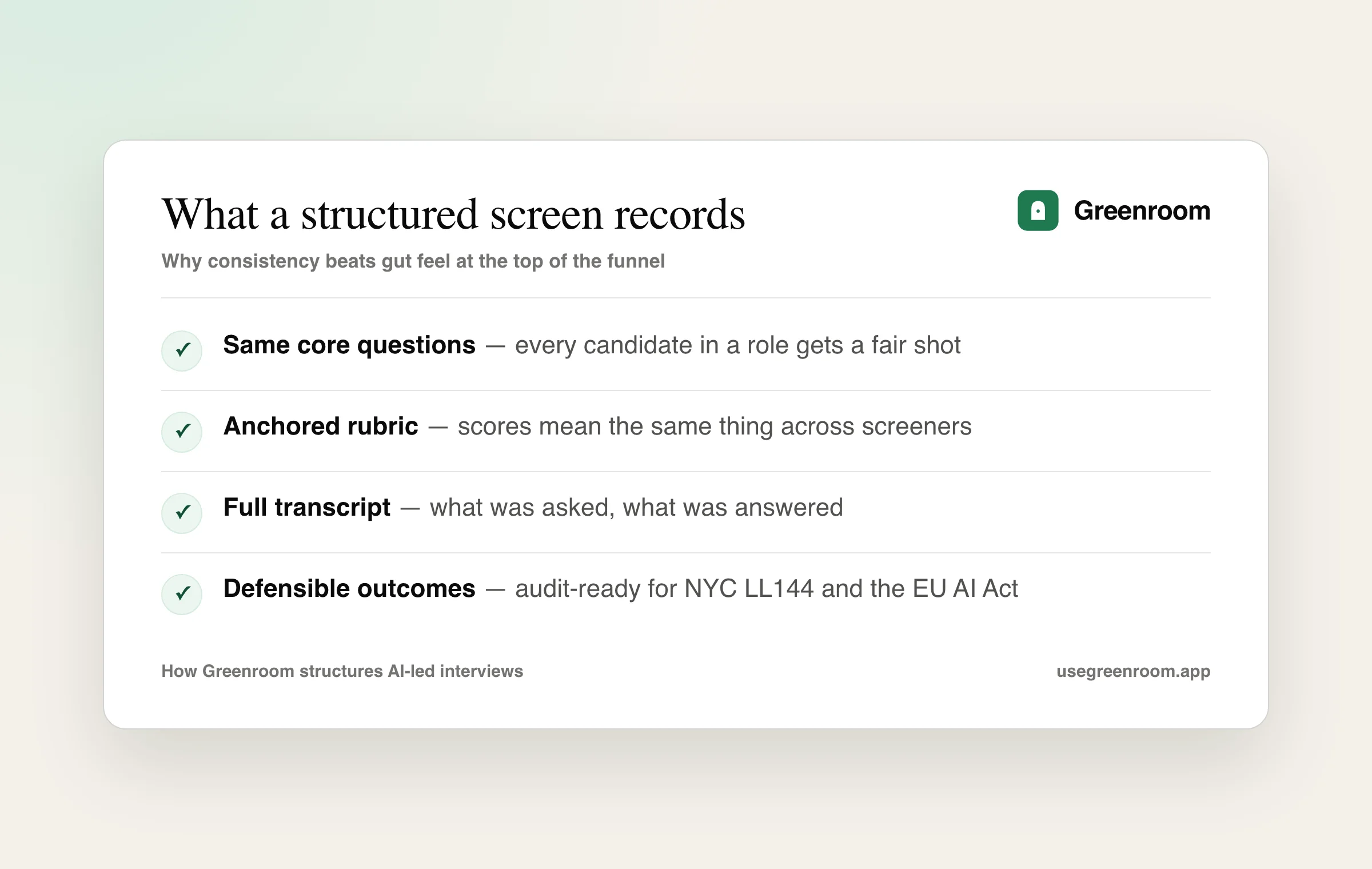
An integrity approach built on visible signals and human judgment is more defensible for everyone. Candidates get a process that won't condemn them on a hidden score. Employers get evidence they can actually stand behind if a decision is ever questioned. And the record itself — what was observed, who reviewed it, what they concluded — is exactly the kind of artifact a fair, auditable hiring process is supposed to produce. Integrity, done honestly, ends up looking a lot like structure: legible, reviewable, and fair precisely because nothing important is hidden.
For the candidate-side view of the same shift, see our proxy interviews and the deepfake crackdown guide.
Frequently asked questions
What cheating signals does Greenroom monitor?
Session-level integrity signals such as long unnatural pauses followed by fluent reading, answer patterns inconsistent with the candidate's own project history, and signs of real-time coaching. Signals are surfaced as context for humans, never as automatic verdicts.
Why not just block or auto-reject suspected cheating?
Because integrity signals are probabilistic and false accusations are costly. The design principle is transparency: show teams what was observed and let humans decide, rather than hiding a black-box judgment.
Do interview copilots actually get candidates caught?
Increasingly, yes. Companies now run proctored or follow-up rounds specifically to catch real-time assistance, and a rescinded offer is the common outcome. Building real skill before the interview is the only assistance that survives contact with the job.