Picture the scene: you're an IIM second-year, six PDFs deep into a shared drive called "Case Bible FINAL v3 (2).pdf", and your case partner has just asked you a profitability question in a tone that suggests they've read Victor Cheng cover to cover twice. You open with "so, um, first I'd like to structure my approach" — and then say nothing else for four full seconds while your brain frantically tries to remember whether it's "customers, cost, competition" or "customers, cost, capabilities." The partner writes something down. You will never know what.
That four-second silence is the entire ballgame. Case interview preparation for McKinsey, BCG and Bain isn't really about memorizing frameworks — every candidate in the room has read the same three prep books. It's about being able to structure an unfamiliar business problem out loud, live, in real time, while someone is watching you think and occasionally interrupting with "why do you think that." This guide covers what a case interview actually tests, the core frameworks worth knowing, where candidates lose points, and how to practice the part that actually decides the outcome — the talking.
What a case interview actually tests
A case interview is not a business-knowledge quiz. Firms assume you don't already know why a client's revenue dropped in Southeast Asia — they're testing how you'd figure it out if you did know nothing, in front of a client, on the spot. Three things are being scored simultaneously:
- Structuring — can you break an ambiguous, open-ended problem ("our profits are down, why?") into a clean, non-overlapping set of hypotheses before you touch a single number?
- Quantitative reasoning — can you do sanity-checked mental math live, without a calculator, and know instinctively when an answer is implausible (a $50 coffee, a 400% margin)?
- Communication under live pressure — can you narrate your thinking clearly enough that a partner who's only half paying attention can follow you, and can you take a "but what if X" curveball without your structure collapsing?
The case content (retail, market entry, a merger) is just the vehicle. This is also why case interviews feel so different from a coding interview or a behavioral round — there's no "correct" final number, and a partner who liked your logic will often tell you your final answer doesn't matter nearly as much as how you got there.
The frameworks worth actually knowing
Most Indian b-school prep culture treats frameworks like a formula sheet to memorize and recite. That's the fastest way to get a "thanks, we'll get back to you." Frameworks are starting points you adapt to the specific case, not a script.
Profitability framework
Profit = Revenue − Cost. Split revenue into price × volume, and volume further into customer segments or channels. Split cost into fixed vs. variable. The skill isn't drawing this tree — every candidate can draw it — it's picking which branch is actually worth digging into given the specific numbers in the case, instead of mechanically walking every box.
Market entry framework
Should the client enter a new market/product/geography? Structure around: market attractiveness (size, growth, competitive intensity), the client's right to win (capabilities, existing assets, brand), financial viability (investment required, payback period), and entry mode (organic build, acquisition, joint venture, partnership).
M&A / acquisition framework
Why acquire, and is this the right target? Structure around: strategic rationale (why buy vs. build), standalone valuation of the target, synergies (revenue and cost — and which are realistic vs. optimistic), integration risk, and the price you'd actually be willing to pay given all of the above.
Growth / new business framework
How should the client grow? This one blends market entry and profitability: organic growth (new customers, new products, price) vs. inorganic growth (M&A, partnerships), sized and prioritized against the client's actual capabilities and appetite for risk.
Case interviews vs. every other interview format
If you're also prepping for tech roles or product management roles, the contrast is useful. A coding interview has one right answer and a compiler that won't lie to you. A behavioral interview rewards a well-told true story. A case interview rewards neither memorized correctness nor a rehearsed script — it rewards live, adaptive reasoning, which is exactly why candidates who ace LeetCode or nail STAR answers can still freeze on a case: they've never practiced thinking on their feet with someone actively probing their logic.
Common mistakes candidates make
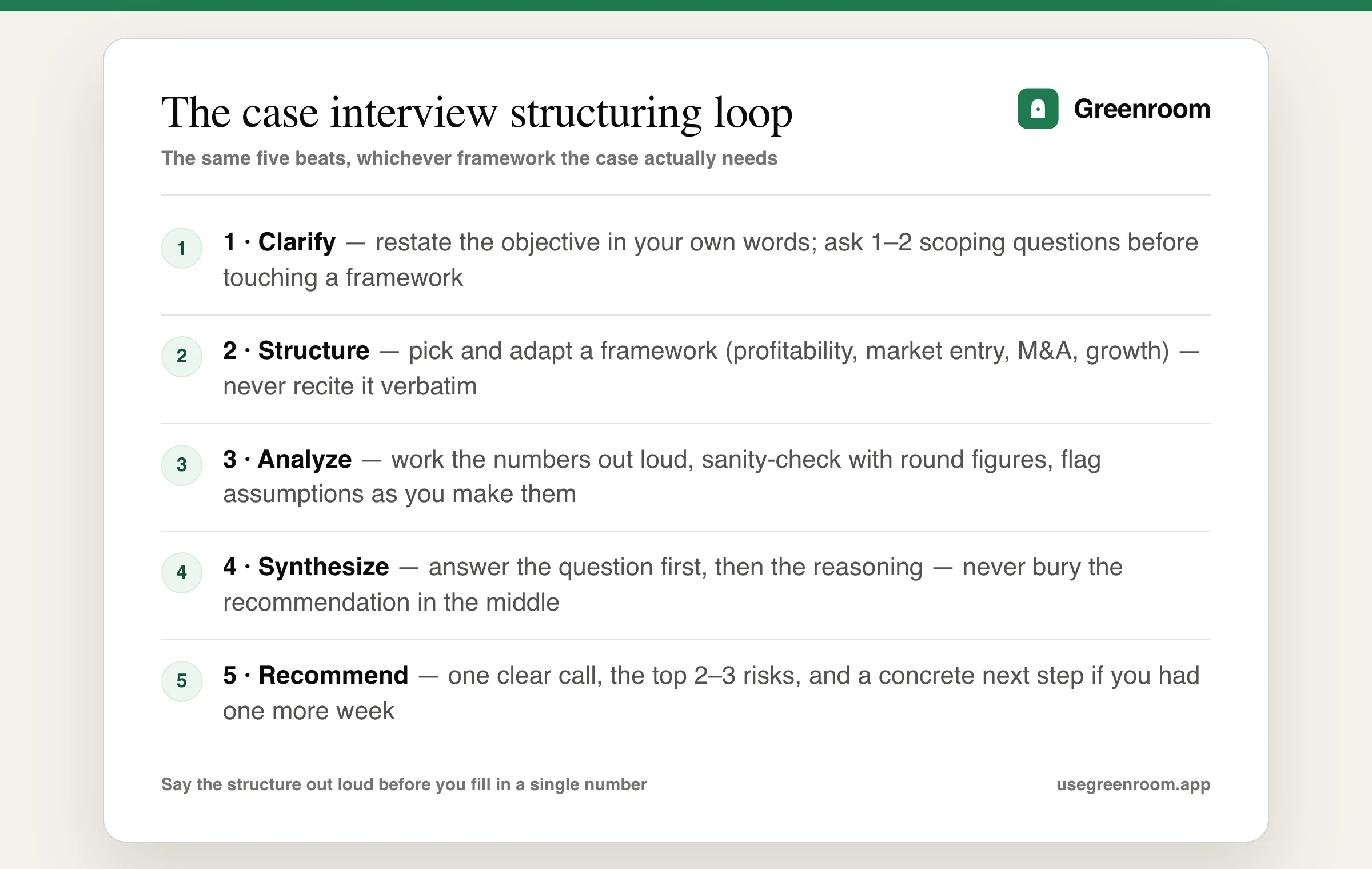
- Reciting a framework instead of adapting one. Interviewers have heard "customers, cost, competition" a thousand times. They're listening for whether you chose it for a reason, not whether you memorized it.
- Silence while structuring. A long pause to think is fine once; going quiet for 20+ seconds reads as either unprepared or unable to communicate under pressure — which is the exact skill being tested. Narrate: "give me a moment to think through the drivers here" beats dead air.
- Skipping the clarifying questions. Diving straight into a framework without confirming the objective ("are we optimizing for revenue or margin here?") is the single fastest way to solve the wrong problem confidently.
- Burying the recommendation. After 25 minutes of good analysis, candidates often ramble through every finding before finally landing on an answer. Consulting firms train for answer-first communication — state the recommendation, then the two or three reasons, then the risks. If you only do one thing differently after reading this, do this one.
- Math that isn't sanity-checked. A candidate who calculates a market size of ₹50 lakh crore for a mid-size Indian retailer and moves on without blinking has just told the interviewer they don't build intuition for numbers — a bigger red flag than the arithmetic error itself.
- Treating the case like a monologue. Good case performance is a dialogue — asking a clarifying question mid-analysis, checking "does this direction make sense before I go further," and taking an interruption as new information rather than a threat to your structure.
How to actually practice the part that matters
Reading Case in Point, drilling frameworks with friends over chai, and working through Victor Cheng's videos all build the content knowledge. But content isn't the bottleneck for most candidates — the bottleneck is doing it out loud, live, under mild social pressure, with follow-ups you didn't prepare for. That's a different skill from reading a model answer and nodding along, the same way reading a fluent essay is different from writing one in an exam hall.
This is exactly the gap Greenroom was built to close, though it's worth being precise about what it is and isn't here: Greenroom isn't a case-interview-specific product with a McKinsey question bank. It's a spoken AI mock interview platform — you talk to Ari, the AI interviewer, out loud, and it asks real follow-up questions and pushes back on your reasoning the way a live partner would, then gives you structured feedback on clarity and structure, not just "correctness." For the specific skill this guide keeps circling back to — structuring a problem verbally, live, with someone probing your logic — that kind of spoken repetition matters more than another framework PDF. Pair it with timed practice: partner cases with a stopwatch, or a mock interview where you can't pause to think in text before answering.
Compare that to the usual alternatives: a WhatsApp group's shared case bank teaches you to recognize frameworks, not to produce them live; ChatGPT can simulate a case prompt but won't interrupt you mid-answer with a pointed "wait, why do you assume that" the way a real partner will; a friend running you through a case is genuinely useful but limited by their own patience and case-bank depth on a Tuesday night. None of these substitute for reps where you have to think and talk simultaneously, under at least a little real pressure — which is the actual thing being graded on interview day.
A realistic prep timeline
- 6–8 weeks out: Read one structured resource (Case in Point or a firm's own prep guide) once, fully. Don't re-read it three times — move to practice sooner than feels comfortable.
- 4–6 weeks out: Do 2–3 timed practice cases a week, alternating framework types (profitability, market entry, M&A, growth), and record yourself or use a spoken mock interview so you can hear your own filler words and pacing.
- 2–3 weeks out: Shift ratio toward mocks with a partner or tool who can genuinely push back, not just read a script. Start timing to the real 30–40 minute case length end to end.
- Final week: Fewer, higher-quality reps. Review your own recorded weaknesses (rambling before recommending, skipping clarifying questions) rather than cramming new frameworks.
Frequently asked questions
How do I prepare for a McKinsey, BCG or Bain case interview?
Learn the core frameworks (profitability, market entry, M&A, growth) as flexible starting points, not scripts, then spend most of your prep time on timed, spoken practice — cases done out loud with a partner or mock interview tool that pushes back, since structuring and communicating live under pressure is what's actually being scored, not framework recall.
What is the best framework for a case interview?
There isn't one universal best framework — the skill is picking and adapting the right starting structure (profitability, market entry, M&A, or growth) to the specific numbers and context of the case in front of you, rather than reciting a memorized tree regardless of fit.
How many practice cases should I do before a real case interview?
Most successful candidates do 15–25 full timed practice cases spread over 6–8 weeks, shifting from solo/reading-heavy prep early on toward live, spoken partner or mock-interview practice in the final two to three weeks, since live reps build the communication skill that reading alone doesn't.
Can I prepare for case interviews alone, without a partner?
Yes, though it's harder to build the live-communication skill solo. Reading frameworks and doing written case math can be done alone; for the spoken structuring practice, a recorded solo run-through or a spoken AI mock interview that asks follow-up questions gets you closer to real interview pressure than silent reading does.
What's the most common reason candidates fail case interviews?
Reciting a framework instead of adapting it to the case, and burying the final recommendation under a long walk through every finding instead of leading with the answer. Both are communication failures, not knowledge gaps — most rejected candidates knew the right framework but didn't demonstrate live, adaptive reasoning clearly enough.
Do case interviews test business knowledge or problem-solving?
Problem-solving, overwhelmingly. Firms don't expect you to know why a specific client's margins dropped — they're testing whether you can structure an ambiguous problem, reason quantitatively on your feet, and communicate clearly under real-time pressure, using the case only as the vehicle for that.
Interviewing at a specific firm? Our ZS Associates interview questions guide covers the guesstimate and case rounds in that loop, the Mu Sigma interview questions guide covers the group discussion stage that eliminates most candidates, and the Fractal Analytics interview questions guide covers the analytics-heavy version of the same case round.