The email lands on a Tuesday: "We'd love to invite you back to meet the team." You reread it four times looking for a catch. There isn't one — you're through to the second interview. Then the second email arrives: "Please prepare a short presentation." And suddenly the win feels like homework. This guide covers the second interview questions that actually come up, what the presentation round looks like, and how to prepare so round two closes the offer instead of reopening the search.
How the second interview differs
- Deeper technical or role-specific questions — they dig past your surface answers. Round one checked that you're plausible; round two checks that you're real.
- More senior interviewers — a hiring manager, director, or skip-level. Different altitude, different questions.
- Stronger focus on fit — culture, team, long-term potential. "Can they do the job" becomes "do we want to do the job with them."
- Sometimes a practical task — a case study, a second interview presentation, or a work sample.
Common second-interview questions
These aren't new questions so much as first-round questions with the training wheels off. Here's what comes up and what each one is really testing.
"Walk me through how you'd handle X"
X is usually a real problem the team has right now. They're not grading the answer; they're grading the approach — do you ask clarifying questions, name trade-offs, and admit what you'd need to learn? A confident wrong-but-reasoned answer beats a vague safe one.
"Why do you want this role and company?" — round two edition
You answered this in round one. Now it comes back with higher expectations: the generic version ("great culture, exciting product") that survived the screen will die in front of a director. Reference something specific you learned in the first round. Our full guide to this question has worked examples.
"Where do you see yourself long term?"
Senior interviewers ask this because they're pricing retention risk. You don't need a five-year plan; you need a believable direction that this role plausibly feeds. See our guide to the five-year question.
"Tell me about a time you disagreed with a decision"
Situational and leadership scenarios show up heavily in round two. Structure the story: the disagreement, what you did about it, and — the part most people skip — what happened after. If you're interviewing for a senior role, our STAR answers for senior engineers breaks down the level they expect.
"What would your first 90 days look like?"
This one quietly separates finalists. A good answer has a shape: learn first (weeks 1–4), contribute small (weeks 5–8), own something (weeks 9–12). Naming that you'd spend the first month listening, not "fixing," reads as senior.
"Do you have any questions for us?"
In round two this is not a formality — senior people judge you on it. Ask about vision, team health, and what success in the role looks like at 12 months. Our list of questions to ask at the end of an interview is sorted by who's across the table.
The second interview presentation: how to prepare one
More and more second rounds — especially for senior, product-facing, and managerial roles — include a second interview presentation: 15–20 minutes of you presenting, then questions. The brief is usually one of three shapes:
- A 30-60-90 day plan — "tell us how you'd approach your first three months."
- A case study — "here's a scenario like the ones we face; how would you tackle it?"
- A teardown — "what would you improve about our product / process / codebase?"
Structure that works for all three: the problem as you understand it → your approach → the plan → risks and open questions. Roughly one slide per two minutes of speaking time, so a 20-minute slot is a ~10-slide deck. End on the open questions slide — it turns the Q&A into a working session, which is exactly the "what would it be like to work with this person" signal they invited you back to get.
Second interview presentation examples
Three real-shaped example briefs and how to angle them: (1) "Present your 90-day plan for the frontend platform role" — anchor each month to one deliverable and one relationship you'd build. (2) "Walk us through how you'd reduce our checkout drop-off" — spend a third of the deck on how you'd diagnose before proposing anything. (3) "Present a project you're proud of" — pick the one with the best story arc (constraint, decision, result), not the biggest one. In all three, rehearse out loud with a timer; running over time is the single most common way candidates sabotage a strong deck.
How to prepare for a second interview
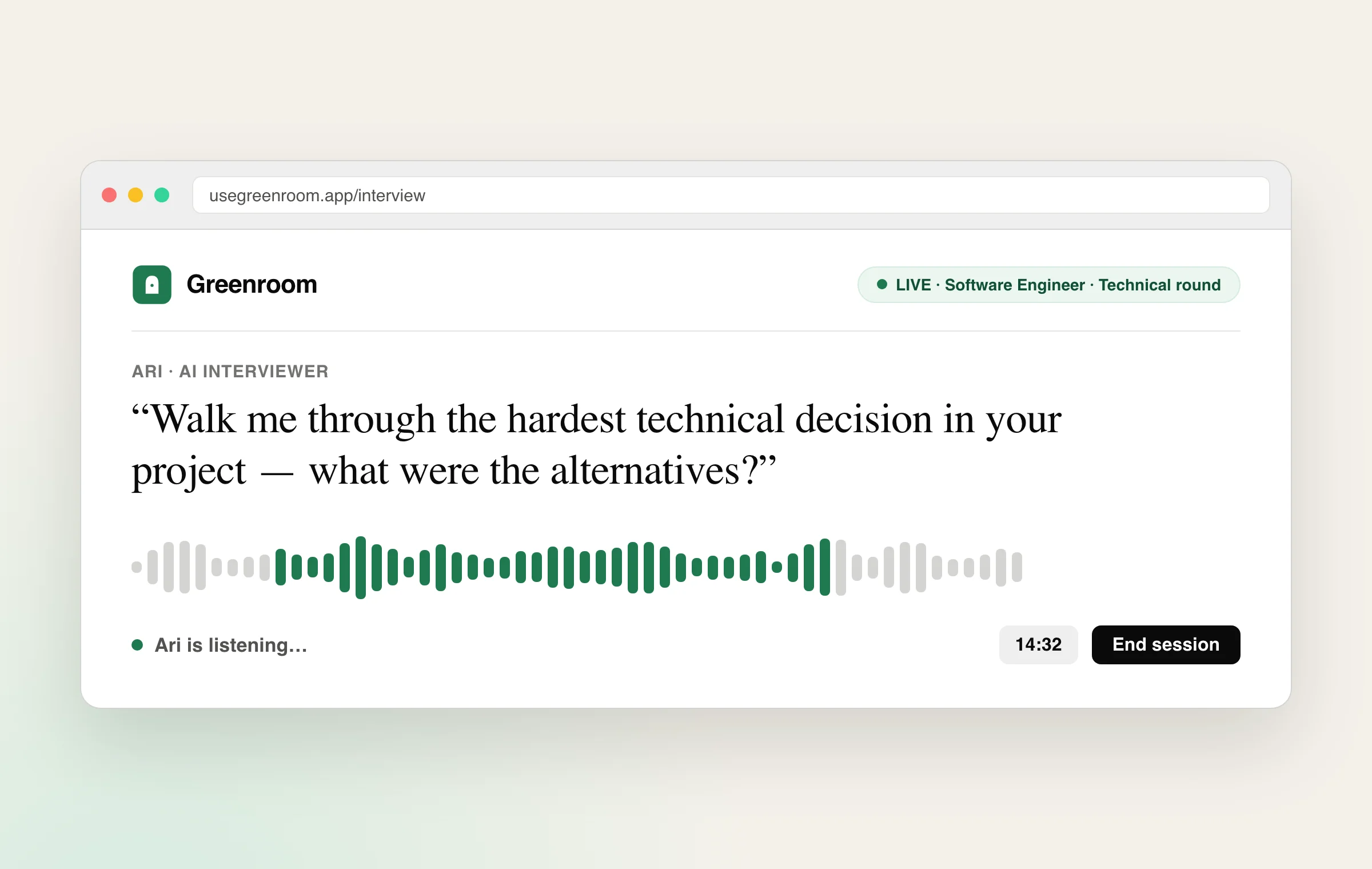
Review what you said in round one — consistency is quietly checked. Research the new interviewers if names are shared. Prepare sharper, more specific examples — depth is the test. And rehearse the spoken parts, because depth that has never left your head comes out tangled under pressure. Re-reading notes is the weakest form of practice; a friend can mock-interview you but rarely pushes back like a director does; prompting ChatGPT gets you plausible text, not practice speaking. A voice-based mock — Greenroom's Ari asks the deeper "walk me through" follow-ups out loud and tells you bluntly where an answer went soft — is the closest rehearsal to the real thing. Pair it with the week-before-interview checklist so logistics don't eat your prep time.
For the last round specifically, see our how to prepare for a final round interview guide — the assessment changes more than most candidates expect.
Frequently asked questions
What questions are asked in a second interview?
Second interviews go deeper: detailed dives into your experience and projects ('walk me through how you'd handle X'), a higher-expectations version of 'why this role and company,' long-term fit and career questions, situational and leadership scenarios, and sharper expectations for the questions you ask. There may also be a practical task like a case study, presentation or work sample.
How is a second interview different from the first?
A second interview goes deeper and probes fit and depth rather than re-covering the basics. It often involves more senior interviewers (a hiring manager, director or skip-level), digs past your surface answers, focuses more on culture and long-term potential, and may include a practical task. Clearing the first round means they're seriously considering you, so it's about confirming depth and fit.
How do I prepare for a second interview?
Review what you said in the first round so you stay consistent and can go deeper, research the new interviewers if known, prepare sharper and more specific examples since depth is being tested, and ready thoughtful questions for senior leaders about vision, team and growth. Rehearse your answers out loud at least once — depth that exists in your head but has never been spoken tends to come out tangled.
Is a second interview a good sign?
Yes. Most companies only take 20–40% of first-round candidates to a second interview, so being invited back means you cleared a real bar and someone is advocating for you. It is not an offer, though — round two usually decides between a small group of finalists, so preparation matters more now, not less.
How do I prepare a presentation for a 2nd interview?
Confirm the brief (topic, time limit, audience and format), then build a short deck — roughly one slide per two minutes of speaking time — structured as: the problem, your approach, your plan for the first 90 days, risks and open questions. Rehearse it out loud against a timer at least twice; going over time is the most common way candidates hurt themselves. Bring a PDF backup in case screen sharing fails.
How long does a second interview last?
Typically 45 minutes to half a day. A single second-round conversation usually runs 45–60 minutes; if the company batches several interviewers, a presentation or a work sample into one visit, plan for two to four hours. The invitation email normally states the total time — if it doesn't, it's completely fine to ask the recruiter.
Does a second interview mean I'll get the job?
Not guaranteed, but it's a strong signal — you cleared the first bar and they're seriously considering you. The second round confirms depth, fit and motivation, sometimes against a few other finalists. Treat it as a real evaluation, not a formality: go deeper, stay consistent, show enthusiasm, and prepare thoroughly to close the offer.