He had the model. Gradient boosting, AUC of 0.91, cross-validated properly, the whole thing. He described it beautifully for four minutes. Then the interviewer asked, "The client is a retail category head. What do you tell her to do on Monday?" and he said "the AUC is 0.91" again, slightly louder, as though the problem had been volume.
That gap — between a good model and a decision someone can act on — is the entire theme of Fractal Analytics interview questions. Fractal sells AI to Fortune 500 boardrooms, so its loop is built to find people who can do the maths and land the recommendation. I built Greenroom after freezing in an interview I had prepared hard for, so this guide walks the Fractal loop round by round and shows what to say out loud.
The Fractal Analytics interview process in 2026
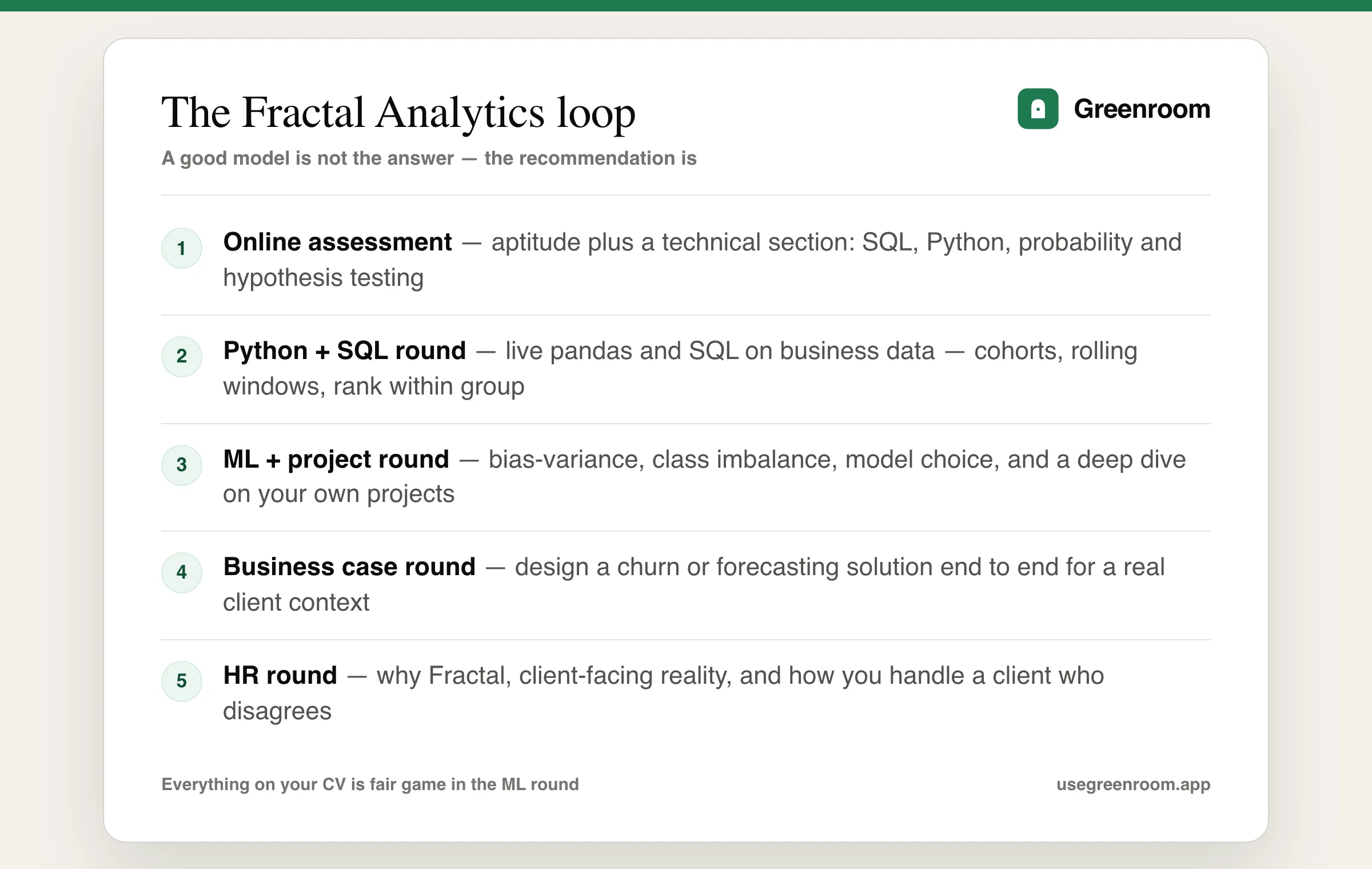
Fractal (Fractal Analytics, headquartered in Mumbai with large offices in Bengaluru, Gurgaon, Pune, Chennai and Coimbatore) hires into several tracks — data scientist, data engineer, business analyst / consultant, and ML engineer. The reported Fractal Analytics interview process runs roughly:
- Online assessment — aptitude and logical reasoning plus a technical section: SQL, Python, statistics, and often a short coding task. Some drives use a case or essay component.
- Technical round 1 — Python and SQL live, with statistics probing underneath. Expect to explain, not just write.
- Technical round 2 / ML round — machine learning fundamentals and a deep dive into a project on your résumé. Everything on that CV is fair game.
- Business case / client round — a business problem framed as an analytics problem: what would you build, what data would you need, how would you measure success.
- HR round — why Fractal, location, and how you handle a client who disagrees with your analysis.
The volume of rounds varies by track and level — experienced hires often get an extra panel — but the ML-plus-business-case pairing is close to universal. Fractal's stated positioning is "AI, engineering and design" for enterprise decisions, and the loop is a direct reflection of that sentence.
Fractal Analytics online assessment and aptitude questions
The Fractal Analytics online test is a two-part paper: general aptitude (quant, logical reasoning, data interpretation, verbal) and a technical section that is heavier than most service-company screens — SQL output prediction, Python snippets, probability, and questions on distributions and hypothesis testing.
The probability questions are where people lose time. Expect conditional-probability word problems (the classic disease-test Bayes setup appears often), expected-value questions, and at least one that is only hard because it is phrased confusingly. Practise reading them slowly. The aptitude test preparation guide covers the timing strategy for the first half.
Fractal Analytics Python and SQL interview questions
The first technical round is live and conversational. The Fractal Python interview questions lean pandas rather than algorithms: group-bys, merges, handling missing values, reshaping, and writing something readable. A representative problem — compute each customer's rolling 3-month spend and flag the ones whose spend has dropped:
import pandas as pd

def flag_declining_customers(txns, drop_threshold=0.30):
    """txns: customer_id, month (period), amount. Returns customers whose latest
    3-month spend fell more than drop_threshold vs the previous 3 months."""
    monthly = (txns.groupby(["customer_id", "month"], as_index=False)["amount"]
                    .sum()
                    .sort_values(["customer_id", "month"]))

    g = monthly.groupby("customer_id")["amount"]
    monthly["recent_3m"] = g.transform(lambda s: s.rolling(3).sum())
    monthly["prior_3m"]  = g.transform(lambda s: s.rolling(3).sum().shift(3))

    latest = monthly.groupby("customer_id").tail(1).dropna(subset=["prior_3m"])
    return latest[latest["recent_3m"] < (1 - drop_threshold) * latest["prior_3m"]]
Narrate two things while writing it. First, the customers with fewer than six months of history are dropped by dropna — is that what the business wants, or should a new customer be excluded explicitly rather than silently? Second, this is in-memory pandas; at client scale it becomes a SQL window function or a Spark job. Volunteering both unprompted is a strong signal. Our Python interview questions guide covers the language layer.
The Fractal SQL interview questions are standard analyst fare with a business skin: window functions for running totals and rank-within-group, self-joins for month-on-month comparison, LEFT JOIN plus IS NULL for "customers who did not buy", and at least one deduplication problem. Expect a follow-up on what the query would cost on a billion rows.
Fractal Analytics machine learning and case study questions
The ML round is where the offer is decided for data science roles. Reported Fractal Analytics machine learning interview questions cluster tightly:
- Explain bias and variance, and tell me which one your last model suffered from and how you knew.
- Your classifier has 98% accuracy on a fraud dataset. Is it good? (Class imbalance — precision, recall, PR-AUC, and what the business cost of a false negative is.)
- How do you handle imbalanced data — and why is naive oversampling before the train-test split wrong?
- Random forest vs gradient boosting: when would you choose which, and what would you tell a client who wants "the most accurate one"?
- How would you explain a model's prediction to a non-technical stakeholder? (SHAP, feature importance, and their limits.)
- Design a churn / demand forecasting / price elasticity solution for a retail client end to end.
The last one is the real Fractal question. A complete answer moves through: what decision the client is making, what the target variable actually is and over what horizon, what data exists and what is missing, the baseline you would beat before touching a model, the metric tied to business cost rather than to Kaggle, how it gets deployed and monitored, and what you would do when it drifts. Candidates who open with "I'd use XGBoost" have skipped the four steps that Fractal is scoring. The machine learning engineer interview questions guide and the data scientist interview questions guide go deeper on the fundamentals.
Your own projects get the same treatment. Whatever is on your CV, be ready for: why that algorithm, what the baseline was, what you would do differently, and what the model got wrong. "I got 0.91 AUC" invites the question that ended the story at the top of this page. Our how to explain your project in an interview guide has the structure.
The HR round: why Fractal, and the consulting reality check
HR is short but not decorative. "Why Fractal?" is checked against whether you understand that this is client-facing analytics consulting, not an in-house research lab — you will work on someone else's problem, with someone else's messy data, on someone else's deadline. Saying that plainly reads as maturity.
The other reliable question is about disagreement: a client insists your analysis is wrong, or wants the chart to say something it does not. The good answer separates the finding from the framing — you do not change the number, you do change how you present it and what you check next. Vague "I'd convince them with data" answers land badly because everyone says it.
Kaggle, Analytics Vidhya, ChatGPT — where each fits
- Kaggle — excellent for modelling craft, actively misleading for this loop. Kaggle hands you a clean target and a fixed metric; Fractal's round is about choosing both.
- Analytics Vidhya and GeeksforGeeks — good coverage of the ML question list and past interview experiences. The limit is that reading an answer and being able to say it under a follow-up are different skills.
- StrataScratch / DataLemur — the best structured SQL and Python practice for the technical round.
- Your own past project — the highest-yield prep in this list, and the most neglected. Write one page on it: decision, data, baseline, metric, what broke.
- ChatGPT — useful for generating case prompts and stress-testing a written design. It will not interrupt your fourth minute of model description to ask what the client should do on Monday.
- Greenroom — the spoken layer. Ari, the AI interviewer, runs the ML and case rounds aloud, pushes back when your answer is metric-first instead of decision-first, and scores structure and clarity. Fair tradeoff: Ari will not debug your notebook.
How to prepare for the Fractal Analytics interview
- Week 1: aptitude and the technical screen — timed DI sets, plus daily probability and statistics questions answered out loud in plain English.
- Week 2: pandas and SQL every day on realistic business shapes — cohorts, rolling windows, rank-within-group, dedup — each one re-explained in ninety seconds without looking.
- Week 3: ML fundamentals and one end-to-end case per day, spoken: decision, target, data, baseline, metric, deployment, monitoring. Record yourself and count how long you spend on the algorithm versus the decision.
- Final week: rewrite your project story, prepare five behavioral answers in first person, and run two full spoken mocks with interruptions. The night before, reread your one-pager — not new material.
Interviewing across the Indian analytics circuit? The ZS Associates interview questions guide, the Mu Sigma interview questions guide and the Tiger Analytics interview questions guide cover the closest alternatives, and the Publicis Sapient interview questions guide covers the engineering-heavy end of the same market.
Frequently asked questions
What is the Fractal Analytics interview process?
Candidates report an online assessment covering aptitude, logical reasoning, SQL, Python and statistics, followed by a live technical round on Python and SQL, a machine learning round that also deep-dives your résumé projects, a business case or client round, and a short HR round. Experienced hires often get an additional panel, but the ML round plus business case pairing is close to universal.
What questions are asked in a Fractal Analytics interview?
The most reported questions are pandas and SQL problems on business data such as cohorts, rolling windows and rank-within-group; machine learning fundamentals including bias-variance, class imbalance, and model selection; an end-to-end case such as designing a churn or demand forecasting solution for a retail client; a deep dive on a project from your CV; and HR questions about why Fractal and how you handle client disagreement.
Is the Fractal Analytics interview difficult?
The technical bar is moderate rather than extreme — standard analyst-level SQL, practical pandas, and textbook machine learning. The difficulty is that every technical answer gets a business follow-up, and candidates who can only discuss models in terms of accuracy metrics struggle. Interviewers repeatedly push toward what the client should actually do with the result.
What machine learning questions does Fractal Analytics ask?
Commonly reported ML questions include explaining bias and variance with an example from your own work, why 98% accuracy on an imbalanced fraud dataset can be worthless, how to handle class imbalance without leaking through the train-test split, random forest versus gradient boosting tradeoffs, how to explain a prediction to a non-technical stakeholder, and how to design a churn or forecasting solution end to end.
Does Fractal Analytics ask coding questions?
Yes, but they are practical rather than algorithmic. Expect pandas data manipulation, SQL with window functions and joins, and occasionally a short coding task in the online assessment. Pure data-structures-and-algorithms rounds are more common for engineering and ML engineer tracks than for data scientist and business analyst roles.
How do I prepare for a Fractal Analytics case study round?
Practise the full chain out loud: what decision the client is making, what the target variable is and over what horizon, what data exists, the simple baseline you would beat first, a metric tied to business cost rather than a leaderboard, how the solution is deployed and monitored, and what you do when it drifts. Do one case per day spoken rather than five read on paper.