Somewhere in a Bengaluru campus drive, an interviewer asked a final-year mechanical engineering student why she wanted to be a Decision Scientist. She said she loved data. He said, "Everyone in this queue loves data. Why should a client pay for your opinion?" She had no answer. Neither, in fairness, did the eleven people behind her.
That question is the spine of every round in the loop, which is why Mu Sigma interview questions look so unlike a normal placement interview. Mu Sigma hires from every branch of engineering, teaches analytics on the job, and screens almost entirely for how you think out loud. I built Greenroom after freezing in an interview I had genuinely prepared for — so this guide covers the Mu Sigma process round by round, honestly, including the parts people wish they had known first.
The Mu Sigma interview process in 2026
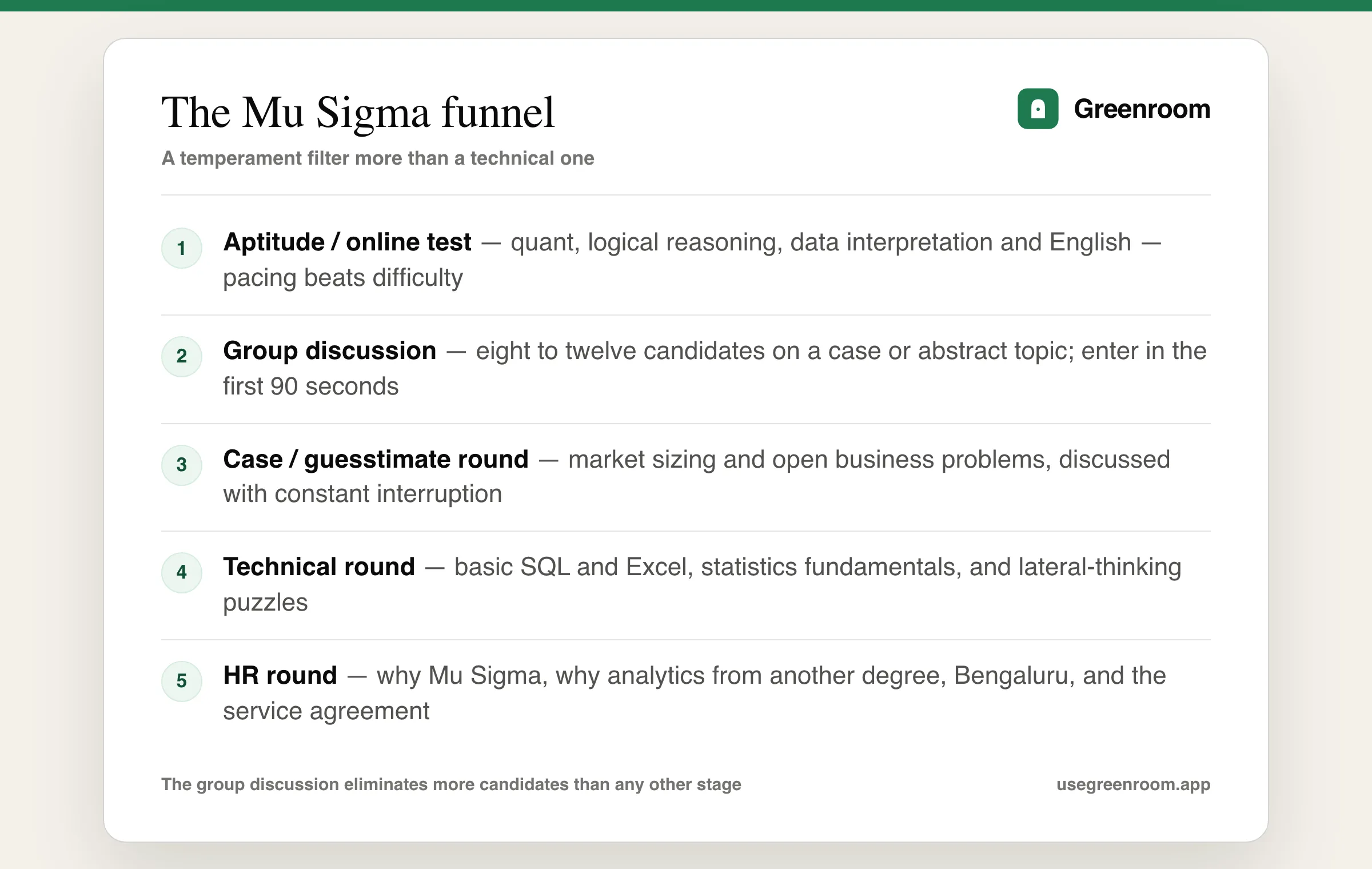
Mu Sigma is a Bengaluru-headquartered decision-sciences firm that hires in volume, largely for the Decision Scientist (previously Trainee Decision Scientist) role. The reported Mu Sigma interview process is a funnel, and it is deliberately attritional:
- Aptitude / online assessment — quantitative aptitude, logical reasoning, data interpretation and English. Some drives add a psychometric or situational-judgment section.
- Group discussion — a case or abstract topic, 8–12 candidates, and it eliminates more people than any other stage.
- Case / guesstimate interview — market sizing or a loose business problem, discussed conversationally with an interviewer who will interrupt.
- Technical / analytical round — basic SQL and Excel, statistics, puzzles, and a strong emphasis on structured reasoning rather than syntax.
- HR round — why Mu Sigma, why analytics from a non-analytics degree, relocation to Bengaluru, and the service agreement.
The loop is not technically hard. It is a filter for a specific temperament: comfortable being wrong in public, comfortable with an ambiguous question, and comfortable being one of many. Understanding that reframes how you prepare.
Mu Sigma aptitude test and online assessment questions
The Mu Sigma aptitude test is a standard Indian placement paper with a slightly heavier data-interpretation weighting: percentages, ratios, averages, time-speed-distance, permutations and probability, seating and blood-relation puzzles, series completion, and DI off tables and charts. Some drives include an English section and a personality inventory.
Speed is the constraint, not difficulty. Candidates who fail here almost always failed on pacing — spending four minutes on a puzzle worth the same as a fifteen-second percentage question. Practise full timed papers, not topic-wise sets, in the final week. The aptitude test preparation guide covers sectional pacing and what to skip.
The Mu Sigma group discussion round
This is the stage that surprises people. The Mu Sigma group discussion puts a large group on a topic — sometimes a business case ("a coffee chain's footfall dropped 30%, what should it do?"), sometimes abstract ("is social media making us less social?"), sometimes a mini-guesstimate the group must solve together.
The scoring is not about talking the most. Consistently reported signals:
- Enter within the first ninety seconds. After that the group forms, and the quiet person becomes invisible. You do not need a brilliant point — a structuring one works: "Can we split this into demand-side and supply-side reasons?"
- Build on someone by name. "To add to what Rahul said" scores higher than the same content said in isolation, because the job is client teamwork.
- Bring a number. One rough estimate or segmentation lifts the whole discussion and marks you as the analytical one.
- Do not fight for the floor. Interrupting aggressively is the fastest way out of a Mu Sigma GD; so is going silent after being interrupted once.
- Summarise if nobody has. The person who closes with a clean three-point summary is remembered by every panellist.
Our group discussion tips for placements guide covers entry lines and recovery when you are talked over, and the how to speak confidently in interviews guide covers pace and volume, which matter more in a room of twelve than in a one-on-one.
Mu Sigma case study and guesstimate interview questions
The interview stage is dominated by open-ended reasoning. Reported Mu Sigma guesstimate questions and cases include:
- How many petrol pumps are there in Bengaluru?
- Estimate the number of pizzas Domino's sells in India in a day.
- How many tennis balls fit in a Boeing 747?
- An e-commerce client's returns rate doubled in a quarter. How would you find out why?
- How would you price a product with no comparable competitor?
- A retail chain wants to open ten new stores. How would you choose the cities?
The structure that scores
Identical discipline to any consulting case, and it must be spoken, not thought: clarify the question first, state the equation before doing arithmetic, segment instead of averaging, label every assumption as an assumption, and sanity-check the answer at the end. For the returns-rate case, the branches are product mix, customer mix, logistics, and policy change — name all four before diving into one.
The Mu Sigma-specific twist is a fondness for puzzles and lateral thinking — bulbs and switches, weighing problems, river crossings. They are not testing puzzle trivia; they are watching whether you go quiet or start reasoning aloud. Say the wrong idea out loud and discard it. The case interview preparation guide for India drills the framework; the harder skill is doing it audibly.
Mu Sigma technical round: SQL, Excel and statistics
The technical bar is lower than at most analytics firms — Mu Sigma explicitly hires non-CS graduates and trains them. Expect fundamentals: joins, GROUP BY, basic subqueries, Excel lookups and pivots, mean vs median, correlation vs causation, and what a standard deviation tells you about a distribution.
-- Classic screen: customers who ordered in January but not in February
SELECT c.customer_id, c.city
FROM customers c
JOIN orders jan
  ON jan.customer_id = c.customer_id
 AND jan.order_month = '2026-01'
LEFT JOIN orders feb
  ON feb.customer_id = c.customer_id
 AND feb.order_month = '2026-02'
WHERE feb.customer_id IS NULL
GROUP BY c.customer_id, c.city;
The follow-up matters more than the query: why LEFT JOIN … IS NULL rather than NOT IN, and what happens to NOT IN when the subquery returns a NULL. Then the business follow-up — is a customer who skipped one month actually churned? Our SQL interview questions guide covers the join family in depth.
The HR round, the bond, and being honest about the tradeoff
The HR round asks why Mu Sigma, why analytics when your degree is in mechanical or civil engineering, whether you will relocate to Bengaluru, and how you feel about a service agreement. Candidates report a bond or service agreement being part of the offer at various points in Mu Sigma's history — terms have changed over the years, so read your specific offer letter carefully and ask the recruiter directly rather than trusting a forum post.
It is worth being honest with yourself about the tradeoff, because the interviewers will be: Mu Sigma is a high-volume training ground. It hires people with no analytics background, teaches them fast, works them hard, and a lot of alumni move on within a few years to product companies and analytics consultancies. If your honest answer to "why Mu Sigma" is "I want to learn analytics from scratch and I am willing to work hard for it," say that. It is a better answer than a rehearsed line about company values.
For the "why are you switching fields" question, our how to get a job without experience guide has the framing, and the self-introduction for freshers guide covers the opening two minutes.
PrepInsta, GeeksforGeeks, ChatGPT — where each fits
- PrepInsta and IndiaBix — the right tool for the aptitude stage. Timed, close to the real paper, cheap. Nothing for the GD or case rounds.
- GeeksforGeeks interview experiences — good for knowing what gets asked. The limit is structural: a written dump gives you the question and the answer simultaneously, which is exactly what a live interviewer withholds.
- Your college GD practice group — genuinely valuable if it exists and meets. The failure mode is that everyone is polite, so nobody practises being interrupted.
- Case books — read for structure, then close them. Reciting "I'll use the 4Ps framework" out loud lands badly.
- ChatGPT — fine for generating guesstimate prompts and reviewing a written structure. It will not sit through your ten-second silence or ask "why should a client pay for your opinion?" and then wait.
- Greenroom — the spoken layer. Ari, the AI interviewer, runs case and HR rounds out loud, interrupts when you skip your assumptions, and scores structure, clarity and pace. Fair tradeoff: Ari cannot simulate eleven other people in a group discussion — for that, find humans.
How to prepare for the Mu Sigma interview
- Week 1: full timed aptitude papers, every other day, with a focus on pacing and on the DI sets.
- Week 2: one guesstimate a day, out loud and recorded. Play it back and count how many seconds pass before you say a number — if it is under ten, you skipped the structure.
- Week 3: group discussion practice with real people if possible, plus three puzzle problems a day narrated aloud. Practise the entry line and the closing summary specifically.
- Final week: basic SQL and statistics revision, five behavioral answers in first person including "why analytics from a non-analytics degree", and two full spoken mocks with interruptions.
Comparing offers across the Indian analytics circuit? The ZS Associates interview questions guide, the Fractal Analytics interview questions guide and the Tiger Analytics interview questions guide cover the three most common alternatives, and the Publicis Sapient interview questions guide covers the engineering-heavy end of the same market.
Frequently asked questions
What is the Mu Sigma interview process?
Candidates report a five-stage funnel: an aptitude and online assessment covering quant, logical reasoning, data interpretation and English; a group discussion with eight to twelve candidates; a case or guesstimate interview; a technical round covering basic SQL, Excel, statistics and puzzles; and an HR round covering why Mu Sigma, relocation to Bengaluru and the service agreement. The group discussion eliminates more candidates than any other stage.
What questions are asked in a Mu Sigma interview?
The most reported questions are market-sizing guesstimates such as how many petrol pumps there are in Bengaluru or how many pizzas Domino's sells in India per day, open business problems such as why an e-commerce client's returns rate doubled, lateral-thinking puzzles, basic SQL joins and aggregation, statistics fundamentals like mean versus median, and HR questions about why analytics when your degree is in another field.
Is the Mu Sigma interview difficult?
The technical bar is deliberately low — Mu Sigma hires graduates from every engineering branch and trains analytics on the job. The difficulty is volume and temperament. You are competing against a large queue, and every round scores whether you keep reasoning out loud on questions that have no correct answer, which is a skill most candidates have never practised.
What is the Mu Sigma Decision Scientist role?
Decision Scientist is Mu Sigma's core role, and the one most campus and entry-level hires join. The work involves analysing client data, building models and dashboards, and framing business problems as analytical ones across industries. Mu Sigma explicitly recruits from non-analytics degrees and provides structured internal training, so the entry bar is behavioural and analytical reasoning rather than prior tooling experience.
Does Mu Sigma have a bond or service agreement?
Candidates have reported a bond or service agreement forming part of Mu Sigma offers at various points, and the terms have changed over the years. Do not rely on forum posts or older interview experiences for this. Ask the recruiter directly during the HR round and read the specific clause in your own offer letter, including the notice period and any recovery amount, before you sign.
How do I prepare for the Mu Sigma group discussion?
Practise entering within the first ninety seconds with a structuring point rather than an opinion, building on other people by name, and bringing one rough number or segmentation into the discussion. Also practise closing with a three-point summary if nobody else has. Rehearse with a group that will genuinely interrupt you, because a polite practice circle does not prepare you for the real room.