Most interview advice assumes you have a partner, a study group, or money for a coach. A lot of people have none of those — they're prepping at night, after work, on their own. The good news: solo practice works, if you do it deliberately. Reading answers in your head doesn't. Here's a routine that does.
The one rule: out loud, always
The single biggest mistake in solo prep is rehearsing silently. Your brain fills gaps, smooths transitions, and skips the hard parts when you “practice” in your head. The moment you say an answer aloud, you discover you don't actually know how it starts, you ramble in the middle, and you have no ending. That gap is the whole point of practice. If you take nothing else from this: say every answer out loud, every time.
A weekly solo routine
1. Build your question bank (once)
List 15–20 questions you're likely to face: a few behavioral (“tell me about a time…”), a few about your projects, a few role-specific technical ones. You can generate these with an AI assistant from your target job description in five minutes.
2. Record yourself answering (the core drill)
Pick a question, hit record on your phone, and answer as if it's real — no restarts, no editing. Then watch it back. This is uncomfortable and incredibly effective. You'll immediately see the filler words, the rambling, the lack of a clear ending. Most people improve more from watching one recording than from ten silent run-throughs.
3. Self-score against a rubric
For each recorded answer, grade three things: Was it structured? (clear beginning, middle, end) Was it specific? (real numbers, your exact role, an actual trade-off) Was it concise? (under ~2 minutes for behavioral). Write the score down. Tracking it turns vague “that felt bad” into a concrete thing to fix.
4. Rehearse your own projects hardest
The questions people most often freeze on aren't algorithm puzzles — they're “walk me through a project you're proud of” and the follow-ups. Pick your two strongest projects and drill them: the problem, your approach, the key decision, the trade-off, what you'd change. We have a deeper guide on talking about GitHub projects if this is your weak spot.
How to simulate pressure when you're alone
Solo practice has one big hole: there's no pressure, and pressure is what you're actually training for. Three ways to add it back:
- Timer on screen. Give yourself a hard limit and don't pause. Constraint creates urgency.
- No second takes. Treat the first attempt as the real one. The instinct to restart is the instinct you're trying to kill.
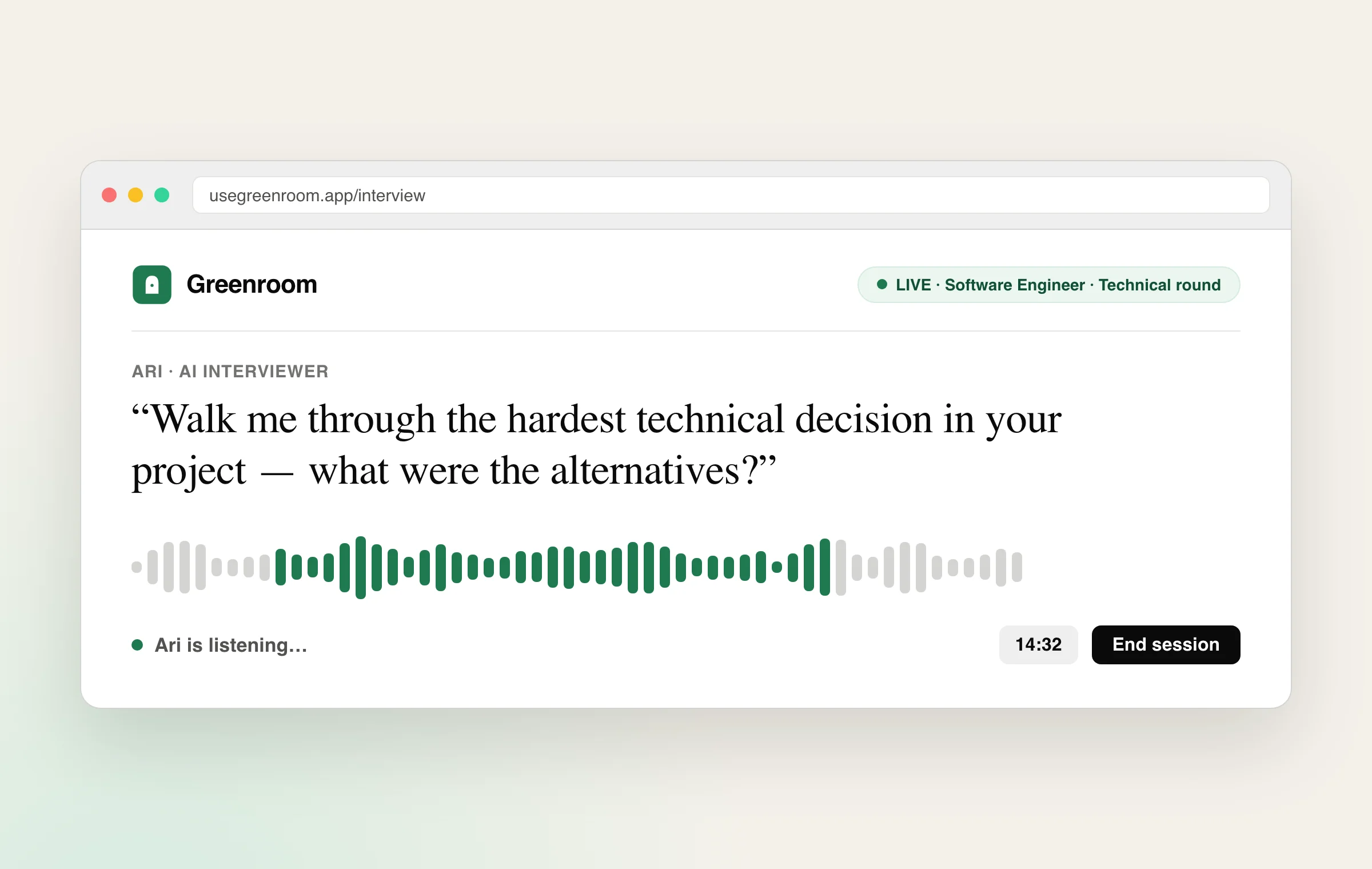
- Use an AI interviewer that talks back. A tool that asks follow-ups out loud and doesn't let you off the hook simulates the back-and-forth a recording can't. This is the closest solo substitute for a real partner.
What to do the week before
Switch from learning to simulating. Stop adding new material and run full mock sessions instead — end to end, out loud, timed. Our week-before checklist covers the rest. And if you tend to blank under pressure, practicing recovery out loud is the only thing that fixes it.
This isn't just a hunch — it's exactly what the learning-science research says. Our Make It Stick summary applied to interview prep breaks down why retrieval practice beats rereading, and how to structure spaced, interleaved practice instead of a single silent review.
The shortcut: an AI interviewer that does this for you
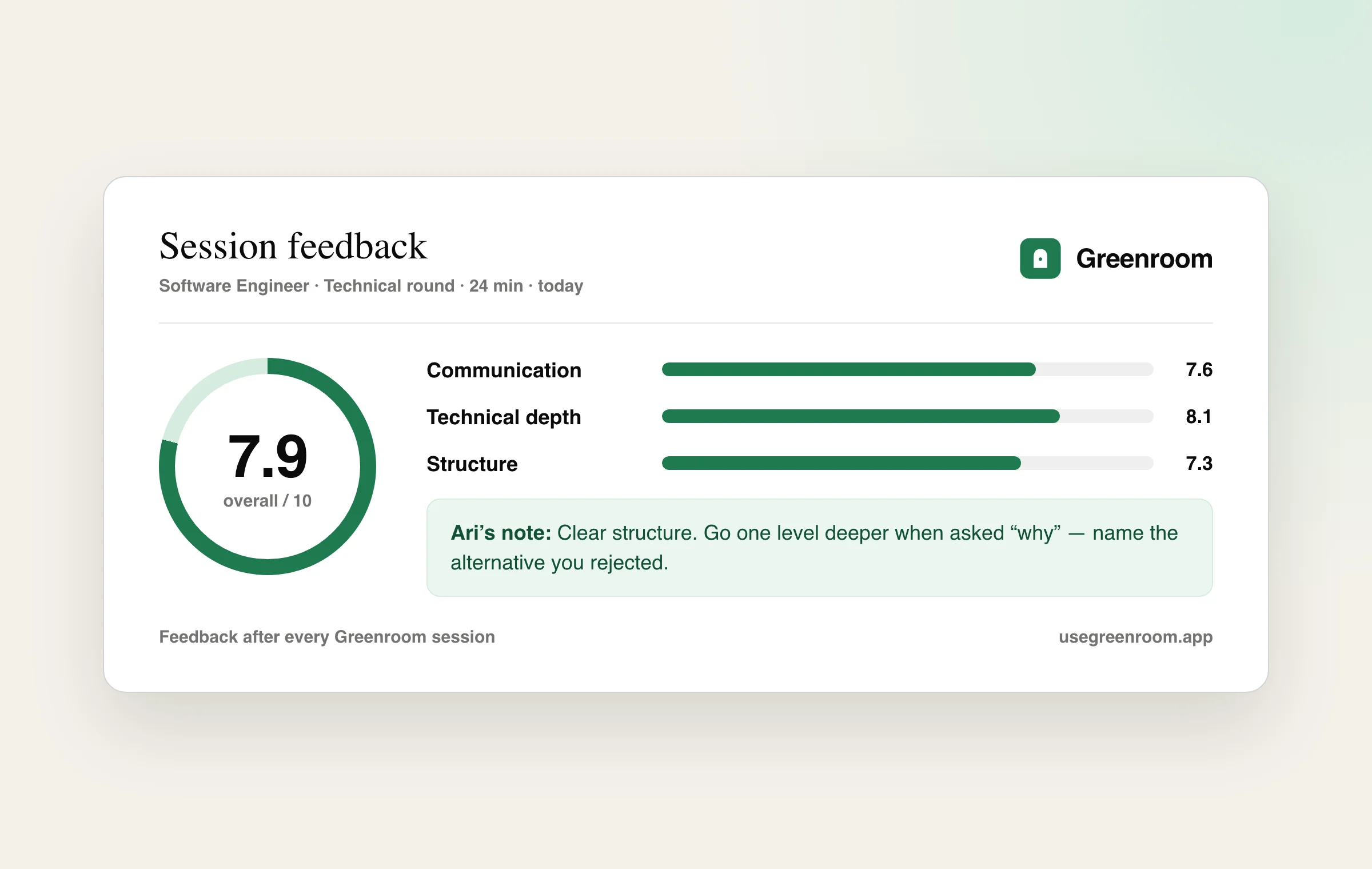
Greenroom turns this whole routine into one step. It reads your GitHub, asks questions out loud about your real projects, applies follow-up pressure, and scores you afterward — so you get the recording, the rubric, and the pressure without assembling them yourself. The free tier is enough to run your first session tonight.
If you are weighing whether to pay instead, our is interview prep worth paying for guide covers the three cases where it is genuinely worth it.
Frequently asked questions
How do I practice for an interview by myself?
Build a bank of 15–20 likely questions, then answer them out loud and record yourself on your phone. Watch the recording, self-score for structure, specificity and concision, and rehearse your own projects hardest. Add pressure with a timer and a no-second-takes rule. An AI interviewer that asks follow-ups out loud can simulate a real partner.
Does practicing interviews alone actually work?
Yes, if it's spoken and recorded rather than silent. Reading answers in your head lets your brain skip the hard parts. Saying answers out loud and reviewing the recording exposes the rambling, filler and missing structure that real practice fixes.
How can I simulate interview pressure when practicing alone?
Use a visible timer, refuse to restart an answer mid-way, and use an AI interviewer that talks back with follow-up questions. The goal is to remove the safety of editing and rehearsing silently.
What should I practice most when prepping solo?
Your own projects. “Walk me through something you built” and its follow-ups are where most candidates freeze, more than algorithm puzzles. Drill the problem, your approach, the key decision, the trade-off, and what you'd change.