The interviewer asked her how many insulin pens are sold in India every year. She said, quite reasonably, "I don't know." There was a pause long enough to hear a Gurgaon office AC cycle on. Then: "Neither do I. Estimate it." She started with the population of India and, forty minutes later, walked out convinced she had failed. She got the offer.
That is the single most misunderstood thing about ZS Associates interview questions: nobody is checking your number. They are checking whether, when handed a question with no answer key, you build a structure out loud instead of freezing. I built Greenroom after walking out of an interview I had genuinely prepared for and realising I had never once practised saying any of it — so this guide covers the ZS loop round by round, and how to think through it audibly.
The ZS Associates interview process in 2026
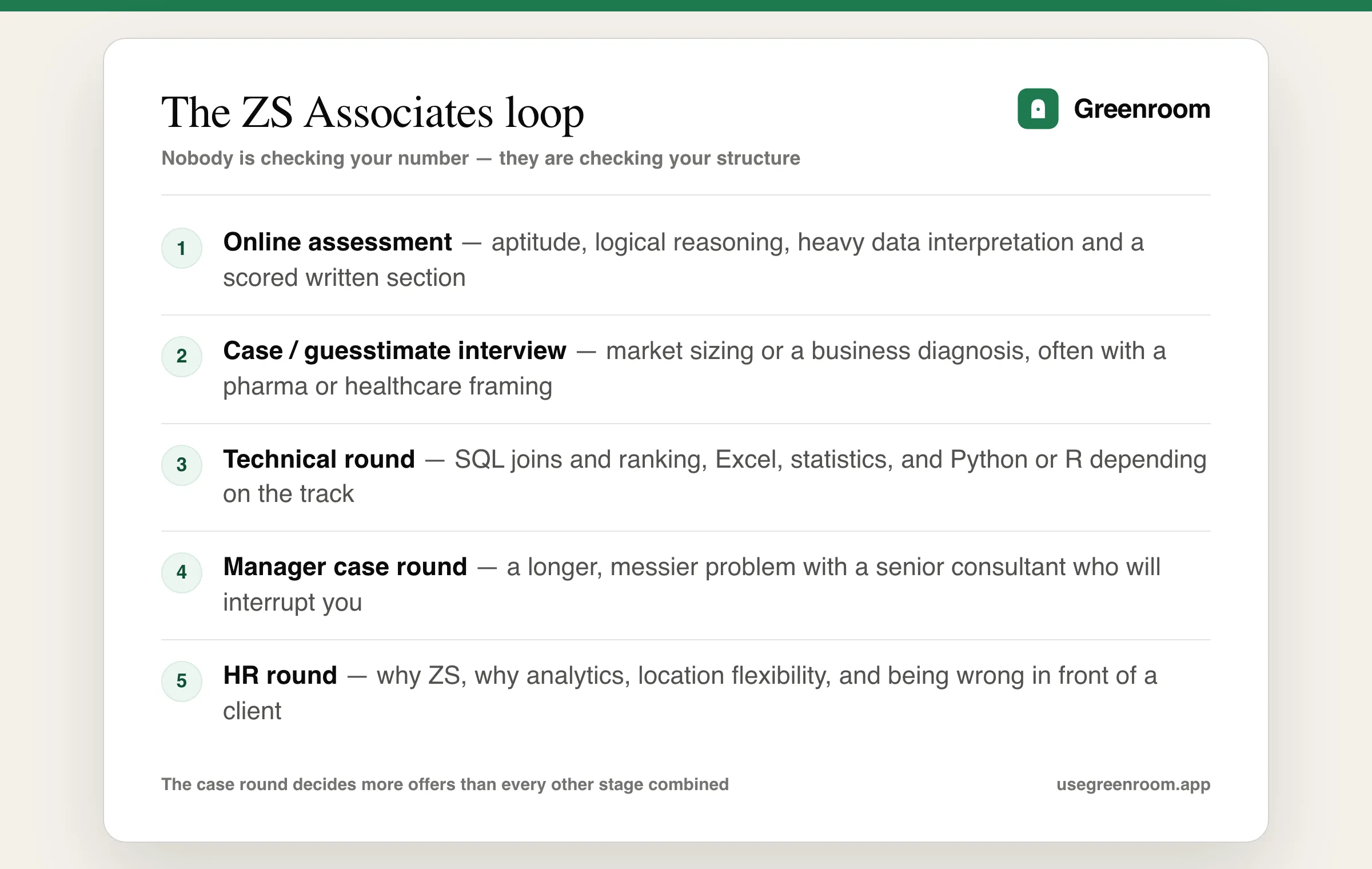
ZS is a management consulting and analytics firm with a deep specialism in pharma and healthcare commercial strategy, and its India offices — Gurgaon, Pune, Bengaluru, Delhi NCR — hire in serious volume. Most candidates enter through the Decision Analytics Associate (DAA) or Business Technology Solutions (BTS) track. The reported ZS Associates interview process is remarkably consistent:
- Online assessment — aptitude, logical reasoning, data interpretation, and often a written business-judgment or essay section. Sectional cutoffs, timed hard.
- Case / guesstimate interview — the round that decides most outcomes. Market sizing, a business problem, or a pharma-flavoured scenario, discussed conversationally.
- Technical round — SQL, Excel, statistics, and Python or R depending on the track. BTS candidates get more coding; DAA candidates get more data reasoning.
- Second case / manager round — a longer, messier problem with a real senior consultant who will interrupt you.
- HR round — why ZS, why analytics, location flexibility, and how you handle being wrong in front of a client.
Campus drives compress this into a single day; off-campus and experienced-hire loops spread it across two weeks. Either way, the centre of gravity is the case round — you can be excellent at SQL and still not clear ZS.
ZS Associates aptitude test and online assessment
The first filter is arithmetic under a clock. The ZS Associates online assessment typically mixes quantitative aptitude (percentages, ratios, time-and-work, profit-and-loss), logical reasoning (arrangements, syllogisms, puzzles), data interpretation off charts and tables, and a verbal or written section.
Two things trip people up. First, the data interpretation sets are heavier than a standard placement test — expect a table with four columns of pharma-ish sales data and questions that require you to actually compute a growth rate, not eyeball it. Second, the written section is scored: ZS is a consulting firm and a consultant who cannot write a clear paragraph is a liability. Practise timed DI sets specifically, not just general aptitude. Our aptitude test preparation guide covers the sectional strategy.
ZS Associates guesstimate and case interview questions
This is the round people search for, and the one that decides offers. ZS Associates guesstimate questions are almost always market sizing or business diagnosis, frequently with a healthcare or consumer flavour. Reported examples:
- How many insulin pens / paracetamol strips are sold in India per year?
- Estimate the annual revenue of a single pharmacy in a tier-2 Indian city.
- How many air conditioners are sold in Delhi in a summer month?
- A pharma client's drug lost 20% market share in six months. Why, and what would you check first?
- How would you help a client decide whether to expand a sales force from 200 to 300 reps?
- How many WhatsApp messages are sent in India in a day?
The structure that actually scores
Say your approach before your arithmetic. The sequence that reads as "consultant" rather than "student guessing":
- Clarify the question. "By insulin pens, do you mean units sold or unique patients? And India only, retail plus hospital?" This is not stalling — it is the first scored behaviour.
- State the equation before the numbers. "Pens per year = diabetic population × share on insulin × share using pens × pens consumed per patient per year." Now the interviewer can follow you even if a number is wrong.
- Segment, don't average. Urban vs rural, type 1 vs type 2, metro vs tier-2. A single national average is the classic weak answer.
- Say your assumptions out loud and label them as assumptions. "I'll take India's population as 1.4 billion and diabetes prevalence around 8–9% — correct me if you have a better figure."
- Sanity-check at the end. "That gives roughly X crore pens, which implies about ₹Y of market — does that feel the right order of magnitude to you?" Candidates who never sanity-check are the ones who confidently produce a number larger than India's GDP.
For a business-diagnosis case, the same discipline applies with a different frame: internal vs external, then within internal, product / price / promotion / place. Do not recite a framework name at the interviewer — build the branches aloud and prune the ones that do not matter. The case interview preparation guide for India drills this pattern, and Victor Cheng's Case Interview Secrets and the classic Case in Point remain the reference texts.
ZS Associates SQL, Excel and technical round questions
The technical round is data-fluency, not a coding contest. ZS Associates technical interview questions concentrate on SQL joins and aggregation, Excel (lookups, pivots, and yes, they may ask you to describe a formula verbally), descriptive statistics, and — for BTS and data science roles — Python or R.
The most reported SQL shape is a rank-within-group question over sales data:
-- Top 3 prescribing doctors per territory, by units in the last quarter
SELECT territory, doctor_id, units
FROM (
  SELECT t.territory,
         r.doctor_id,
         SUM(r.units) AS units,
         DENSE_RANK() OVER (PARTITION BY t.territory ORDER BY SUM(r.units) DESC) AS rnk
  FROM rx_sales r
  JOIN territories t ON t.territory_id = r.territory_id
  WHERE r.period >= '2026-04-01'
  GROUP BY t.territory, r.doctor_id
) ranked
WHERE rnk <= 3
ORDER BY territory, rnk;
Expect follow-ups rather than a pass/fail on syntax. Why DENSE_RANK and not ROW_NUMBER — what happens on a tie? What if a doctor prescribes in two territories? What does the client actually want to do with a top-3 list? That last one is the ZS question hiding inside the SQL question: they want analysts who ask what the number is for. Our SQL interview questions guide and the data analyst interview questions guide cover the rest of this family.
On statistics, keep it plain: mean vs median and when the distribution makes one useless, correlation vs causation with a real example, what a p-value does and does not tell a client, and how you would explain a regression coefficient to a brand manager who has never taken a stats class. That last framing appears constantly.
The ZS Associates HR round and behavioral questions
The HR round is short and mostly disqualifying rather than qualifying — but it has teeth on two questions. "Why ZS?" is checked against whether you know what ZS actually does. An answer mentioning pharma and healthcare commercial analytics, prescriber-level data, and sales-force effectiveness lands. "Why analytics and not a pure tech role?" is checked for whether you will still be here in two years.
The other reliable question is some version of "tell me about a time you were wrong in front of other people." Consulting runs on being corrected by clients, so the strong answer is calm and specific: what you claimed, how you found out, what you did in the next hour, and what you changed. Our tell me about a time you failed guide has the structure, and the self-introduction guide covers the opening two minutes that set the tone.
PrepInsta, GeeksforGeeks, ChatGPT — where each actually helps
An honest map of the prep stack for this specific loop, because they are not interchangeable:
- PrepInsta and IndiaBix — genuinely good for the aptitude and DI stage. Timed, sectional, close to the real paper. They do nothing for the case round.
- GeeksforGeeks interview experiences — useful for what gets asked and in what order. The limitation is that a written question dump gives you the question and the answer at the same time, which is precisely the condition a real interview removes.
- Case books (Case in Point, IIM/consulting club compendiums) — the right way to learn frameworks. Read them, then close them, because reciting a framework verbatim reads badly.
- A friend on a call — the best free option if you have a friend who will genuinely interrupt you. Most friends will not; they nod politely and tell you it was great.
- ChatGPT — decent at generating fresh guesstimate prompts and critiquing a written structure. Weak at the thing that decides this round, because it will not sit in silence while you flounder, and it accepts your first answer instead of asking "are you sure about that 8%?"
- Greenroom — the spoken layer. Ari, the AI interviewer, runs the case out loud, pushes the follow-up when you skip a segmentation, and scores structure, clarity and pace. Fair tradeoff: Ari will not teach you pharma domain knowledge, so pair it with a case book.
How to prepare for the ZS Associates interview
- Week 1: timed aptitude and data interpretation daily, one full mock paper at the end. Fix the section you are slowest at, not the one you enjoy.
- Week 2: one guesstimate a day, spoken aloud and recorded. Play it back — you will hear yourself skip the clarifying question and jump to arithmetic, which is the exact failure mode.
- Week 3: business cases and SQL. Alternate: one profitability or market-entry case aloud, one SQL problem written then re-explained in ninety seconds without looking at it.
- Final week: two full spoken mocks with interruptions, five behavioral stories in first person, and a one-page note on what ZS does and which practice you want. The night before, review that page — not new material.
Interviewing across the Indian analytics circuit? The Fractal Analytics interview questions guide, the Mu Sigma interview questions guide and the Tiger Analytics interview questions guide cover the three closest alternatives, and the Publicis Sapient interview questions guide covers the engineering-heavy end of the same consulting market.
Frequently asked questions
What is the ZS Associates interview process?
Candidates consistently report five stages: an online assessment covering aptitude, logical reasoning, data interpretation and a written section; a guesstimate or case interview; a technical round covering SQL, Excel, statistics and sometimes Python or R; a second, longer case with a manager; and a short HR round. Campus drives compress this into a single day, while off-campus loops spread it over about two weeks.
What questions are asked in a ZS Associates interview?
The most reported questions are market-sizing guesstimates such as how many insulin pens are sold in India per year, business diagnosis cases such as why a drug lost market share, SQL problems involving joins and ranking within a group, Excel and statistics fundamentals, and HR questions about why ZS and why analytics. Pharma and healthcare framing appears in a large share of the case questions.
Is the ZS Associates interview difficult?
It is competitive rather than technically deep. The SQL and statistics sit at standard analyst difficulty, and the aptitude test is comparable to other Indian placement papers. The difficulty is the case round, where there is no correct answer and you are scored on structure, assumptions and how clearly you reason out loud under interruption. Strong coders regularly fail here.
How do I prepare for a ZS Associates guesstimate question?
Practise saying the structure before the arithmetic. Clarify what is being asked, write the equation you will solve, segment rather than average, state every assumption as an assumption, and sanity-check the final number against something you know. Do one guesstimate a day out loud rather than ten on paper, because the round is scored on spoken reasoning, not on the final figure.
What is the ZS Associates Decision Analytics Associate role?
Decision Analytics Associate is ZS's main entry-level analytics track in India. The work combines client data analysis, largely in pharma and healthcare commercial strategy, with building the models and reports that inform decisions like sales-force sizing, territory design and brand performance. The day-to-day tools are typically SQL, Excel, and Python or R, plus a large amount of client communication.
Does ZS Associates ask coding questions?
It depends on the track. Decision Analytics candidates are asked mostly SQL, Excel and statistics, with light Python or R. Business Technology Solutions and data science candidates get a genuinely technical round with coding, data structures and sometimes a take-home or platform assessment. Ask your recruiter which track you are interviewing for, because the preparation differs substantially.