The trip screen looked right. Map, marker, ETA, a driver card at the bottom. Then the interviewer said the driver sends a location every second for a twenty-minute ride, and asked what happens to the React tree. The candidate said it re-renders. The interviewer waited. "All of it?" he asked. "Every second? Including the ETA card, the driver photo and the fare breakdown?" It did. It had, in production, at a previous job, and nobody had ever asked.
That is the register of Uber frontend interview questions. Uber's interfaces are real-time and map-heavy, so the rounds go straight at render cost, state boundaries and what a screen does when data arrives continuously. Add a bar raiser round that probes your stories three follow-ups deep and you get a loop that rewards people who have actually operated a live interface. I built Greenroom after freezing in an interview I had prepared hard for, so this guide covers what Uber asks and how to reason through it out loud.
The Uber frontend engineer interview process in 2026
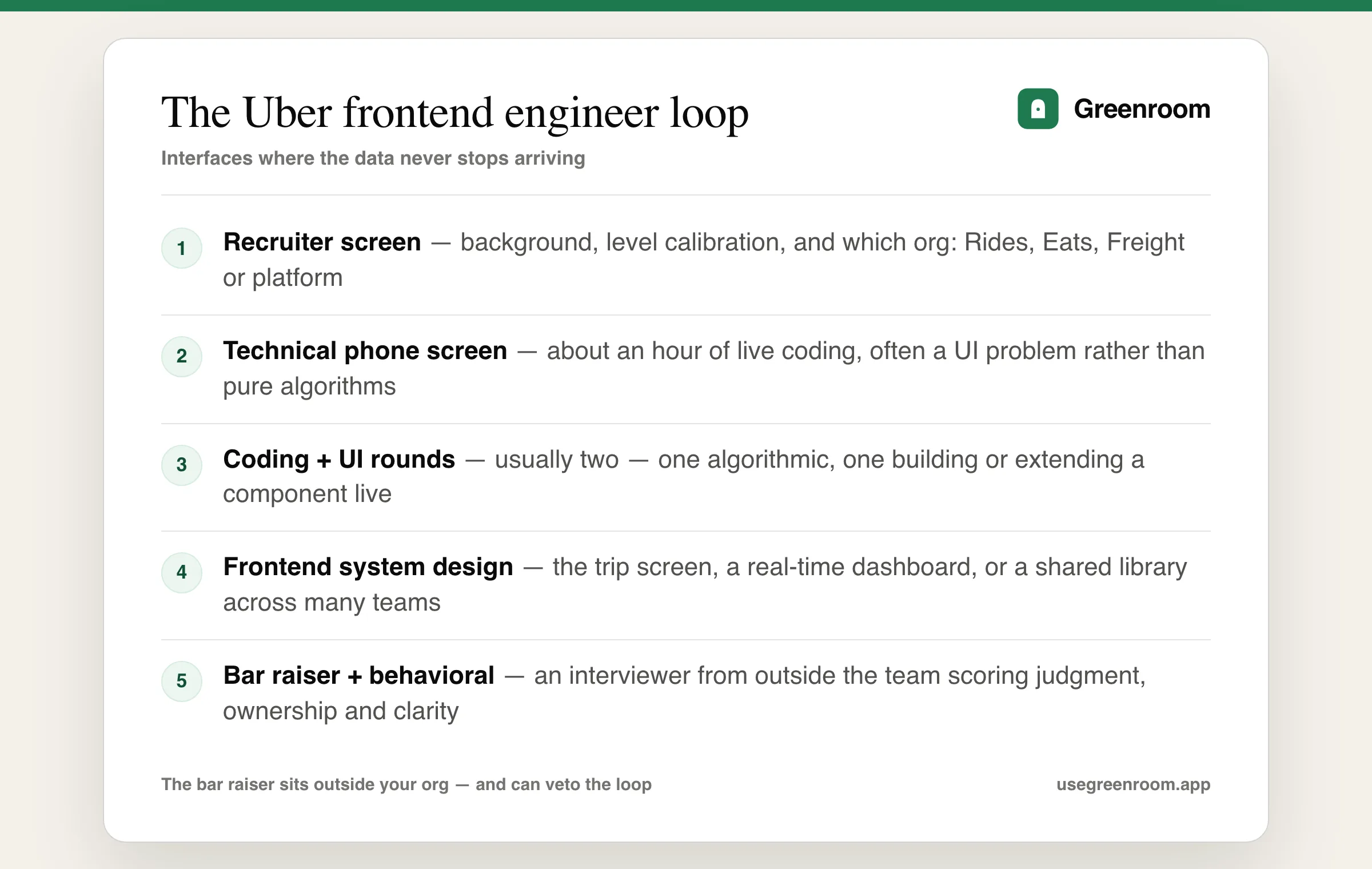
Uber's Bengaluru and Hyderabad offices run essentially the global loop. What candidates report as the Uber frontend interview process:
- Recruiter screen — background, level calibration, and which org: Rides, Eats, Freight or a platform team.
- Technical phone screen — around an hour of live coding on a shared editor. Often a UI problem rather than a pure algorithm one.
- Coding and UI rounds — usually two: one algorithmic, one building or extending a component in the browser.
- Frontend system design round — the trip screen, a real-time dashboard, or a shared component library across many teams.
- Bar raiser and behavioral — an interviewer from outside the hiring team scoring judgment, ownership and clarity. They can veto.
The onsite is normally a single virtual day. The bar raiser is the round candidates underestimate most. Our Uber interview preparation guide covers the company-wide loop, and the Uber backend engineer guide covers the dispatch systems these screens sit on top of.
Real-time UI: the moving marker problem
Every Uber frontend design conversation converges here. A location arrives every second or two for the length of a trip, and the interface must stay smooth on a mid-range phone. The naive implementation puts that location in top-level state and re-renders the world.
- Isolate the fast-changing state. The marker position should live as close to the marker as possible — its own component, its own subscription — so a position update does not re-render the fare breakdown. This single idea is most of the answer.
- Do not render high-frequency data through the framework at all where you can avoid it. Imperatively updating a map layer, or writing to a ref and animating outside the render cycle, is a legitimate and senior-sounding answer.
- Interpolate between pings. Positions arrive every few seconds; animating smoothly between them is what makes it feel live. Use
requestAnimationFrame, not asetIntervalfighting the browser's frame budget. - Throttle what the user cannot perceive. The ETA text does not need to update at 60Hz. Different data, different cadence — say that explicitly.
- Reconnection and stale data. Mobile networks drop. Exponential backoff, resume from last known state, and a visible "reconnecting" affordance rather than a frozen marker that silently lies.
- Pause when hidden. The Page Visibility API, for battery and data. Mentioning it unprompted is a strong signal.
- Clean up. Sockets closed, animation frames cancelled, observers disconnected on unmount.
The pattern worth having in your fingers is keeping high-frequency values out of render entirely:
function DriverMarker({ socket }) {
  const el = useRef(null);
  const target = useRef({ lat: 0, lng: 0 });

  useEffect(() => {
    // positions never enter React state, so nothing re-renders
    const off = socket.on('location', (p) => { target.current = p; });

    let raf;
    const tick = () => {
      moveTowards(el.current, target.current);   // interpolate one frame
      raf = requestAnimationFrame(tick);
    };
    raf = requestAnimationFrame(tick);

    return () => { off(); cancelAnimationFrame(raf); };
  }, [socket]);

  return <div ref={el} className="marker" />;
}
Then say the sentence: "the position is a stream, not state — putting it in state means the framework does reconciliation work sixty times a minute for a pixel offset." Our React interview questions guide covers the render semantics this depends on.
The coding and UI rounds
Uber's coding rounds sit at LeetCode medium-to-hard on the algorithmic side, with a preference for realistic problems over puzzles. The UI round is more distinctive: you build or extend something in the browser while talking, often with the interviewer adding a requirement halfway through to see how your structure holds.
Common UI-round asks: a typeahead with cancellation, a paginated or infinite list, a form with cross-field validation, a component that polls and displays live data, or extending an existing component someone else wrote. The last one is the most revealing and the least practised.
What is graded alongside correctness: clarifying requirements before typing, handling loading and error states without being reminded, cleaning up subscriptions, choosing readable structure over cleverness, and narrating as you go. Six minutes of silence reads as stuck. Our how to think out loud in interviews guide covers the narration pattern and the DSA coding interview preparation guide covers the algorithm list.
JavaScript and React depth
The fundamentals bar is high, and questions tend to arrive as follow-ups inside the coding round rather than as a separate quiz. Be fluent in:
- The event loop, including microtask versus macrotask ordering and why a long synchronous task blocks rendering entirely.
- Closures,
thisbinding and prototypes, at mechanism level. Implementingbindanddebouncefrom memory is table stakes. - Why a component re-rendered — reference equality, context value identity, and why a new object or arrow function in props defeats memoization.
useEffectsemantics — dependency arrays, cleanup, and the class of bugs caused by a stale closure capturing an old value.- Render-blocking work. Long tasks,
requestIdleCallback, and moving genuinely heavy computation to a web worker. At Uber's data rates this comes up naturally. - Memory leaks. Uncancelled subscriptions and retained closures on a screen that lives for a twenty-minute trip. Few candidates raise this; it lands well.
Our JavaScript interview questions guide and TypeScript interview questions guide cover the ground — and TypeScript is worth real preparation here, since Uber's web codebases are heavily typed.
Frontend system design at Uber
Design prompts stay in the browser but assume scale in two directions: many users, and many engineering teams sharing one surface. Structure your answer this way:
- Constraints first. Update frequency, device profile, network conditions, and which data must be fresh versus which can lag.
- State ownership and boundaries. Server state versus client state versus ephemeral stream data, and which layer owns each. The trip screen is the canonical example of all three coexisting.
- Transport choice with a reason. Websockets for high-frequency bidirectional data, server-sent events for one-way status, plain requests for everything else.
- Component library and consistency. When many teams ship one app, a shared design system with versioning, and how a breaking change rolls out. Micro-frontend tradeoffs are fair game — including the honest cost, which is bundle duplication and version drift.
- Internationalisation and localisation. Uber operates in many countries: right-to-left layouts, locale-aware formatting, and strings that change length. Raising this unprompted is a strong signal.
- Accessibility and degradation. Keyboard paths, screen-reader behaviour for live updates, and what the screen does when the stream dies.
- Instrumentation. Real-user monitoring for frame drops and long tasks, not a lab score.
The Uber frontend engineer prep page has a round-by-round checklist, and our system design interview guide for India covers the shared vocabulary.
The bar raiser round: judgment, not trivia
The bar raiser is an experienced interviewer from outside the hiring team whose job is to protect the company-wide bar rather than fill the role. They run behavioral questions with unusually persistent follow-ups: what did you do, what did the data say, what did you do when you were wrong, what would you do differently.
What works: five or six stories, each with a real number, each rehearsed in first person and out loud. Cover an incident you owned, a disagreement you resolved, a project that slipped, a time you influenced without authority, and something you learned recently. Expect the second and third follow-up on each — memorised stories collapse at that depth while lived ones do not.
Our behavioral interview questions guide and tell me about a time you failed guide cover the structure. The Amazon leadership principles guide is also useful drilling — not because Uber uses those principles, but because the follow-up depth is comparable.
LeetCode, GreatFrontEnd, ChatGPT — where each fits
An honest map of the prep stack for this loop:
- LeetCode — necessary at medium-to-hard for the algorithmic round. Readable, correct code beats minimal code here.
- GreatFrontEnd and JavaScript.info — the right depth for the fundamentals that arrive as follow-ups mid-round.
- MDN — the source of truth for
requestAnimationFrame, the Page Visibility API, WebSocket andIntersectionObserver. - The Uber Engineering blog — unusually specific and genuinely useful. Their public writing on web performance and real-time systems describes the problems you will be asked about.
- Timed self-builds — build a screen that consumes a fake location stream and stays at 60 frames per second. Profile it. That exercise alone covers half the design round.
- ChatGPT — useful for generating prompts and reviewing pasted code. It will not ask "all of it? every second?" at the moment your answer has no defence.
- Greenroom — the spoken layer. Ari, the AI interviewer, runs the round out loud, pushes the bar-raiser-style third follow-up on your stories, and scores structure and clarity. Fair tradeoff: Ari will not review your JSX line by line, so pair it with LeetCode and real builds.
How to prepare for the Uber frontend interview
- Week 1: DSA at medium climbing to hard, plus JavaScript mechanisms — event loop, closures,
this,bindanddebouncefrom memory. - Week 2: the real-time set — isolating fast-changing state,
requestAnimationFrameinterpolation, throttling by perceptibility, reconnection, cleanup and leaks. Explain each in ninety seconds without notes. - Week 3: build a live-updating screen and profile it, then design the trip screen and a shared component library out loud, constraints first.
- Final week: six bar-raiser stories in first person with numbers, rehearsed to three follow-ups deep, two full spoken mocks, and the role-specific prep page the night before — not new material.
Interviewing across comparable loops? The Swiggy frontend engineer guide covers a very similar real-time tracking problem at a different company, the Zomato frontend engineer guide covers search and feed performance, the Flipkart frontend engineer guide covers the machine coding format, and the Atlassian frontend engineer guide covers accessibility and design systems.
Frequently asked questions
What is the Uber frontend engineer interview process?
Candidates report a recruiter screen, a technical phone screen of about an hour of live coding often on a UI problem, an onsite with two coding and UI rounds plus a frontend system design round, and a bar raiser and behavioral round run by an interviewer from outside the hiring team. The onsite is normally a single virtual day, and the bar raiser can veto an otherwise strong loop.
How do you handle a map with a live-updating marker in a frontend interview?
Keep the high-frequency position out of component state so it does not re-render the tree — subscribe close to the marker, write to a ref, and animate with requestAnimationFrame, or update the map layer imperatively. Interpolate between pings so movement looks smooth, throttle slower-changing data such as the ETA text to a lower cadence, handle reconnection with backoff and a visible affordance, pause when the tab is hidden, and cancel frames and sockets on unmount.
What is the bar raiser round at Uber?
It is a round run by an experienced interviewer from outside the hiring team whose job is to protect the company-wide hiring bar rather than fill the role, and they can veto. It is mostly behavioral with unusually persistent follow-ups about what you personally did, what the data said and what you did when you were wrong. Prepare five or six real stories with numbers, rehearsed out loud to three follow-ups deep.
What JavaScript and React questions does Uber ask frontend engineers?
Fundamentals usually arrive as follow-ups inside the coding round rather than as a separate quiz: event loop and microtask ordering, why a long synchronous task blocks rendering, closures and this binding at mechanism level, implementing bind and debounce from memory, why a component re-rendered and how a new object or arrow function in props defeats memoization, useEffect cleanup and stale closures, and memory leaks from uncancelled subscriptions on long-lived screens.
Is the Uber frontend interview hard?
It is a FAANG-comparable bar. Coding sits at medium-to-hard with a preference for realistic problems, the UI round often adds a requirement mid-way to test whether your structure holds, the design round expects genuine reasoning about render cost under continuous data, and the bar raiser probes stories to a depth that exposes anything rehearsed but not lived.
How many rounds is the Uber frontend interview and how long does it take?
Most reported loops run five to six rounds — recruiter screen, technical phone screen, two coding and UI rounds, a frontend system design round and a bar raiser — over roughly three to six weeks, with the onsite compressed into a single virtual day. Use the gap before the onsite to practise designing and telling stories under spoken pushback.