Eighty-eight minutes in, his autocomplete component was beautiful. Debounced, accessible, keyboard-navigable, wrapped in a custom hook he was genuinely proud of. Then the interviewer typed three characters quickly and the dropdown filled with results for the first two. A stale response had landed last and won. He had built everything except the one thing the round was testing.
That is the texture of Flipkart frontend interview questions. The loop is built around a machine coding round where you build a working UI under a clock, and the scoring lives in the parts nobody practises: race conditions, cleanup, error states, and whether the thing stays usable on a slow phone. I built Greenroom after freezing in an interview I had prepared hard for, so this guide covers what Flipkart asks of frontend engineers and how to talk through it.
The Flipkart frontend engineer interview process in 2026
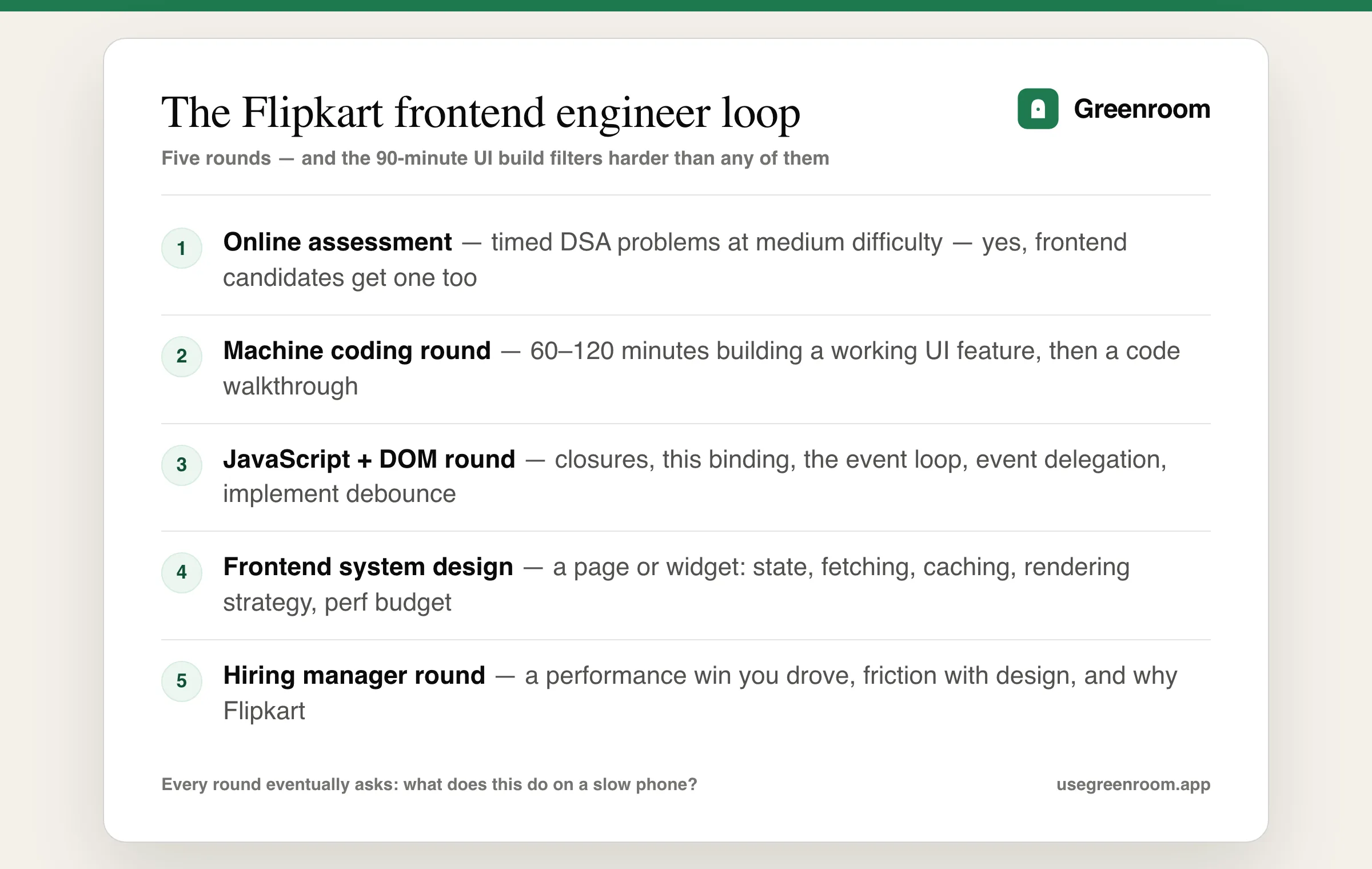
Flipkart's frontend loop mirrors its backend loop in shape but swaps the content. What candidates report as the Flipkart frontend interview process:
- Online assessment — timed DSA problems, medium difficulty. Yes, frontend candidates get one too.
- Machine coding round — 60 to 120 minutes to build a working UI feature from a written brief, usually in vanilla JavaScript or React, followed by a walkthrough. This round does the most filtering.
- JavaScript and DOM round — closures,
this, the event loop, prototypes, event delegation, and "implementdebouncefrom scratch." - Frontend system design round — architect a page or a widget: state, data fetching, caching, rendering strategy, performance budget.
- Hiring manager round — ownership, a performance win you drove, a disagreement with design, and why Flipkart.
The through-line: Flipkart's users are on mid-range Android phones on patchy networks in tier-2 and tier-3 cities. Every round eventually asks some version of "and what does this do on a slow device?" Our Flipkart interview questions guide covers the company-wide loop, and the Flipkart backend engineer guide covers the other side of the stack.
The Flipkart machine coding round for frontend
The Flipkart machine coding round hands frontend candidates a UI brief and 60 to 120 minutes: build an autocomplete with API search, an infinite-scrolling product list, a multi-step checkout form, a nested comment thread, a star-rating widget, or a shopping cart with quantity rules. No design file, no component library — usually plain React or vanilla JS.
What earns points, in the order reviewers look for it:
- It runs and it does the stated thing. A working feature with plain styling beats an unfinished elegant one. Ship the happy path in the first third of the time.
- Async is handled properly. Loading, empty, error and success are four states, not one. Candidates who render only success lose marks they never see.
- Race conditions are addressed. The single most-tested thing in this round, and the most-skipped.
- Cleanup on unmount. Abort in-flight requests, clear timers, remove listeners. Say it out loud even if the harness never unmounts.
- Keyboard and accessibility basics. Arrow keys and Enter on a dropdown, labels on inputs, focus that goes somewhere sensible. At an e-commerce company this is revenue, not charity.
- Component boundaries you can defend. Two or three well-named components, state lifted to where it is actually shared. Not one 400-line file, not fifteen files.
Here is the race-condition fix that ends most autocomplete rounds well. Note that the guard is the abort signal plus a request-ordering check, not a setTimeout:
function useSearch(query) {
  const [state, setState] = useState({ status: 'idle', items: [] });

  useEffect(() => {
    if (!query) { setState({ status: 'idle', items: [] }); return; }

    const controller = new AbortController();
    setState((s) => ({ ...s, status: 'loading' }));

    fetch(`/api/search?q=${query}`, { signal: controller.signal })
      .then((r) => r.json())
      // only the latest effect is still un-aborted, so this cannot be stale
      .then((items) => setState({ status: 'success', items }))
      .catch((e) => {
        if (e.name === 'AbortError') return;   // superseded, not a failure
        setState({ status: 'error', items: [] });
      });

    return () => controller.abort();   // cleanup cancels the previous query
  }, [query]);

  return state;
}
Then say the sentence that scores: "debouncing reduces the number of requests, but it does not guarantee ordering — only cancellation or a request-id check does that." Interviewers hear debounce constantly and correct ordering rarely. Our machine coding round guide covers the 90-minute time budget and the React interview questions guide covers the hooks semantics this leans on.
JavaScript and DOM questions Flipkart asks
The JavaScript round is fundamentals-heavy and implementation-flavoured — less trivia, more "write it." Recurring asks:
- Implement
debounceandthrottlefrom scratch, then explain when each is wrong. Debounce a search box; throttle a scroll handler. - Closures and the classic loop question — why
varin aforloop withsetTimeoutlogs the same number, and three ways to fix it. thisbinding — implicit, explicit,new, arrow functions. Then implementFunction.prototype.bindyourself.- The event loop — order of
setTimeout, promises andqueueMicrotask. Expect a code snippet and "what prints, in what order?" - Event delegation — why one listener on a parent beats a thousand on children, and how
event.targetversuscurrentTargetbehaves. - Deep clone, flatten,
Promise.allfrom scratch — the standard implement-it set. ==versus===, hoisting, prototypal inheritance — quick-fire, usually as follow-ups.
Answer with the mechanism, not the rule. "Arrow functions do not have their own this, so it resolves lexically to the enclosing scope" beats "arrow functions fix this." Our JavaScript interview questions guide covers the full set and the TypeScript interview questions guide covers the typing follow-ups that increasingly appear.
Performance: the ₹7,000 Android phone is the real interviewer
This is where Flipkart's frontend round differs most from a generic one. Frontend performance in India is a first-class engineering constraint, not a polish item, and interviewers push on it hard. Flipkart's own progressive web app work is a well-known case study in the industry, so the topic is fair game and expected.
- Bundle size is the headline number. Code splitting by route, lazy loading below-the-fold components, tree shaking, and knowing what a heavy dependency actually costs. Naming an approximate kilobyte budget shows you have shipped.
- Images dominate an e-commerce page. Modern formats, responsive
srcset, explicit dimensions to prevent layout shift, and lazy loading anything below the fold. - Core Web Vitals by name. Largest Contentful Paint, Interaction to Next Paint and Cumulative Layout Shift — what each measures and one concrete fix for each.
- Rendering strategy. Server rendering or static generation for the first paint on a slow device, hydration cost as the tradeoff, and when a client-only SPA is simply the wrong call.
- The network is the bottleneck, not the CPU — until it isn't. On a low-end phone, parsing and executing a large JavaScript bundle is genuinely slow. Say both halves.
- Measure, then fix. Mention Lighthouse and real-user monitoring, and that lab numbers on a fast laptop are a lie about your actual users.
Our HTML and CSS interview questions guide covers layout and paint, and the Next.js interview questions guide covers rendering-strategy tradeoffs in detail.
Frontend system design at Flipkart
At senior levels you get a design round scoped to the browser: design the product listing page, the search experience, the cart, or a reusable design-system component. Structure it like this:
- Requirements and constraints first. Device profile, network, page-weight budget, SEO needs. Asking about the device profile immediately marks you as someone who has worked on Indian consumer web.
- Component decomposition and where state lives — local, lifted, context, or a store. Justify the choice; "we use Redux for everything" is not a justification. Our Redux interview questions guide covers when it genuinely earns its place.
- Data fetching and caching. Cache keys, stale-while-revalidate, pagination or cursoring for long lists, and prefetching on intent.
- Rendering long lists. Ten thousand products means virtualization or windowing, not a longer
map. - Failure and degradation. Slow API, partial data, offline. What renders, and does the user lose their cart?
- Instrumentation. How you would know it got slower after next Tuesday's release.
The Flipkart frontend engineer prep page has a compact round-by-round checklist, and our system design interview guide for India covers the vocabulary.
Behavioral rounds: performance wins, design friction, why Flipkart
The hiring manager round leans on ownership and on working with designers and product. Reliable questions: a performance improvement you drove end to end, a time you pushed back on a design, a bug that reached production, and why Flipkart.
First person, two minutes, real numbers. "We made the page faster" is invisible. "The listing page was 4.1 seconds to Largest Contentful Paint on a mid-range Android, I moved the hero image to a responsive format and deferred the recommendation carousel, and we landed at 1.9 seconds" is a hire signal. For "why Flipkart," tie it to building for the next hundred million users on constrained devices rather than to company size. Our tell me about a time you failed guide has the structure.
LeetCode, Frontend Masters, ChatGPT — where each fits
An honest map of the prep stack for this specific loop:
- LeetCode — needed for the online assessment only, at medium difficulty. It is roughly one round in five and teaches nothing about the other four.
- GreatFrontEnd, Frontend Masters and JavaScript.info — the right depth for the JavaScript round and the implement-it questions. JavaScript.info in particular is free and unusually rigorous on the event loop and prototypes.
- MDN — the actual source of truth for
AbortController, event delegation and the DOM APIs you will be asked to use from memory. - web.dev's Core Web Vitals documentation — read it before the performance conversation. Naming metrics precisely is most of the credit.
- Timed self-builds — the highest-leverage machine coding prep. Build an autocomplete, an infinite list and a nested comment thread on a 90-minute clock. Actually run out of time once.
- ChatGPT — good for generating briefs and reviewing code you paste in. It will not type three characters fast and watch your dropdown show the wrong results.
- Greenroom — the spoken layer. Ari, the AI interviewer, runs the round out loud, pushes the follow-up when you say "I'd just debounce it," and scores structure and clarity. Fair tradeoff: Ari will not review your JSX line by line, so pair it with real timed builds.
How to prepare for the Flipkart frontend interview
- Week 1: DSA at medium difficulty for the assessment, plus the implement-it set —
debounce,throttle,bind, deep clone,Promise.all. Write them without looking. - Week 2: three timed machine coding builds — autocomplete with cancellation, infinite scroll with virtualization, a multi-step form. Handle all four async states in each, then explain each aloud in five minutes.
- Week 3: performance and design — Core Web Vitals, bundle budgets, rendering strategies. Design the product listing page and the cart out loud, constraints first.
- Final week: five behavioral stories in first person with numbers, two full spoken mocks with design pushback, and the role-specific prep page the night before — not new material.
Interviewing across similar loops? The Swiggy frontend engineer guide covers real-time order tracking UI, the Zomato frontend engineer guide covers search and infinite feeds, the Uber frontend engineer guide covers map-heavy interfaces, and the Atlassian frontend engineer guide covers accessibility and design systems at enterprise scale.
Frequently asked questions
What is the Flipkart frontend engineer interview process?
Candidates report five stages: an online assessment with timed medium-difficulty DSA problems, a machine coding round of 60 to 120 minutes building a working UI feature, a JavaScript and DOM round covering closures, this binding, the event loop and event delegation, a frontend system design round, and a hiring-manager round on ownership and performance work. The machine coding round filters hardest.
What is asked in the Flipkart machine coding round for frontend?
You get a UI brief and 60 to 120 minutes to build it, usually in React or vanilla JavaScript with no component library. Common prompts are an autocomplete with API search, an infinite-scrolling product list, a multi-step checkout form, a nested comment thread and a shopping cart with quantity rules. Reviewers score whether it runs, whether loading, empty, error and success states all exist, whether race conditions are handled, and whether cleanup happens on unmount.
What JavaScript questions does Flipkart ask frontend engineers?
The round is implementation-flavoured rather than trivia-based. Recurring asks are implementing debounce and throttle from scratch, the var-in-a-loop closure question and three ways to fix it, this binding across implicit, explicit, new and arrow forms, implementing Function.prototype.bind, event loop ordering across setTimeout and promises, event delegation, and writing deep clone, flatten or Promise.all yourself.
How do you handle race conditions in an autocomplete interview question?
Debouncing reduces the number of requests but does not guarantee ordering, so a slow earlier response can still land last and overwrite newer results. The fix is cancellation or ordering: abort the previous request with an AbortController in the effect cleanup, or tag each request with an id and ignore any response that is not the latest. Saying this distinction out loud is what the round is testing.
How important is performance in the Flipkart frontend interview?
Very. Flipkart's users are largely on mid-range Android devices and patchy networks, so interviewers push on bundle size and code splitting, image formats and responsive images, Core Web Vitals by name with a concrete fix for each, rendering strategy and hydration cost, and how you would measure regressions with real-user monitoring rather than lab numbers on a fast laptop.
How many rounds is the Flipkart frontend interview and how long does it take?
Most reported loops run four to six rounds — online assessment, machine coding, a JavaScript and DOM round, one or two design rounds, and a hiring-manager round — across roughly two to five weeks. Gaps between rounds are usually scheduling rather than deliberation, so use them to practise building and explaining under spoken pushback.