Uber's interview leans heavily on real-world system design — which makes sense for a company that solves live matching, mapping, pricing, and payments at massive scale. The coding rounds are standard FAANG-style, but the design rounds are where strong candidates separate themselves, because Uber loves problems drawn from its own product. Here's how to prepare.
The Uber interview process
- Recruiter screen — background and logistics.
- Technical phone screen — one or two coding problems on a shared editor.
- On-site loop — typically two coding rounds, one or two system design rounds (for experienced roles), and a behavioral round.
Uber coding questions
- Arrays, strings, hash maps — interval problems, sliding window, two pointers.
- Graphs and trees — BFS/DFS, shortest path, which map naturally to Uber's domain.
- Heaps and greedy — top-K, scheduling, matching.
- Dynamic programming — a moderate problem, with clear narration expected.
Uber system design (the differentiator)
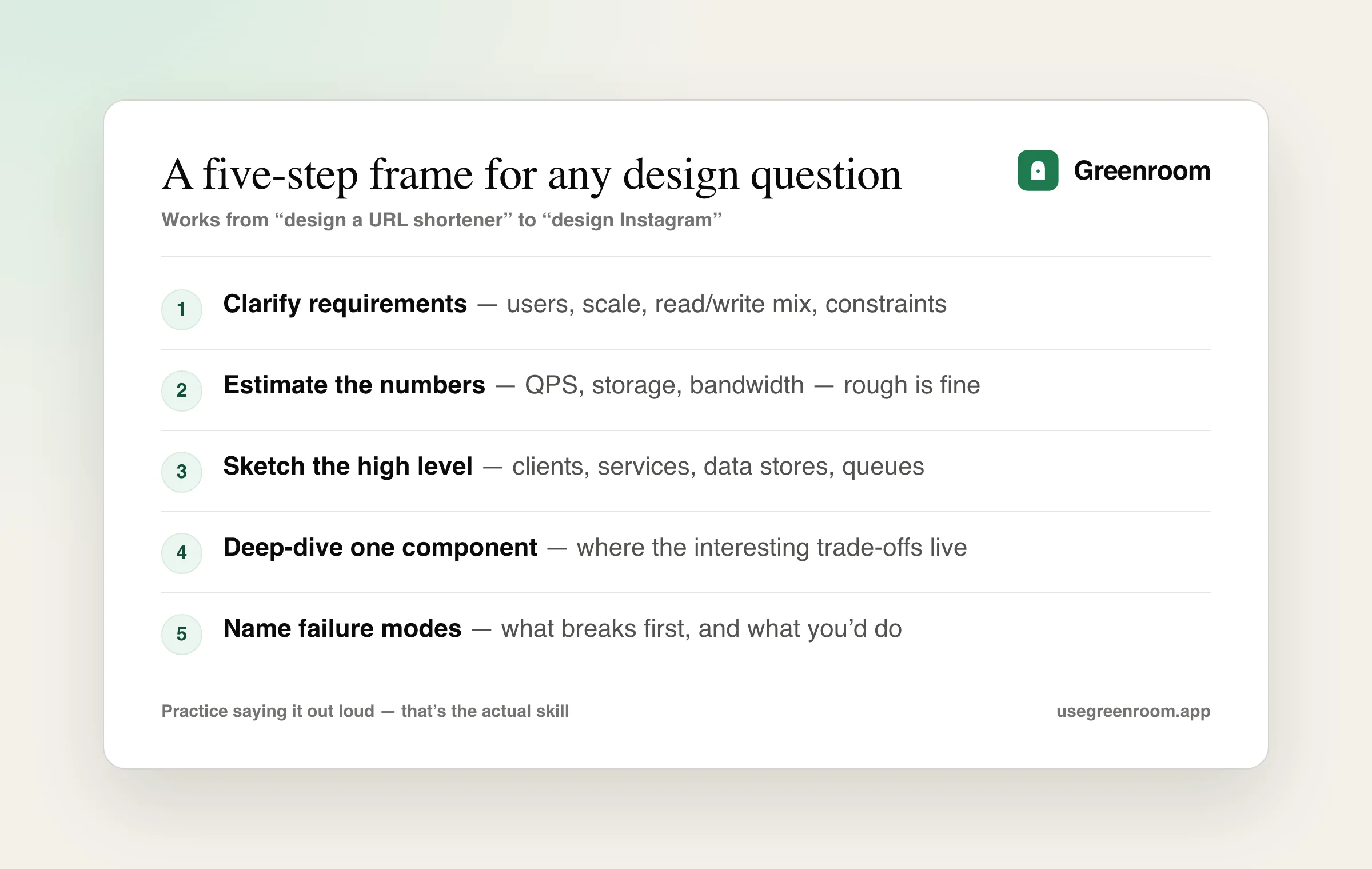
Expect realistic, product-flavored prompts: design a ride-matching service, surge pricing, a driver-location tracking system, a notification system, or a payments flow. They want:
- Clear functional and non-functional requirements.
- Data modeling and API design.
- Real scale thinking — geo-sharding, real-time updates, consistency vs availability trade-offs.
- Honest discussion of failure modes and bottlenecks.
Our system design guide gives you a repeatable framework.
Uber behavioral round
Uber's behavioral questions probe ownership, dealing with ambiguity, and impact. Use STAR and quantify results.
How to prepare
System design is a spoken skill — you're explaining a moving architecture in real time while fielding "what if this 10x's?" You can't build that reading articles. Greenroom runs voice interviews that make you talk through design and trade-offs with live follow-ups. Pair it with our FAANG prep guide and coding communication tips.
Interviewing specifically for a backend role? Our Uber backend engineer interview questions guide goes deep on dispatch and matching, geospatial indexing, surge, and the bar raiser round.
Interviewing for a frontend role instead? Our Uber frontend engineer interview questions guide covers map-heavy real-time UI, render cost and the bar raiser round.
Frequently asked questions
What is the Uber interview process?
Uber's process includes a recruiter screen, a technical phone screen with one or two coding problems, and an on-site loop of about two coding rounds, one or two system design rounds for experienced roles, and a behavioral round. The system design rounds carry a lot of weight and often use prompts drawn from Uber's own product.
What system design questions does Uber ask?
Uber favors real-world, product-flavored prompts like designing a ride-matching service, surge pricing, driver-location tracking, a notification system or a payments flow. They want clear requirements, data modeling, API design, real scale thinking (geo-sharding, real-time updates, consistency vs availability) and an honest discussion of failure modes.
What coding questions does Uber ask?
Uber asks standard FAANG-style problems: arrays, strings and hash maps (intervals, sliding window, two pointers), graphs and trees (BFS/DFS, shortest path), heaps and greedy problems (top-K, scheduling, matching), and a moderate dynamic-programming question. Narrating your approach clearly is expected throughout.
How do I prepare for the Uber interview?
Practise solid coding, but prioritize real-world system design since that's where Uber offers are decided — rehearse geo- and matching-flavored designs out loud while narrating trade-offs and handling 'what if this 10x's?' follow-ups. A voice-based mock interview that makes you talk through design in real time is the closest match to Uber's loop.