The calendar invite said "Interview with Alex". She joined, said hello, and Alex said hello back in a voice that was almost right. Thirty seconds in she realised there was no person — no nodding, no "mm-hm", no small laugh at the joke she had used successfully in four previous interviews. She spent the next twenty minutes talking into a silence that gave her nothing back, and she has no idea whether she did well, because nothing in the room told her.
That experience has become common enough to have its own backlash. Greenhouse, the hiring platform, reported in 2026 that around 63% of job seekers surveyed had been interviewed by AI — up roughly 13 percentage points in six months — and coverage of the same research found that close to four in ten candidates have abandoned a hiring process because it required an AI interview. Those are survey figures from one vendor rather than settled fact, and they skew US-heavy, but the direction is not really in dispute: if you are job hunting in 2026, you will probably talk to software at some point.
So here is the practical version of how to pass an AI interview — what these rounds actually score, how to answer without a human to read, and what to do if you would rather not do one at all. I built Greenroom after freezing in an interview I had prepared hard for, so I have a stake in this topic and I will be upfront about that where it matters.
What an AI interview actually is
Three different things get called an AI interview, and the preparation differs:
- An asynchronous video interview. You record answers to prompts on a timer, often with one or two retakes. This has existed for years; the AI part is usually the scoring or the transcript analysis.
- A live conversational AI interviewer. A voice agent asks questions, listens, and asks follow-ups. This is the newer format and the one people find unnerving.
- AI-assisted screening of a human interview. A person interviews you; software transcribes and scores it afterwards. Increasingly common, and often not announced.
Ask the recruiter which one you are getting. It is a completely normal question and the answer changes how you prepare.
What it scores
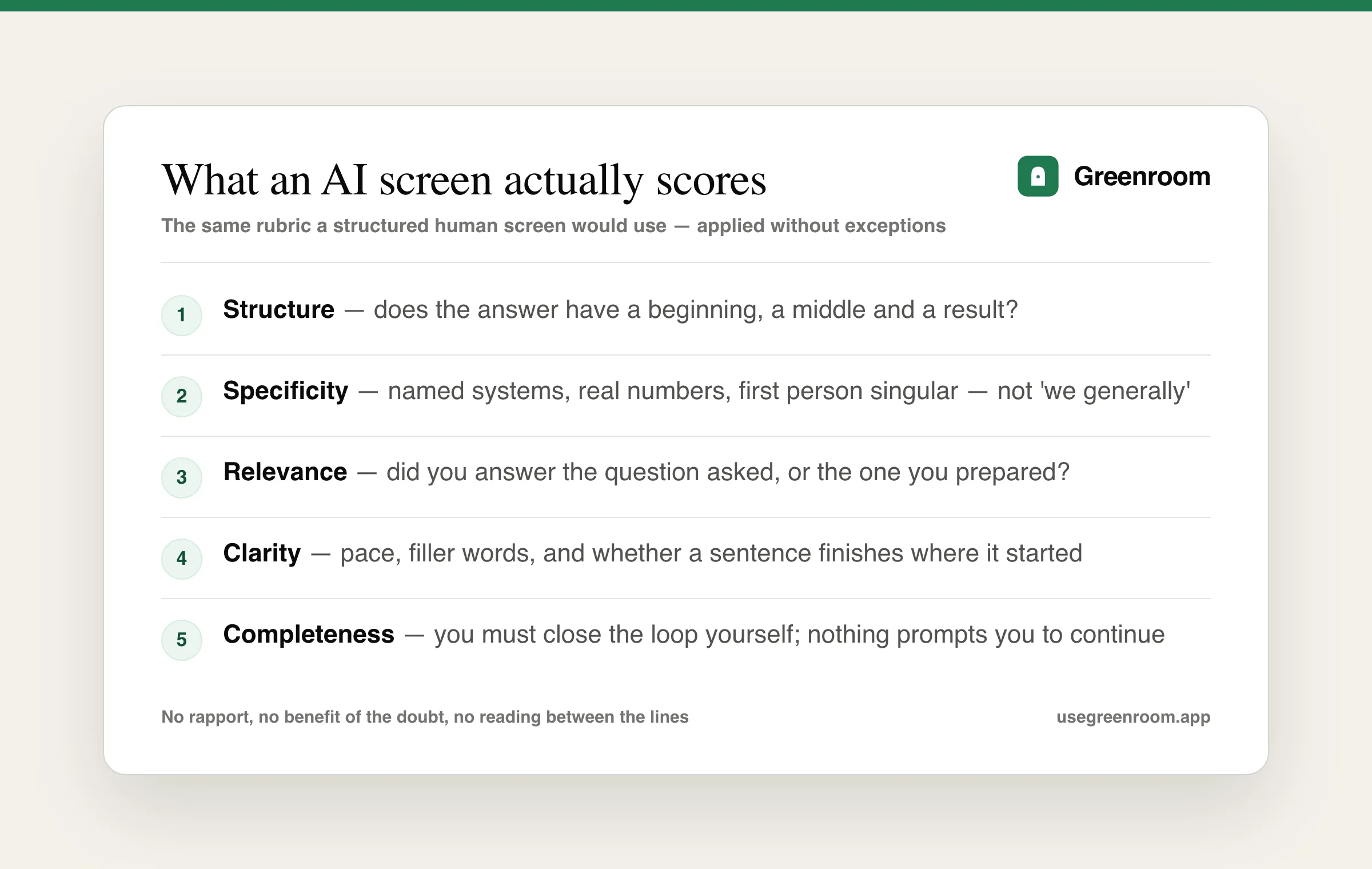
Most systems are implementing a structured interview — the same set of questions for every candidate, scored against a defined rubric. That is the point of them from the employer's side: structured interviews are better predictors of performance than unstructured ones, which is a genuinely well-established finding in the research and the honest argument in their favour.
What that means for you is that the rubric is doing the work that rapport normally does:
- Structure. Does the answer have a situation, an action and a result? Rambling costs you here in a way it does not with a sympathetic human.
- Specificity. Named technologies, real numbers, first person singular. "We improved performance" scores near zero; "I cut p99 latency from 1.4s to 380ms by fixing an N+1 query" scores.
- Relevance. Did you answer the question asked? A human will mentally redirect you; software marks the question unanswered.
- Clarity. Pace, filler words, and whether your sentences finish where they started.
- Completeness. Nobody will say "and then what happened?" You have to close your own loop.
How to actually answer one
- Say the structure out loud. "There are three parts to this — the problem, what I did, and what changed." It sounds slightly formal to a human and it maps perfectly onto a rubric.
- Front-load the answer. Give the conclusion first, then the reasoning. If the response gets truncated by a time limit, you want the substance already delivered.
- Use the full time, but stop when finished. Trailing off into "so, yeah" is a real cost. End on the result.
- Name things. Systems, tools, metrics, dates. Specificity is the single largest scoring lever.
- First person singular. "We" is invisible to a rubric that is trying to measure you.
- Do not perform for the camera. Warmth is not being scored, and manufacturing it wastes energy you need for content.
- Restate the question if it is ambiguous. "I'll take that as asking about X" is a legitimate move and it protects you from answering the wrong thing.
- Check the basics. Quiet room, headphones with a decent mic, stable connection, good light. If your audio is poor, a transcription-based system cannot score what it cannot hear. Our video interview tips guide covers the setup.
What people get wrong
- Treating it as a formality. These are frequently the actual filter, not a warm-up.
- Reading from a script. It produces a flat, over-smooth delivery, and worse, it collapses the moment a follow-up goes off-script. Live conversational systems ask follow-ups.
- Trying to keyword-stuff. Repeating "leadership, teamwork, ownership" mechanically does not work on a modern scoring system and reads badly to the human who reviews the transcript afterwards — and a human usually does.
- Panicking about the silence. It is not a bad sign. There is nothing to read, so stop trying to read it.
- Assuming nobody hears it. In most implementations a recruiter reviews the recording or transcript for anyone near the bar. Do not say anything you would not say to a person.
Can you refuse an AI interview?
Sometimes, and it is worth knowing your options honestly.
You can ask for a human alternative, and some employers will accommodate it, particularly if you cite a disability or accessibility need — a request many companies are legally obliged to consider. Reports of candidates walking away from AI-only processes suggest employers are increasingly aware of the cost of refusing.
You can also decline and withdraw, which some candidates do on principle. That is a legitimate choice, and it is a real tradeoff rather than a costless protest — you are removing yourself from a pipeline that will fill anyway.
Two things worth knowing about the rules. In New York City, Local Law 144 requires bias audits and candidate notice for automated employment decision tools; our bias audit logs and NYC LL144 guide covers what that means in practice. In the EU, the AI Act classifies employment-related AI as high risk with associated obligations — see our EU AI Act and hiring tools guide. India has no equivalent hiring-specific regime yet, though the DPDP framework governs how your personal data is processed. You are generally entitled to ask what is being recorded, how long it is kept, and whether a human reviews the outcome. Asking is not rude.
Where Greenroom fits, honestly
I should be direct about the conflict of interest: Greenroom is an AI interviewer, so "practise with an AI" is obviously a self-serving recommendation. Here is the honest version of it.
The thing that makes an AI screen hard is not that it is artificial. It is that you have never done one, so the first time you speak into a silence that does not react is during a round that counts. That is fixable with repetition and only with repetition, and it does not have to be with us — an async recording of yourself answering ten questions with no audience achieves most of it for free.
What Ari, the AI interviewer adds is the follow-up: a real spoken round where the question after your answer is based on what you actually said, and a score against structure, specificity and clarity — which are the same things the screen is measuring. The honest tradeoff is that Ari cannot tell you that company's rubric, and no tool can.
And one thing we deliberately do not do: Greenroom is not a copilot. It does not sit in your live interview feeding you answers, which is what several tools in this category are built for. That distinction matters more in 2026 than it used to, because employers are actively detecting it — our proxy interviews and the deepfake crackdown guide covers what that detection now looks like, and our cheating signals page is a transparent account of where we stand. Our Greenroom vs Final Round AI comparison is the direct version of that difference.
A one-week preparation plan
- Days 1-2 — record yourself answering five standard questions with no audience. Watch them back. Almost everyone discovers they say "um" more than they thought and finish weaker than they thought.
- Days 3-4 — rewrite each answer to lead with the result and include one number. Say them out loud until the number arrives without hesitation.
- Day 5 — practise follow-ups, because conversational systems ask them. Have someone push twice on each story.
- Day 6 — set up and test your actual environment: room, mic, lighting, connection.
- Day 7 — one full spoken run, then stop. Our how to think out loud in interviews guide covers narrating under pressure and how to answer tell me about yourself covers the answer you will definitely be asked.
A note on the numbers in this post: the adoption and backlash figures come from Greenhouse's 2026 candidate research as reported in the trade press, and single-vendor survey data should be treated as directional rather than precise. The research on structured interviews outperforming unstructured ones is much older and much better established.
The mirror-image question is also live in 2026: our can you use AI in a coding interview guide covers which companies now allow it and how the AI-assisted round is graded.
Frequently asked questions
What is an AI interview?
Three different formats get called an AI interview. An asynchronous video interview records your answers to prompts on a timer with AI used for scoring or transcript analysis. A live conversational AI interviewer asks questions by voice and asks follow-ups based on your answers. And AI-assisted screening is where a human interviews you and software transcribes and scores it afterwards. Asking the recruiter which format you will face is entirely normal and changes how you prepare.
How do you pass an AI interview?
Answer to the rubric rather than to a person. Say the structure of your answer out loud, front-load the conclusion before the reasoning in case of a time limit, name specific systems and include real numbers, use first person singular because we is invisible to a scoring rubric, restate ambiguous questions before answering, and close your own loop since nothing will prompt you to continue. Also fix the basics — a quiet room and clear audio, because a transcription-based system cannot score what it cannot hear.
Do AI interviews actually decide whether you get hired?
Often they are the filter rather than a warm-up, which is why treating them as a formality is the most expensive mistake. In most implementations a human recruiter still reviews the recording or transcript for anyone near the bar, so you should assume a person will hear everything you say. The scoring itself is usually structured — the same questions for every candidate against a defined rubric — which is the main argument employers make in their favour.
Can you refuse to do an AI interview?
You can ask for a human alternative, and some employers will accommodate it, particularly where a disability or accessibility need is cited, which many companies are obliged to consider. You can also decline and withdraw, which some candidates do on principle, though it is a genuine tradeoff rather than a costless one. You are generally entitled to ask what is recorded, how long it is retained and whether a human reviews the outcome.
Are AI interviews legal and regulated?
It varies by jurisdiction. New York City's Local Law 144 requires bias audits and candidate notice for automated employment decision tools, and the EU AI Act classifies employment-related AI as high risk with corresponding obligations. India currently has no hiring-specific regime, though the DPDP framework governs how your personal data is processed. In practice this means you can ask what is being recorded and whether a human reviews the decision.
How do you practise for an AI interview?
Record yourself answering five standard questions with no audience and watch them back, because the difficulty is not that the interviewer is artificial but that you have never spoken into a silence that does not react. Then rewrite each answer to lead with the result and contain one real number, rehearse follow-ups since conversational systems ask them, and test your actual room, microphone and connection before the day. A free self-recording achieves most of this; a mock interview tool mainly adds the follow-up question.