Bias audits are painful when the underlying interview process is loose. Teams wind up reconstructing what happened from recruiter notes, ATS comments, and spreadsheets that were never designed for auditability. Then a deadline arrives, and what should be a routine export becomes a multi-week archaeology project. Bias audit logs exist to make that project disappear — the audit becomes a query, not an investigation.
What Local Law 144 actually requires
New York City's Local Law 144 governs automated employment decision tools (AEDTs) used to screen candidates for jobs in NYC. If you use one, the law imposes three concrete obligations:
- An independent annual bias audit. A third party computes selection rates and impact ratios across sex and race/ethnicity categories — and intersectional categories — using your real usage data.
- A public summary. The results, plus the audit's distribution date, must be published where candidates can find them.
- Candidate notice. Candidates must be told an AEDT is being used, what it assesses, and be able to request an alternative process.
The penalties are per-violation and per-day, which means a sloppy process isn't just a compliance risk — it's a recurring one. But the practical pain point is simpler: the audit needs structured selection-rate data, and most hiring stacks don't store it in a form an auditor can use.
What we store
Greenroom's bias audit log captures the four things an auditor actually needs, at the moment they happen rather than reconstructed later:
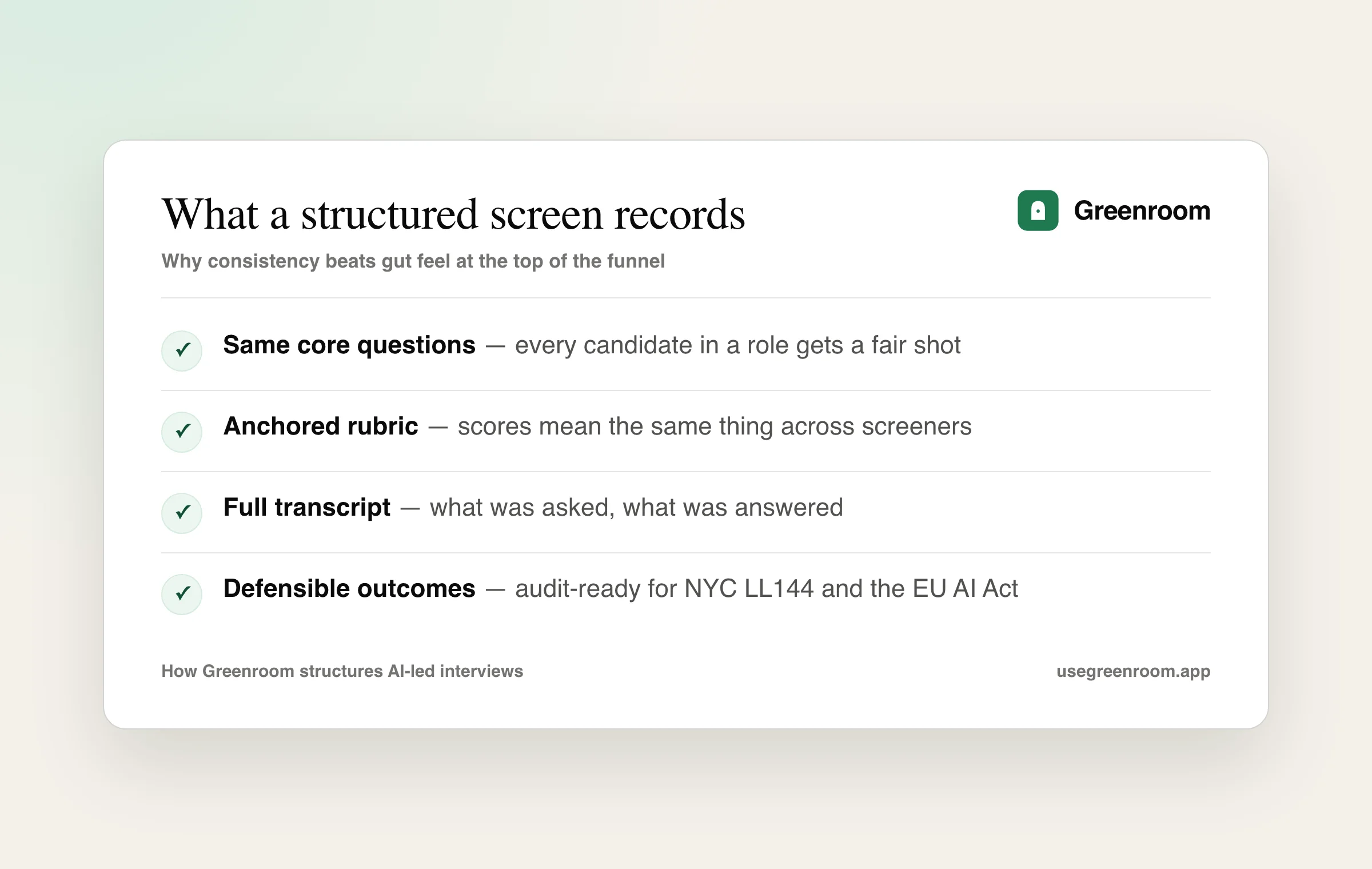
- The question set used for each role, so you can show every candidate in a role was assessed on the same competencies.
- The anchored rubric applied, so a given score means the same thing across candidates and across screeners.
- The per-candidate scores generated, the raw material for selection-rate and impact-ratio math.
- The recommendation outcome at each stage, so the audit can trace scores through to decisions.
That gives legal and people-ops teams a stable record for annual review instead of ad hoc screenshots. When the auditor asks for data, you export it — in a shape they can consume directly — rather than assembling it by hand from four systems.
Why structure is the actual fairness mechanism
It's tempting to treat a bias audit as a checkbox bolted onto hiring. It isn't. The audit only works if the underlying process is legible — if you can say, with evidence, what each candidate was asked and how it was scored. An unstructured screen can't produce that record because it never existed; the decision lived in someone's head.
This is why structured interviewing and auditability are the same project viewed from two angles. Structure is what makes hiring fair in the first place — same questions, same rubric, comparable scores — and that same structure is what makes it auditable. You don't choose between fairness and compliance; one produces the other.
Why it matters beyond the deadline
The point is not just compliance theater. Once the same data is consistently available, you can do something most hiring teams can't: spot drift before it becomes a finding. You can compare selection rates across roles, cohorts, and interview versions and catch an inconsistency in month three instead of in next year's audit. The annual report stops being a verdict you await and becomes a confirmation of what you already monitor.
There's a strategic angle too. Local Law 144 is the first wave, not the last. The EU AI Act classifies hiring tools as high-risk and asks for overlapping artifacts — documentation, human oversight, records of how decisions were made. A team that already logs questions, scores, and outcomes for NYC is most of the way to compliance everywhere else. Building the record once and reusing it is far cheaper than reconstructing it per jurisdiction.
A note on scope
To be precise about where this applies: Local Law 144 governs tools employers use to screen candidates. Greenroom's candidate-facing product is practice — a person preparing for their own interviews — and that isn't an AEDT. The bias audit logging described here applies to Greenroom's structured screening use by hiring teams, where the tool is part of an employment decision. We keep that line bright on purpose.
Frequently asked questions
What does NYC Local Law 144 require from hiring tools?
If you use an automated employment decision tool for NYC candidates, you need an independent annual bias audit, a public summary of results, and notice to candidates. The audit needs structured selection-rate data by demographic category.
What data does Greenroom store for bias audits?
Per-session question lists, anchored rubric scores, and stage outcomes — exportable in a format your auditor can consume directly, so assembling the annual audit doesn't become an engineering project.
Does Local Law 144 apply to AI interview practice tools?
It applies to tools used by employers to screen candidates, not to candidate-side practice. Greenroom's candidate product is practice; this logging applies to its structured screening use by hiring teams.