He was told he could use the AI assistant, so he did what he does at work: pasted the problem in, took the answer, ran it, and it passed. Eleven minutes, done. The interviewer asked why the solution used a set rather than a list, and he did not know, because he had not read it. Then she asked what happened when the input contained duplicates, and neither of them knew, and only one of them was being assessed.
Two years ago the answer to "can you use AI in a coding interview?" was a flat no everywhere. In 2026 it depends entirely on the company, and at a growing number of them the answer is not merely yes but yes, and we are watching how. Here is where things actually stand and how to handle each case.
Which companies allow it
The reported picture as of mid-2026 — worth confirming with your own recruiter, because these policies are moving fast:
- Meta began piloting an AI-enabled coding interview in late 2025, reported as a 60-minute round in a CoderPad-style environment with an assistant built in, replacing one of the two coding rounds at the onsite, with plans to extend the format more broadly through 2026.
- Canva replaced its computer science fundamentals round with an AI-assisted coding interview for backend, frontend and machine learning roles, where using the assistant is optional but actively encouraged.
- Shopify and Rippling have also been reported as permitting AI in interviews.
- Most other companies still prohibit it, including most Indian product companies and services firms, where an undeclared copilot is treated as cheating rather than as tooling.
The only reliable move is to ask the recruiter directly: "Is the use of AI assistants permitted in the technical rounds?" It is a completely normal question in 2026 and the answer determines your entire approach. Never assume in either direction.
When AI is allowed: what is actually being graded
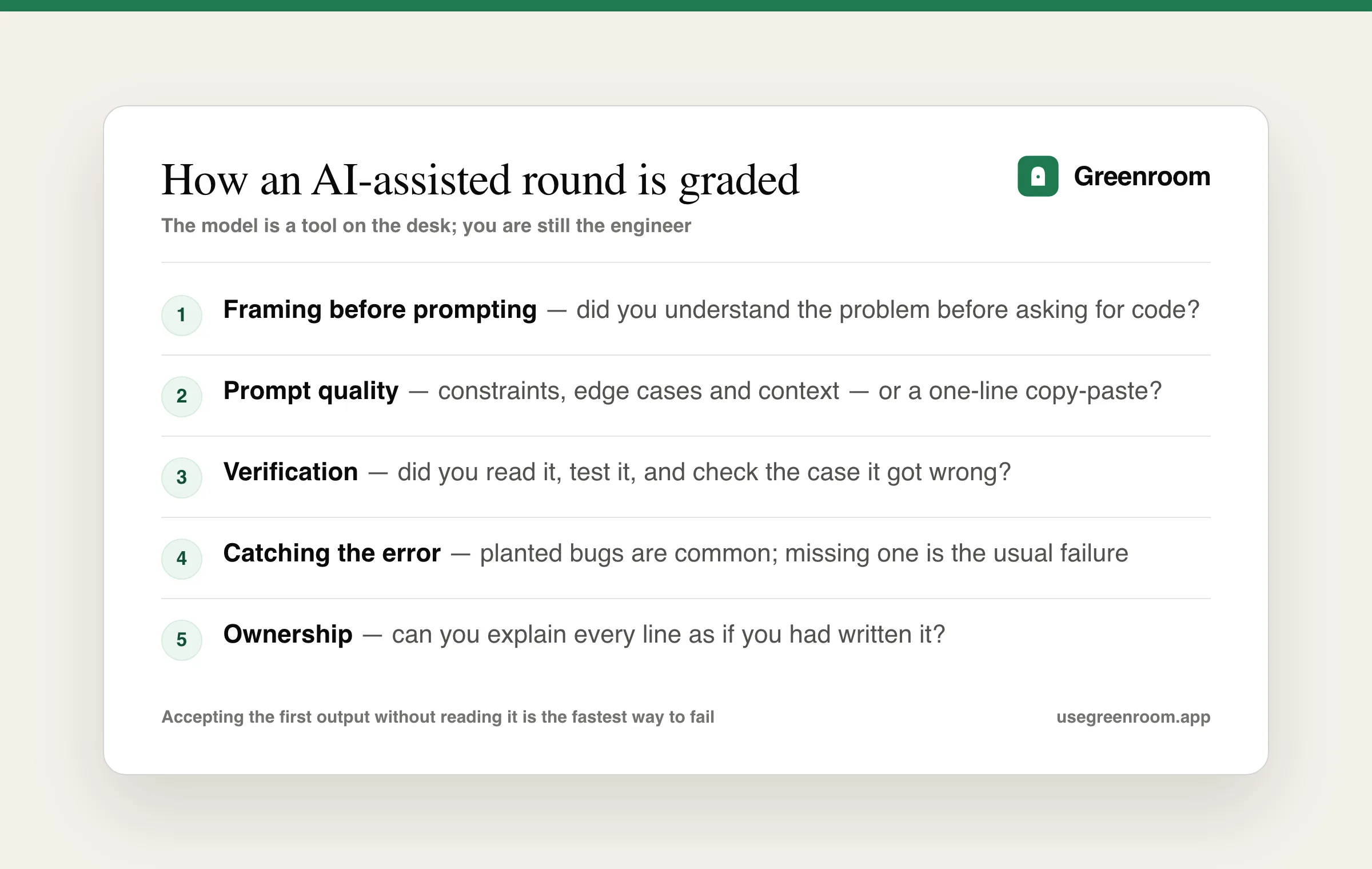
The critical reframe: the assistant is not the thing being tested. Your direction of it is. Companies moving to this format are explicit that they are evaluating how you use the tool, not whether you can.
- Problem framing before prompting. Candidates who prompt first and think second do badly. Clarify requirements, state your approach out loud, *then* use the assistant for the parts where it helps.
- Prompt quality. A prompt containing the constraints, the edge cases and the context produces a usable answer. A one-line copy-paste of the problem statement produces something generic, and the interviewer sees both your prompt and the result.
- Verification. Read the output. Trace an example through it. Run it against the awkward input. This is the single largest differentiator and the thing candidates skip under time pressure.
- Catching what it got wrong. Interviewers in these formats frequently choose problems where the obvious generated answer has a subtle flaw — an off-by-one, an unhandled empty case, an O(n²) solution presented confidently. Missing it is the standard way to fail.
- Ownership. You must be able to explain every line as though you wrote it, because you will be asked. "The AI chose that" is not an answer.
- Judgment about when not to use it. Reaching for the assistant on a five-line function is slower than typing it and it reads as dependence. Using it for boilerplate, tests and unfamiliar API syntax reads as competence.
The mental model that works: treat it exactly like a very fast, very confident junior engineer. You would not merge their first pull request unread. You would give them a clear brief, review the output, and question the odd choice.
How to run the round well
- Spend the first two or three minutes on requirements, with the assistant untouched. Say your approach and complexity out loud before any code exists.
- Prompt in the open and narrate it. "I'm going to ask it for the parsing layer, with the constraint that input may be empty and dates may be malformed." The interviewer is scoring that sentence.
- Read the output aloud as you scan it. "This assumes sorted input — we don't have that guarantee, so I'll adjust it."
- Test before you declare victory. Walk one edge case through the code manually.
- Ask for the tests. Generating unit tests is one of the highest-value uses of an assistant in these rounds, and very few candidates do it.
- Say when you are choosing not to use it. "I'll write this bit myself, it's quicker than describing it." That is a scored judgment call.
- Keep talking. In this format silence is worse than usual, because without narration all the interviewer sees is you reading a screen. Our coding interview communication tips guide covers narration.
When AI is not allowed
Which is still most places. Two things matter here.
Do not use it anyway. Detection has improved substantially, the format is shifting towards live follow-ups that copilots handle badly, and the consequence is not a rejection but permanent removal from consideration — with criminal complaints in some reported Indian proxy cases. Our proxy interviews and the deepfake crackdown guide covers what is now being detected.
Understand the second-order problem, which is real and underdiscussed: if you use an assistant for everything at work, your unassisted problem-solving gets rusty in a way you will not notice until you are in a locked-down editor with no autocomplete. Several interviewers have described exactly this pattern — strong engineers who cannot write a binary search unaided any more.
The fix is unglamorous: practise some problems with the assistant off. Not all of them, and not forever, but enough that the unassisted version of you still exists. Our common coding interview mistakes guide covers the rest of that round.
What to ask the recruiter
- "Are AI assistants permitted in the technical rounds?"
- "If so, is it a specific environment with a built-in assistant, or my own tools?"
- "Is using it expected, or merely allowed?" — a meaningful difference at companies where declining to use it reads as odd.
- "Will the round be recorded, and will my prompts be visible to the interviewer?" — usually yes to both.
- "Are there rounds where it is specifically not allowed?" — many companies run a mixed loop.
Where this is going, honestly
It is worth saying plainly that this is unsettled. The argument for allowing AI is straightforward: it is how the job is now done, and testing people without the tool they use daily measures something increasingly artificial. The argument against is also straightforward: it makes it much harder to assess raw problem-solving, and it advantages people fluent in a specific tool over people with better fundamentals.
Both are reasonable and the industry has not resolved it, which is precisely why you must ask rather than assume. Expect mixed loops to become the norm — one traditional round for fundamentals, one AI-assisted round for realistic work.
For what it is worth from our side: what improves in an AI-assisted round is not your prompting, it is your ability to say your reasoning out loud while your hands are busy — framing the problem, justifying the choice, catching the flaw. That is the same skill the follow-up-heavy human rounds are also converging on, and it is the thing Ari, the AI interviewer is built to rehearse. Greenroom is practice before the interview and deliberately not a copilot during one — see our cheating signals page for where we draw that line.
Frequently asked questions
Can you use AI in a coding interview?
It depends entirely on the company and the policies are changing quickly. Meta has piloted an AI-enabled coding round that replaces one of its two onsite coding interviews, Canva replaced its computer science fundamentals round with an AI-assisted coding interview, and Shopify and Rippling have also been reported as permitting it. Most other companies, including most Indian product and services firms, still prohibit it and treat an undeclared assistant as cheating. Always ask the recruiter directly rather than assuming either way.
How is an AI-assisted coding interview graded?
On how you direct the tool rather than whether you can use it. Interviewers assess whether you framed the problem before prompting, the quality of your prompt including constraints and edge cases, whether you actually read and verified the output, whether you caught the subtle flaw in it — these rounds often use problems where the obvious generated answer has an off-by-one or an unhandled empty case — and whether you can explain every line as if you had written it yourself.
What is the biggest mistake in an AI-assisted coding round?
Accepting the first output without reading it. Candidates paste the problem, take the answer, run it, and then cannot explain why the code made a particular choice or what happens on an awkward input. The mental model that works is treating the assistant like a very fast, very confident junior engineer: you would not merge their first pull request unread, so brief it clearly, review the output, question the odd choice, and own the result.
Should you use AI for everything in an AI-assisted interview?
No, and knowing when not to is itself scored. Reaching for the assistant on a five-line function is slower than typing it and reads as dependence, whereas using it for boilerplate, unit tests and unfamiliar API syntax reads as competence. Saying out loud that you are choosing to write a particular section yourself because it is quicker than describing it is a judgment call interviewers explicitly value.
What happens if you use AI when it is not allowed?
Detection has improved significantly and the consequence is typically not a simple rejection but permanent removal from consideration, with criminal complaints in some reported Indian proxy-interview cases. Interview formats are also shifting towards deep live follow-ups that copilots handle badly, so the risk has increased while the benefit has decreased. The safer and more durable approach is fluency in your own material.
Does using AI at work make you worse at coding interviews?
It can, and it is an underdiscussed risk. Engineers who rely on an assistant for everything often find their unassisted problem-solving has quietly atrophied, which only becomes apparent in a locked-down editor with no autocomplete. The practical fix is to solve some practice problems with the assistant switched off — not all of them and not permanently, but enough that the unassisted version of your skill still exists.