Hiring software is moving from convenience tooling into regulated workflow territory. The EU AI Act pushes interview platforms to document risk management, human oversight, and data handling with more rigor than most recruiting stacks currently support. If you hire in the EU — or hire EU residents from anywhere — 2026 is the year "we use an AI screening tool" stops being a footnote and becomes a thing you have to be able to defend.
Why hiring tools are squarely in scope
The EU AI Act is risk-tiered: it bans a small set of uses, lightly regulates most, and reserves its heaviest obligations for a defined list of high-risk systems. AI used in recruitment and employment decisions — screening applications, evaluating candidates, influencing who advances — sits explicitly in that high-risk category. That classification is the whole story, because it triggers the obligations below.
Two things make this broader than teams expect. First, it follows the candidate, not the office: assessing an EU-based applicant can pull you in even if your company isn't European. Second, "AI" is interpreted functionally — a tool that scores or ranks candidates counts even if you think of it as "just automation."
What high-risk classification actually requires
Once a hiring tool is high-risk, the Act asks deployers and providers to support a cluster of obligations. In plain terms:
- Technical documentation and record-keeping. You need to be able to show how the system works and keep logs of how it was used.
- Human oversight. A person must be able to understand, review, and override the system's output — no fully automated rejections in a black box.
- Transparency to candidates. People must be informed they're being assessed by an AI system.
- Data governance and quality. The data behind the system has to be managed for relevance and bias, not scraped and forgotten.
- Accuracy, robustness, and risk management. Ongoing, documented — not a one-time sign-off.
The operational shift
Teams will need more than a vendor promise. They need records of what was asked, how scoring worked, what outputs influenced hiring, and what controls exist when something goes wrong. The era of "the recruiter had a good feeling" is exactly the thing the Act is designed to surface — because a gut feeling can't be documented, reviewed, or overridden, which means it can't be governed.
Practically, that turns into a few near-term tasks for hiring leaders in 2026:
- Inventory. List every tool that makes or meaningfully influences an employment decision. Most teams underestimate this count.
- Demand artifacts from vendors. Technical documentation, logging capabilities, and a clear account of where human oversight sits. "Trust us" is not a compliance posture.
- Wire in human review. Ensure a person reviews and can override AI outputs, and that the review itself is recorded.
- Keep the record. Maintain durable records of how each decision was reached, not reconstructed notes.
Why interview structure helps
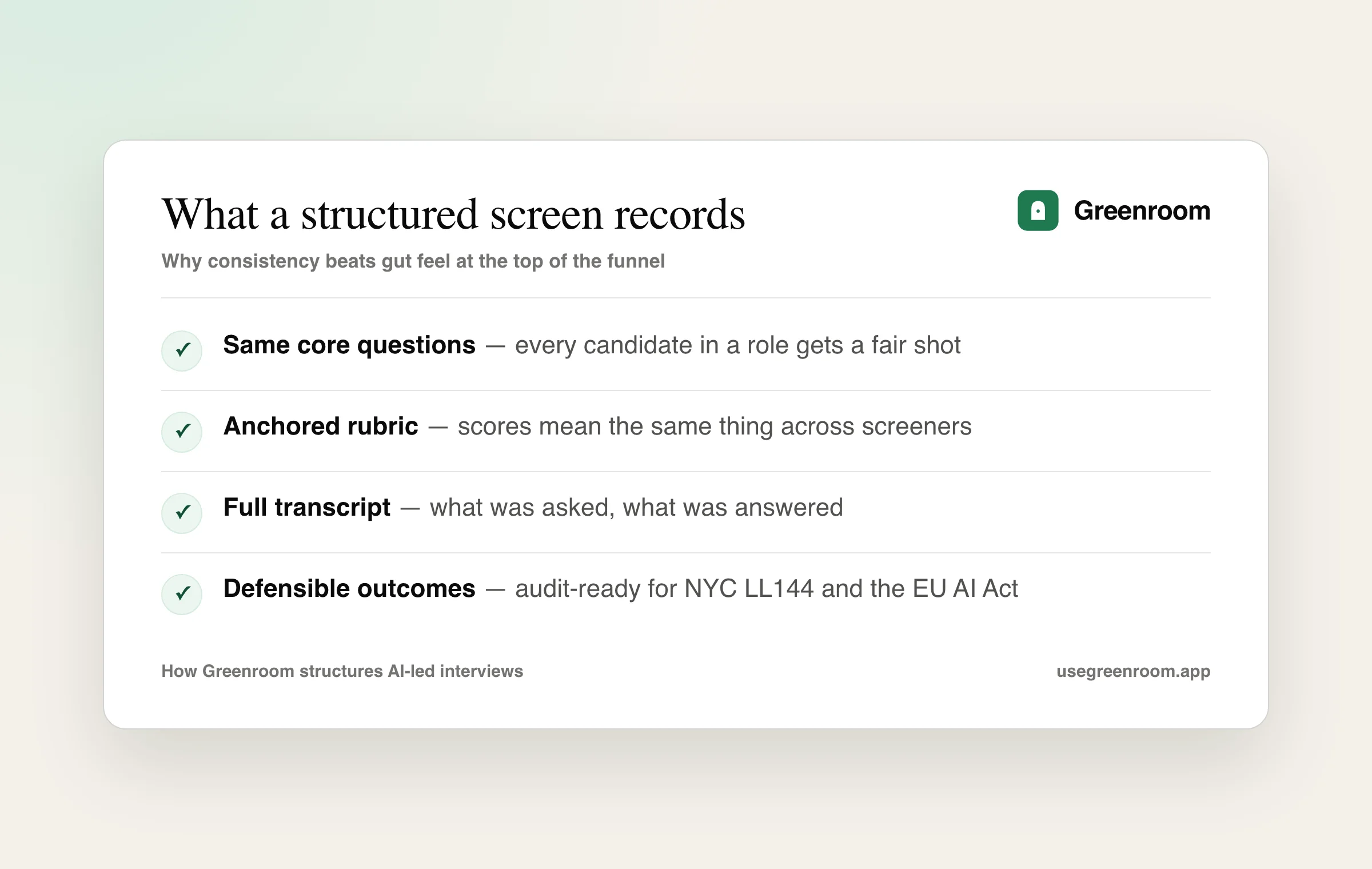
Structured systems are easier to govern because the decision path is legible. The more deterministic the question rubric and review workflow are, the easier it is to explain and audit. A structured interview produces — almost as a by-product — exactly the artifacts the Act asks for:
- Consistent questions per role become your documentation of what was assessed.
- An anchored rubric becomes your account of how it was scored.
- Full transcripts become the record that makes human review meaningful.
- Reviewable outcomes let a human confirm or override — and prove they could.
The opposite — an unstructured, gut-feel screen — is the single hardest thing to document or defend, precisely because there's nothing to point to. Under the Act, opacity isn't neutral; it's a liability.
Build the record once, reuse it everywhere
The EU AI Act doesn't exist in isolation. NYC Local Law 144 asks for overlapping evidence — selection-rate data, consistent assessment, records of decisions. A hiring team that captures questions, scores, transcripts, and outcomes for one regime is most of the way to compliance with the others. The expensive mistake is treating each jurisdiction as a separate project; the cheap path is to make legible, structured hiring your default and let the documentation fall out of it.
Regulation is converging on a single idea: if AI touches an employment decision, you must be able to show your work. Teams that already run structured, recorded interviews will experience 2026 as a paperwork exercise. Teams that don't will experience it as a scramble.
Frequently asked questions
Does the EU AI Act classify hiring tools as high-risk?
Yes — AI systems used in recruitment and employment decisions fall in the high-risk category, which brings obligations around documentation, human oversight, transparency to candidates, and data governance.
What do hiring teams need to do about the EU AI Act in 2026?
Inventory which of your tools make or influence employment decisions, demand technical documentation and audit artifacts from vendors, ensure human review of AI outputs, and keep records that show how decisions were made.
How does structured interviewing help with EU AI Act compliance?
Structure produces the artifacts regulators ask for almost as a by-product: consistent questions, anchored scoring, full transcripts and reviewable outcomes. Unstructured gut-feel screens are the hardest thing to document or defend.