"How would you evaluate an ETA model?" He said RMSE. The interviewer asked whether being ten minutes early and ten minutes late were equally bad. They are not — early means a rider waits outside a restaurant, late means a cold order, an angry customer and sometimes a refund. RMSE treats them identically, which meant the metric he had just proposed was indifferent to the entire business problem.
That asymmetry is the most Swiggy thing about Swiggy ML engineer interview questions. The models here predict time and assign people, and their errors show up physically — a rider idling, a cold biryani, a rating. The loop is a familiar shape: a real coding round, ML fundamentals, and a design round that keeps returning to prediction under conditions nobody controls. I built Greenroom after freezing in an interview I had prepared hard for, so this guide covers each round.
The Swiggy ML engineer interview process
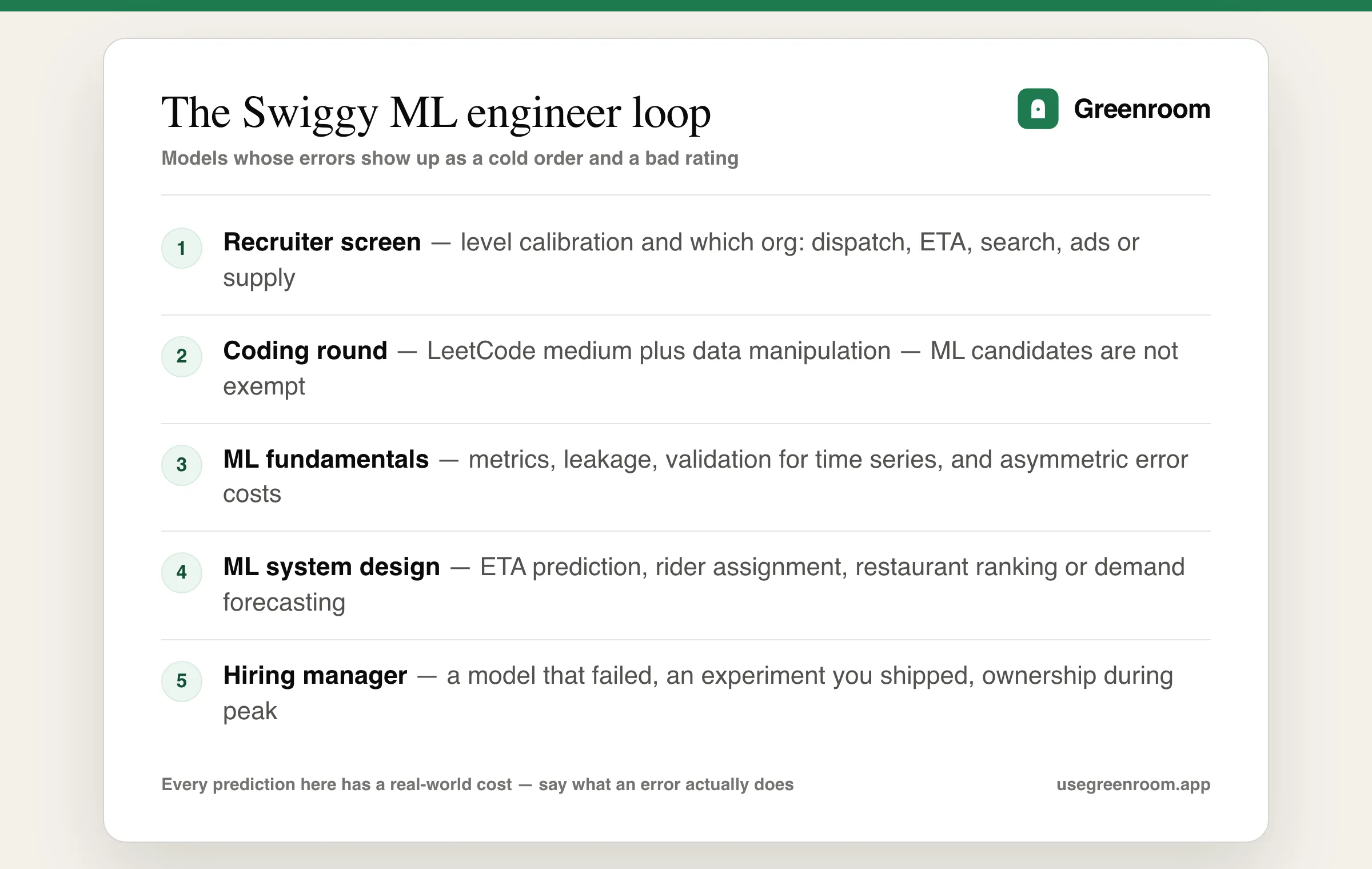
- Recruiter screen — level calibration and org: dispatch, ETA, search and discovery, ads, or supply and demand.
- Coding round — LeetCode medium plus data manipulation. ML candidates get a genuine coding bar.
- ML fundamentals round — metrics, validation, leakage, feature design, plus depth on whatever is on your resume.
- ML system design round — ETA prediction, rider assignment, restaurant ranking, or demand forecasting.
- Hiring manager round — a model that failed, an experiment you shipped, and ownership during peak hours.
Our Swiggy interview questions guide covers the company-wide process and the Swiggy data engineer guide covers the pipelines feeding these models.
The coding round
Standard medium, often with a logistics flavour: shortest path on a road graph, assigning riders to orders, merging time windows, top-K restaurants by a score, streaming aggregation. You may also be asked for pandas or SQL on a data manipulation task.
State complexity aloud and expect a scaling follow-up on each. Our DSA coding interview preparation guide covers the list.
ML fundamentals, with asymmetric costs
The distinguishing theme is that errors here are not symmetric, and the round rewards candidates who say so.
- Choosing a loss and a metric for ETA. RMSE punishes both directions equally; a quantile loss lets you deliberately over-predict, and predicting the 70th percentile rather than the median is a legitimate, business-aware answer. Being able to explain that tradeoff is close to the single highest-value thing you can say in this loop.
- Validation for time series. A random split leaks the future. Use a time-based split, and be able to say why.
- Leakage. Especially features unavailable at prediction time — you cannot use actual pickup time to predict delivery time.
- Distribution shift. Rain, festivals, a new city, a promotion. Models trained on ordinary conditions fail exactly when the business needs them most.
- Metrics under imbalance, for the fraud and cancellation problems.
- Calibration, where a downstream system multiplies your probability by something.
- Cold start for new restaurants and new riders, which is continuous rather than occasional.
Our machine learning engineer interview questions guide covers the role-general bank.
ML system design: the four prompts
ETA prediction. The most likely question. Frame it properly: the total is a sum of stages — order placement to restaurant acceptance, food preparation, rider assignment, rider travel to restaurant, waiting, travel to customer. Predicting each stage separately is usually better than one end-to-end regression, and saying so demonstrates you have thought about the problem rather than the model.
Features: restaurant historical prep time by item and hour, current kitchen load, rider availability in the area, distance and route, traffic, weather, time of day, day of week. Then the honest parts — what happens when the restaurant is slower than usual today, and what you show the customer when uncertainty is high. Showing a range or a conservative estimate is a real product decision and interviewers like it raised.
Rider assignment and dispatch. This is an optimisation problem with an ML component, not purely a prediction problem. Discuss batching nearby orders, the tradeoff between waiting to batch and dispatching immediately, and why greedy nearest-rider assignment degrades at peak. Mention that the assignment is a matching problem and that predicted travel times feed it.
Restaurant ranking and discovery. Multi-objective by nature: relevance to the user, delivery time, restaurant reliability, and marketplace considerations. Cover candidate generation then ranking, personalisation, cold start for new restaurants, and position bias in the training data.
Demand forecasting. For rider supply planning. The interesting parts are the spikes — rain, weekends, match days, festivals — and why you must model known future events rather than treating them as anomalies. Forecast at the right granularity: a zone in a city for an hour, not a city for a day.
Cross-cutting and repeatedly probed: latency budget for a model that sits in the ordering path, cost per prediction at scale, training-serving skew and the feature store answer, A/B testing in a two-sided marketplace where changing rider allocation affects customers who are not in your experiment, and a fallback when the model is unavailable — usually a simpler distance-based heuristic. Our MLOps interview questions guide covers the serving discipline.
The hiring manager round
Expect: a model that failed in production and what you changed structurally, an experiment that came out negative, a disagreement about which metric to optimise, and how you operated during a peak or an incident.
Rain is a genuinely good scenario to have thought about, because it simultaneously increases demand, reduces rider availability and increases travel time — a single event that breaks three models at once. Our behavioral interview questions guide covers the structure.
Where each prep option actually helps
- Designing Machine Learning Systems by Chip Huyen — the best single preparation for the design round.
- Anything on quantile regression and asymmetric loss — a short read that directly answers the ETA question.
- Public engineering writing from delivery and ride-hailing companies — dispatch, batching and ETA decomposition are well documented and very few candidates arrive with the vocabulary.
- LeetCode — mediums, because the coding round is real.
- ChatGPT — good for generating design prompts and critiquing an architecture. It will not ask whether ten minutes early and ten minutes late are equally bad.
- Greenroom — the spoken layer. Ari, the AI interviewer runs the ML design round out loud and asks the cost-of-error follow-up. Honest tradeoff: Ari will not review your training code, so pair it with real projects.
Interviewing across comparable loops? The Flipkart ML engineer guide covers commerce ranking at India scale, the Google ML engineer guide covers a broader fundamentals round, and the Meta ML engineer guide covers ranking at feed scale.
Frequently asked questions
What is the Swiggy ML engineer interview process?
Candidates report a recruiter screen for level and org calibration across dispatch, ETA, search, ads or supply, a coding round at LeetCode medium that also tests data manipulation, an ML fundamentals round covering metrics, validation and leakage plus depth on your resume, an ML system design round on ETA prediction, rider assignment, ranking or forecasting, and a hiring manager round about a model that failed and experiments you shipped.
How do you design an ETA prediction system?
Decompose the total rather than predicting it end to end: order acceptance, food preparation, rider assignment, travel to the restaurant, waiting, and travel to the customer are separate stages with different drivers, and predicting each is usually better. Use restaurant historical prep times by item and hour, current kitchen load, rider availability, distance and route, traffic, weather and time features. Then address what you show when uncertainty is high, which is a genuine product decision rather than only a modelling one.
What metric should you use for an ETA model?
Not a symmetric one. Being ten minutes early and ten minutes late have very different costs — early means a rider waiting, late means a cold order, a poor rating and sometimes a refund — so RMSE is indifferent to the actual business problem. A quantile loss that lets you deliberately over-predict, for example targeting the 70th percentile rather than the median, is the answer that demonstrates awareness of asymmetric error cost.
What ML system design questions does Swiggy ask?
Four prompts recur: ETA prediction, rider assignment and dispatch which is an optimisation problem with an ML component including whether to batch nearby orders, restaurant ranking and discovery which is inherently multi-objective across relevance, delivery time and reliability, and demand forecasting for rider supply where known future events such as rain, weekends and festivals must be modelled rather than treated as anomalies.
How do you handle distribution shift in a delivery ML system?
Model the conditions explicitly rather than hoping they average out. Rain is the canonical example because it simultaneously increases demand, reduces rider availability and increases travel time, breaking three models at once. Practical answers include weather and event features, separate handling for known future events, monitoring input drift so you notice before the business metric moves, and a simpler distance-based fallback for when the primary model is clearly out of distribution.
Does Swiggy ask ML engineers coding questions?
Yes, at LeetCode medium with a frequent logistics flavour — shortest path on a road graph, assigning riders to orders, merging time windows, top-K by score, or streaming aggregation — and sometimes a pandas or SQL data manipulation task. ML candidates are not given a reduced coding bar, so practise stating complexity aloud and answering a scaling follow-up on each problem.