Meera's Swiggy interview was cruising along nicely — she'd just finished sketching a clean orders-and-deliveries data model — when the interviewer asked, almost gently, "cool, now what does this look like at 8:47 on a Friday night, when every order in a 3km radius fires within the same four minutes?" Meera's clean model suddenly needed a rewrite, live, while the interviewer waited with the patience of someone who had asked this exact question forty times before.
That four-minute dinner-rush spike is the real subject of the Swiggy data engineer interview — not a hypothetical "web scale" the way generic prep material frames it, but a specific, recurring, every-single-night traffic pattern. I built Greenroom after freezing in exactly this kind of live, follow-up-driven round, so this guide covers the real SQL, modeling and pipeline questions Swiggy asks, and a prep plan built around speaking your reasoning out loud, not just getting to a working query.
The Swiggy data engineer interview process
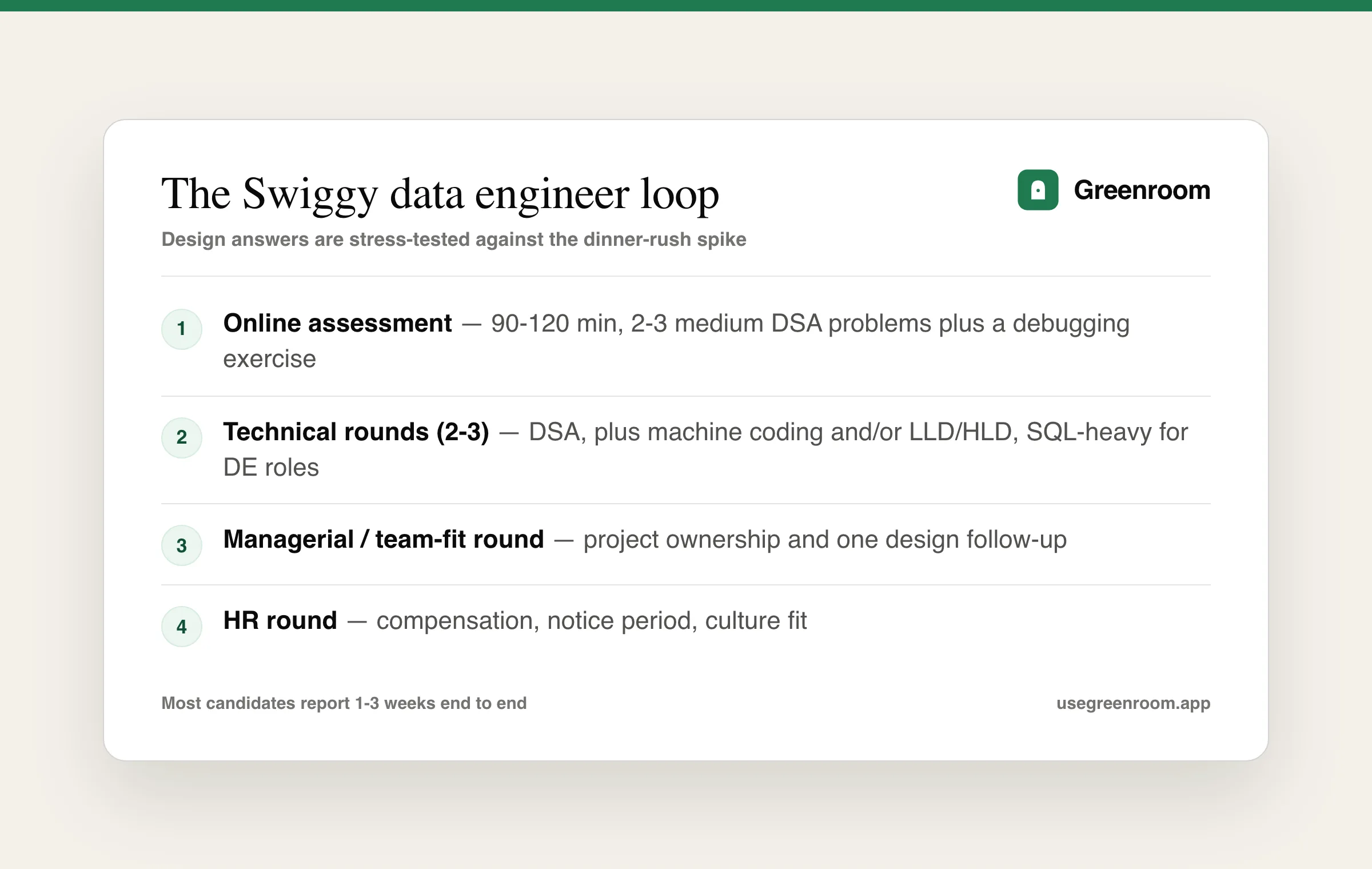
The Swiggy data engineer interview process runs four stages, and it moves fast compared to most companies:
- Online assessment — 90–120 minutes: 2–3 medium DSA problems plus a debugging exercise, usually on HackerRank or HackerEarth.
- Technical rounds (2–3) — DSA, plus machine coding and/or low-level/high-level design, with a strong SQL and data-modeling slant for DE roles.
- Managerial / team-fit round — how you work with a team, project ownership, and one design follow-up.
- HR round — compensation, notice period, and culture fit.
Most candidates report 1–3 weeks end to end — one of the fastest loops among Indian food-delivery and quick-commerce companies. The condensed breakdown lives on our Swiggy Data Engineer interview prep page — this post goes deep on the actual questions.
Swiggy data engineer SQL interview questions
SQL is scored live, usually shared-screen, and almost always tied back to delivery logistics. Reported shapes:
- Write a SQL query to find the 7-day rolling retention of users.
- Find restaurants whose average delivery time increased more than 20% week over week.
- Return each delivery partner's most recent completed order (dedup with ROW_NUMBER).
- Compute the median order-to-delivery time per city per day:
-- Median order-to-delivery time per city per day
SELECT
  city,
  order_date,
  PERCENTILE_CONT(0.5) WITHIN GROUP (
    ORDER BY delivery_minutes
  ) AS median_delivery_minutes
FROM orders
GROUP BY city, order_date;
The follow-up lands within seconds: how does this query behave when every table in this query 10x's in write volume for a two-hour dinner window? Our SQL interview questions guide covers the underlying window-function and aggregation patterns.
Data modeling questions
The modeling round anchors to logistics domains Swiggy actually runs in production:
- Design a data model for order-to-delivery tracking. Grain first: is one row an order, an order-status event, or a GPS ping?
- When would you choose a star schema over a wide denormalized table for a restaurant-analytics dashboard?
- Explain SCD Type 1 vs Type 2 — and where Swiggy would need Type 2 (delivery-partner ratings history, restaurant menu-price history).
- How do you pick a partition key for a fact table queried by date city-wide, and by delivery partner individually?
Interviewers consistently reward "what's one row here?" before any table gets drawn — jumping straight to schema design reads as guessing the answer rather than deriving it.
Pipeline and system design questions
The design round is a data-flavored system design interview scaled to the dinner-rush pattern:
- Design a pipeline that ingests order-status events at 10x normal volume for a two-hour dinner window, with exactly-once semantics.
- Batch or streaming for a live "average delivery time in your area" widget — defend the choice.
- A backfill needs to reprocess 6 hours of delivery events without double-counting completed orders downstream. Walk me through it.
- How do you handle GPS pings that arrive out of order from a delivery partner's phone with a spotty connection?
Structure beats vocabulary: state the peak-window assumption out loud, propose ingestion → buffer → storage → transform → serve, then volunteer failure modes — idempotent writes, dead-letter queues, backpressure — before being asked. The general framework is in our data engineer interview questions guide.
Behavioral and managerial-round questions
The managerial round decides whether you can be trusted on-call during dinner rush:
- Tell me about a data quality incident you owned end to end, and how you prevented a repeat.
- Describe a time a pipeline you built fell behind during a traffic spike. What did you do in the moment?
- Walk me through a modeling decision you'd make differently with hindsight.
Answers need real numbers — "improved pipeline reliability" loses to "cut late-arriving-event lag from 12 minutes to 90 seconds." Our data engineer interview questions guide has more STAR-shaped examples for technical behavioral rounds.
LeetCode, StrataScratch, a senior's notes — where each fits
An honest map of the usual prep stack for this specific loop:
- LeetCode — partially calibrated; Swiggy's DE coding leans SQL and data manipulation over hard graph algorithms, though the online assessment's DSA section is real and timed.
- StrataScratch / DataLemur — close in shape to Swiggy's SQL screens; good for reps, silent on the live scale follow-ups.
- GeeksforGeeks interview experiences / a senior's notes — useful for calibrating recent loops, but treat as anecdotes since round order shifts by team.
- ChatGPT — fine for generating extra practice prompts or reviewing a written answer; it will not interrupt your query mid-sentence with "what about the dinner-rush spike?" the way a real interviewer will.
- Greenroom — the spoken layer. Ari, the AI interviewer, runs SQL-reasoning, modeling and pipeline-design rounds out loud with live scale-based follow-ups, scoring the structure a managerial round actually listens for. Pair it with the fundamentals above.
How to prepare for the Swiggy data engineer interview
- Week 1: SQL depth — window functions, medians, rolling retention, dedup — explained out loud, not just passed against test cases.
- Week 2: data modeling — order tracking, delivery-partner and restaurant-analytics domains, grain declared first, plus SCDs and partitioning.
- Week 3: pipeline design — batch vs streaming, exactly-once, backfills, out-of-order events — talked through as full designs with a dinner-rush stress test built in.
- Week 4: behavioral stories with real numbers, rehearsed until they survive a "tell me more about that decision" follow-up.
If you're interviewing at other Indian scale-ups in parallel, the loops rhyme but the specific spike differs — our Flipkart data engineer interview guide and Zomato data engineer interview guide cover where each diverges.
For the models these pipelines feed, see our Swiggy ML engineer interview questions guide.
Frequently asked questions
What questions are asked in a Swiggy data engineer interview?
Advanced SQL (window functions, medians, rolling retention, dedup), data modeling (star schema, SCDs, grain and partitioning for delivery logistics), pipeline/system design for dinner-rush order spikes, and behavioral questions about data quality incidents.
How many rounds are there in the Swiggy data engineer interview?
Typically four: an online assessment (90–120 minutes of DSA plus debugging), 2–3 technical rounds, a managerial/team-fit round, and HR. Most candidates report 1–3 weeks end to end.
Is the Swiggy data engineer interview hard?
The SQL and modeling bar is high but predictable in shape. What surprises most candidates is how consistently every design answer gets stress-tested against the dinner-rush order spike rather than an average-traffic day.
Does the Swiggy data engineer interview include DSA coding?
Yes — the online assessment has 2–3 medium DSA problems plus a debugging exercise. Technical rounds then shift toward SQL, data modeling and machine coding or LLD/HLD design.
How fast is the Swiggy data engineer hiring process?
One of the fastest among Indian delivery and quick-commerce companies — most candidates report 1–3 weeks from the online assessment to an offer decision.
How do I prepare for the Swiggy data engineer interview in one month?
Week 1 SQL window functions and aggregation, week 2 data modeling for delivery logistics, week 3 pipeline design with a dinner-rush stress test, week 4 spoken behavioral stories with real numbers — with at least one full spoken mock per round type before the real loop.