A friend of mine, I'll call him Rohit, got a Swiggy machine-coding round where the brief was "design an in-memory rate limiter for our order-placement API." Forty-five minutes, one Google Doc, no autocomplete. He'd spent the whole week before drilling LeetCode hards on trees, and the actual round barely touched a tree. It wanted clean, extensible classes he could explain out loud while extending them live, because that's closer to what he'd do on the job than reversing a linked list under pressure ever is.
That's the shape of Swiggy interview questions: less "solve the puzzle," more "build the small thing correctly and defend every decision." I built Greenroom after freezing in exactly this kind of spoken, follow-up-heavy round — where the panel doesn't just want the right answer, they want to watch you reason your way to it. This guide covers the real Swiggy interview process, the questions that actually come up, and where role-specific prep (backend, data, ML, frontend, fullstack, EM) branches off.
The Swiggy interview process
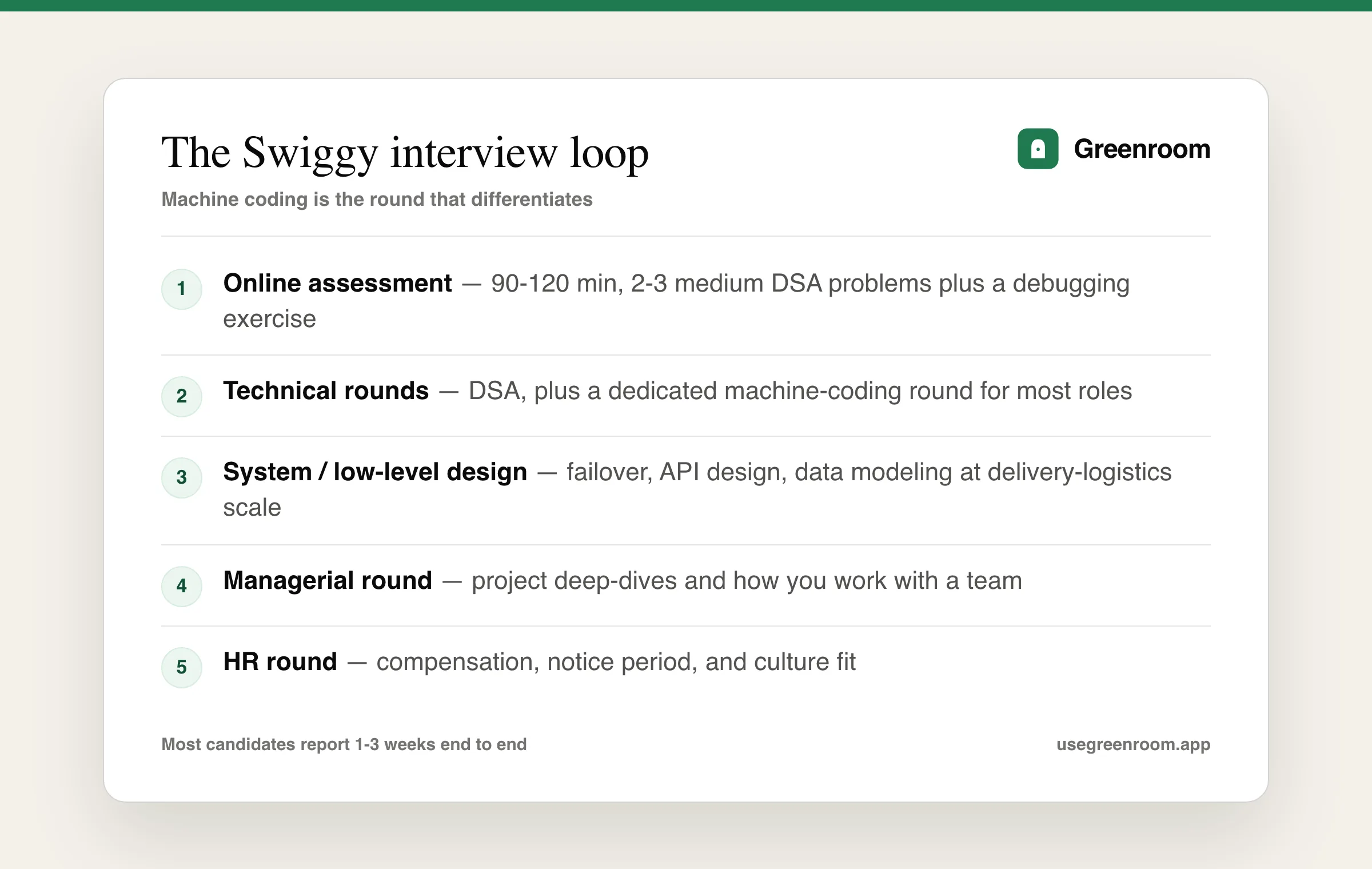
Across engineering roles, candidates report a consistent shape for the Swiggy interview process:
- Online assessment: 90–120 minutes, typically 2–3 medium DSA problems plus a debugging exercise, run on HackerRank or HackerEarth.
- 2–3 technical rounds: DSA, and for most roles, a dedicated machine-coding round plus low-level or high-level design.
- Managerial / team-fit round — project deep-dives and how you work with a team, not just what you built.
- HR round: compensation, notice period, and culture fit.
Most candidates report 1–3 weeks end to end, faster than a typical FAANG loop. The machine-coding round is the one that surprises people coming from a pure-DSA prep background: it's judged on working, extensible object-oriented code delivered in a fixed window, not on algorithmic cleverness.
DSA and coding questions
Expect core data structures and algorithms, asked with a bias toward things that map to real backend problems rather than pure puzzle-solving:
- Given a stream of events, return the top-K most frequent items in a sliding window.
- Reverse a linked list in groups of K.
- Find the shortest path in a weighted graph with negative edges allowed — when does Dijkstra break, and what do you reach for instead?
- Design a data structure that supports insert, delete, and getRandom in O(1).
The machine-coding round: Swiggy's signature round
This is what separates Swiggy's loop from a generic product-company interview: you're handed a scoped problem (a rate limiter, a parking-lot allocator, an in-memory key-value store with TTL) and 45–60 minutes to design classes, write working code, and extend it live when the interviewer adds a requirement mid-round. Common prompts:
- Design a rate limiter that works correctly across a distributed fleet of servers.
- Build an in-memory LRU cache with TTL support.
- Design a simple ride/order-matching system between two lists of entities.
Interviewers grade extensibility over cleverness: can your class hierarchy absorb "now support per-user limits" without a rewrite? Rohit's mistake wasn't his algorithm: it was hardcoding a single global limiter with no interface to swap in a per-user variant, so when the interviewer added that requirement at minute 30, he had to start over.
System design questions
For senior and full-stack-leaning roles, expect system design pulled straight from Swiggy's own product surface — delivery logistics gives interviewers a lot of real constraints to push on:
- Design an order-matching system between delivery partners and restaurants at city scale.
- How would you shard a write-heavy Postgres table handling order writes?
- Design a live-tracking system for a delivery partner's location with low latency.
- Walk through the failover story for a service that can't be down during lunch-hour peak load.
Work these the same way you'd work any system design prompt: clarify scale and latency constraints first, propose data model and API shape, pick a caching/queueing strategy, and close with failure modes and monitoring. Our system design interview guide covers the general framework this borrows from.
Behavioral and hiring-manager questions
The managerial round is a project deep-dive plus team-fit check, not a scripted values quiz:
- Tell me about a time you debugged a production incident under pressure.
- Walk me through a project where the requirements changed halfway through.
- Describe a disagreement with a teammate about a technical approach, how did you resolve it?
Our behavioral interview questions and answers guide covers structuring these with STAR without sounding rehearsed.
Role-specific prep: it's not one interview
"Swiggy interview questions" changes meaningfully by role: the DSA-plus-machine-coding shape above is the backend/frontend/fullstack default, but two roles diverge hard enough to need their own prep:
- Data Engineer — leads with advanced SQL and data modeling over classic algorithms, then pipeline design for reliability at scale. See the full Swiggy Data Engineer interview prep or our Swiggy data engineer interview questions guide.
- ML Engineer — blends coding with ML-system design: model serving, feature pipelines, evaluation metrics and production reliability, not just training a model. See the Swiggy ML Engineer interview prep.
- Engineering Manager — weighs people leadership as much as technical depth: stories about growing engineers, resolving conflict, and driving delivery, on top of enough design fluency to earn a team's trust. See the Swiggy Engineering Manager interview prep.
- Backend Engineer, the process described above almost verbatim. Full breakdown at the Swiggy Backend Engineer interview prep.
- Frontend Engineer: same DSA-plus-machine-coding shape, with JavaScript fundamentals, framework internals, and browser performance layered on. See the Swiggy Frontend Engineer interview prep.
- Fullstack Engineer: API design and databases on one side, React and frontend on the other, tied together in end-to-end system design. See the Swiggy Fullstack Engineer interview prep.
LeetCode, GeeksforGeeks, WhatsApp PDFs: where each fits
An honest map of the usual prep stack, since each solves a different piece of this loop:
- LeetCode — right for the DSA gate round; wrong as the main event, since machine coding and system design decide more of the outcome.
- GeeksforGeeks interview experiences — useful for calibrating what past candidates were actually asked at Swiggy specifically; treat them as anecdotes, not a syllabus, since accuracy and recency vary post to post.
- The senior's WhatsApp PDF of "100 Swiggy questions": good for pattern recognition, but it's a list of questions with no answers rehearsed out loud, and the machine-coding round punishes exactly that gap.
- ChatGPT — solid for generating practice machine-coding prompts and reviewing a written design; it won't interrupt you mid-round with "now make it per-user" the way a real Swiggy interviewer will.
- Greenroom, the spoken layer. Ari, the AI interviewer, runs a live system-design or machine-coding-style round out loud, pushes follow-ups the way Rohit's interviewer did, and scores structure and clarity, the same things the managerial round is quietly grading. It won't teach you distributed systems from zero; pair it with the fundamentals above.
How to prepare for the Swiggy interview
- Week 1: core DSA (arrays, trees, hash maps, graphs) until you can explain time/space trade-offs out loud, not just get the right answer.
- Week 2: machine coding: pick three prompts (rate limiter, LRU cache, order matcher) and build each with clean, extensible classes in a timed 45-minute window, twice.
- Week 3: system design at Swiggy's actual scale (order matching, live tracking, sharding a write-heavy table) talked through out loud, not just diagrammed.
- Final week: one spoken mock per round type, plus the role-specific prep page above the night before, not a new textbook.
If Swiggy is one of several food-delivery or e-commerce companies you're targeting, the shape rhymes but the specifics shift: our Flipkart interview questions guide covers a similar machine-coding-plus-DSA loop at e-commerce scale, our Urban Company interview questions guide covers a related loop where the system design round is about matching customers to service professionals instead of delivery logistics, and the general backend developer interview questions guide covers the fundamentals every one of these loops assumes.
Interviewing specifically for a backend role? Our Swiggy backend engineer interview questions guide covers the machine coding round, order state machines, delivery partner assignment and dinner-rush system design in depth.
Interviewing for a frontend role instead? Our Swiggy frontend engineer interview questions guide covers the machine coding round, live order tracking UI and optimistic cart updates.
For the ML loop specifically, see our Swiggy ML engineer interview questions guide, covering ETA prediction, dispatch and asymmetric error costs.
Frequently asked questions
What questions does Swiggy ask in a technical interview?
Expect DSA and coding (arrays, trees, hash maps, graphs), a dedicated machine-coding round (build a scoped system like a rate limiter or LRU cache with clean, extensible code), system design at delivery-logistics scale (order matching, live tracking, sharding), and behavioral questions about production incidents and team disagreements.
How many rounds are in the Swiggy interview process?
Typically an online assessment (90–120 minutes, 2–3 medium DSA problems plus debugging), 2–3 technical rounds covering DSA and machine coding or design, a managerial/team-fit round, and an HR round. Most candidates report 1–3 weeks end to end.
What is the Swiggy machine-coding round?
A 45–60 minute round where you design and code a scoped system (a rate limiter, an LRU cache, an order-matching engine) from scratch, then extend it live when the interviewer adds a new requirement. It's graded on clean, extensible object-oriented design over algorithmic cleverness.
Is the Swiggy interview process the same for every role?
The DSA-plus-machine-coding-plus-system-design shape is the default for backend, frontend and fullstack roles, but Data Engineer interviews lead with SQL and data modeling, ML Engineer interviews blend coding with ML-system design, and Engineering Manager interviews weigh people leadership as heavily as technical depth.
How hard is the Swiggy interview?
It's a consistently high bar rather than a trick-question gauntlet. The part most candidates underprepare for isn't the DSA round. It's the machine-coding round, which rewards extensible design under a live-changing spec more than any single algorithm.
How long does the Swiggy interview process take?
Most reported timelines run 1–3 weeks from the online assessment to a final decision, faster than a typical FAANG-scale loop: which also means less time to prep between rounds, so structure your practice before you apply, not after the first call.