"How would you improve search relevance?" She talked about a better ranking model for ten minutes — architecture, features, training data, offline metrics. The interviewer waited, then asked how many milliseconds she had. She had not thought about it. The answer, for a search results page serving a country's worth of shoppers on a phone with a weak connection, was not many, and it turned out to constrain almost every decision she had just described.
That is the register of Flipkart ML engineer interview questions. The modelling questions are real, but the design rounds are dominated by serving constraints — latency budgets, cost per thousand requests, and traffic that multiplies on a date everybody knows in advance. Add a coding round that ML candidates are not exempt from, and you get a loop that rewards people who have shipped a model rather than trained one. I built Greenroom after freezing in an interview I had prepared hard for, so this guide covers each round.
The Flipkart ML engineer interview process
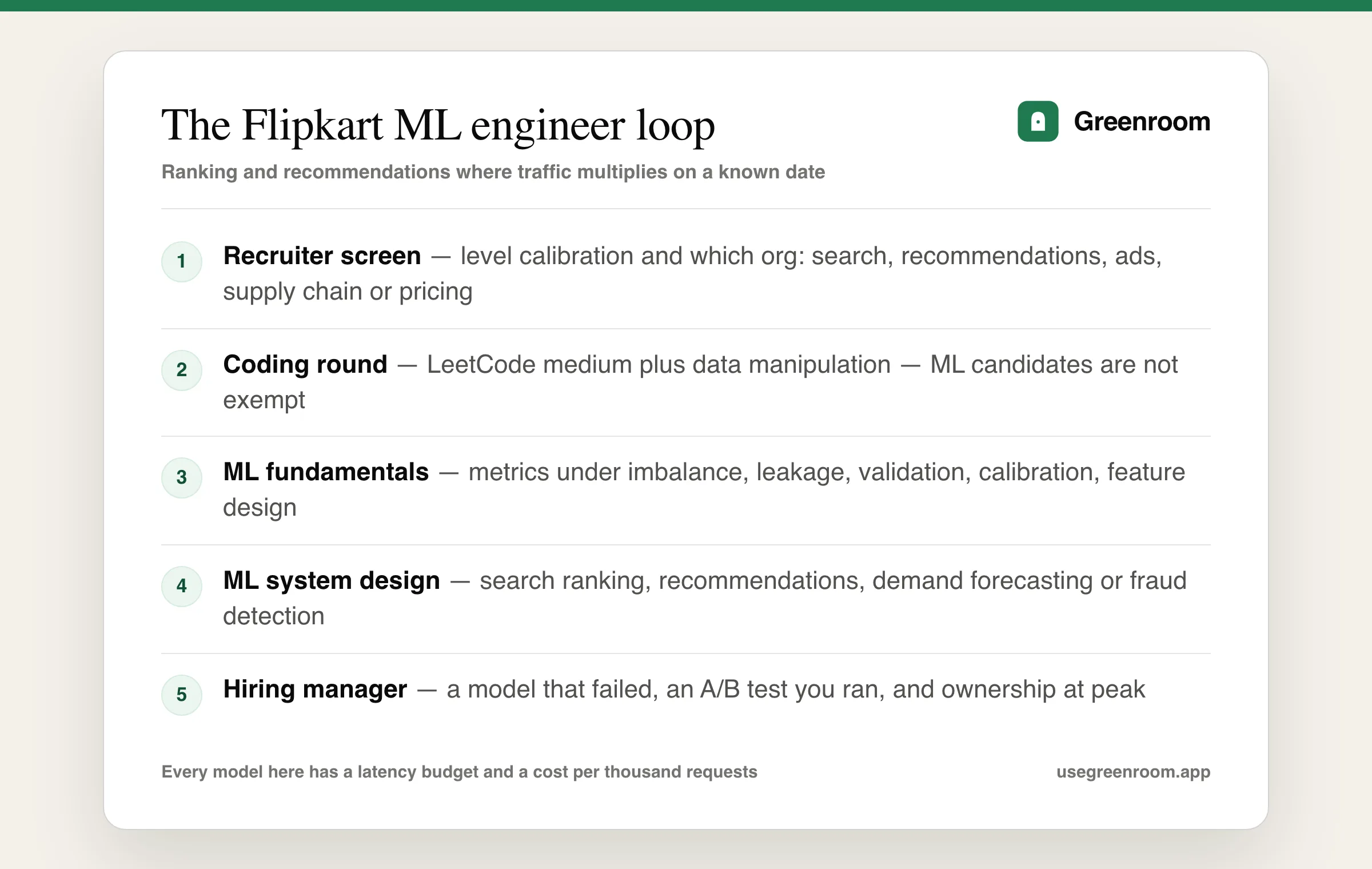
- Recruiter screen — level calibration and org: search, recommendations, ads, supply chain, pricing or fraud.
- Coding round — LeetCode medium plus data manipulation. ML candidates get a real coding bar here.
- ML fundamentals round — metrics, validation, leakage, calibration, feature design, and depth on whatever is on your resume.
- ML system design round — search ranking, recommendations, demand forecasting or fraud detection.
- Hiring manager round — a model that failed, an experiment you ran, and ownership during peak.
Our Flipkart interview questions guide covers the company-wide process and the Flipkart data engineer guide covers the pipelines feeding these models.
The coding round
Standard medium: arrays and hashing, heaps and top-K, graphs, intervals, sliding window, plus data-flavoured problems like deduplication, streaming aggregation or sampling. You may also be asked to write pandas or SQL for a data manipulation task.
State complexity aloud, and expect a scaling follow-up on each — what if this is a stream, what if it does not fit in memory. Our DSA coding interview preparation guide covers the list and pandas interview questions covers the data manipulation half.
ML fundamentals
Questions go one layer below the textbook answer:
- Metrics under imbalance. Conversion and fraud rates are low single digits or lower, so accuracy is meaningless. Know when precision-recall beats ROC-AUC, and how you choose a threshold when a false positive and a false negative cost different amounts — for fraud, in rupees.
- Leakage. Target leakage, temporal leakage, and leakage through a transformation fitted before the split. Expect a scenario question where a model performs suspiciously well.
- Validation. Why a random split is wrong for time series and for grouped data such as multiple events per user.
- Calibration. A ranking model that outputs meaningless probabilities breaks anything downstream that multiplies by them, such as expected revenue ranking or a bid.
- Feature design. How you build features from user behaviour, and how you avoid features unavailable at serving time — which is the leakage question in production clothing.
- Cold start. New products and new users, which in a marketplace with constant catalogue churn is a permanent condition rather than an edge case.
- Depth on your resume. Whatever you claim, expect three follow-ups. Do not list a technique you cannot derive at a high level.
Our machine learning engineer interview questions guide covers the role-general bank and data scientist interview questions covers the statistics.
ML system design, with serving constraints
Search ranking. The most likely prompt. The expected structure: query understanding and intent, retrieval of candidates from the catalogue, then multi-stage ranking — a cheap ranker over thousands, an expensive one over the top few hundred. State the latency budget for each stage. Cover the relevance-versus-business-objective tension explicitly, since Flipkart ranks for relevance, margin, availability and delivery speed at once, and those conflict.
Recommendations. Homepage, product page and cart recommendations are different problems with different candidate pools and different latency budgets. Cover embeddings for users and items, approximate nearest neighbour retrieval, cold start for both sides, and how you keep recommendations fresh when the catalogue changes hourly.
Demand forecasting. For inventory and supply chain. The interesting part is the spike: Big Billion Days breaks any model trained on ordinary demand, so discuss event features, handling known future events rather than treating them as anomalies, and forecasting at the right granularity — a product in a region, not a product globally.
Fraud detection. Extreme class imbalance, adversarial drift as fraudsters adapt, delayed labels because a chargeback arrives weeks later, and a threshold set by the rupee cost of each error type. Also the human loop: what gets auto-blocked versus queued for review.
Cross-cutting, and repeatedly probed:
- Latency budget per stage, stated in milliseconds and treated as a hard constraint.
- Cost per thousand requests. Model size, hardware, and whether the accuracy gain is worth it. Volunteering this is a strong signal.
- Training-serving skew, and the mechanism preventing it. Our MLOps interview questions guide covers the feature store answer.
- Traffic spikes on a known date. Unlike most products, you know the peak is coming, so pre-warming caches, precomputing recommendations and shedding non-essential model calls are all legitimate answers.
- A/B testing. What you randomise, the metric you ship on, how long you run it, and network effects in a marketplace where sellers and buyers interact.
- Fallback. What ranks the page when the model is unavailable — a simpler model or a heuristic. Naming this unprompted lands well.
The hiring manager round
Expect: a model that failed in production and what you changed structurally, an A/B test you ran including one that came out negative, a disagreement about which metric to optimise, and how you operated during a peak event.
The negative-experiment story is the strongest thing you can bring, because it proves you shipped and measured rather than only trained. Our behavioral interview questions guide covers the structure.
Where each prep option actually helps
- Designing Machine Learning Systems by Chip Huyen — the best single preparation for the design round, especially on skew and serving.
- LeetCode — mediums, because the coding round is real.
- Public writing on multi-stage ranking — retrieval then ranking is the backbone of every prompt in this loop.
- Any A/B testing reference — knowing what you randomise, how long you run, and what a network effect does is worth an afternoon.
- ChatGPT — good for generating design prompts and critiquing a written architecture. It will not ask how many milliseconds you have.
- Greenroom — the spoken layer. Ari, the AI interviewer runs the ML design round out loud and asks the latency and leakage follow-ups. Honest tradeoff: Ari will not review your training code, so pair it with real projects.
Interviewing across comparable loops? The Google ML engineer guide covers a broader fundamentals round, the Meta ML engineer guide covers ranking at feed scale, and the Amazon ML engineer guide covers the leadership-principle overlay.
Comparing India ML loops? Our Swiggy ML engineer interview questions guide covers a logistics-shaped problem space with very different error costs.
Frequently asked questions
What is the Flipkart ML engineer interview process?
Candidates report a recruiter screen for level and org calibration across search, recommendations, ads, supply chain or pricing, a coding round at LeetCode medium that also tests data manipulation, an ML fundamentals round covering metrics, leakage, validation and calibration plus depth on your resume, an ML system design round on ranking, recommendations or forecasting, and a hiring manager round about a model that failed and experiments you ran.
What ML system design questions does Flipkart ask?
The most common prompts are search ranking, recommendations for different surfaces, demand forecasting for inventory, and fraud detection. Strong answers set an explicit latency budget per stage, use multi-stage retrieval and ranking with a cheap ranker over thousands and an expensive one over hundreds, address the conflict between relevance and business objectives such as margin and delivery speed, cover cold start in a catalogue that churns constantly, and include a fallback for when the model is unavailable.
Does Flipkart ask ML engineers coding questions?
Yes. ML candidates face a real coding round at LeetCode medium covering arrays and hashing, heaps and top-K, graphs, intervals and sliding window, often with data-flavoured problems such as deduplication, streaming aggregation or sampling, and sometimes a pandas or SQL data manipulation task. State complexity aloud and be ready for a scaling follow-up on each problem.
How do you handle traffic spikes like Big Billion Days in an ML design answer?
Treat the spike as a known future event rather than an anomaly, which is unusual and worth saying explicitly. For forecasting, add event features and model the known date rather than letting the model treat it as an outlier. For serving, pre-warm caches, precompute recommendations ahead of the event, degrade gracefully by shedding non-essential model calls, and have a simpler fallback ranker so the page still works if the primary model is saturated.
What ML fundamentals does Flipkart probe?
Metrics under extreme class imbalance and threshold selection when false positives and false negatives have different rupee costs, every form of leakage including features unavailable at serving time, why random splits are wrong for time series and grouped data, calibration and why a well-ranking but poorly calibrated model breaks anything that multiplies by its probability, feature design from user behaviour, and cold start for new users and products. Expect three follow-ups on anything listed on your resume.
What does the Flipkart ML hiring manager round ask?
Expect a model that failed in production and the structural change you made afterwards, an A/B test you ran including one that came out negative, a disagreement about which metric the team should optimise, and how you operated during a peak sale event. The negative-experiment story is the strongest thing to bring, because it demonstrates that you shipped and measured rather than only trained models offline.