"Design a system that ranks the feed." The candidate started drawing a transformer. Twelve layers in, the interviewer asked, mildly, how many candidate posts the model would score per request. About two million, the candidate said, doing the arithmetic in real time and watching his own architecture catch fire. The budget was fifty milliseconds.
That single question — how many things are you scoring, and how long do you have — is the spine of Meta ML engineer interview questions. Meta's ML work is ranking and retrieval at a scale where the interesting constraint is almost never model quality; it is how you get from millions of candidates to a few hundred cheaply enough to afford a good model on the survivors. I built Greenroom after freezing in an interview I had studied hard for, so this guide covers what Meta asks ML engineers and how to reason through it aloud.
The Meta ML engineer interview process in 2026
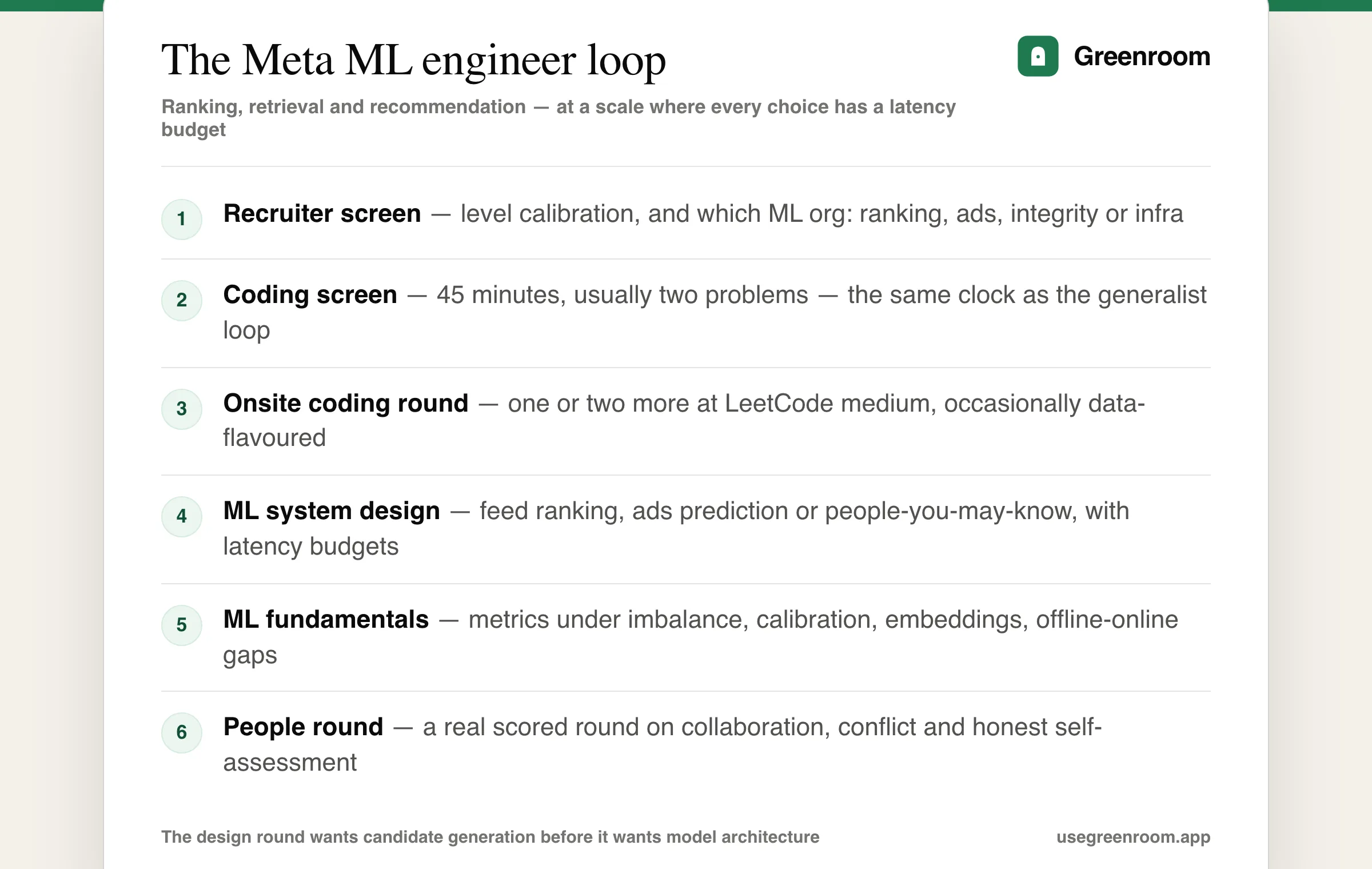
- Recruiter screen — level calibration and which ML org: feed and ranking, ads, integrity, or ML infrastructure. The emphasis differs meaningfully.
- Coding screen — 45 minutes, usually two coding problems, same format as every other Meta loop.
- Onsite (virtual) — one or two coding rounds, an ML system design round, an ML fundamentals round, and the behavioral people round.
- Hiring committee — a written packet reviewed by people who never met you.
- Team matching — separate from the hiring decision.
Our Meta interview preparation guide covers the company-wide loop and the Meta backend engineer guide covers the serving infrastructure these models sit on.
The coding rounds keep the same clock
Two problems in 45 minutes, in an editor that usually does not run your code. Mostly LeetCode medium: graphs, heaps, intervals, hash-map counting, binary search. ML candidates are not given an easier set.
Pace deliberately: two minutes clarifying, three stating approach and complexity, twelve to fifteen coding, two tracing an example. If problem one is running long, say so and move. Our DSA coding interview preparation guide covers the list and common coding interview mistakes covers how this round is lost.
ML system design: retrieval before ranking
Meta's design prompts are almost always recommendation-shaped: rank the news feed, predict ad click-through, build people-you-may-know, detect harmful content, rank comments. The expected structure:
- Numbers first. Candidates per request, latency budget, requests per second, and how stale a feature may be. Without these the design cannot be evaluated.
- Two-stage or three-stage architecture. Retrieval narrows millions to thousands cheaply — usually approximate nearest neighbour over embeddings, or simple heuristics. Then a light ranker, then a heavy ranker on the top few hundred. Say the cost per stage.
- Embeddings. How users and items are embedded, how the embeddings are trained, how often they are refreshed, and the cold-start problem for both new users and new items.
- Multi-objective ranking. Feed ranking optimises several things at once — engagement, time spent, integrity, diversity — and they conflict. Describe how you combine them and who decides the weights. This is a distinctly Meta question and it lands well.
- Labels and delayed feedback. A click is immediate, a conversion is not, and a "regret" signal may arrive days later. Say how you train with delayed labels.
- Position and presentation bias. The top item gets clicked because it is at the top. Meta cares about this; mention inverse propensity weighting or randomised exploration slots.
- Feature freshness and training-serving skew. Real-time counters versus batch features, and the mechanism that keeps training and serving computing the same thing.
- Evaluation. Offline metrics such as NDCG or AUC, the online metric you actually ship on, the gap between them, and A/B test design including network effects, which are unavoidable on a social graph.
- Integrity and failure. What the ranker does when the model is down, and what the guardrails are for harmful content.
The Meta ML engineer prep page has a round-by-round checklist, and our system design interview guide covers the shared vocabulary.
ML fundamentals Meta probes
- Metrics under extreme imbalance. Click-through rates are low single-digit percentages; accuracy is meaningless and you should say why in one sentence.
- Calibration. Ads ranking needs a probability that means something, because it is multiplied by a bid. A model that ranks correctly but is badly calibrated breaks the auction. This is one of the most reliable Meta follow-ups.
- Embeddings and similarity. What a learned embedding actually encodes, how approximate nearest neighbour indexes trade recall for latency, and how you would evaluate retrieval separately from ranking.
- Overfitting at scale. With billions of examples the failure mode changes; talk about feature leakage and distribution shift rather than classic overfitting.
- Loss functions for ranking. Pointwise, pairwise and listwise, and when the extra complexity is worth it.
- Counterfactual evaluation. You only observe outcomes for what you showed. Meta asks this more than most companies.
Our deep learning interview questions and NLP interview questions guides cover the model side, and machine learning engineer interview questions covers the role-general bank.
The people round
Meta's behavioral round is genuinely scored and frequently breaks ties. It covers collaboration, conflict, ambiguity and honest self-assessment.
For ML candidates specifically, have a story about a model that did not work in production and what you learned, and one about a disagreement over a metric. Those two land more often than any generic teamwork story. Rehearse each out loud to two follow-ups deep. Our behavioral interview questions guide covers the structure.
Kaggle, Chip Huyen, ChatGPT — where each fits
- LeetCode — Meta-tagged mediums, in pairs, on a 45-minute clock.
- Designing Machine Learning Systems by Chip Huyen — the best single preparation for the design round's vocabulary.
- Meta's research and engineering blogs — their published writing on embedding-based retrieval and on feed ranking describes exactly the systems the design round abstracts.
- Kaggle — builds modelling reflexes and actively harms production judgment. In this round, retrieval and latency beat model choice every time.
- ChatGPT — good for generating design prompts and critiquing an architecture you have written down. It will not ask how many candidates you are scoring, at the moment the answer is two million.
- Greenroom — the spoken layer. Ari, the AI interviewer runs the design round out loud, asks the latency and calibration follow-ups, and scores structure and clarity. Honest tradeoff: Ari will not review your training code, so pair it with real projects.
How to prepare for the Meta ML engineer interview
- Week 1 — Meta-tagged LeetCode mediums in pairs under a 45-minute clock.
- Week 2 — the fundamentals set as ninety-second spoken answers: imbalance metrics, calibration, embeddings and ANN tradeoffs, delayed labels, position bias, counterfactual evaluation.
- Week 3 — design feed ranking, ad click-through prediction and people-you-may-know out loud. Numbers, retrieval, ranking, labels, evaluation, monitoring — in that order.
- Final week — five people-round stories including one failed model, rehearsed to two follow-ups deep, two full spoken mocks, and the role-specific prep page the night before.
Interviewing across comparable loops? The Google ML engineer guide covers a broader fundamentals round, the Amazon ML engineer guide covers the leadership-principle overlay, and the Meta data engineer guide covers the pipelines feeding these models.
Frequently asked questions
What is the Meta ML engineer interview process?
Candidates report a recruiter screen, a 45-minute coding screen that usually contains two problems, and a virtual onsite of one or two coding rounds, an ML system design round, an ML fundamentals round and the behavioral people round. A hiring committee reviews the written packet afterwards, and team matching happens separately from the hiring decision.
What ML system design questions does Meta ask?
Almost all of them are recommendation-shaped: rank the news feed, predict ad click-through, build people-you-may-know, detect harmful content, or rank comments. Strong answers start with candidates per request and the latency budget, then describe multi-stage retrieval and ranking with a cost per stage, embeddings and cold start, multi-objective ranking where engagement and integrity conflict, delayed labels, position bias, feature freshness, and A/B design that accounts for network effects on a social graph.
Why does Meta ask about model calibration?
Because ads ranking multiplies a predicted probability by a bid, so a model that ranks items in the right order but outputs probabilities that are systematically too high or too low breaks the auction economics even though its AUC looks fine. The expected answer covers what calibration means, how you would measure it with a reliability curve, and how you would fix it with a post-hoc method such as isotonic or Platt scaling.
Does Meta ask ML engineers coding questions?
Yes, and in the same format as every other Meta loop — roughly two problems in 45 minutes, mostly LeetCode medium, in an editor that typically does not execute your code. ML candidates are not given a reduced algorithm bar, so pacing practice matters as much as it does for a generalist candidate.
What is the people round at Meta for ML candidates?
It is Meta's scored behavioral round on collaboration, conflict, ambiguity and honest self-assessment, and it often breaks ties. For ML candidates the two highest-yield stories are a model that failed in production and what you changed as a result, and a disagreement about which metric the team should optimise, both rehearsed out loud to two follow-ups deep.
How do you answer design the news feed ranking system?
Ask for numbers first — how many candidate items per request and what the latency budget is — then propose multi-stage architecture: cheap retrieval from millions to thousands using embeddings or heuristics, a light ranker, then an expensive ranker on the top few hundred. Cover how labels are collected including delayed feedback, position bias correction, multi-objective weighting across engagement and integrity, feature freshness and training-serving skew, offline versus online evaluation, and what the feed shows if the ranker is unavailable.