Four rounds in, he could not have told you what any of them had been for.
There had been a twenty-minute call with a recruiter that felt like admin. A coding test on a platform that timed him. A session where an engineer watched him debug something and kept saying "what are you thinking?" A conversation with a manager that felt like a chat and turned out not to be. He had prepared, genuinely hard, for about six weeks — and he had prepared the same way for all four.
Which is the mistake, and almost nobody names it. A hiring process is not one interview repeated. It is a sequence of rounds whose scoring functions actively contradict each other. The online assessment rewards heads-down silent output; the pairing round treats silence as the primary failure. The recruiter screen rewards brevity; the hiring manager round punishes it. Prepare "for interviews" in general and you arrive averagely wrong at every stage.
Here is what each one is actually measuring.
The whole loop, stage by stage
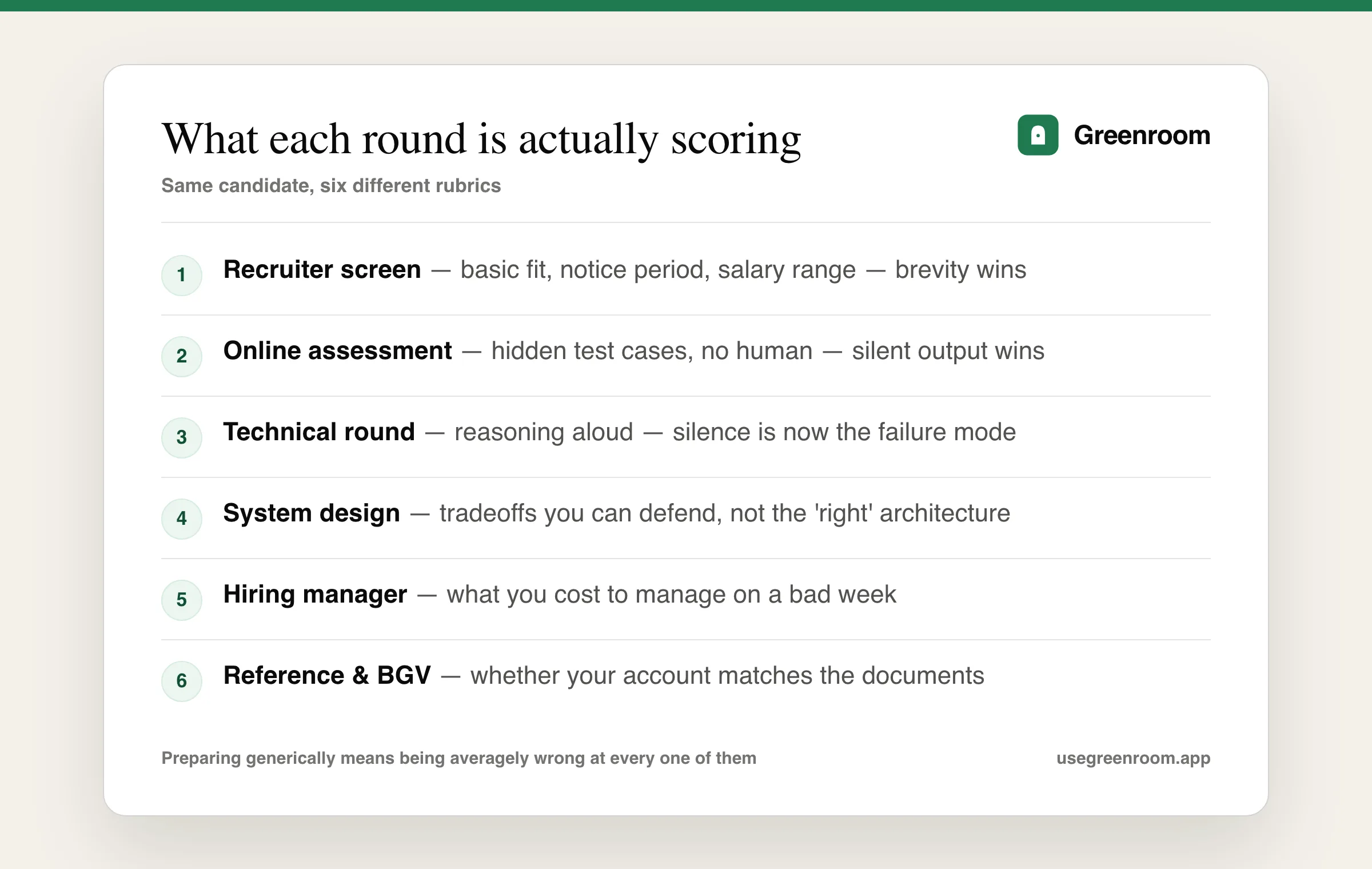
Shapes vary by company and role — a startup may run three rounds, a large product company seven, and campus hiring compresses several into one day. The order below is the common one, and what matters is the scoring function of each, not its position.
1. The recruiter screen
What it looks like: 15–30 minutes, phone or video, usually not technical.
What it actually scores: whether you are worth the engineering time. Concretely — do you match the role's level, what is your notice period, what is your salary range, and can you describe your own work clearly in two minutes.
What people get wrong: treating it as a formality, and answering at technical-round length. A recruiter asking "tell me about your current role" wants ninety seconds, not eight minutes of architecture. Our bad phone screen cost guide covers what a weak screen actually costs you, and what are your salary expectations covers the question that decides most of this call.
Brevity is the scoring function here. It is the only round where that is true.
2. The online assessment
What it looks like: a timed, auto-graded coding test, often proctored, sent as a link with a few days to complete.
What it actually scores: hidden test cases. There is no human in the loop, which means your reasoning, your comments and your approach are worth precisely nothing. Edge cases are worth everything.
What people get wrong: writing elegant solutions that fail on empty input. Partial credit is per test case, never per idea. Our online coding assessments guide has the boundary checklist that is the actual margin here.
This is the round most people are rejected at, particularly in Indian campus hiring, where a cohort of thousands is cut to a shortlist in one automated pass.
3. The technical round
What it looks like: 45–90 minutes with an engineer. Depending on the company this is a live coding interview, a pair programming session, or a longer machine coding round.
What it actually scores: how you reason, out loud, while uncertain — and in the pairing variant, how cheaply someone can steer you. The code matters; it is not the differentiator between two candidates who both finish.
What people get wrong: carrying assessment habits into it. Going quiet, refusing hints, defending a wrong approach. The behaviour that scored in round two is the one that fails you in round three, and nobody warns you about the switch.
4. The system design round
What it looks like: 45–60 minutes, usually for mid-level and above, sometimes a frontend variant.
What it actually scores: whether you can name tradeoffs and defend a choice — not whether you produce a canonical architecture. Our system design interviews: what they test guide covers the distinction properly.
What people get wrong: reciting a memorised diagram. Interviewers push on choices specifically to see whether you understand what you drew or are reproducing a YouTube video.
5. The hiring manager round
What it looks like: 45 minutes, deliberately conversational, often framed as "an informal chat."
What it actually scores: what you cost to manage. By this point capability is largely settled; the manager is forecasting whether you reduce their workload, whether you want this specific role, and how you behave when things go badly.
What people get wrong: reading "informal" as low-stakes. This is frequently the round where the decision is actually made. Our hiring manager round guide covers the six things being scored, and culture fit interview questions covers the values round it is often paired with.
6. The final round, and then the checks
The final round is often a skip-level or cross-functional conversation, and it usually confirms rather than decides.
After that the process stops being about you performing and starts being about documents. A reference check is a confirmation call hunting for contradiction, not a poll on whether people liked you. Background verification checks dates, title and education against records — and in India this is close to universal and matters more than the reference call.
The failure mode at this stage is inconsistency, not weakness. Titles and dates that do not match what you claimed cause more offers to stall than bad references do.
How long all of this takes
Honestly: it varies enormously and anyone quoting you a single number is guessing. Startups can run the whole loop in a week; large companies commonly take four to eight weeks between first contact and an offer letter, with the gap between rounds usually caused by interviewer scheduling rather than by any decision about you.
Two practical consequences. Start more processes in parallel than feels comfortable, because sequencing them costs months. And silence is usually logistics — our how to follow up after no response guide covers the follow-up that is worth sending and the ones that are not.
Where the usual advice comes up short
"The hiring process explained" articles. Nearly all of them are written from the company's side — requisition, sourcing, screening, offer. Accurate and useless to you, because it describes the workflow rather than the rubric.
LeetCode and question banks. Genuinely necessary for stages two and three, and irrelevant to four, five and six. Many strong engineers prepare exclusively for the rounds they are already good at.
Company-specific "interview experience" posts. Useful for the shape of a particular loop. Treat process details as varying by role, team and campus rather than as fixed — they change more often than the posts do.
Generic ChatGPT prompting. Good for drafting answers and drilling problems. It cannot tell you that you went quiet for four minutes, or that your answer was three times too long for a recruiter screen — the two most common stage-specific failures.
Greenroom. Straight about the boundary: Greenroom does not run coding assessments, so stage two is not its job. It covers the spoken rounds — three, four and five — where the score comes from what you say while uncertain and how you handle a follow-up. Ari, the AI interviewer asks the question, then asks the one after it. Honest tradeoff: for the auto-graded stage, timed practice on a real judge beats any conversation.
The one-line version
Work out which round you are in before you prepare for it: brevity wins the recruiter screen, hidden test cases win the assessment, thinking aloud wins the technical round, defensible tradeoffs win system design, and being cheap to manage wins the hiring manager round — because the same answer is strong in one of those rooms and disqualifying in another.
Frequently asked questions
What are the stages of a software engineering interview process?
A common loop runs: a recruiter screen of 15 to 30 minutes checking level, notice period and salary range; an online assessment that is timed and automatically graded; a technical round with an engineer, either live coding, pair programming or a longer machine coding round; a system design round for mid-level and above; a hiring manager conversation; and finally reference checks and background verification. Shapes vary considerably — startups may run three rounds and large product companies seven, while campus hiring compresses several into a single day.
How long does the interview process usually take?
It varies enough that any single figure is a guess. Startups sometimes complete a loop within a week, while larger companies commonly take four to eight weeks from first contact to an offer letter. Most of the delay between rounds comes from interviewer scheduling rather than from deliberation about you. The practical implication is to run more processes in parallel than feels comfortable, because sequencing them one at a time can add months to a search.
Which interview round do most candidates get rejected at?
The online assessment removes the largest number of people, particularly in Indian campus hiring where a cohort of several thousand can be cut to a shortlist in a single automated pass. It is also the round with the least feedback, since no human reviews it. Among the later rounds, the hiring manager conversation is where decisions most often turn, because capability has usually been established by then and the assessment shifts to what you are like to work with.
Why do I pass technical rounds but fail the hiring manager round?
Because they measure different things and preparation for one does not transfer. Technical rounds assess reasoning and problem-solving; the hiring manager is forecasting what you cost to manage — whether you reduce their team's workload, whether you want that specific role rather than any role, and how you describe past failures. Common causes of failing it include generic enthusiasm, past-failure stories where the fault always lies elsewhere, and treating a deliberately friendly conversation as a formality.
Should I prepare differently for each interview round?
Yes, because several rounds score contradictory behaviours. An online assessment rewards silent heads-down output against hidden test cases, whereas a pair programming round treats silence as the main failure and rewards stating intent and taking hints. A recruiter screen rewards ninety-second answers, while a hiring manager round rewards specificity and depth. Preparing generically produces answers that are averagely wrong everywhere, so the first step is identifying which round you are actually in.
What happens after the final interview round?
The process shifts from assessment to verification. A reference check is typically a short call in which a hiring manager or recruiter speaks to someone who managed you, looking for anything that contradicts what you said rather than for praise. Background verification checks employment dates, job title and education against records, and in India it is close to universal and generally carries more weight than the reference call. The common failure at this stage is inconsistency between your account and your documents, not a poor reference.