He prepared for the final round the way he had prepared for the previous three: more problems, more system design, more revision. Then he spent an hour with a director who asked him almost nothing technical, and instead asked what he wanted to be doing in three years, what he would change about his current team, and why this company rather than the two others he had mentioned. He answered all three vaguely, because those were the questions he had not practised, and he was rejected by a panel that had already agreed he could do the job.
Here is what nobody tells you: the final round is not a harder version of the earlier rounds. It is a different assessment. By the time you reach it, the technical question has largely been answered — that is why you are still here. What is open now is risk, judgment, fit and whether you would actually say yes.
Preparing more technical depth for this round is not wrong, exactly. It is just aimed at the question they have already stopped asking.
The four shifts
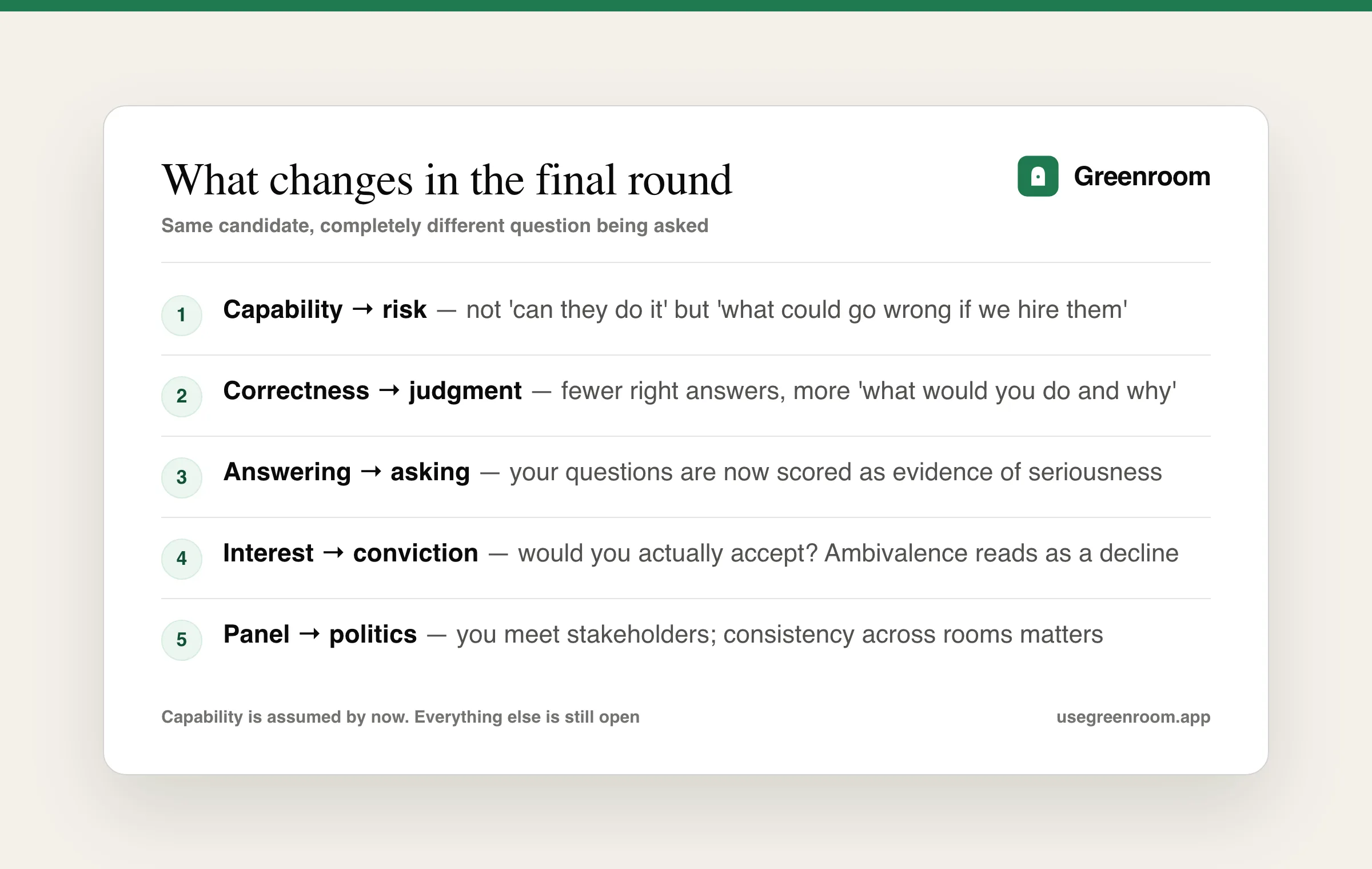
Capability becomes risk. Earlier rounds ask "can this person do the job?" The final round asks "what could go wrong if we hire them?" Will they leave in eight months, clash with the team, need more support than we have, or turn out to be a different person from the one in round two? Every question is a version of that.
Correctness becomes judgment. Fewer questions with right answers, more that begin "what would you do if…". They want your reasoning and your priorities, not a solution.
Answering becomes asking. Your questions are now genuine assessment data. A candidate at final round who asks nothing specific reads as someone who has stopped evaluating — and therefore either desperate or disengaged.
Interest becomes conviction. This is the one people miss. Late-stage panels are also deciding whether to *spend an offer* on you, and a candidate who seems ambivalent is a risk of a wasted offer. Warmth is not manipulation here; it is information they legitimately need.
Who you are meeting, and what each one is checking
- The hiring manager, often again. Checking working style, how you take feedback, and whether they want you in their team every day. Their veto is the strongest in the room.
- A skip-level or director. Checking judgment, ambition and communication one level up. Usually not technical, and usually underestimated by candidates.
- A cross-functional stakeholder — product, design, data, another engineering team. Checking whether you can be worked *with*. Our how to explain your project in an interview guide covers the jargon-free explanation this round wants.
- A peer. Checking whether they would want you on their standup. Peers are also the most likely to be honest with you, so ask them the real questions.
- A bar raiser or values interviewer at companies that run one. Our Amazon engineering manager guide covers that format in depth.
What to actually prepare
Five stories, tightened. By final round your stories should be sharp, numbered and rehearsed to two follow-ups. Cover: something you owned end to end, a conflict you resolved, a failure and what changed structurally, a time you influenced without authority, and something you shipped that mattered. Our behavioral STAR answers for senior engineers guide covers the structure.
A three-sentence answer to "why us". Specific to this company and this team, referencing something you learned during the process itself — "the thing that convinced me was what Priya said about rebuilding the platform team." That sentence is worth more than any research, because it proves you were listening.
Your questions, tiered by who you are meeting. Do not ask the director about the tech stack or the peer about strategy. Three or four questions per person, at their altitude. Our questions to ask at the end of an interview guide has options that are not "what's the culture like".
Your numbers. Expected compensation as a fixed figure, notice period, earliest start. Final rounds frequently end with a recruiter conversation, and hesitating here reads as unserious. Our what are your salary expectations guide covers the wording.
Consistency. Panels compare notes, and contradictions across rooms are noticed far more than candidates expect. If you told round two you left for scope, do not tell round five it was compensation.
The questions that decide it
- "Why are you looking to leave?" — asked again, deliberately, to check consistency. Same answer, forward-looking.
- "What are you looking for in your next role?" — checking fit against what this role actually is. Answer honestly; a mismatch discovered now is better than one discovered in month three.
- "What would you want to change about how your current team works?" — a judgment and diplomacy test at once. Be specific and non-bitter.
- "Where do you see yourself in three years?" — checking retention risk. Something that is plausibly achievable *here* beats ambition that obviously is not.
- "Do you have any concerns about the role?" — the trap that is not a trap. Naming one real, mild concern and asking about it reads as maturity; "no, none at all" reads as either passive or dishonest.
- "What other processes are you in?" — timeline and competition. Our do you have any other offers guide covers all four honest positions.
Closing it
The last two minutes with the hiring manager are worth preparing as carefully as anything else.
State your position plainly: *"I want to be direct — this is the role I want. The platform ownership is exactly what I'm looking for, and I've liked everyone I've met. Is there anything about my background that gives you hesitation?"*
That last question is the single most useful thing you can ask in a final round. It surfaces the objection while you are still in the room and able to answer it, rather than after it has been written into a debrief you never see. Most candidates never ask it, and the ones who do occasionally save an offer with a two-sentence clarification.
Then send a short note the same day — three lines, one specific thing from the conversation, restating interest. Our thank you email after an interview guide covers it.
Practical notes
- Rest. A final round after four previous rounds is a fatigue problem as much as a preparation problem. Our how to survive a full-day onsite guide covers stamina across a long loop.
- Re-read your own earlier answers if you noted them. You will be asked about at least one thing you said in round two.
- Do not learn anything new in the last 48 hours. Nothing you cram now will be retrievable, and the anxiety of half-learning it will be.
- Know the timeline. Ask when a decision is expected, so your follow-up has a date rather than a guess. Our signs an interview went well or badly guide covers reading the aftermath.
Where each option actually helps
- Your own notes from earlier rounds — the highest-yield preparation available, because the final round is largely built on them.
- The people you already met — LinkedIn them before you meet them again. Knowing someone's background changes the questions you ask them.
- Glassdoor and AmbitionBox — for the shape of a company's final round, though treat individual accounts as anecdotes.
- ChatGPT — good for generating judgment-style questions from the job description. Its limit is the same as always: this round is spoken, and typing an answer trains nothing.
- Greenroom — the spoken layer. Ari, the AI interviewer pushes the second and third follow-up on your stories, which is the depth a final-round panel actually probes to. Honest tradeoff: Ari does not know this company's panel — the recruiter will tell you who you are meeting if you ask.
Frequently asked questions
How is a final round interview different from earlier rounds?
It stops testing whether you can do the job and starts testing risk, judgment and conviction. By the final round your technical capability is largely assumed — it is why you are still in the process — so the open questions become what could go wrong if we hire this person, how do they reason when there is no right answer, can people work with them, and would they actually accept an offer. Preparing a harder version of round two aims at a question they have stopped asking.
What questions are asked in a final round interview?
Recurring ones include why you are looking to leave, asked again deliberately to check consistency against your earlier answers; what you are looking for in your next role, checking fit; what you would change about how your current team works, which tests judgment and diplomacy simultaneously; where you see yourself in three years, checking retention risk; whether you have any concerns about the role; and what other processes you are in.
Who do you meet in a final round?
Typically the hiring manager again, checking working style and whether they want you on the team daily, with the strongest veto in the room. Often a skip-level or director assessing judgment and communication one level up, usually non-technically. Frequently a cross-functional stakeholder from product, design or another team checking whether you can be worked with, and a peer deciding whether they want you on their standup. Some companies also run a dedicated values or bar raiser round.
How do you close a final round interview?
State your position plainly rather than hinting — say directly that this is the role you want and why, then ask whether there is anything about your background that gives them hesitation. That question is the most useful thing you can ask in a final round, because it surfaces the objection while you are still in the room to answer it rather than after it has been written into a debrief you will never see. Follow with a short note the same day referencing one specific thing from the conversation.
Should you say you have other offers in a final round?
Answer honestly with your real timeline, because the question is usually about scheduling rather than leverage. If you have an offer with a deadline, say so and state plainly that you would prefer this role — that combination is honest, gives them a real constraint to work with, and tells them you are winnable. Inventing a competing offer fails immediately, because the next question is always about the deadline.
What should you do in the 48 hours before a final round?
Tighten five stories to two follow-ups deep, prepare a three-sentence answer to why this company that references something you learned during the process itself, write questions tiered to each person you are meeting, and fix your numbers for compensation, notice period and start date. Then stop — do not learn anything new, because nothing crammed in the last two days will be retrievable and the anxiety of half-learning it will be. Rest matters more than revision by this stage.
Once the round itself is over, the waiting starts — and it can go quiet for longer than feels normal. See our what to do when you're ghosted after the final round guide for how long to wait and the exact follow-up that gets an answer.