The invite said *"Culture Fit — 30 mins"*, which is a genuinely alarming thing to receive when you have spent three weeks preparing graph traversals. There is no syllabus. There is no rubric anyone will show you. There is a strong implication that you are about to be assessed on who you fundamentally are as a human being, over a video call, by someone who joined the company eight months ago.
She spent the evening trying to work out what a company culture even is, decided it was probably about being enthusiastic, and arrived the next morning determined to be extremely enthusiastic. Thirty minutes later she had described herself as a people person twice, agreed with everything, and volunteered that she loved a fast-paced environment — a phrase which at that point had no meaning left in it whatsoever.
The rejection said "not a culture fit", which is the single least actionable sentence in professional life.
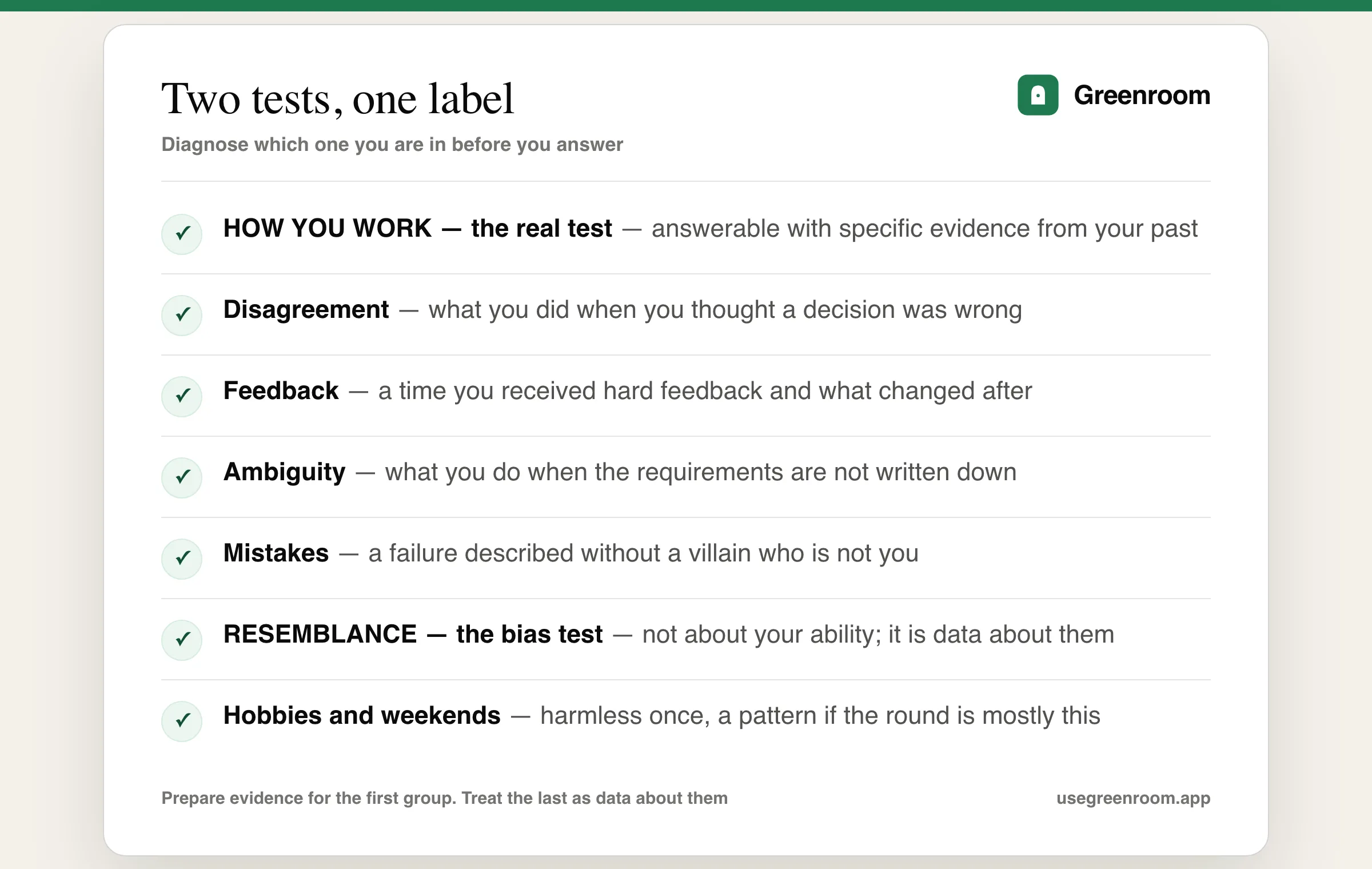
Here is the thing nobody tells you, and it is the only useful frame I know: "culture fit" is not one round. It is one label sitting on top of two completely different tests. One of them is real, specific and entirely preparable. The other is not about you at all. Almost all the confusion — and most of the bad advice — comes from treating them as the same thing.
Test A: how you actually work
This is the legitimate version, and it is the majority of what good companies are doing in this round. It is not asking whether you are a nice person. It is asking a much narrower and more answerable question: when the work gets difficult, what do you do?
Specifically, four things:
- Disagreement. What you did the last time you thought a decision was wrong. Not whether you disagree — everyone disagrees — but the mechanics of how. Did you raise it, to whom, with what, and what did you do once the decision went the other way anyway?
- Feedback. A time you got hard feedback and what measurably changed afterwards. The second half is the answer; almost everyone gives only the first half.
- Ambiguity. What you do when the requirements do not exist. Some teams want you to ask; some want you to make a call and flag it. Both are legitimate cultures. Saying which you did, and why, is the point.
- Mistakes. A real failure, narrated without a villain who is not you. Our behavioral interview questions and answers guide covers building these stories, and tell me about a conflict with a coworker covers the hardest of them.
Every one of these is answerable with evidence. Which means the premise that you cannot prepare for a culture fit interview is simply false — you cannot prepare a personality, but you can absolutely prepare four specific stories about how you behave under conditions that are not ideal.
Test B: whether you resemble the interviewer
This is the version the term deserves its bad reputation for, and pretending it does not exist would be dishonest.
"Culture fit" has a well-documented tendency to collapse into similarity — hiring people who went to similar places, talk in similar ways, and would be pleasant to have a drink with. Research on hiring bias has covered this extensively, and it is precisely why many companies have deliberately renamed the round "culture add" or "values alignment", and why some have replaced the open-ended chat with a structured rubric. That rename is not corporate cosmetics; it is a real attempt to fix a real defect.
You can usually tell within about ten minutes which test you are in. If the questions are about how you handled specific situations, you are in Test A. If twenty-five of the thirty minutes are about your hobbies, your weekend, and where you grew up, you are in Test B.
What to do in each
In Test A, be specific and be willing to be unflattering. The candidate who says "I handle feedback well" scores nothing. The candidate who says "my tech lead told me my code reviews were slowing the team down, I was defensive about it for about a day, then I started time-boxing reviews to 20 minutes and the complaints stopped" has answered the actual question. Concreteness is the entire game, and mild self-criticism reads as confidence rather than weakness.
In Test B, answer warmly and briefly, then take control of the remaining time by asking real questions. This is not a lost round — you can absolutely pass a resemblance test by being personable. It is that you should be simultaneously gathering data, because a team that assesses candidates mostly on rapport will also *manage* mostly on rapport, and that has consequences for how work gets allocated after you join.
The questions worth asking back
The culture round is the one place where your questions are genuinely diagnostic, because you are asking about culture in a round explicitly about culture and nobody can deflect:
- "How does this team handle disagreement about a technical decision?" Ask for a recent example. Hesitation is itself an answer.
- "What happened the last time a project slipped?" You are listening for whether the story has a blamed individual in it.
- "How is feedback usually given here?" If the answer is "we're all very direct", ask what happens when someone takes it badly.
- "What kind of person struggles on this team?" The most useful question on this list. A thoughtful answer signals self-awareness. "Nobody, we're all great" signals that nobody has looked.
Our questions to ask at the end of an interview guide has a broader set, and the hiring manager round covers the round this one is most often confused with.
The phrases to retire
Some answers are so common they now carry no information at all, which means using them costs you a slot without buying anything:
- "I'm a people person." Unfalsifiable.
- "I thrive in a fast-paced environment." Every candidate says this; the interviewer stopped hearing it years ago.
- "I'm a perfectionist" as a weakness. Widely understood as a dodge.
- "I don't really have any conflicts with people." Reads as either not having worked on anything contested, or not noticing.
Replace each with an incident. An incident cannot be faked at speed, which is exactly why it scores.
Where the usual advice comes up short
"Just be yourself." The most repeated advice about this round and among the least useful. Yourself over thirty minutes with a stranger is largely a function of nerves. What you can actually control is which four stories you have ready.
Company values pages. Worth reading once, so you can use their vocabulary. Not worth reciting — quoting a company's values back at them is transparent, and interviewers have seen it several hundred times.
Question dumps and PDF lists. They will give you the questions, which were never the hard part. Everyone in the pipeline has the same list. The differentiator is a specific incident from your own work, which no list contains.
Generic ChatGPT prompting. Good for drafting and stress-testing your four stories. Its limit is that this round is conversational and follow-up driven — the score comes from what you say when someone asks "and what happened after that?", which reading a polished answer silently does not build.
Greenroom. This round is unstructured, spoken, and scored mostly on follow-ups, which is the hardest shape to rehearse alone. Ari, the AI interviewer, asks the situational question and then asks the follow-up you were hoping to avoid. Honest tradeoff: Ari cannot tell you whether a specific team's culture is any good — the questions in the section above are how you find that out, and they only work if you actually ask them.
The one-line version
Prepare four incidents — a disagreement, hard feedback, an ambiguous brief, and a failure that was yours. Use them instead of adjectives. Then work out within the first ten minutes which of the two tests you are actually in, and if it is the resemblance one, spend the back half asking what happens on that team when a project slips. Our are you a team player guide covers the question this round leans on most.
Frequently asked questions
What is a culture fit interview?
It is a round assessing how you work with other people rather than whether you can do the technical job, and the label covers two quite different tests. The legitimate version asks how you behave in specific difficult situations — disagreement, feedback, ambiguity and failure — and is answerable with evidence from your past. The weaker version drifts towards assessing whether you resemble the interviewer socially. Diagnosing which one you are in usually takes about ten minutes and should change how you spend the remaining time.
What questions are asked in a culture fit interview?
Most commonly: describe a time you disagreed with a decision; tell me about hard feedback you received and what changed afterwards; what do you do when requirements are unclear; tell me about a mistake you made; and how do you prefer to work with a team. Some rounds also include lighter questions about interests and background. The situational questions are the scored ones, and each is best answered with a specific incident rather than a description of your general tendencies.
How do I prepare for a culture fit interview?
The claim that it cannot be prepared for is false. You cannot prepare a personality, but you can prepare four specific incidents: a time you disagreed with a decision and what you did once it went against you, a time you received hard feedback and what measurably changed, a time you worked without clear requirements, and a genuine failure narrated without blaming someone else. Rehearse them out loud, because the round is scored largely on follow-up questions rather than on your opening answer.
Is culture fit hiring biased?
It can be, and the concern is well documented. Assessing fit through open-ended conversation tends to reward similarity — comparable backgrounds, shared references, social ease — rather than the ability to do the work. That criticism is why many organisations have renamed the round culture add or values alignment and replaced the unstructured chat with a structured rubric covering specific behaviours. As a candidate, a round spent mostly on hobbies and weekend plans rather than working situations is a reasonable signal about how that team evaluates people generally.
What does 'not a culture fit' mean in a rejection?
It is usually a summary rather than an explanation, and it can cover several very different things: your examples were too vague to score, a described conflict raised concerns about how you handle disagreement, your stated working preferences genuinely differed from how the team operates, or the assessment was largely about rapport. Because the phrase is unactionable on its own, it is worth asking the recruiter for a specific behavioural example, though many companies decline to provide one for legal reasons.
What should I ask in a culture fit interview?
Ask how the team handles disagreement about a technical decision and request a recent example; ask what happened the last time a project slipped, listening for whether the story blames an individual; ask how feedback is normally given, and what happens when someone takes it badly; and ask what kind of person struggles on that team. The last is the most revealing — a thoughtful answer indicates real self-awareness, while a claim that nobody struggles usually indicates that nobody has examined it.