The offer was verbally confirmed, the salary was agreed, and he had already told three people. Then the recruiter emailed asking for two professional references, which he read as a formality — the paperwork equivalent of a handshake.
He gave his current skip-level, who barely knew him, and a manager from two roles ago who he had got on with well. Warm, decent people, both of them. The problem was that in his interviews he had described "leading the migration", and his old manager, asked to describe his role on the migration, said — accurately, cheerfully, with no ill intent whatsoever — that he had been one of four engineers on it and that Ravi had led it.
Nobody said anything bad about him. That is the part people find hardest to believe afterwards. A reference check is not a poll on whether you were liked. It is a confirmation step, and what it is hunting for is a contradiction.
Which means the thing you should be preparing is not a list of people who will praise you. It is a set of references who know what you actually claimed.
Reference check, referral, BGV — three different things
These get conflated constantly, and the confusion causes real mistakes:
- A referral gets you *into* the process. Someone inside the company vouches for you so your application is seen. It happens at the start. Our how to ask for a referral guide covers that.
- A reference check happens near the *end*. A recruiter or hiring manager speaks to someone who managed you, usually by phone, usually for ten to fifteen minutes.
- Background verification (BGV) is a documentary check, typically run by a third-party agency, matching dates, title, education and sometimes criminal record against records. It is largely automated and it does not care whether anyone liked you. In India this is by far the more common of the two, and our background verification in India guide covers it in detail.
The distinction matters because the failure modes are different. BGV fails on paperwork. A reference call fails on inconsistency.
What actually gets asked
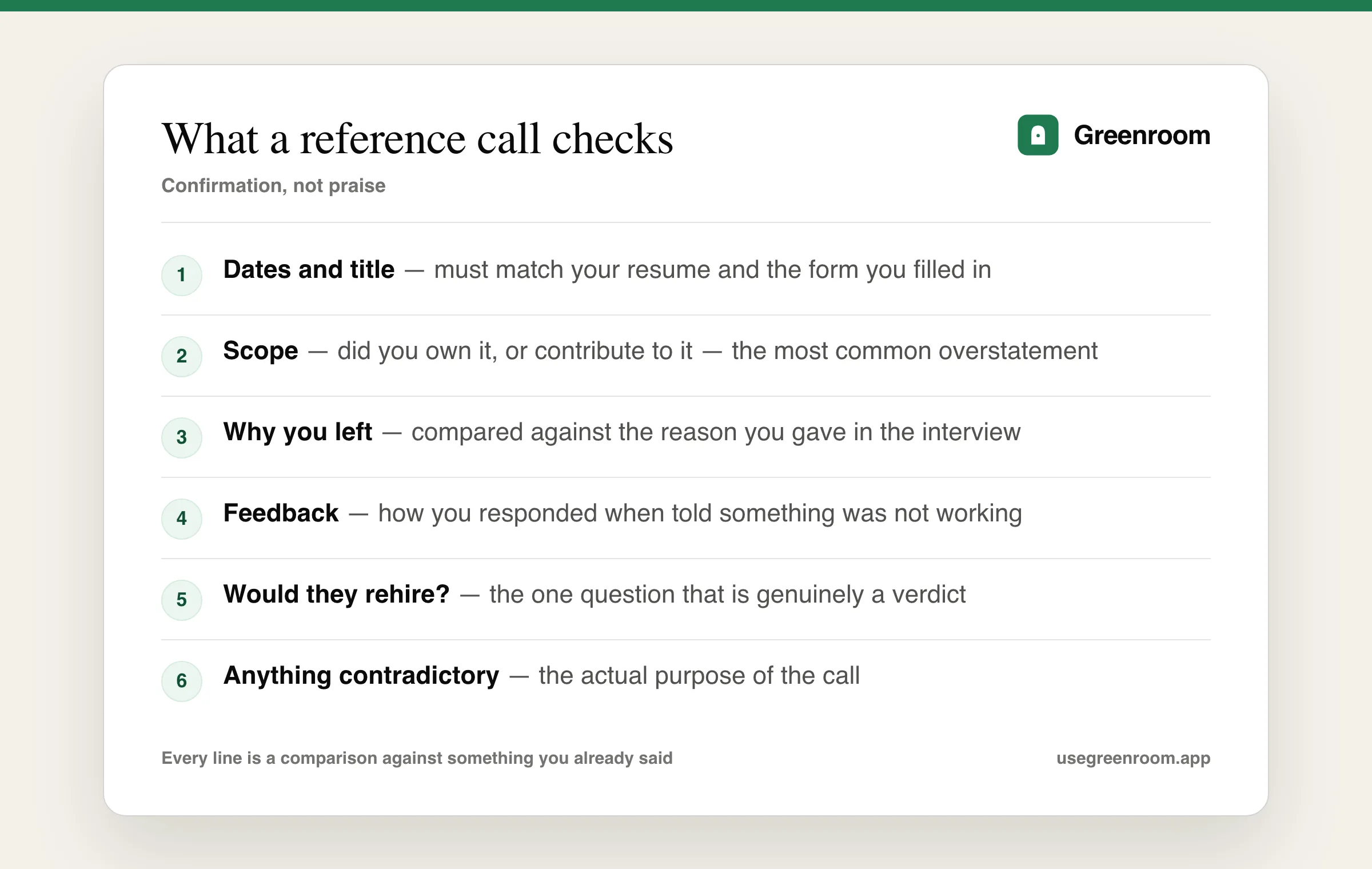
Reference calls are short and the questions are more standardised than candidates expect:
Confirming dates, title and reporting line. Dull, and the fastest way to create a problem if your resume rounded anything. "Senior Engineer" when the official designation was "Engineer II" is the classic.
"What was their actual role on X?" The highest-risk question in the call, because this is where interview language meets reality. "Led", "owned", "drove" and "built" are the words that get tested. There is nothing wrong with having been one of four engineers on a migration — it is a perfectly good thing to have done. The damage comes from the gap between that and what was claimed.
"Why did they leave?" Compared, silently, against the reason you gave in your interviews. These do not have to be identical, and they should not be contradictory.
"How did they respond to feedback?" The behavioural question that appears in almost every version of this call.
"Would you hire them again?" The one genuine verdict question. A hesitation before the answer is itself the answer, and experienced recruiters listen for exactly that.
Anything else we should know? An open door. Most people say no.
Who to pick
In rough order of usefulness:
- A direct manager from a recent role. The gold standard, because it is who they want and asking for anyone else invites the question of why.
- A skip-level or senior colleague who saw your work closely. A reasonable substitute when a direct manager is unavailable.
- A cross-functional peer — a product manager or designer you worked with daily. Weaker on your technical depth, strong on collaboration, and credible.
Who to avoid, even when tempting:
- Someone who likes you but cannot describe your work. Warmth with no specifics reads as a thin reference, which is worse than a neutral one.
- Your current manager, before you have resigned. Never offer this without an explicit conversation. Reputable recruiters understand and will not push; if one does push, that is information about them. Our how to resign professionally guide covers sequencing.
- A friend with an impressive title who never managed you. Ten seconds of questioning exposes it, and it converts a neutral check into a credibility problem.
The step almost nobody takes: brief them
This is the entire practical payload of this article, and it takes one phone call.
Contact each reference *before* you give their name. Then tell them four things:
- The role you are interviewing for, and the company.
- What you emphasised. "I talked a lot about the payments migration — I was clear that I owned the reconciliation piece, not the whole project."
- What is likely to be asked, including the leaving question and the rehire question.
- Ask directly whether they are comfortable giving a strong reference. This is the important one, and it must be asked in a way that makes "no" easy to say. "Would you be able to give me a strong reference, or would you rather I asked someone else?" A hesitant yes is a no, and you would much rather discover that now.
None of this is coaching anyone to lie. It is making sure that two people describing the same job describe it the same way, which is otherwise surprisingly unlikely — people forget, compress and misremember, especially about work from three years ago.
If you are worried about a specific past manager
First, check whether they will actually be contacted. You usually choose your references, and a reference check is not the same as BGV — BGV verifies employment with the company's HR, not with your old boss.
If a bad relationship is likely to surface, the workable move is to get ahead of it briefly and without bitterness: "My manager on that project and I disagreed about the direction, which is part of why I moved. Happy to give you two other people from that team." One calm sentence, then references who can speak to the same period. Litigating who was right is what turns a manageable situation into the thing they remember.
Some organisations, particularly larger ones, restrict what employees may say about former colleagues and route all requests to HR for dates-and-title confirmation only. That is worth knowing, and worth not relying on.
A note on India specifically
Practice varies, so treat this as the general shape rather than a rule. In India, BGV is close to universal for salaried roles and the reference call is less consistently used, appearing more often for senior positions, product companies, startups and roles hired through search firms. What is close to universal is documentary strictness — the relieving letter, the experience letter and payslips do more work here than a phone call does, which is why our background verification guide is the more load-bearing of the two, and why notice period negotiation matters as much as it does.
Where the usual advice comes up short
"Pick people who like you." True and insufficient. Being liked does not stop someone accurately describing a project scope that differs from what you claimed.
Reference letters. Largely decorative for corporate hiring, which prefers a live call it can ask follow-ups in. Useful in academia and for some visa processes.
LinkedIn recommendations. Public, solicited and universally positive, which is precisely why nobody weighs them. Harmless to have.
Question dumps. The questions are not the difficulty here, and in any case you are not the one answering them.
Greenroom. The connection is indirect and worth stating honestly: reference checks fail on the gap between what you claimed in an interview and what actually happened. The fix for that is claiming accurately in the first place — describing real ownership precisely enough that it is impressive *and* survives a phone call. Ari, the AI interviewer, pushes on exactly those claims, asking what you personally did when you say "we". Honest tradeoff: no amount of interview practice helps if you have already overstated something on your resume.
The one-line version
Ask permission before giving anyone's name, brief each reference on what you actually claimed, choose a direct manager over a friendly senior title, and make sure your resume's job titles and dates match reality exactly — because the call is not looking for praise, it is looking for the one detail that does not line up. Once it clears, our what to do after accepting an offer, before joining guide covers the rest.
Frequently asked questions
What is a job reference check?
It is a short call, usually ten to fifteen minutes, in which a recruiter or hiring manager speaks to someone who managed or worked closely with you, typically near the end of the process. It is distinct from a referral, which happens at the start when someone inside the company vouches for your application, and from background verification, which is a documentary check of dates, title and education usually run by a third-party agency. The purpose is confirmation rather than praise — the call is checking whether anything contradicts what you said.
What questions are asked in a reference check?
Typically: confirmation of your employment dates, job title and reporting line; what your actual role was on a specific project; why you left; how you responded to feedback; whether they would hire you again; and an open invitation to add anything else. The question about your real scope on a project carries the most risk, because it is where interview language such as led, owned or drove gets compared against what actually happened.
Can a bad reference stop a job offer?
It can, though outright criticism is a less common cause than inconsistency. The more frequent failure is a mismatch — a referee accurately describing a role, title or scope that differs from what you claimed, with no ill intent involved. Hesitation on whether they would rehire you also carries weight, since experienced recruiters listen for it. Because the decision is usually made before the call happens, the company is effectively looking for a reason to stop rather than a reason to proceed.
Who should I use as a job reference?
A direct manager from a recent role is the strongest option and the one employers expect. A skip-level or a senior colleague who saw your work closely is a reasonable substitute, and a cross-functional peer such as a product manager can speak credibly to collaboration. Avoid someone who likes you but cannot describe your work specifically, avoid a friend with an impressive title who never managed you, and never offer your current manager before you have resigned without an explicit conversation first.
Should I tell my references before giving their name?
Yes, and this is the single most useful step available. Contact each one first and tell them the role and company, what you emphasised in your interviews and how you described your scope, and what they are likely to be asked. Then ask directly whether they can give a strong reference, phrased so that declining is easy — a hesitant yes is effectively a no, and it is far better to learn that before their name is submitted than after.
Do companies in India do reference checks?
Practice varies. Background verification is close to universal for salaried roles in India, generally covering employment dates, title, education and sometimes criminal record through a third-party agency, with documents such as the relieving letter, experience letter and payslips carrying substantial weight. The professional reference call is used less consistently and appears more often for senior positions, product companies, startups and roles hired through search firms. It is sensible to prepare for both rather than assuming only one will apply.