Ninety minutes, three problems, one browser tab that was not allowed to lose focus. He got the first one in twelve minutes, spent forty on the second, and wrote what he still maintains was a genuinely elegant solution to the third — a clean sliding window, correct complexity, the kind of thing that would have earned a nod in a live round.
It passed six of nine test cases. The three it failed were an empty array, a single-element array, and one where every element was identical.
He never heard back. There was no feedback, because there was nobody there to give any. Somewhere a scoring script recorded 6/9 and a threshold said 7.
This is the part that catches strong candidates, and it is not about ability: an online assessment is not a shorter version of the interview. It is graded by hidden test cases with no human in the loop, and that inverts the entire scoring function. Everything you were correctly told to do in a live round — think aloud, explain the tradeoff, discuss the approach before coding — is worth precisely nothing here. Meanwhile the thing nobody practises, handling inputs you cannot see, is worth everything.
What an OA actually is
A timed, auto-graded coding test, usually sent as a link with a window of a few days to complete it, run on a platform such as HackerRank, HackerEarth, Codility or similar. Typically two to four problems in 60–120 minutes. Frequently proctored — full-screen enforcement, tab-switch detection, webcam, or some combination.
It is worth separating it from three things it gets confused with:
- The aptitude test — quantitative, logical and verbal reasoning, no code. Different preparation entirely; our aptitude test preparation for placements guide covers that one.
- The take-home assignment — an untimed project, read by a human, judged on structure and judgment. Almost the opposite kind of test. Our take-home assignment interview tips guide covers it.
- The machine coding round — a live two-to-three hour build, also human-reviewed. Our machine coding round guide covers that.
The OA is the only one of the four where nobody reads your code.
The six things that make it a different game
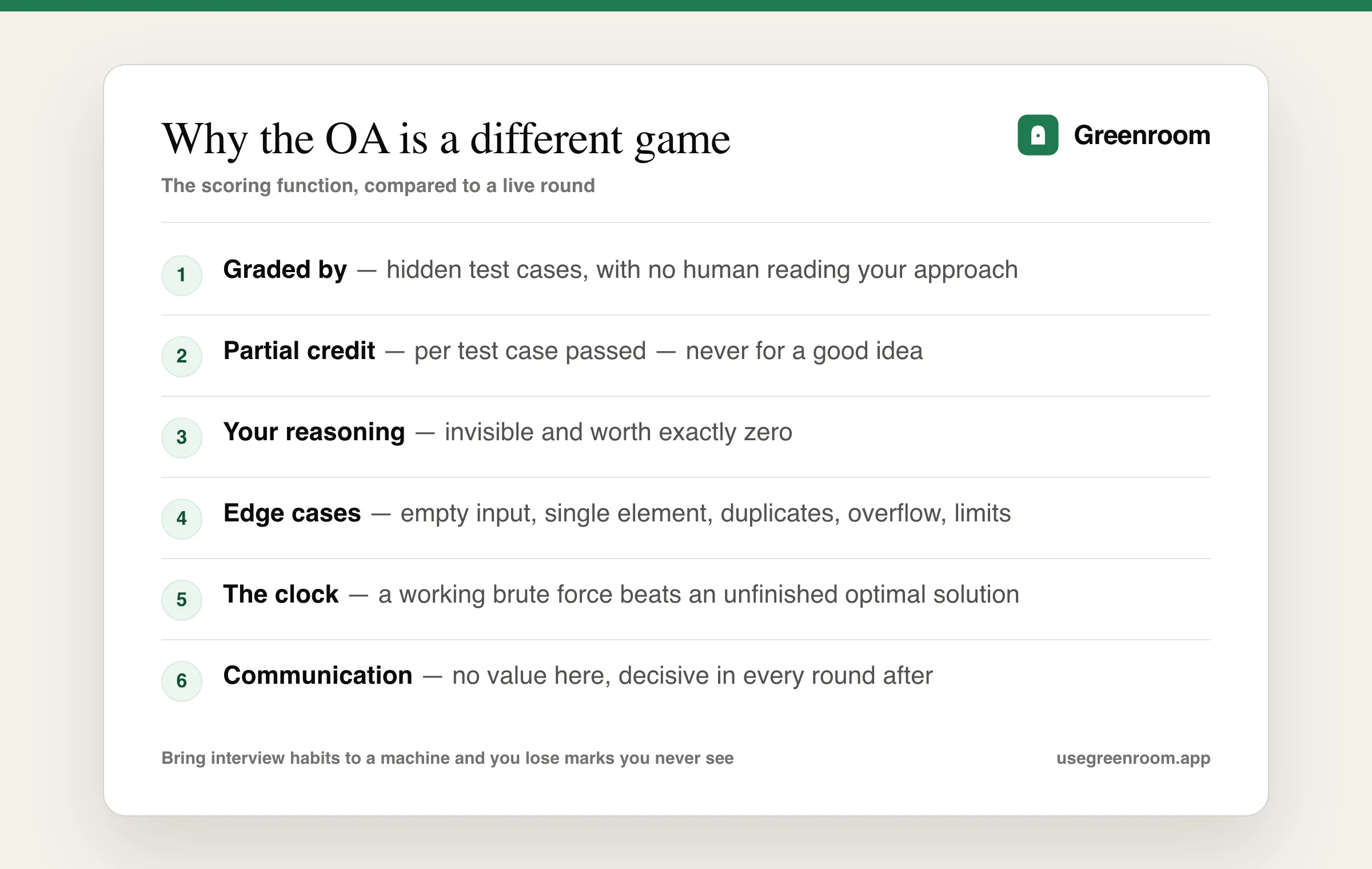
It is graded by hidden tests. You see a few sample cases. You are scored on a larger set you never see. This single fact drives everything else.
Partial credit is per test case, not per idea. A brilliant approach that fails on empty input scores worse than a clumsy one that handles it. There is no examiner to award marks for insight.
Your reasoning is invisible. Comments are not read. In a live round, explaining why you chose a heap is a large share of the score. Here it is decoration.
Edge cases are where the marks are. Not the algorithm — the boundaries.
The clock rewards triage over elegance. A working brute force submitted is worth more than an optimal solution still being debugged when time expires.
Communication is worth nothing. It becomes decisive again in the very next round, which is why this test is bad practice for interviews and should not be treated as preparation for them.
The edge cases that fail people
Before submitting anything, run through this list. It takes ninety seconds and it is the highest-return habit in the entire round:
- Empty input. Empty array, empty string, zero items. The most common single cause of a failed hidden test.
- One element. Loops written for pairs frequently break here.
- All elements identical, and all elements already sorted, and sorted in reverse.
- Duplicates, when your logic quietly assumed uniqueness.
- Negative numbers and zero, when the examples only showed positives.
- The stated limits. If the constraints say n can reach 10⁵ and your solution is O(n²), it will pass the samples and time out on the hidden set. Reading the constraints tells you the intended complexity — this is the closest thing to a free hint you get. Our Big-O and time complexity guide covers reading them.
- Integer overflow, in languages where that is a real concern.
How to spend the clock
- Read all the problems first. Two minutes. Solve the easiest first regardless of order — the platform does not award points for sequence.
- Get something passing before optimising. A working brute force banks partial credit. Then improve it if time allows.
- Test the boundaries before you submit, not after.
- Do not spend forty minutes on one problem. If it is not moving after fifteen, bank what you have and move on; come back with whatever remains.
- Watch for one-way submissions. Some platforms lock a problem once submitted. Check before you find out.
Proctoring, and the honest part about AI
Most OAs now monitor something: full-screen enforcement, tab-switching, copy-paste events, sometimes webcam or keystroke patterns. Practically: set up somewhere quiet, close everything else, and do not switch tabs to look something up mid-test.
On using AI assistants during an OA — the straightforward position is that if the instructions say not to, don't. Beyond the ethics, it is a bad trade on its own terms. Platforms increasingly flag anomalies, and a flagged assessment is worse than a mediocre score. More to the point, the OA exists to filter for the live rounds, and passing it with help you will not have in a live round buys you an interview you are not ready for. Our can you use AI in a coding interview guide covers the live-round version, and cheating signals and integrity covers what these signals do and do not prove.
In India specifically
For campus hiring, the OA is usually the largest single filter in the funnel — a cohort of several thousand reduced to a shortlist in one automated pass, often combining an aptitude section with a coding section in the same sitting. Off-campus, it typically arrives after the resume screen and before any human contact.
Two practical consequences. First, the OA is where most rejections happen, which makes it worth disproportionate preparation relative to how much attention it usually gets. Second, because it is automated and high-volume, there is rarely feedback and rarely an appeal — so the edge-case checklist above is not fussiness, it is the whole margin.
Where the usual advice comes up short
"Just do LeetCode." Necessary and insufficient. It builds pattern recognition, which is most of the battle, and it does not build the submission discipline — constraint reading, boundary testing, triage under a clock — that separates 6/9 from 9/9. Practise at least some problems under a real timer with no editor autocomplete.
Question dumps for specific companies. Question sets rotate, and relying on having seen the exact problem is fragile. Pattern coverage transfers; memorised answers do not.
Competitive programming. Excellent overkill. The overlap is real but CP optimises for harder problems than most OAs contain; your time is usually better spent on breadth and reliability.
Generic ChatGPT prompting. Genuinely useful for understanding a pattern you keep failing, and actively harmful if used to produce solutions you then cannot reproduce under a timer.
Greenroom. Worth being straight about the fit: Greenroom does not run coding assessments, and it will not help you pass an OA. It is for the round after — the live conversation where your reasoning suddenly counts for everything again, which is exactly the muscle the OA does not build. Ari, the AI interviewer, is where you practise explaining the solution out loud. If your OA is tomorrow, close this tab and go do timed problems instead; our how to deal with interview anxiety guide is more useful to you tonight.
The one-line version
Read the constraints to infer the intended complexity, solve the easiest problem first, get something passing before you make it elegant, and spend the last ninety seconds on empty input, single element, duplicates and the upper limit — because the thing grading you cannot see how good your idea was, only which cases it survived.
Frequently asked questions
What is an online coding assessment?
A timed, automatically graded coding test, usually sent as a link with a window of a few days and run on a platform such as HackerRank, HackerEarth or Codility. It normally contains two to four problems in 60 to 120 minutes and is often proctored through full-screen enforcement, tab-switch detection or a webcam. The defining feature is that no human reads your code — it is scored by hidden test cases, which is what makes it different from a take-home assignment or a machine coding round.
Why do good programmers fail online assessments?
Usually because they bring live-interview habits to a machine. In an interview, explaining your reasoning and choosing a defensible approach carries much of the score; in an OA those are worth nothing, because the grader only observes outputs. Failures cluster on edge cases rather than algorithms — empty input, a single element, duplicates, negative numbers, or a solution whose complexity passes the visible samples but times out against the stated constraints. Partial credit is awarded per test case passed, never for a good idea.
What edge cases should I check before submitting?
Empty input, a single element, all elements identical, already sorted and reverse sorted input, duplicates where your logic assumed uniqueness, negative numbers and zero when the examples only showed positives, and integer overflow where the language makes that possible. Also check your complexity against the stated constraints — if n can reach ten to the fifth and your solution is quadratic, it will pass the samples and fail the hidden set. This check takes about ninety seconds and is the highest-return habit in the round.
How should I manage time in an online assessment?
Read every problem first, then solve the easiest one regardless of the order presented, since sequence earns nothing. Get a working brute force submitted before attempting to optimise, because that banks partial credit. If a problem has not progressed in about fifteen minutes, move on and return later. Test boundary cases before submitting rather than after, and check whether the platform locks a problem once submitted, as some do.
Are online assessments proctored, and can I use AI?
Many are proctored to some degree, commonly through full-screen enforcement, tab-switch and copy-paste detection, and sometimes a webcam. If the instructions prohibit AI assistance, using it is a poor trade regardless of the ethics: platforms increasingly flag anomalies, and a flagged assessment is worse than a modest score. It is also self-defeating, because the assessment exists to filter for live rounds where that assistance is unavailable, so passing this way produces an interview you are not prepared for.
How important is the online assessment in Indian campus placements?
It is typically the largest single filter in the funnel. A cohort of several thousand students is commonly reduced to a shortlist in one automated pass, often with an aptitude section and a coding section in the same sitting. For off-campus applications it usually arrives after the resume screen and before any human contact. Because the process is automated and high volume, there is rarely feedback and rarely an appeal, which is why disciplined boundary testing matters more here than in any human-reviewed round.