It is 11:40pm, the interview is at 10am, and your interview preparation notes have reached page fourteen of a Notion doc. There is a toggle list titled "STAR stories (FINAL v3)". There is a colour-coded table of the company's last four funding rounds. There is a full, word-for-word answer to "tell me about yourself" that you have now edited so many times it has started to sound like a LinkedIn post written by a committee. You feel prepared, in the way a person who has packed six umbrellas feels prepared for rain.
Then at 10:07 the next morning the interviewer asks, "So what made you leave your last team?" — a question that is in the doc, on page nine — and your brain returns exactly one word: "So." Fourteen pages of notes, and none of them made it into your mouth.
I know that silence personally. I walked out of my own early interviews knowing the answers were somewhere in my head and that I had simply never practised getting them out — which is the reason Ari, the AI interviewer behind Greenroom, exists at all. The lesson I took from it is the whole point of this post: the problem was never how much I had written down. It was what I had written down, and whether I had ever said it out loud.
Why long interview prep notes make you worse
Writing notes feels like preparation because it produces something you can see. A full page is visible progress. Saying an answer out loud to an empty room produces nothing visible at all, so it feels like wasted time — and that is exactly backwards.
Memory researchers have a name for the gap. The testing effect, studied for decades by Henry Roediger and Jeffrey Karpicke and popularised in the book Make It Stick, is the finding that retrieving information strengthens it far more than re-reading it. Re-reading your fourteen pages builds familiarity: "yes, I recognise this." An interview demands recall: "produce this, now, in sentences, while a stranger watches." Familiarity and recall are different skills, and long notes only train the first one.
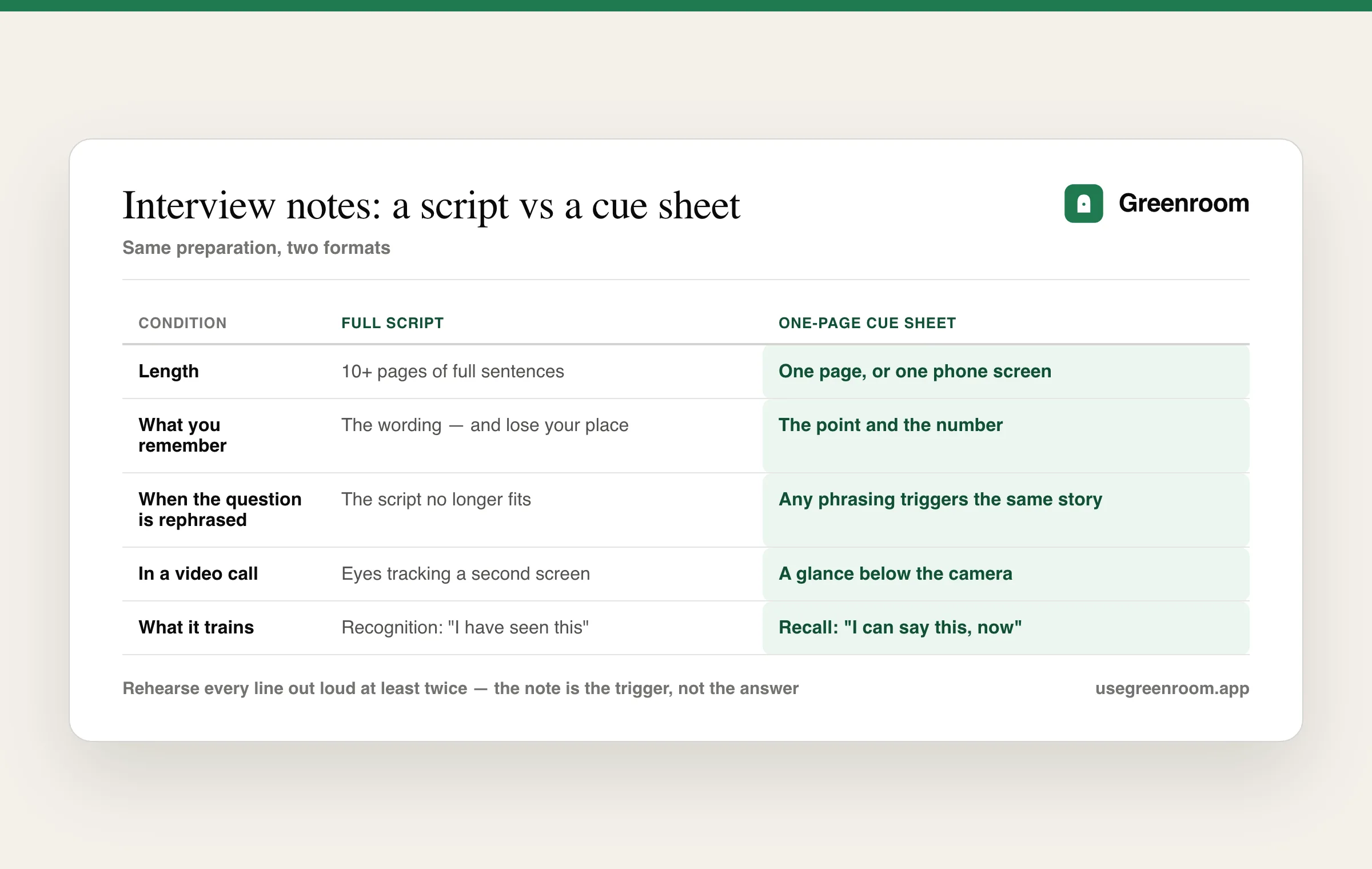
Long notes cause a second, subtler problem. When you write a full script, you start trying to remember the wording instead of the point. The moment the interviewer phrases the question differently from how you wrote it — and they always do — the script no longer fits, and you lose the thread trying to find your place in a paragraph that is not there.
How to prepare notes for an interview: the one-page cue sheet
The fix is not "fewer notes" as a vague virtue. It is a specific artefact: one page, written in cue words rather than sentences, that you have used to rehearse out loud at least twice. Here is what goes on it, in this order.
1. Your opening, in five words
Not your full answer to "tell me about yourself" — five cue words that map to its three beats: where you are now, the one thing you are proudest of, why this role. Something like backend · payments · 40% latency · fintech · scale. If you can say the full answer from those five words, you know it. If you cannot, the script was doing the work, not you. Our guide to answering tell me about yourself has the three-beat structure in full.
2. Five stories, two lines each
Most behavioural rounds pull from the same small set: a conflict, a failure, a time you led, a time you went beyond scope, a hard technical call. Write one story per slot, as a title plus the number that proves it. "Checkout migration — cut failed payments 3.1% to 0.4%." The title triggers the story; the number is the part you will otherwise forget under pressure. One story can often cover two slots, which is why five is enough.
3. Three facts about the company that change your answers
Not their founding year. Three things that actually alter what you say: what the team is building right now, a constraint they have publicly talked about, and why you specifically want this one. If a fact would not change a single answer, it does not belong on the sheet. Our guide on how to research a company before an interview covers where to find the useful ones.
4. Your numbers
Current CTC, expected range, notice period, earliest join date. These are the questions candidates fumble not because they are hard but because they are asked casually, mid-conversation, and nobody rehearses the casual ones.
5. Two questions to ask them
Two, not ten. Specific to this team. If you need a starting list, our guide to questions to ask the interviewer has ones that do not sound copied from the first page of Google.
Interview prep notes template: what the page actually looks like
Put together, the whole sheet fits on a single A4 page or one phone screen without scrolling. A worked example for a mid-level backend candidate:
- Opening: backend · payments · 40% latency · fintech · scale
- Conflict: PM vs API deadline — shipped v1, cut scope, kept SLA
- Failure: cache invalidation outage — 22 min, wrote the runbook after
- Led: onboarded 3 juniors — first PRs merged in week 1
- Beyond scope: on-call alert noise — 140/week to 30
- Hard call: Kafka vs SQS — picked SQS, ops cost
- Company: new UPI product · public latency post · team of 8
- Numbers: 18 LPA now · 24–27 range · 60-day notice · buyout possible
- Ask: what breaks first at 10x? · what does month 3 look like?
Every line is a trigger, not an answer. Read it to a friend and it means almost nothing. Read it to yourself after two rehearsals and every line unpacks into ninety seconds of fluent speech. That asymmetry is the test that your notes are the right shape.
Can you use notes during a virtual interview?
Usually, yes — with limits. Most interviewers in a video round are not bothered by a candidate glancing at a single page of cue words, any more than they would be by someone checking their own resume. What reads badly is reading: eyes tracking left to right across a second screen, long pauses while you search, and answers delivered in suspiciously finished paragraphs. Interviewers notice that pattern quickly, and some teams now treat it as an integrity signal rather than a style issue — our post on what interviewers read as cheating signals covers how that judgement gets made.
The practical rules: keep the page just below or beside your camera so a glance looks like thinking, never paste notes into a window you have to scroll, and do not use them at all during a live coding exercise or a test that explicitly says closed-book. If in doubt, ask at the start: "Is it okay if I keep a page of notes nearby?" Interviewers almost always say yes, and asking reads as honest rather than nervous. For the rest of the camera and lighting setup, see our video interview tips.
In person, the same sheet works as a final review in the lobby — then it goes in your bag. Glancing at notes across a table reads differently from glancing below a webcam.
Should you memorise interview answers word for word?
No — memorise the structure and the numbers, not the sentences. Word-for-word answers have two failure modes. They sound recited, which interviewers tend to read as rehearsed-but-shallow. And they are fragile: one rephrased question or one interruption and you are hunting for the next line of a paragraph instead of talking to a person.
The middle path is what the cue sheet forces: you know the beats and the specific figures cold, and you let the wording be slightly different every time. That variation is not sloppiness. It is what fluent speech actually sounds like. If you do blank mid-answer anyway, our guide on recovering from blanking in an interview has the exact phrases that buy you ten seconds without sounding lost.
Where your notes come from: the honest comparison
- A Notion or Google Docs prep doc — excellent for collecting raw material across weeks. The mistake is walking into the interview with that doc instead of distilling it. Keep the long doc as your archive; build the cue sheet from it the night before.
- A senior's or friend's WhatsApp PDF of "expected questions" — useful as a list of question titles. Their answers belong to their stories, not yours, and borrowed answers fall apart on the first follow-up.
- GeeksforGeeks and Glassdoor question lists — good for knowing what might be asked, especially for company-specific rounds. They give you the question; they cannot give you your answer.
- ChatGPT — genuinely good at turning a messy brain-dump into tidy bullet points, and at suggesting likely questions from a job description. But it produces polished paragraphs, which is the script format this post argues against, and typing to it trains writing, not speaking.
- Greenroom — this is the rehearsal half, not the note-taking half. Ari, the AI interviewer, asks you the questions out loud and follows up on your answers the way a real interviewer would, so you find out which lines on your cue sheet actually unpack into fluent answers and which ones were wishful thinking. The honest tradeoff: Ari does not write your notes for you or know this specific company's panel, and it cannot replace a mock with someone who has sat on that exact hiring loop. What it does is make the out-loud part cheap enough to do twice the night before.
If you prefer to rehearse without any tool at all, our guide to practising mock interviews alone works with nothing but your phone's voice recorder. And if the interview is a week out rather than tomorrow, the week-before-interview checklist shows where the cue sheet fits in the days before.
The night-before routine, in 45 minutes
Fifteen minutes to cut your long doc down to the one-page cue sheet. Twenty minutes to say every line out loud — opening, five stories, numbers — once from the sheet and once without it. Ten minutes to fix the lines that did not unpack: rewrite the cue word, or swap the story. Then stop. Page fifteen of the Notion doc can wait forever. If you have longer than a night, the 2-week interview preparation plan shows where the cue sheet fits across a full fortnight.
Frequently asked questions
How do I prepare notes for an interview?
Build one page of cue words, not full sentences: a five-word trigger for your opening answer, five stories written as a title plus the number that proves each, three company facts that change your answers, your salary and notice-period numbers, and two questions to ask. Then rehearse every line out loud at least twice so each cue unpacks into a fluent answer.
Can I use notes during a virtual interview?
Usually yes, within limits. Glancing at a single page of cue words placed near your camera is generally fine, and you can simply ask at the start whether it is okay to keep notes nearby. Reading full answers off a second screen is what interviewers notice, and notes are never appropriate in a closed-book test or live coding exercise that says so.
Should I memorize interview answers word for word?
No. Memorize the structure and the specific numbers, not the sentences. Word-for-word answers sound recited and break as soon as the interviewer rephrases the question or interrupts, while knowing the beats lets you answer any phrasing fluently.
What should be on an interview cheat sheet?
Your opening answer as five cue words, two lines each for five behavioural stories, three company facts that would change what you say, your current and expected salary, notice period and join date, and two specific questions for the interviewer. If a line would not change any answer you give, leave it off.
Is it okay to bring notes to an in-person interview?
Bringing a notebook and a page of notes is normal, and reviewing them in the waiting area is a good final step. During the conversation itself, keep them closed unless you are asking your prepared questions at the end, since glancing down across a table reads very differently from glancing below a webcam.
How long should interview preparation notes be?
One page, or one phone screen without scrolling. Keep a longer prep document as your archive if you like, but distil it into a single cue sheet the night before the interview, because anything you cannot scan in a glance will not help you mid-answer.