You are twelve minutes into a final-round interview when the hiring manager leans back and asks the question that should be the easiest of the day: "So — what do you know about us?" And your mind, which an hour ago held seventeen browser tabs of company facts, returns exactly one: the logo is green. You hear yourself say, "You're a really exciting company doing exciting things in the space," and you watch the interviewer write something down that is definitely not a compliment.
Everyone tells you to "research the company before an interview." Almost nobody tells you what to research, where to find it, or — the part that actually wins offers — how to turn what you find into a sentence you can say out loud under pressure. This guide on how to research a company before an interview fixes all three. You will not need three hours. You will need about forty-five focused minutes and a plan, which is exactly what the rest of this page is.
Why researching a company before an interview matters
Interviewers are not testing whether you memorized their About page. They are testing a proxy for something they genuinely care about: do you actually want to work here, or are you spray-applying to every job posting with a pulse? A candidate who can name a recent product launch and connect it to their own experience signals low flight-risk and real intent. A candidate who says "exciting space" signals the opposite — and in a tight hiring market, intent is often the tiebreaker between two technically similar people.
Good research also quietly improves every other answer you give. When you know the company runs on Go and event-driven services, your "tell me about a project" story leans into the relevant parts. When you know they just raised a Series B and are scaling the platform team, your questions at the end land as a real conversation instead of filler. Company research is not a separate task from interview prep — it is the lens that focuses all of it. If you are still mapping out the broader plan, start with our guide on how to prepare for an interview and treat this page as the company-research module inside it.
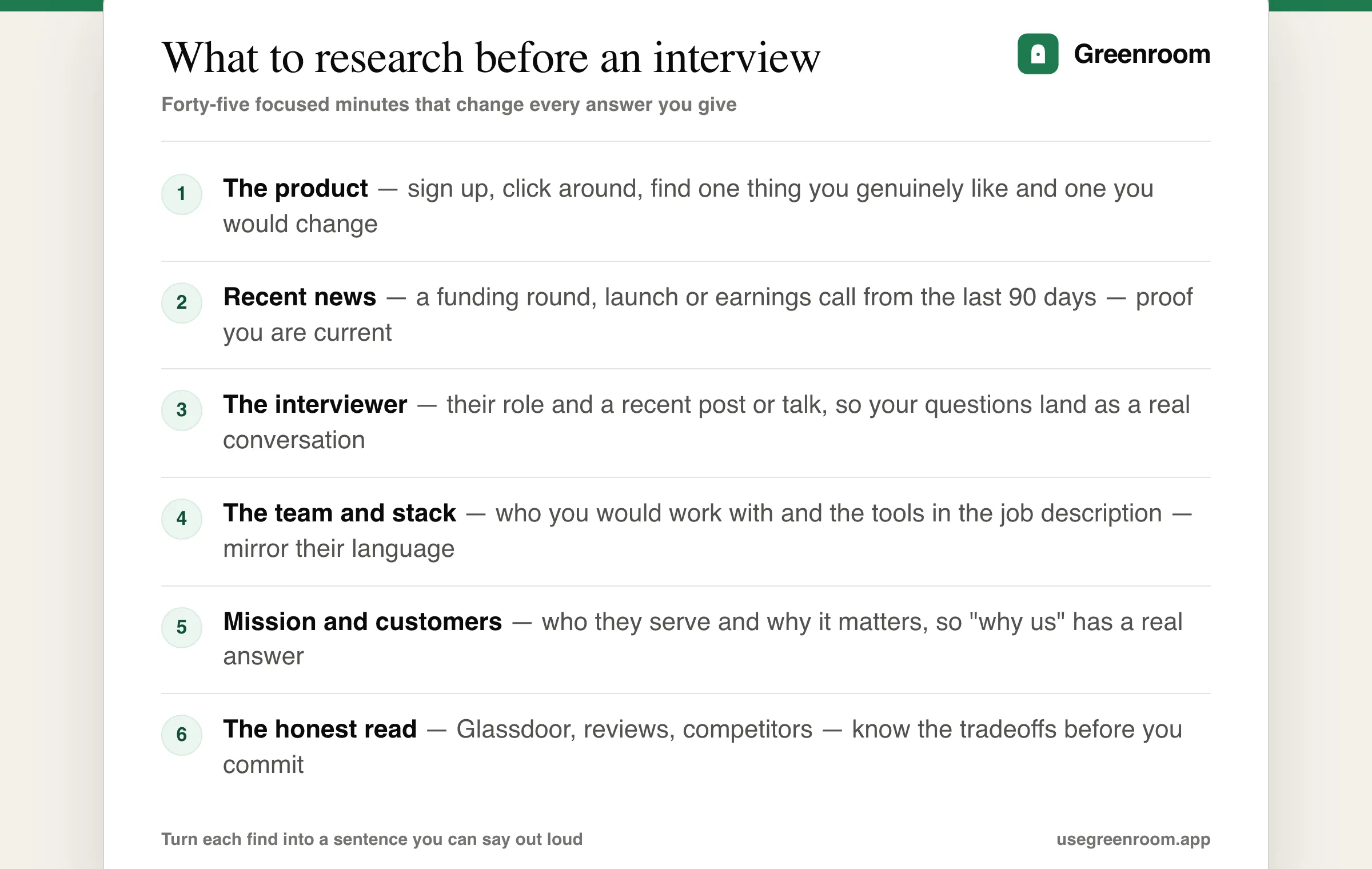
The 45-minute company research checklist
You can drown in a company's website for an afternoon and walk away with nothing sayable. The fix is to research with a target: each thing you look up should become one sentence you could say in the room. Here is the checklist, in priority order, so that if you only have twenty minutes you still cover what matters.
1. Use the product (or read how it works)
This is the single highest-leverage thing you can do, and the most commonly skipped. Sign up for a free trial, click around, and form one specific opinion: one thing you genuinely like, and one thing you would change. "I signed up over the weekend and the onboarding flow was honestly smoother than I expected — though I did get a little lost finding the export button" is worth more than any amount of mission-statement paraphrasing, because it proves you did the work and you think like a user. If the product is internal, enterprise, or you can't access it, read the docs, watch a demo video, or read a teardown.
2. Find one piece of recent news
Search the company name plus "news" and filter to the last ninety days. You are hunting for one concrete, recent event: a funding round, a product launch, an acquisition, an earnings call, a new market, a notable hire. Recency is the whole point — referencing something from 2026 proves you are current; quoting a 2021 press release proves you found one old article. You only need one. "I saw you just launched the India region last month — is the team you're hiring for going to support that rollout?" is a question that makes an interviewer sit up.
3. Look up the people you'll talk to
If you know your interviewers' names (ask the recruiter — they will usually tell you), spend two minutes each on their LinkedIn or a recent talk, post, or blog. You are not stalking; you are calibrating. Knowing that your interviewer leads the payments team, or recently gave a conference talk on database migrations, tells you what they will care about and gives you a natural, specific question. It also calms your nerves: a stranger feels less intimidating once you know one real thing about their work.
4. Map the team and the tech stack
Read the job description like it is a primary source, because it is. The tools, languages, and responsibilities listed are the literal words the team chose to describe themselves — mirror that vocabulary in your answers. Cross-reference with the engineering blog, their GitHub org, or sites that track company tech stacks. When you can say "I noticed you're moving toward TypeScript and Kubernetes — I led a similar migration last year," you have turned a job posting into evidence of fit.
5. Understand the mission and the customer
Read the About and Careers pages, but extract only two things: who they serve and why it matters. You need a real answer to "why do you want to work here," and "I believe in your mission" is not one. "You're helping small clinics handle billing without a full-time admin — my sister runs a clinic, so I've seen exactly that pain" is. Connect the mission to something true about you. We go deep on this in our guide to answering "why do you want to work here?".
6. Get the honest read
Spend your last five minutes on the unglamorous part: Glassdoor reviews, recent Reddit threads, news about layoffs or leadership churn, and a quick look at their main competitors. This serves two purposes. First, the interview is a two-way evaluation — you are deciding whether to commit a year or more of your life here, so know the tradeoffs. Second, understanding their competitive position makes you sound strategic: "You're up against the bigger incumbents, but your pricing seems aimed at the teams they ignore — is that the deliberate bet?" is a question almost no candidate asks.
How to turn research into answers that land
Research that stays in your head is useless. Research only counts when it surfaces in the room, and it surfaces in three predictable places. Prepare a sentence for each before the interview, out loud, not just in your notes.
The "why us" answer. Combine the product, the mission, and one true thing about you. Structure it as: what you observed about them + why it connects to your experience or values + what you want to contribute. Specific beats flattering every time.
The tailored story. When you tell a project or behavioral story, choose and emphasize the version that maps to their stack and problems. Same story, different spotlight. If they care about reliability, your story's climax is the on-call incident you fixed; if they care about speed, it's the launch you shipped in a week. Our guide on explaining a project without rambling shows the framework for this.
Your questions at the end. The questions you ask are graded. Research is what makes them good. Turn your news, people, and competitor findings into two or three genuine questions — see questions to ask at the end of an interview for ready-made structures. A researched question is the cleanest possible proof that you did the work.
Where to actually look (a source-by-source map)
Forty-five minutes goes fast if you wander, so here is where each finding lives:
- The company website — product pages, pricing, the Careers page, and especially the engineering or company blog, which is where teams reveal what they actually care about.
- The product itself — a free trial or demo beats every secondhand description. This is non-negotiable for a consumer or SaaS role.
- LinkedIn — your interviewers' backgrounds, the team's size and recent growth, and the company page's "Posts" tab for recent announcements in their own voice.
- News and search — last-90-days filter, looking for funding, launches, and leadership moves. A single recent, concrete fact is the goal.
- Glassdoor, Blind, and Reddit — the unfiltered read on culture, interview process, and red flags. Weight patterns, not single angry reviews.
- GitHub and tech-stack trackers — for engineering roles, their open-source repos and stated stack tell you what to brush up on and what vocabulary to mirror.
A note on sources you should be skeptical of: a glowing About page is marketing, not truth, and a single furious Glassdoor review is one person's bad week, not a verdict. Triangulate. The goal is an accurate picture, not a flattering or a cynical one.
How company research compares to what most people do
Most candidates "research" by skimming the homepage in the elevator and memorizing the mission statement. That is why "what do you know about us?" produces so many identical, forgettable answers. The alternatives people reach for each have a gap. A GeeksforGeeks-style "company interview experience" dump tells you which DSA questions appeared last year, which is genuinely useful for the technical round — but tells you nothing you can use to answer "why us" or to ask a sharp question. A generic ChatGPT prompt ("tell me about Company X") will hand you a confident, fluent summary that is sometimes out of date and occasionally invented, so it is a fine starting scaffold but a dangerous final source — verify anything specific against the company's own pages.
Here is the honest tradeoff: reading and memorizing facts is the easy half, and it is where most prep stops. The hard half is saying them — converting "they raised a Series B" into a fluent, natural question while a stranger watches you think. That is a verbal skill, and reading does not build it. This is exactly the gap a spoken mock interview closes: Greenroom runs realistic voice interviews and will actually ask you "so what do you know about us?" and follow up on your answer, so the first time you say it out loud is not in the room that decides your job. Pair the research checklist on this page with a couple of mock interview sessions and the difference is obvious.
Common company-research mistakes to avoid
- Memorizing the mission statement verbatim. Reciting their tagline back to them sounds like flattery, not understanding. Paraphrase it through your own experience instead.
- Researching everything, preparing nothing. Twenty facts you can't deploy lose to three facts you turned into sentences. Always end research by drafting what you'll actually say.
- Using stale information. A two-year-old funding announcement makes you look like you stopped reading in 2024. Always filter for recency.
- Skipping the product. For a consumer or SaaS company, not having tried the product is the single most visible tell that you didn't really prepare.
- Ignoring the negatives. If every answer is uncritical praise, you sound naive. Knowing one honest tradeoff and asking about it thoughtfully signals maturity.
Practise saying it, not just reading it
You can do flawless research and still freeze when the question comes, because knowing a fact and producing it on demand — calmly, in your own words, with someone watching — are two different skills. The interview is verbal, so the rehearsal has to be verbal too. Greenroom runs spoken mock interviews that ask the real questions, including "what do you know about us?", probe your answer with follow-ups, and give feedback on how clearly and confidently you delivered it. Combine it with our guides on speaking confidently in interviews and answering "tell me about yourself", and walk into the room with the easy question already handled.
Frequently asked questions
How long should I spend researching a company before an interview?
About forty-five focused minutes is enough for most roles. Spend it on a priority order — try the product, find one recent news item, look up your interviewers, map the tech stack, understand the mission, and get an honest read from reviews — and finish by drafting the two or three sentences you will actually say. Hours of unfocused reading that you cannot deploy in the room is worse than a short, targeted session that ends in rehearsed lines.
What should I research about a company before an interview?
Research six things, in priority order: the product (ideally by using it), one recent piece of news from the last ninety days, the people who will interview you, the team and tech stack named in the job description, the mission and who they serve, and an honest read from Glassdoor, Reddit, and a look at their competitors. The goal is to turn each finding into one specific sentence you can say out loud.
Where can I find reliable information about a company before an interview?
Use the company website and engineering blog, the product itself via a free trial or demo, LinkedIn for your interviewers and team growth, a last-90-days news search for recent events, and Glassdoor, Blind, or Reddit for the unfiltered read on culture and process. Triangulate across sources — a marketing page overstates the good and a single angry review overstates the bad.
How do I answer "what do you know about us?" in an interview?
Lead with something specific and recent that you observed, then connect it to your own experience or values, and end with what you want to contribute. For example, mention a product feature you tried or a launch you read about, tie it to relevant work you have done, and turn it into genuine interest. Avoid reciting the mission statement or saying vague things like "you are an exciting company."
Is it worth using ChatGPT to research a company before an interview?
It is useful as a starting scaffold but dangerous as a final source. A general AI summary can be out of date or occasionally invented, so use it to orient yourself quickly, then verify anything specific — funding, launches, leadership — against the company's own pages and recent news. For practising how to actually deliver what you learned, a spoken mock interview that asks "what do you know about us?" is far more valuable than another summary.
Does researching the company actually affect whether I get the offer?
Often, yes — especially as a tiebreaker. Interviewers read company knowledge as a proxy for genuine intent and low flight-risk, which matters when two candidates are technically similar. Research also sharpens every other answer: your "why us," your tailored project stories, and the questions you ask at the end all get stronger when they are grounded in specific, current facts about the company.